Scientific Journal Cover Art Guidelines (2026)
How to submit scientific journal cover art: verified Nature specs, what Cell Press, ACS, RSC and Wiley ask for, composition zones and AI-art rules.
Turn a research idea into a clean concept sketch. Useful for thumbnails and brainstorming, not a substitute for publisher-approved final art.
Open the toolMost publishers invite cover art only after your paper is accepted, and the exact rules live on each journal's own cover page. The one set of numbers published in full is Nature's: 213 x 285 mm with a 3 mm bleed, at least 300 dpi at actual size, in PSD, TIFF, JPEG or PNG, and no images made by generative AI. Cell Press, ACS, RSC and Wiley set their rules per journal. The cheat sheet below shows what each one says publicly, checked on 2026-11-28.
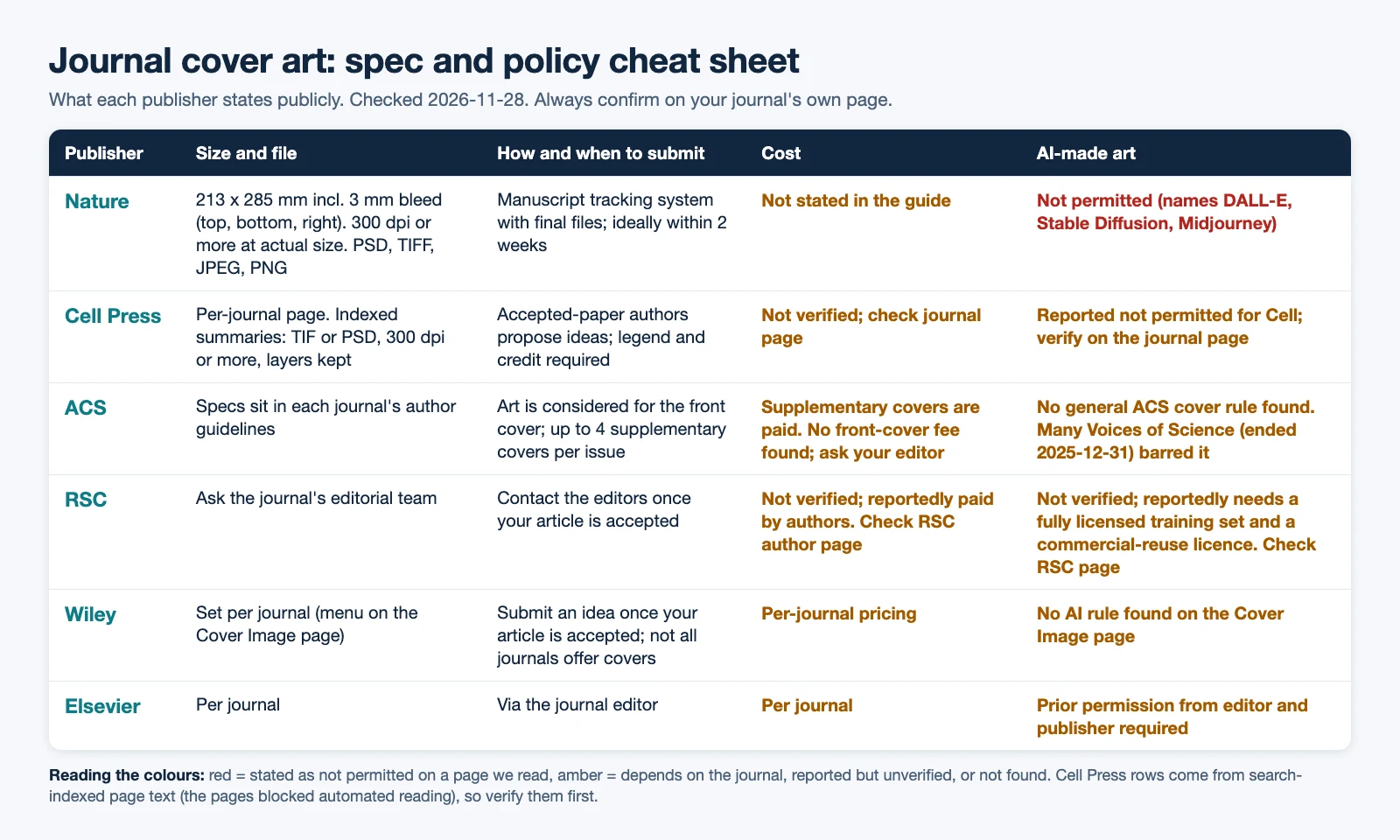
Cover art cheat sheet. Red marks what a publisher says is not permitted; amber marks rules that depend on the journal or are not stated publicly.
This page is about the artwork on the front of a journal issue. It is not about the cover page of a manuscript or a cover letter to the editor. For the broader craft of designing the image, see our complete guide to science journal cover design. This guide goes the other direction: what the publishers actually ask for, how to lay the image out, and why submissions fail.
What a cover is for (and why authors bother)
A cover is not a bigger figure. Nature's own guide says covers "do not bear the burden of telling the entire story of your research" and instead "tempt the viewer to learn more." That shapes every decision below: fewer elements, one clear idea, and a strong silhouette.
There is also a practical payoff. Wiley reports that cover images are associated with up to 135% more full-text views on Wiley Online Library and 148% higher Altmetric scores than articles in the same issue without them. That is Wiley's own figure for its platform, not a promise for your paper, and Nature adds that cover art is reusable in press releases, posters, presentations and social media even if it never lands on the cover.
Cover art rules by publisher
Nature and Nature-branded journals
Nature publishes the most complete spec. These numbers come from the Nature cover art page and the Nature covers author guide (PDF):
| Item | What Nature states |
|---|---|
| Cover size | 213 mm x 285 mm, including a 3 mm bleed on the top, bottom and right |
| Resolution | At least 300 dpi at actual size |
| File types | PSD, TIFF, JPEG or PNG |
| How to submit | Through the manuscript tracking system with the final manuscript files; ideally within 2 weeks |
| Lower-res first? | Allowed, if you note that a higher resolution is available |
| Logos | Leave space for the journal logo and coverlines; do not draw logos into the art |
| Generative AI | "Images created by Generative AI (such as from DALL-E, Stable Diffusion, and Midjourney) are not permitted" |
Two details are worth knowing. First, the diagram in Nature's PDF labels the width as 215 mm while the text says 213 mm, so ask your editor which figure applies if you are building to the millimetre. Second, selection is competitive: papers are assigned to an issue, a shortlist of cover submissions is made, and shortlisted papers compete. For the flagship Nature journal only, the cover paper should be freshly published, so papers on the accelerated route are generally not eligible.
Our guide to figures for Nature and Science journals covers the in-paper figures, which follow different rules.
Cell Press
Cell Press publishes a separate cover submission page for each journal (Cell, Immunity, Chem, Matter, Med and others). Those pages refused automated access during our check, so the points below come from search-indexed text of those pages, not a full read. Treat them as a checklist of what to look for, and read your journal's live page before you build anything:
- Authors of accepted papers can propose a cover idea for their issue.
- Files are described as high-resolution TIF or PSD at 300 dpi or more, with text on removable layers.
- You supply a short legend and an image credit where appropriate. Legend limits differ by journal.
- Third-party copyrighted material needs written permission from the rights holder.
- Cell is reported not to permit generative AI or AI-assisted tools for cover art, and several sister journals reportedly say the same, but we could not verify this. Rules differ across titles.
For tone, Cell Press's Crosstalk blog interviewed cover illustrators. They stress leading with the concept and keeping the science recognisable, and note that editors make the final choice.
ACS Publications
ACS considers submitted art for the front cover and also runs a supplementary cover programme. According to ACS's Axial blog:
- All submitted art is considered for the front cover, and up to four other covers can be selected per issue as supplementary covers.
- If you are invited to submit a revision to any ACS journal, you can submit cover art for consideration.
- Supplementary cover authors receive an 18" x 24" printed poster and a high-resolution file.
- Supplementary covers are paid (ACS describes them as "available for purchase" with a processing fee). We found no statement of a front-cover fee on the pages we read, so ask your editor before assuming either way.
- File dimensions and formats sit in each journal's author guidelines, and we did not find a single ACS-wide cover size to quote. Do not reuse the table-of-contents graphic size here; that is a different asset.
- The separate "Many Voices of Science" cover programme stated that generative AI or assisted technologies cannot be used to create its artwork. That programme concluded on 31 December 2025. We found no general ACS rule on AI for other covers, so check your journal's own author guidelines.
RSC and Wiley
The Royal Society of Chemistry's author pages reportedly say that once your article is accepted you should contact the journal's editorial team if you want artwork considered for the cover. We could not open the RSC pages directly (rsc.org blocked automated access), so the rest comes from search-indexed text of RSC author guidelines and is unverified. Those snippets say that authors using AI tools for cover artwork must confirm the tool was trained on fully licensed datasets and that the output licence permits commercial reuse, and one summary says cover use is at the editor's discretion with a fee payable by the authors. We could not confirm the fee or the dimensions, so please check the official RSC author page and ask the editors.
Wiley runs a Cover Image programme with a journal selector. You can submit an idea as soon as your article is accepted, but not every journal offers covers, and pricing, benefits and requirements are set per journal. Wiley Editing Services also offers a paid design service.
Elsevier titles outside Cell Press
Elsevier's generative AI policy for journals says that authors "must obtain prior permission from the journal editor and publisher before submitting AI-generated cover art," and that permissions for any third-party material must also be shown.
Design the cover around the page furniture
The most common technical mistake is a strong image that collides with the journal's own text. Nature asks authors to leave space for the logo at the top and for coverlines, and notes that one example composition had to be reworked so the journal title did not hide important detail.
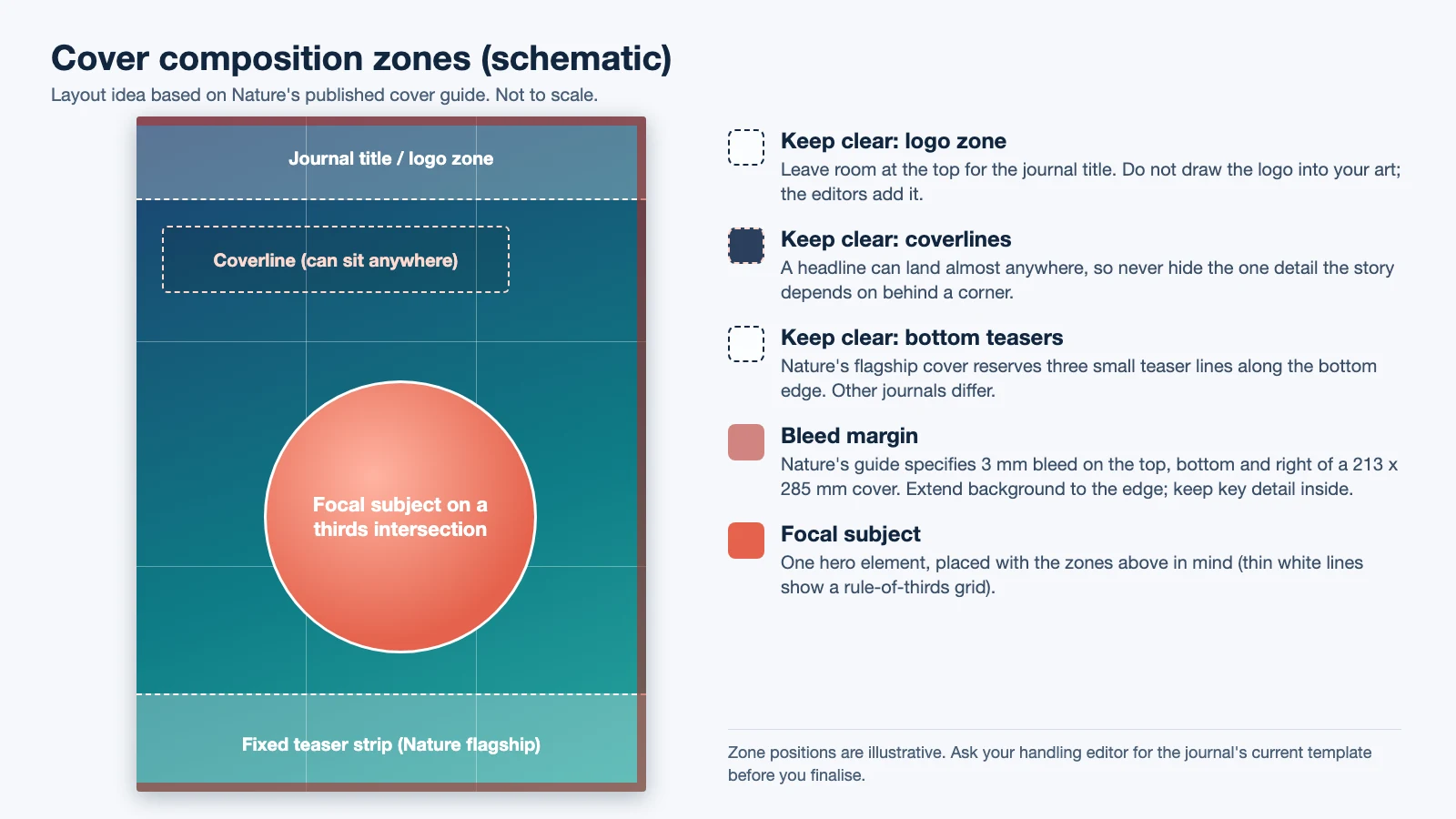
Composition zones, schematic and not to scale. Nature's flagship cover has one main coverline that can go anywhere plus three fixed teasers along the bottom; other Nature-branded journals have a single coverline.
Use the zones as a stress test for every thumbnail:
- Cover the top and bottom edges with background, not detail. If the logo or teasers sit on your hero element, the layout fails.
- Place one focal subject. Nature's list of qualities is beauty (composition, proportion, balance), technical quality, simplicity, novelty and action.
- Let colour carry hierarchy. Nature describes colour as a tool to highlight important elements and separate categories, which should complement the composition.
- Extend the background into the bleed. The key content stays inside; only the background and texture run to the edge.
- Check at thumbnail size. If the idea is not readable in a small preview, the shortlist will not remember it.
From paper to cover in six steps
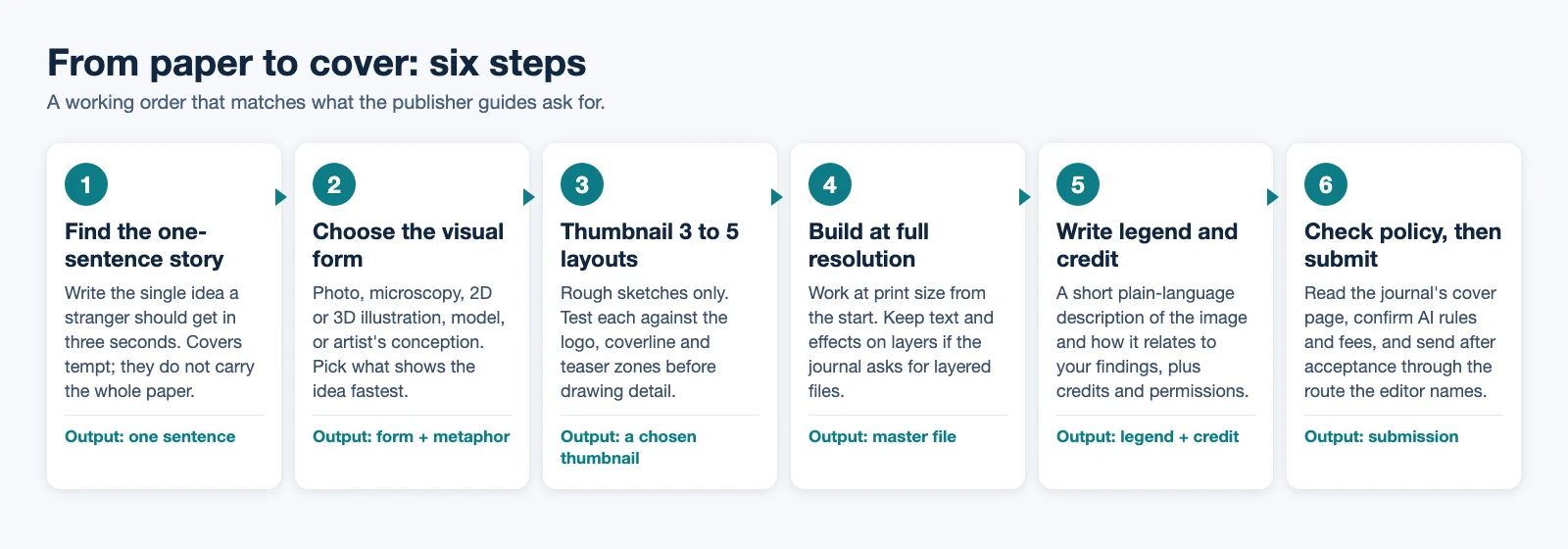
A working order that follows the publisher guides: concept first, layout second, full resolution third, policy check last.
Step 1: Find the one-sentence story. Do not start with the figure list. Write the single idea a non-specialist should get in three seconds, for example "a protein switch that turns a cell on."
Step 2: Choose the visual form. Nature lists photography, 2D and 3D illustration, imaging, computer modelling and artist's conception, and says there is no best medium. Photography implies specificity; illustration is effective for concepts and metaphors. Pick the form that shows the idea fastest.
Step 3: Thumbnail three to five layouts. Small rough sketches, each tested against the logo, coverline and teaser zones. This is where a concept sketch tool is useful, as long as you follow your publisher's AI rule (see below).
Step 4: Build at full resolution. Nature's guide says resolution and clarity "must be addressed at the very beginning stages of creating imagery." Create at print size from the start rather than upscaling a draft.
Step 5: Write the legend and credit. Cell Press pages ask for a short description of the image and how it relates to your findings. Even where it is optional, a plain-language legend helps the editor.
Step 6: Check policy, then submit. Read the journal's cover page, confirm fees and AI rules, and send through the route the editor names, ideally soon after your final files.
Concept sketches: two examples
At the thumbnail stage you need to see whether an idea has a silhouette. The two sketches below were produced with ConceptViz's medical illustration tool. They are labelled figures, which a real cover would not be, but they show how quickly you can test a subject and a sequence.
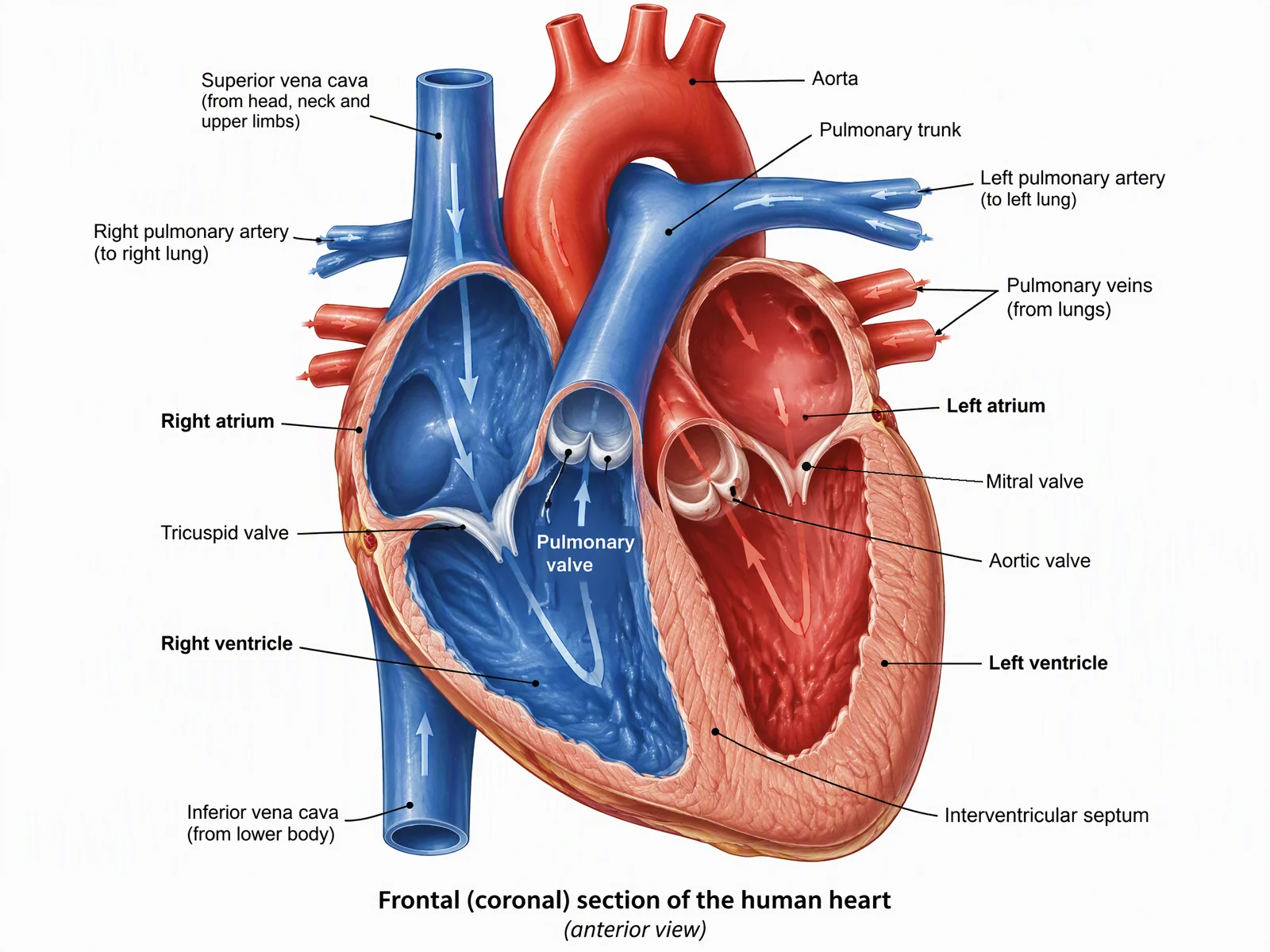
A single-subject concept study: one organ, strong red and blue contrast. A real cover would drop the labels and be redrawn or rendered by the author or an illustrator to the publisher's rules.
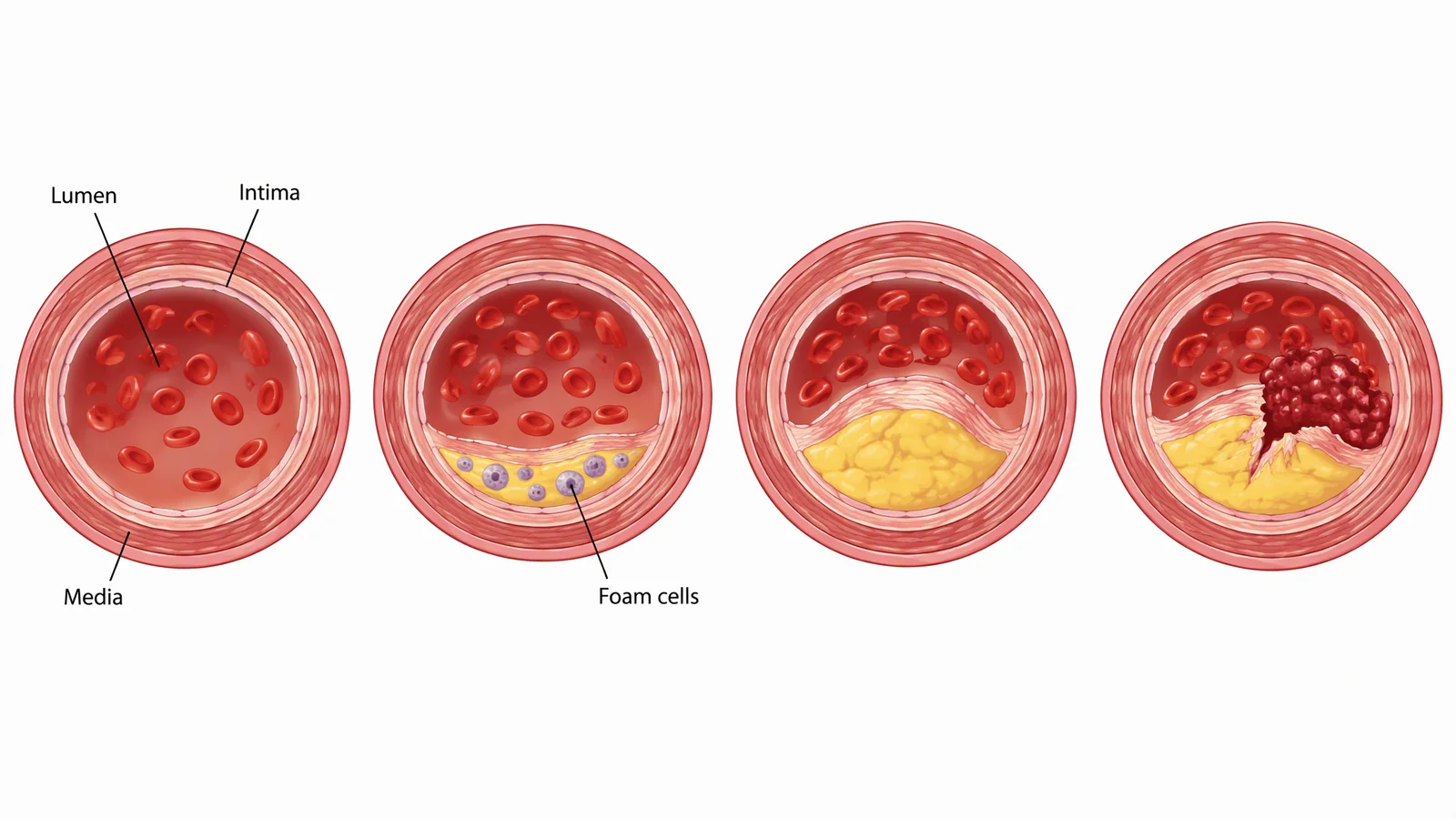
A sequence concept: four stages in one row, easy to compare for a story about progression. Good for deciding what the cover idea is, not for submission.
Medical Illustration Generator
Describe an organ, process or pathway and get a labelled concept illustration to test composition and story before you commission or draw the final art.
Draft a concept →Why cover submissions get turned down
Nature lists the following as common mistakes that can disqualify a submission. The last two items in the chart are practical risks drawn from Cell Press-style guidance rather than Nature's list.
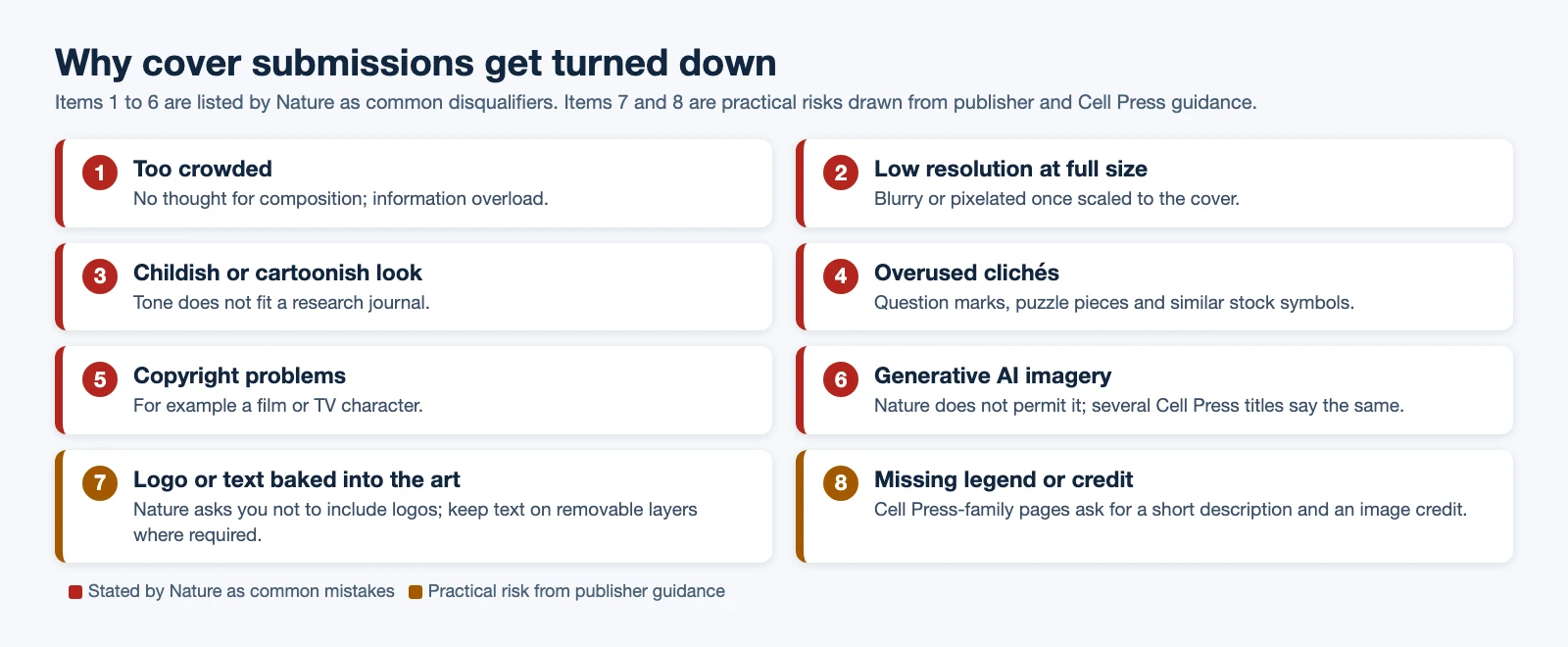
Rejection checklist. Items 1 to 6 are on Nature's list; items 7 and 8 are practical risks.
A quick pre-submission test: print the thumbnail at postage-stamp size, blank out the top and bottom strips, and ask a colleague outside your field what it is about. If they cannot say, simplify.
Using AI sketches without breaking publisher rules
Sketching with AI is not the same as submitting AI imagery, but the line is easy to cross. Use this order of operations:
- Read the rule first. Nature says generative AI images are not permitted. Cell is reported not to permit generative AI for covers (unverified). Elsevier titles require prior permission from the editor and publisher. RSC reportedly requires fully licensed training data and a commercial-reuse licence (unverified). ACS's Many Voices of Science programme, which has ended, barred AI, but we found no general ACS cover rule. If your journal's page is silent, ask the editor in writing.
- Keep AI output out of the file you send unless the publisher has told you it is allowed. A sketch that only informs your own redraw is a different matter from a pasted AI image, but ask if you are unsure how the publisher defines "assisted."
- Check rights. Third-party material needs permission, and you need to be able to show it.
- Ask about disclosure. Elsevier, for example, requires AI use in explanatory images to be disclosed in the caption. For cover art it requires prior permission instead, so ask your editor what disclosure they expect.
Our summary of journal AI image policies tracks the wider rules for figures and graphical abstracts, and the guide to figure resolution and DPI by journal is useful for the file-quality side. If you are preparing the summary image instead of a cover, see TOC graphic requirements by journal.
Frequently asked questions
What size is Nature cover art?
Nature's cover art guide gives a cover size of 213 mm x 285 mm, including a 3 mm bleed on the top, bottom and right. Files should be at least 300 dpi at actual size in PSD, TIFF, JPEG or PNG format. The diagram in the same PDF labels the width as 215 mm, so confirm with your editor if you need millimetre precision. Checked 2026-11-28.
When can I submit a journal cover image?
Most publishers invite cover ideas after your paper is accepted. Nature asks you to upload through the manuscript tracking system with your final manuscript files, ideally within 2 weeks. Wiley says you can submit an idea as soon as your article is accepted. RSC reportedly tells authors to contact the journal's editorial team once the article is accepted. ACS accepts cover art from authors invited to submit a revision.
Does it cost money to put my art on a journal cover?
It depends on the publisher and journal. ACS supplementary covers are paid, and we found no front-cover fee statement, so ask your editor. RSC is reported to charge authors for covers, but we could not verify this and you should check the RSC author page. Wiley sets pricing per journal on its Cover Image page. Nature's cover guide does not state a fee. Always ask the handling editor in writing before you commission artwork.
Can I use AI-generated art for a scientific journal cover?
Often not. Nature states that images created by generative AI are not permitted for its covers. Cell Press is reported not to permit generative AI or AI-assisted tools for cover art, which we could not verify. Elsevier requires prior permission from the journal editor and publisher before AI-generated cover art is submitted. RSC is reported to require a fully licensed training set and a commercial-reuse licence, which we could not verify. ACS's Many Voices of Science programme (ended 31 December 2025) barred generative AI, but we found no general ACS cover rule. Read your journal's page and ask the editor before submitting anything AI-assisted.
What file format and resolution do journal covers need?
Nature asks for at least 300 dpi at actual size in PSD, TIFF, JPEG or PNG. Cell Press pages are described as asking for a high-resolution TIF or PSD at 300 dpi or more, with text on removable layers. ACS, RSC and Wiley set formats and dimensions per journal, so check the specific journal's author guidelines or ask the editorial team.
What is the difference between a journal cover and a graphical abstract?
A cover is an eye-catching image for the issue that tempts readers and does not need to tell the whole story. A graphical abstract summarises the findings for the article page or table of contents and is usually much smaller. Their size, style and submission route differ, so do not reuse one as the other. See our comparison of visual and graphical abstracts for details.
Why do journal cover submissions get rejected?
Nature lists crowded and cluttered compositions, low resolution at full size, childish or cartoonish styles, overused clichés such as question marks or puzzle pieces, copyright infringement and generative AI images as common disqualifiers. In practice, art that hides behind the logo and coverline zones, or ships without a legend or credit when one is requested, also causes problems.
Can I design a cover myself, or do I need an illustrator?
Either works. Nature says there is no best medium, and covers can come from photography, 2D or 3D illustration, imaging, modelling or artist's conception. Many authors work with a scientific illustrator for polish. Whoever creates it, you remain responsible for scientific accuracy, rights and following the journal's AI policy.
Related guides
- Science journal cover design: complete guide
- Figures for Nature and Science journals
- Journal AI image policies
- Visual abstract vs graphical abstract
Sources and verification
Checked on 2026-11-28. Nature specifications and AI wording: research-figure-guide.nature.com/covers and the Nature covers author guide. ACS: Axial supplementary cover programme, 2022 update and Many Voices of Science. Wiley: Cover Image page. Elsevier: generative AI policies for journals. Cell Press cover pages, for example Cell, blocked automated access, so those points reflect search-indexed text and should be verified. Publisher rules change; use your journal's current page as the final authority.
Categories
More Posts
How to Make a Bohr Model: Step-by-Step Guide for Students
Learn how to draw a Bohr model for any element. Covers electron shell rules, common elements, mistakes to avoid, and where Bohr models break down.
How to Write a Research Manuscript: Complete IMRaD Format Guide
A comprehensive IMRaD format guide to writing research manuscripts. Learn the best writing order, avoid common rejection reasons, and get your paper published.
8 Best Free Visme Alternatives in 2026
Best free Visme alternatives: Canva, ConceptViz, Piktochart, Google Slides, Design.com and more. Compare free plans, limits and watermarks.