NLRP3 Inflammasome Diagram Generator NLRP3 to pyroptosis
Generate NLRP3 inflammasome diagrams from text: priming and activation, NEK7, ASC, caspase-1, GSDMD pores, pyroptosis and non-canonical routes. Draft figures.
Create Your NLRP3 Inflammasome Diagram
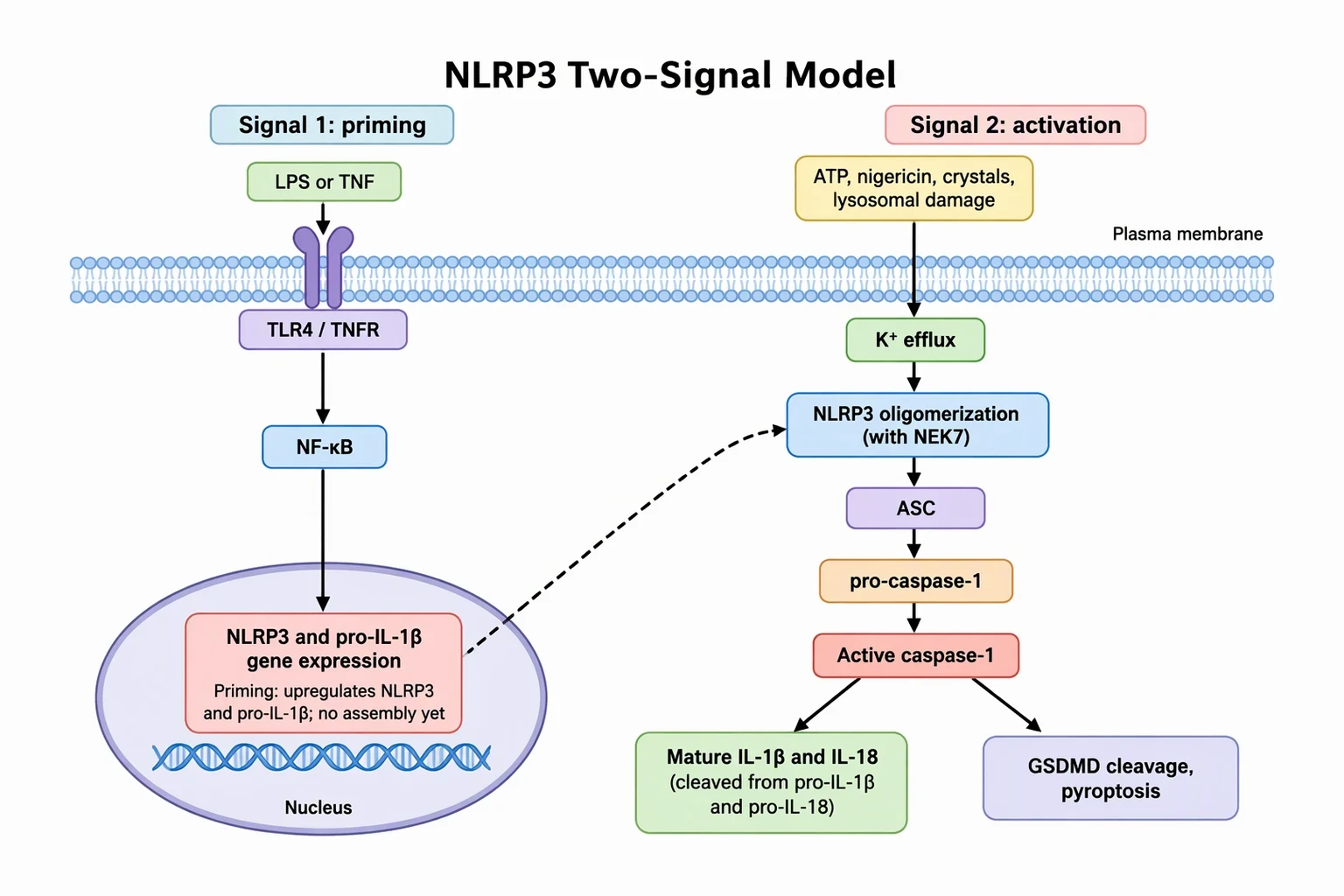 Example: Two-signal modelView full size
Free to try ·
NLRP3 Inflammasome Diagram Examples
Five AI drafts of the two-signal model, NLRP3-ASC-caspase-1 assembly, GSDMD pores and pyroptosis, canonical versus non-canonical routes, and activating stimuli, as starting points. AI diagrams need expert review.
NLRP3 two-signal model
AI draft. Signal 1 (priming) acts through NF-κB to raise NLRP3 and pro-IL-1β expression and does not assemble the inflammasome. Signal 2 (activation), for example K+ efflux, drives NLRP3 oligomerization with NEK7, ASC recruitment and caspase-1 activation.
NLRP3, ASC and caspase-1 assembly
AI draft at domain level. NLRP3 (PYD, NACHT, LRR) recruits ASC through a PYD–PYD interaction; ASC recruits pro-caspase-1 through a CARD–CARD interaction. ASC assembles into a speck, and pro-caspase-1 autocleaves into active caspase-1.
Caspase-1, GSDMD pore and pyroptosis
AI draft. Active caspase-1 cleaves pro-IL-1β and pro-IL-18 into mature cytokines and cleaves gasdermin D. The N-terminal fragment oligomerizes into pores in the plasma membrane, through which IL-1β and IL-18 are released, and the cell undergoes pyroptosis.
Canonical vs non-canonical inflammasome
AI draft. In the canonical NLRP3 route, a signal 2 stimulus assembles NLRP3, ASC and caspase-1. In the non-canonical route, intracellular LPS binds caspase-4 and caspase-5 (human) or caspase-11 (mouse) directly, which cleave GSDMD; the resulting K+ efflux can activate NLRP3 secondarily.
NLRP3 activating stimuli and K+ efflux
AI draft. Many particulate and pore-forming stimuli (ATP through P2X7, nigericin and other toxins, crystals, lysosomal damage) converge on K+ efflux, a common upstream event. Mitochondrial signals can act in parallel, and some stimuli activate NLRP3 without K+ efflux. MCC950 is an NLRP3 inhibitor, drawn as a T-bar onto NLRP3.
Priming (signal 1) runs through NF-κB; see the NF-κB signaling pathway diagram generator. For another innate sensing pathway, use the cGAS-STING pathway diagram generator, and for other receptor pathways and drawing conventions, the signaling pathway diagram generator.
What an NLRP3 inflammasome diagram has to show
The NLRP3 inflammasome is a multiprotein complex in innate immune cells such as macrophages. NLRP3 is a sensor with PYD, NACHT and LRR domains. Once active it recruits the adaptor ASC (PYD and CARD domains), which recruits pro-caspase-1 through CARD–CARD interactions. The complex makes active caspase-1, which matures IL-1β and IL-18 and cleaves gasdermin D to cause pyroptosis, a lytic form of cell death. A clear figure separates the priming step from the activation step, shows the domain-level contacts, and shows that gasdermin D pores, not caspase-1 itself, open the membrane.
The reference order of the two-signal model
- Signal 1 (priming): a TLR ligand such as LPS, or a cytokine such as TNF, activates NF-κB, which raises NLRP3 and pro-IL-1β expression. Priming mainly upregulates NLRP3 and pro-IL-1β transcription and also licenses NLRP3 post-translationally; on its own it does not assemble the inflammasome.
- Signal 2 (activation): stimuli such as extracellular ATP acting through P2X7, nigericin, crystals, lysosomal damage or mitochondrial dysfunction trigger NLRP3 activation. K+ efflux is a common upstream event for many of them, though some stimuli act independently of it.
- NLRP3 oligomerizes, with NEK7 bound, and recruits ASC through a PYD–PYD interaction. ASC assembles into a speck.
- ASC recruits pro-caspase-1 through a CARD–CARD interaction; pro-caspase-1 autocleaves into active caspase-1.
- Caspase-1 cleaves pro-IL-1β and pro-IL-18 into the mature cytokines and cleaves gasdermin D. The N-terminal fragment forms pores in the plasma membrane, releasing IL-1β and IL-18 and leading to pyroptosis.
The non-canonical inflammasome in a figure
- Intracellular LPS from Gram-negative bacteria binds caspase-4 and caspase-5 in humans, or caspase-11 in mice, directly.
- These caspases cleave gasdermin D, and its N-terminal fragment forms a membrane pore.
- K+ efflux through this pore can then activate NLRP3 as a secondary event, leading to caspase-1 activation and IL-1β and IL-18 maturation.
- Draw the LPS binding on the caspase itself; unlike the canonical route, no NLRP3 and ASC step is needed to start it.
Where this figure is used in research
- Innate immunity and inflammation papers: a mechanism figure for the introduction or discussion.
- Cardiometabolic and gout research: crystal-driven NLRP3 activation (monosodium urate, cholesterol).
- Neuroinflammation and autoinflammatory disease: showing where a mutation or a drug acts in the pathway.
- Grant applications and lab meetings: a clean schematic of a hypothesis about a stimulus, a regulator such as NEK7, or an inhibitor such as MCC950.
How to prompt for an accurate NLRP3 inflammasome figure
- Separate the two signals: say that priming raises NLRP3 and pro-IL-1β expression and does not assemble the complex.
- Name the domains for contacts: NLRP3 PYD to ASC PYD, ASC CARD to pro-caspase-1 CARD.
- Say that gasdermin D is cleaved and that its N-terminal fragment forms the pore; name the pore as the route for IL-1β and IL-18 release.
- For the non-canonical route, name caspase-4 and caspase-5 (human) and caspase-11 (mouse) binding LPS directly.
- Ask for T-bars on inhibition with the flat bar only at the target, and check every label and arrow against a primary review before use.
Frequently Asked Questions
Reference sources (checked November 2026)
- Swanson KV, Deng M, Ting JP. The NLRP3 inflammasome: molecular activation and regulation to therapeutics. Nat Rev Immunol 2019
- Broz P, Dixit VM. Inflammasomes: mechanism of assembly, regulation and signalling. Nat Rev Immunol 2016
- Kelley N, Jeltema D, Duan Y, He Y. The NLRP3 inflammasome: an overview of mechanisms of activation and regulation. Int J Mol Sci 2019
- Shi J, Zhao Y, Wang K, et al. Cleavage of GSDMD by inflammatory caspases determines pyroptotic cell death. Nature 2015
- He Y, Zeng MY, Yang D, Motro B, Núñez G. NEK7 is an essential mediator of NLRP3 activation downstream of potassium efflux. Nature 2016
- Coll RC, Robertson AA, Chae JJ, et al. A small-molecule inhibitor of the NLRP3 inflammasome for the treatment of inflammatory diseases. Nat Med 2015
Related Biology Tools
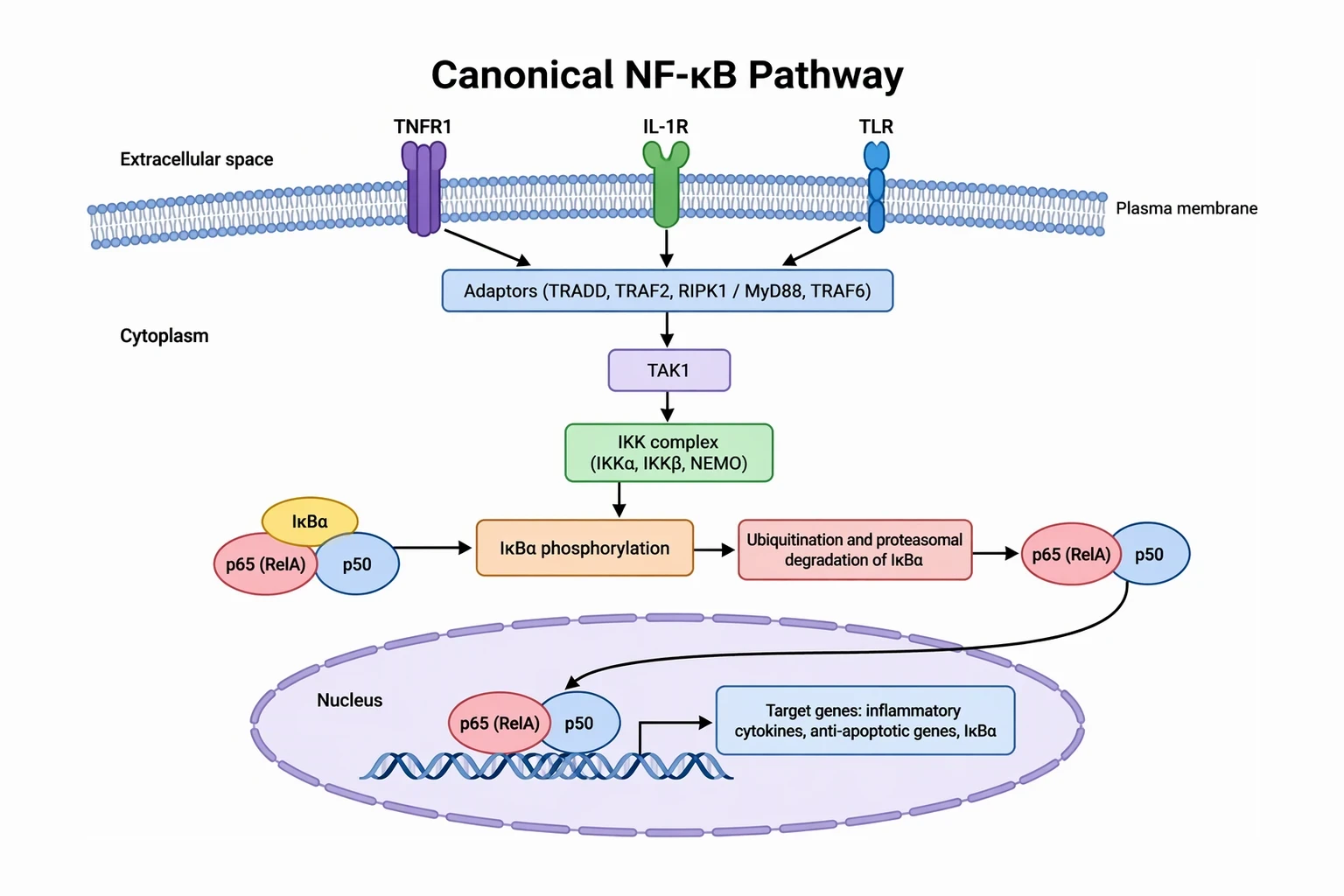
NF-κB Signaling Pathway Diagram Generator
Canonical and non-canonical routes, IKK, IκBα, p65/p50, TLR4/MyD88 and feedback.
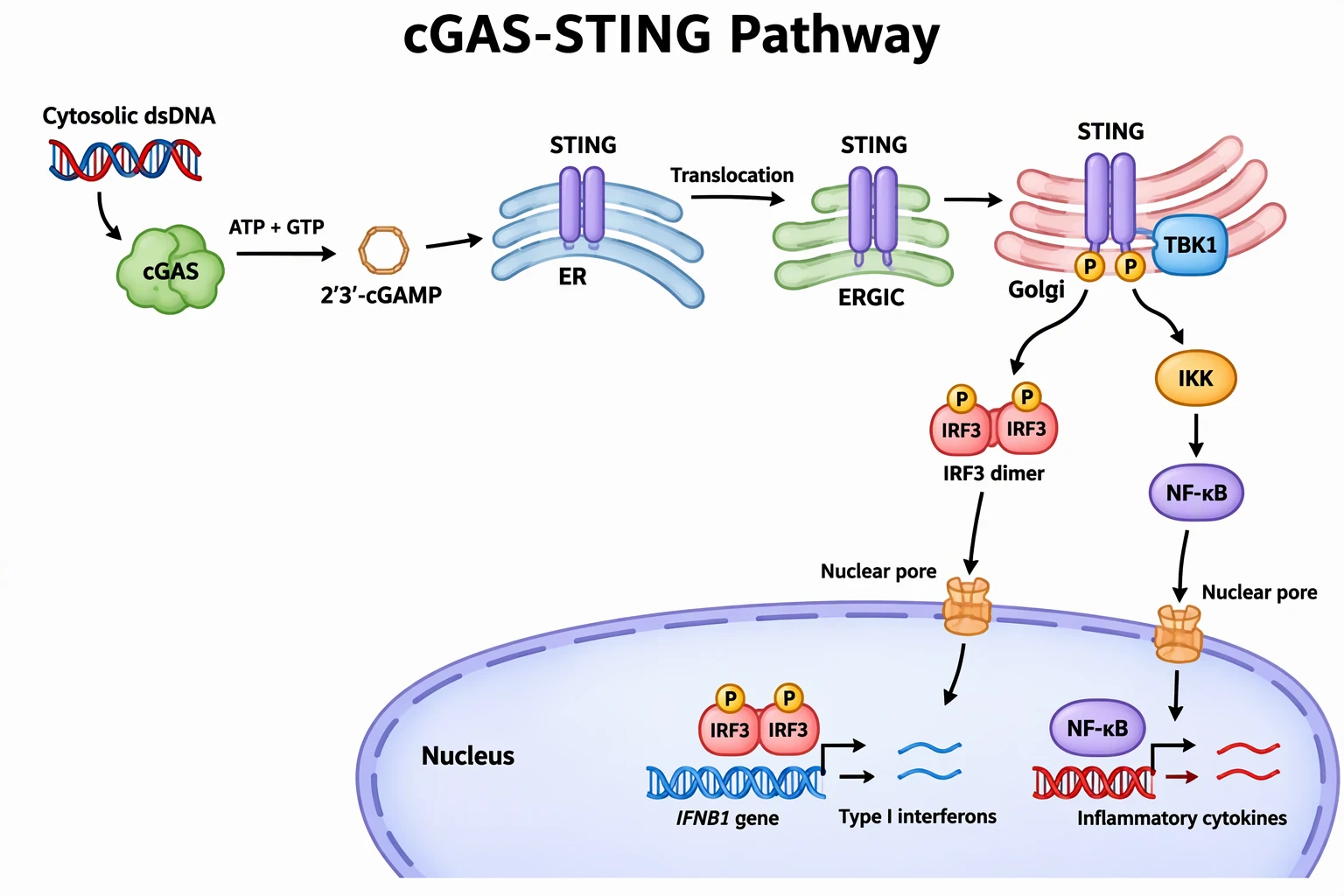
cGAS-STING Pathway Diagram Generator
Cytosolic DNA sensing, cGAMP, STING, TBK1, IRF3 and an NF-κB branch.
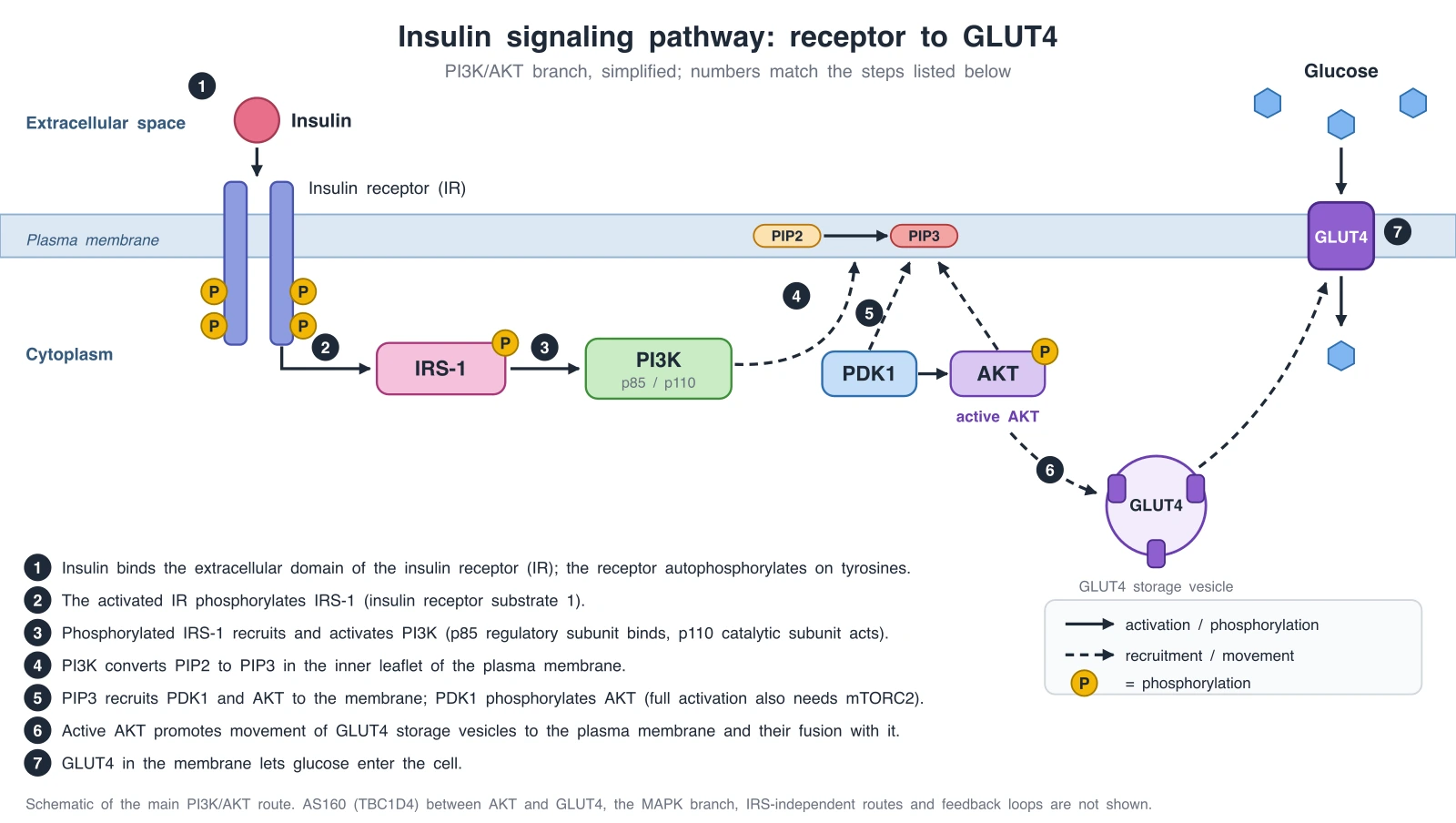
Signaling Pathway Diagram Generator
Receptor pathways, kinase cascades and second messengers drawn from text.