AWG Wire Gauge Chart with mm² and Voltage Drop
AWG wire gauge chart, 0000 to 40: diameter in inches and mm, area in mm² and kcmil, copper resistance, metric sizes and voltage drop. Printable.
Metal for resistance
Search by
| AWG | Dia. inch | Dia. mm | Area mm² | kcmil | CuΩ/km | CuΩ/kft | Closest metric mm² |
|---|---|---|---|---|---|---|---|
| 0000 (4/0) | 0.4600 | 11.68 | 107.2 | 211.6 | 0.1608 | 0.04901 | 120 (+12%) |
| 000 (3/0) | 0.4096 | 10.40 | 85.03 | 167.8 | 0.2028 | 0.06180 | 95 (+12%) |
| 00 (2/0) | 0.3648 | 9.266 | 67.43 | 133.1 | 0.2557 | 0.07793 | 70 (+4%) |
| 0 (1/0) | 0.3249 | 8.251 | 53.48 | 105.5 | 0.3224 | 0.09827 | 50 (-6%) |
| 1 | 0.2893 | 7.348 | 42.41 | 83.69 | 0.4066 | 0.1239 | 50 (+18%) |
| 2 | 0.2576 | 6.544 | 33.63 | 66.37 | 0.5127 | 0.1563 | 35 (+4%) |
| 3 | 0.2294 | 5.827 | 26.67 | 52.63 | 0.6465 | 0.1970 | 25 (-6%) |
| 4 | 0.2043 | 5.189 | 21.15 | 41.74 | 0.8152 | 0.2485 | 25 (+18%) |
| 5 | 0.1819 | 4.621 | 16.77 | 33.10 | 1.028 | 0.3133 | 16 (-5%) |
| 6 | 0.1620 | 4.115 | 13.30 | 26.25 | 1.296 | 0.3951 | 16 (+20%) |
| 7 | 0.1443 | 3.665 | 10.55 | 20.82 | 1.634 | 0.4982 | 10 (-5%) |
| 8 | 0.1285 | 3.264 | 8.366 | 16.51 | 2.061 | 0.6282 | 10 (+20%) |
| 9 | 0.1144 | 2.906 | 6.634 | 13.09 | 2.599 | 0.7921 | 6 (-10%) |
| 10 | 0.1019 | 2.588 | 5.261 | 10.38 | 3.277 | 0.9989 | 6 (+14%) |
| 11 | 0.09074 | 2.305 | 4.172 | 8.234 | 4.132 | 1.260 | 4 (-4%) |
| 12 | 0.08081 | 2.053 | 3.309 | 6.530 | 5.211 | 1.588 | 4 (+21%) |
| 13 | 0.07196 | 1.828 | 2.624 | 5.178 | 6.571 | 2.003 | 2.5 (-5%) |
| 14 | 0.06408 | 1.628 | 2.081 | 4.107 | 8.286 | 2.525 | 2.5 (+20%) |
| 15 | 0.05707 | 1.450 | 1.650 | 3.257 | 10.45 | 3.184 | 1.5 (-9%) |
| 16 | 0.05082 | 1.291 | 1.309 | 2.583 | 13.17 | 4.016 | 1.5 (+15%) |
| 17 | 0.04526 | 1.150 | 1.038 | 2.048 | 16.61 | 5.064 | 1 (-4%) |
| 18 | 0.04030 | 1.024 | 0.8230 | 1.624 | 20.95 | 6.385 | 0.75 (-9%) |
| 19 | 0.03589 | 0.9116 | 0.6527 | 1.288 | 26.42 | 8.051 | 0.75 (+15%) |
| 20 | 0.03196 | 0.8118 | 0.5176 | 1.022 | 33.31 | 10.15 | 0.5 (-3%) |
| 21 | 0.02846 | 0.7229 | 0.4105 | 0.8101 | 42.00 | 12.80 | 0.5 (+22%) |
| 22 | 0.02535 | 0.6438 | 0.3255 | 0.6424 | 52.96 | 16.14 | - |
| 23 | 0.02257 | 0.5733 | 0.2582 | 0.5095 | 66.79 | 20.36 | - |
| 24 | 0.02010 | 0.5106 | 0.2047 | 0.4040 | 84.22 | 25.67 | - |
| 25 | 0.01790 | 0.4547 | 0.1624 | 0.3204 | 106.2 | 32.37 | - |
| 26 | 0.01594 | 0.4049 | 0.1288 | 0.2541 | 133.9 | 40.81 | - |
| 27 | 0.01420 | 0.3606 | 0.1021 | 0.2015 | 168.9 | 51.47 | - |
| 28 | 0.01264 | 0.3211 | 0.08098 | 0.1598 | 212.9 | 64.90 | - |
| 29 | 0.01126 | 0.2859 | 0.06422 | 0.1267 | 268.5 | 81.84 | - |
| 30 | 0.01003 | 0.2546 | 0.05093 | 0.1005 | 338.6 | 103.2 | - |
| 31 | 0.008928 | 0.2268 | 0.04039 | 0.07970 | 426.9 | 130.1 | - |
| 32 | 0.007950 | 0.2019 | 0.03203 | 0.06321 | 538.3 | 164.1 | - |
| 33 | 0.007080 | 0.1798 | 0.02540 | 0.05013 | 678.8 | 206.9 | - |
| 34 | 0.006305 | 0.1601 | 0.02014 | 0.03975 | 856.0 | 260.9 | - |
| 35 | 0.005615 | 0.1426 | 0.01597 | 0.03152 | 1079 | 329.0 | - |
| 36 | 0.005000 | 0.1270 | 0.01267 | 0.02500 | 1361 | 414.8 | - |
| 37 | 0.004453 | 0.1131 | 0.01005 | 0.01983 | 1716 | 523.1 | - |
| 38 | 0.003965 | 0.1007 | 0.007967 | 0.01572 | 2164 | 659.6 | - |
| 39 | 0.003531 | 0.08969 | 0.006318 | 0.01247 | 2729 | 831.8 | - |
| 40 | 0.003145 | 0.07987 | 0.005010 | 0.009888 | 3441 | 1049 | - |
Solid bare round wire, resistance at 20 °C (copper 100% IACS, aluminium 61% IACS). Closest metric size is by area ratio; the percentage is how much larger (+) or smaller (-) that metric size is. Current ratings are not listed: they depend on insulation, installation and local code.
Free AWG Wire Gauge Charts and Worksheets
Every sheet below is drawn from the same computed data as the tool above. View, download and print them free, no sign-up.
AWG Wire Gauge Chart, 0000 to 40
All 44 gauge sizes with diameter, area and copper resistance, computed from the AWG definition.
Reference charts
Printer friendly
Study aids
Worksheets
What AWG means and how it counts
AWG stands for American Wire Gauge, the standard used in North America for the diameter of round, solid, non-ferrous electrical wire. The scale runs backwards: a bigger number means a thinner wire. It is defined by two anchor points. 36 AWG is exactly 0.005 inch across and 0000 AWG is exactly 0.460 inch across, and the 39 steps between them follow a fixed ratio, so every gauge is about 12.3% thicker than the next number up. Because of that ratio, three simple rules hold. Every 3 gauges the area doubles or halves, every 6 gauges the diameter doubles or halves, and every 10 gauges the area, and therefore the resistance, changes by about ten times.
The zeros: 0000, 000, 00 and 0
Wire thicker than 1 AWG continues with 0, 00, 000 and 0000. These are said "one-aught" to "four-aught" and written 1/0, 2/0, 3/0 and 4/0. The chart lists both spellings, so 0000 and 4/0 are the same wire, 11.68 mm across with a cross-section of 107.2 mm². Beyond 4/0 the size is given directly as an area in kcmil (thousands of circular mils), where 1 kcmil is 0.5067 mm². Older documents call the same unit MCM.
AWG, mm² and SWG are different things
- AWG describes a diameter step. Metric cable sizes, for example in IEC 60228, describe the conductor cross-section in mm² and use round numbers such as 1.5, 2.5, 4 and 6. The two lists do not line up, which is why the AWG to mm² chart shows the closest metric size and how far off it is. 13 AWG is 2.624 mm², close to a 2.5 mm² cable. 10 AWG is 5.261 mm², which sits between 4 and 6 mm².
- SWG, the British Standard Wire Gauge, is another backwards-counting scale, but its steps are different. A wire called 12 SWG is about 2.64 mm across while 12 AWG is 2.053 mm, so never swap one for the other.
Resistance and voltage drop
- The resistance columns use annealed copper at 20 °C, which is 100% IACS or 58.0 MS/m, giving a resistivity of 1.724 × 10⁻⁸ ohm metre. Resistance per length is that resistivity divided by the cross-section area, which is why a thicker wire has a lower resistance: 10 AWG is 3.277 ohm per km, 20 AWG is 33.31 ohm per km. Aluminium at 61% IACS has about 1.64 times the resistance of copper for the same size.
- Voltage drop for a two-wire DC or single-phase circuit is V = I × R × 2L, with L the one-way length because the current also returns. For 15 A over 50 ft of 12 AWG copper, R is 1.588 ohm per 1000 ft times 100 ft, which is 0.159 ohm, so the drop is 2.38 V, or 1.99% of a 120 V supply. This only counts resistance. Temperature, AC reactance and connectors change the result.
Solid wire, stranded wire and how to choose a size
- The AWG number of stranded wire is based on the total copper area of all strands, so a stranded 12 AWG wire has about the same copper as a solid 12 AWG wire. Its overall diameter is a little larger because of the gaps between strands, and it is more flexible, which is why it is used for leads and anything that moves.
- This chart deliberately has no current ratings. How much current a wire may carry depends on the insulation temperature rating, how it is installed, the ambient temperature, how many conductors share a conduit and the rules that apply where you live. Use the NEC or your local code and ask a qualified electrician for anything in a building. What this page gives you is the geometry and resistance, so you can compare sizes, convert to metric and check that voltage drop stays acceptable.
Where the numbers come from
Every value is computed in your browser from the ASTM B258 definition, d = 0.005 in × 92^((36 − n) / 39), not copied from a table, and then compared with the American wire gauge article on Wikipedia. Diameters are shown to four significant figures. Metric sizes are a selection of IEC 60228 nominal cross-sections. Checked October 2026.
Frequently Asked Questions
Related Electrical Tools
 Engineering
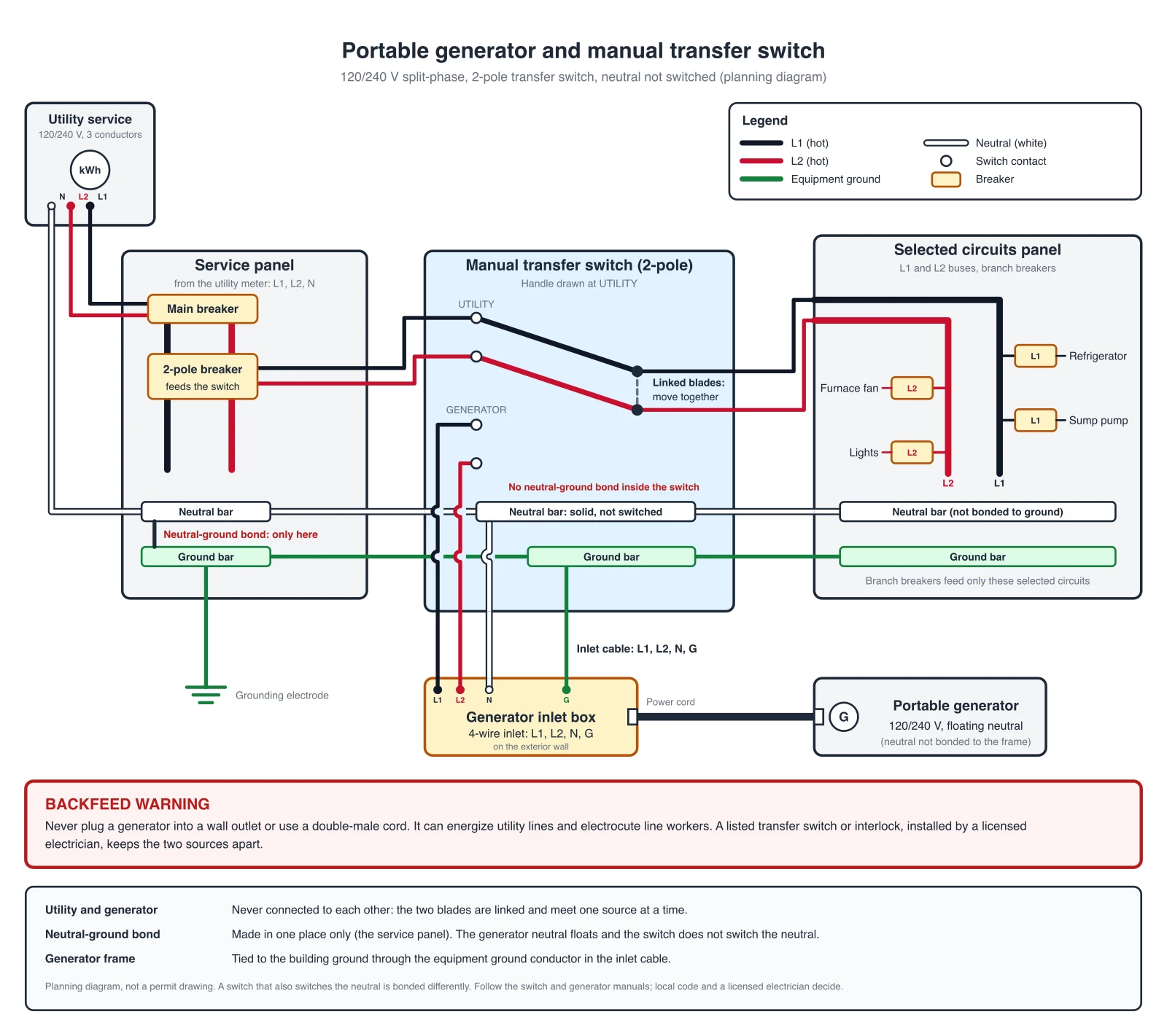
Wiring Diagram Maker
Create wiring diagrams and electrical schematics online, with exact reference diagrams to check them against.
 Engineering
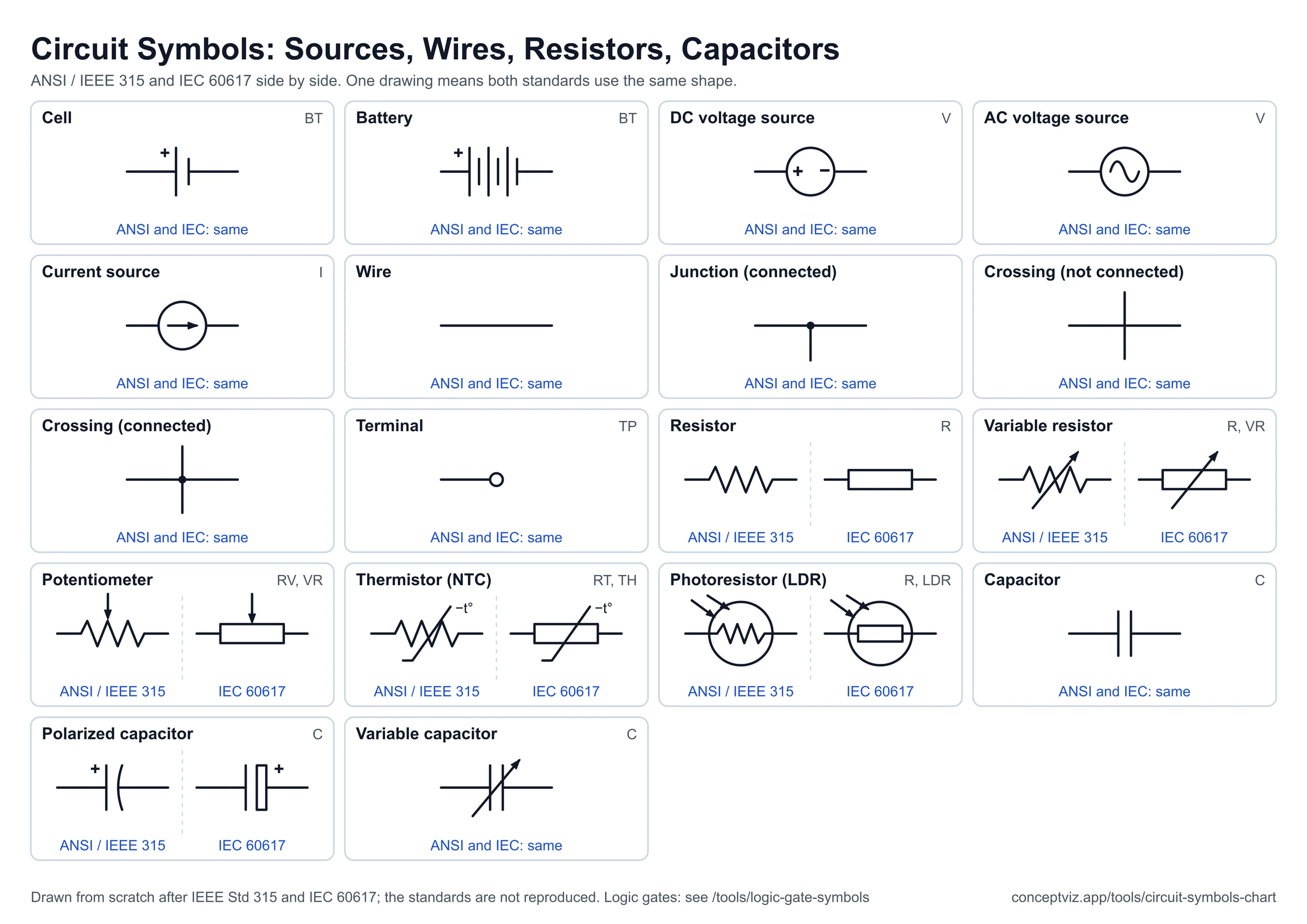
Circuit Symbols Chart
Resistor, capacitor, diode and transistor symbols in ANSI and IEC styles, with a printable cheat sheet.
 Physics
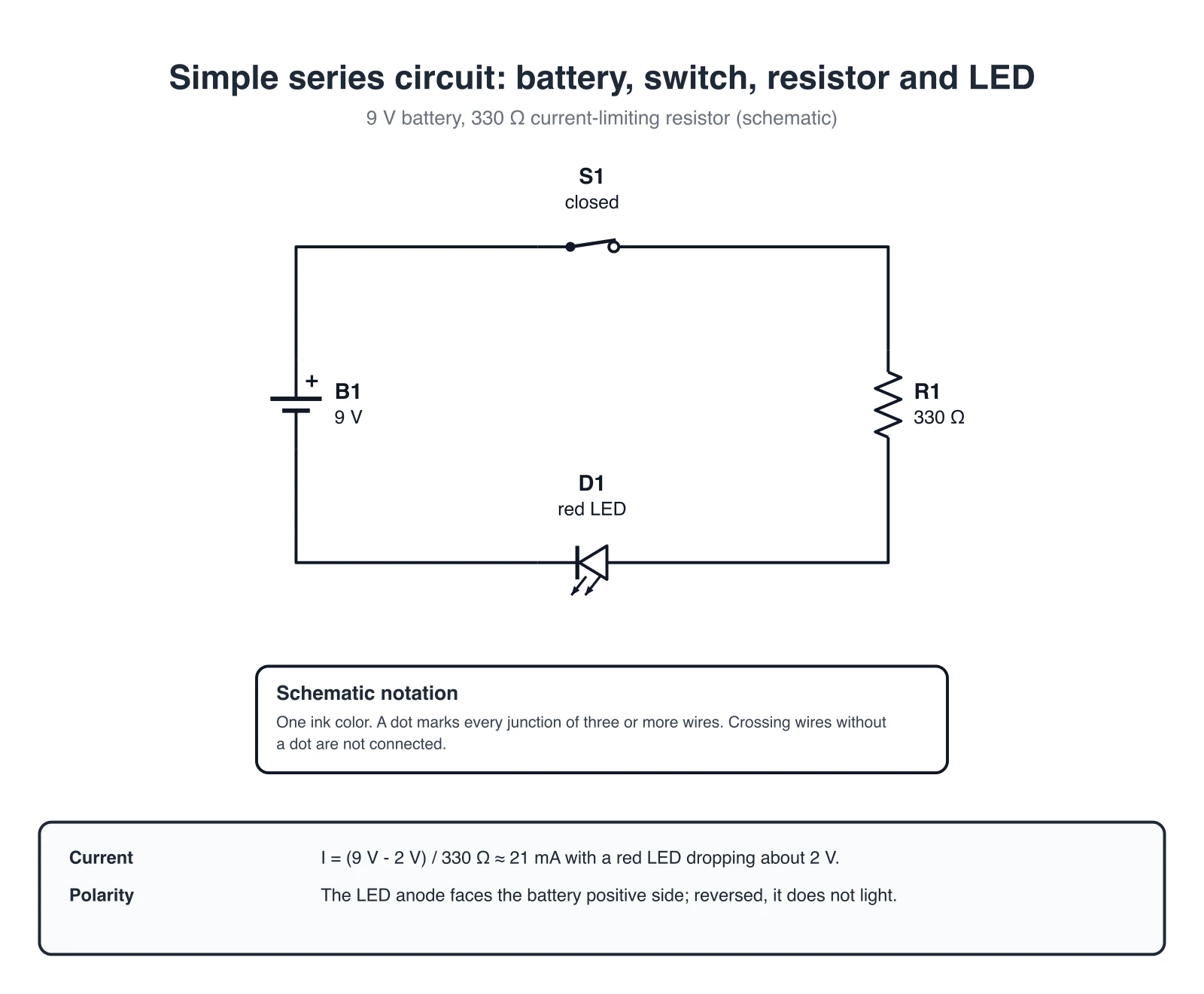
Circuit Diagram Maker
Create circuit diagrams for physics and electrical engineering with standard symbols.
 Education
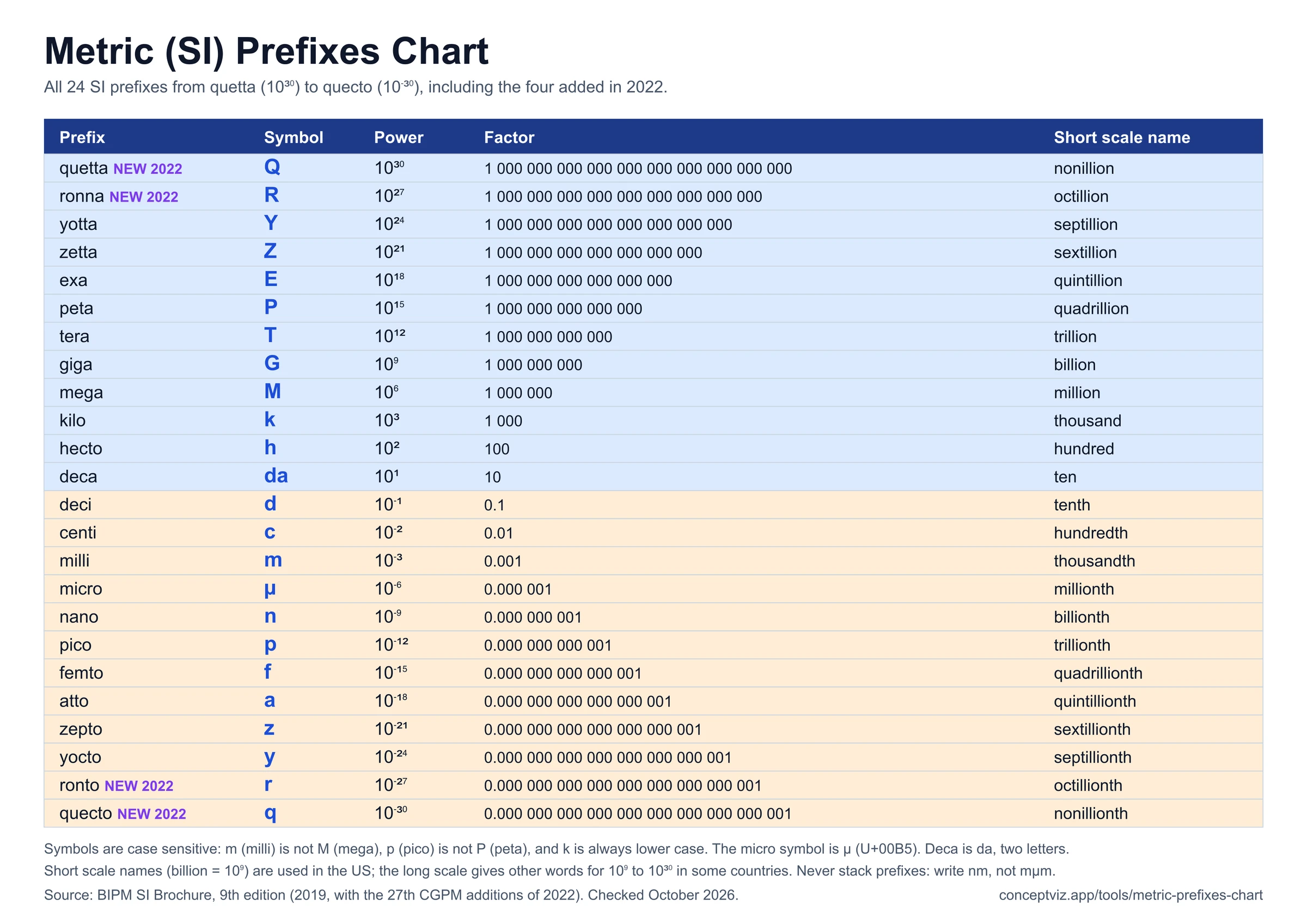
Metric Prefixes Chart
All 24 SI prefixes with an exact converter, handy for milliohms, microns and kilo-circular mils.
 Engineering
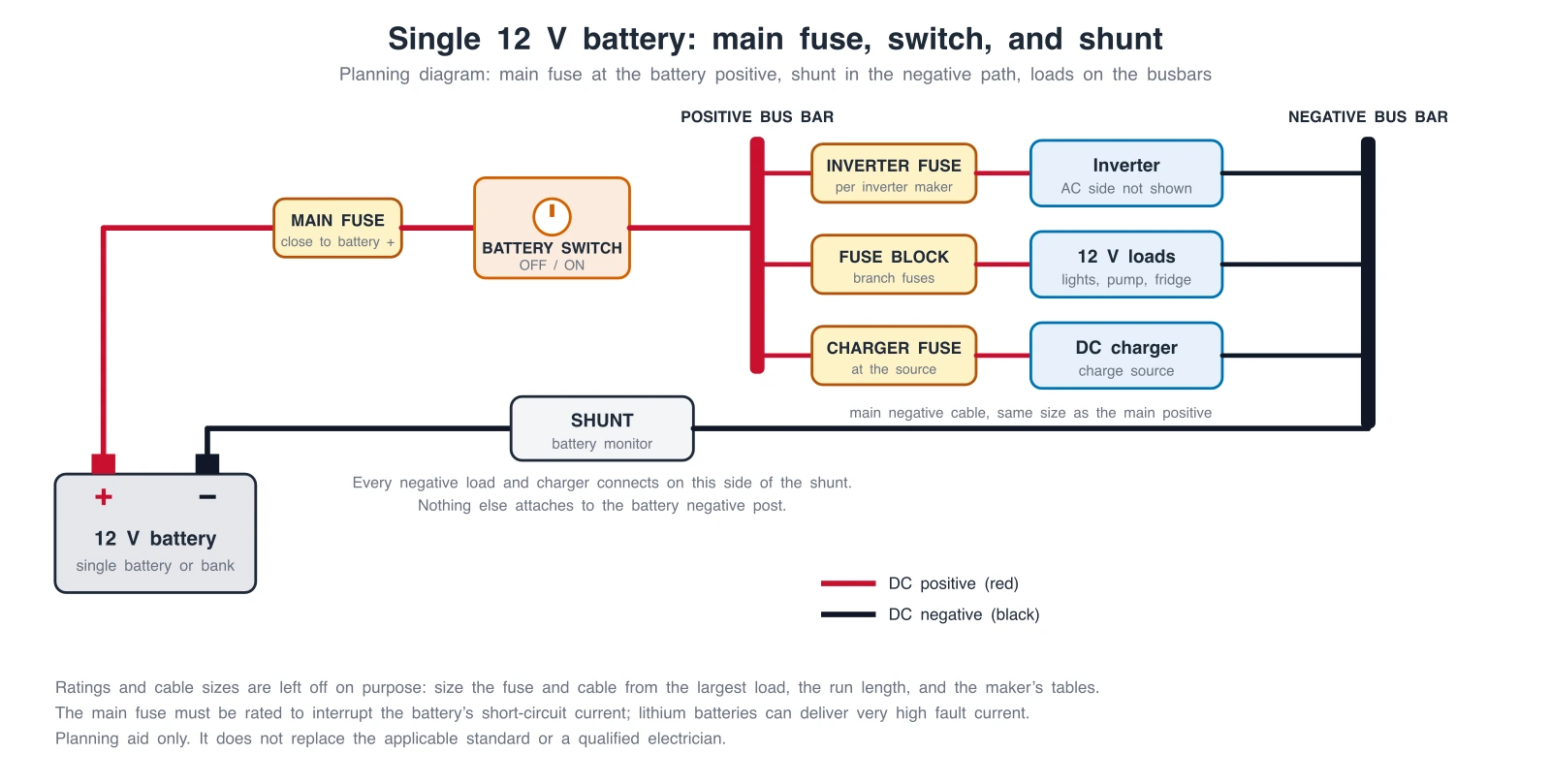
Battery Wiring Diagram Generator
Battery wiring diagrams with main fuse, switch, shunt and series or parallel banks.
 Engineering
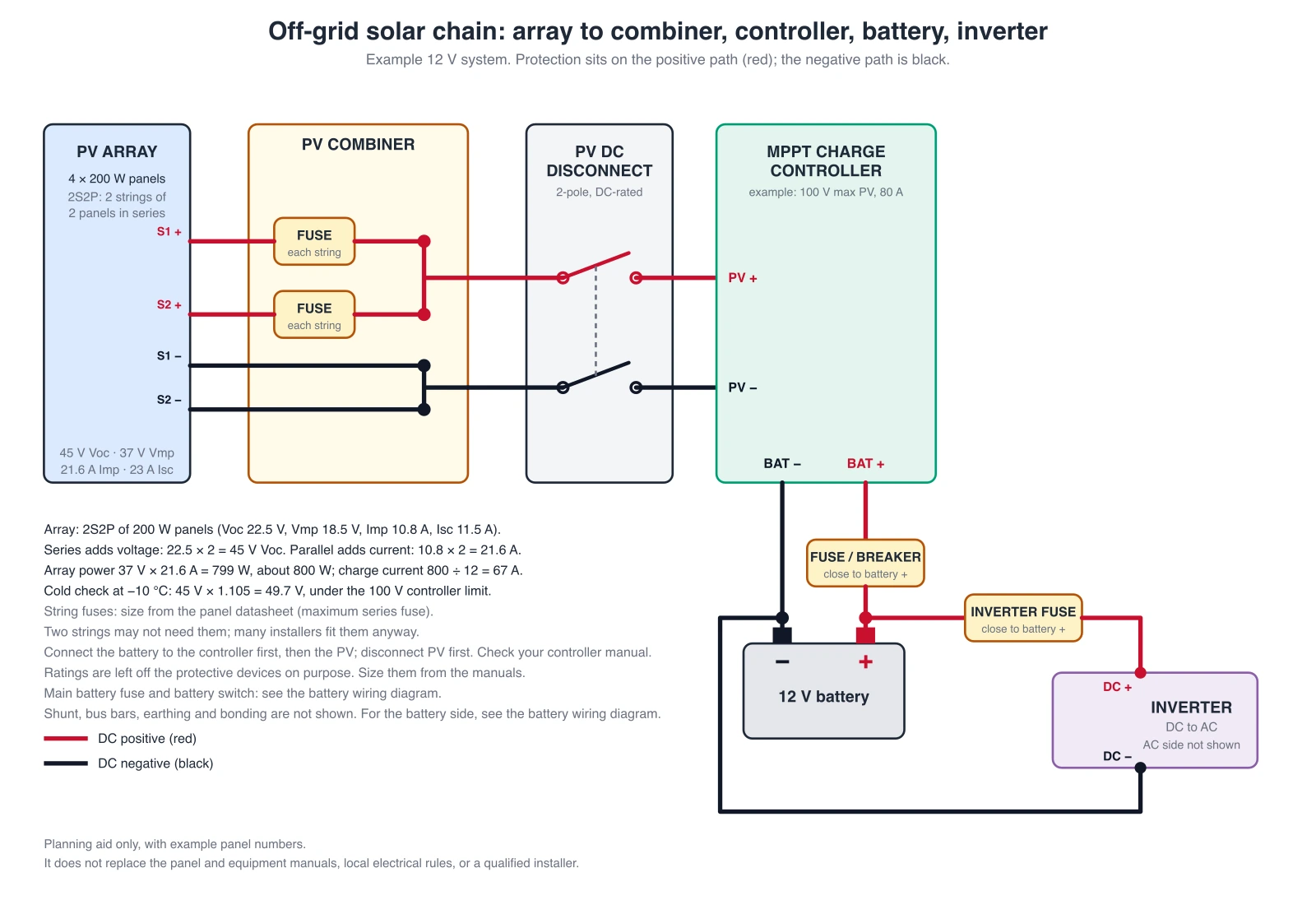
Solar Panel Wiring Diagram Generator
Solar panel wiring diagrams from series and parallel strings to a full off-grid chain.
 Electronics
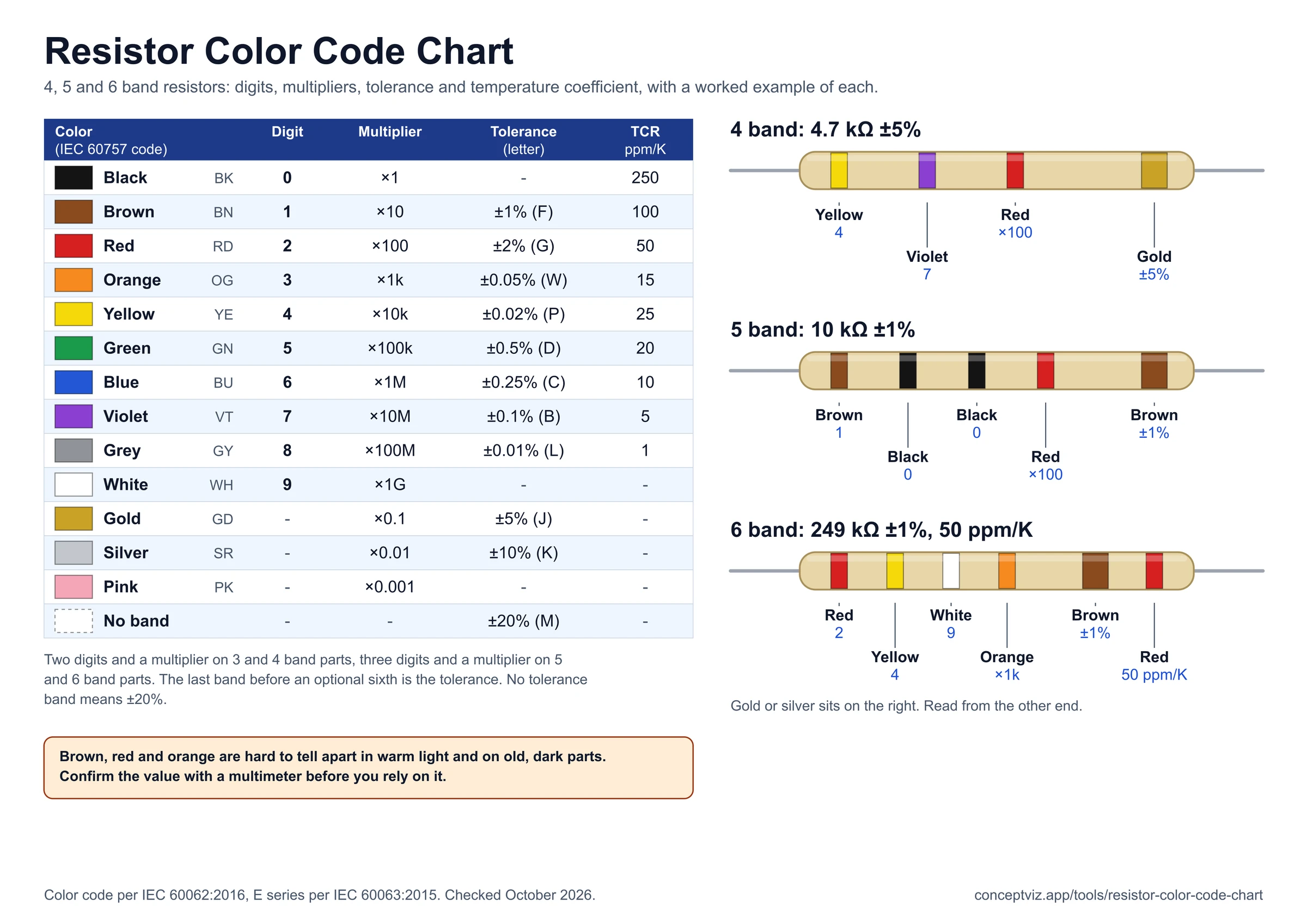
Resistor Color Code Chart
4, 5 and 6 band color codes with a two-way calculator and E12 and E24 values.
 Electronics
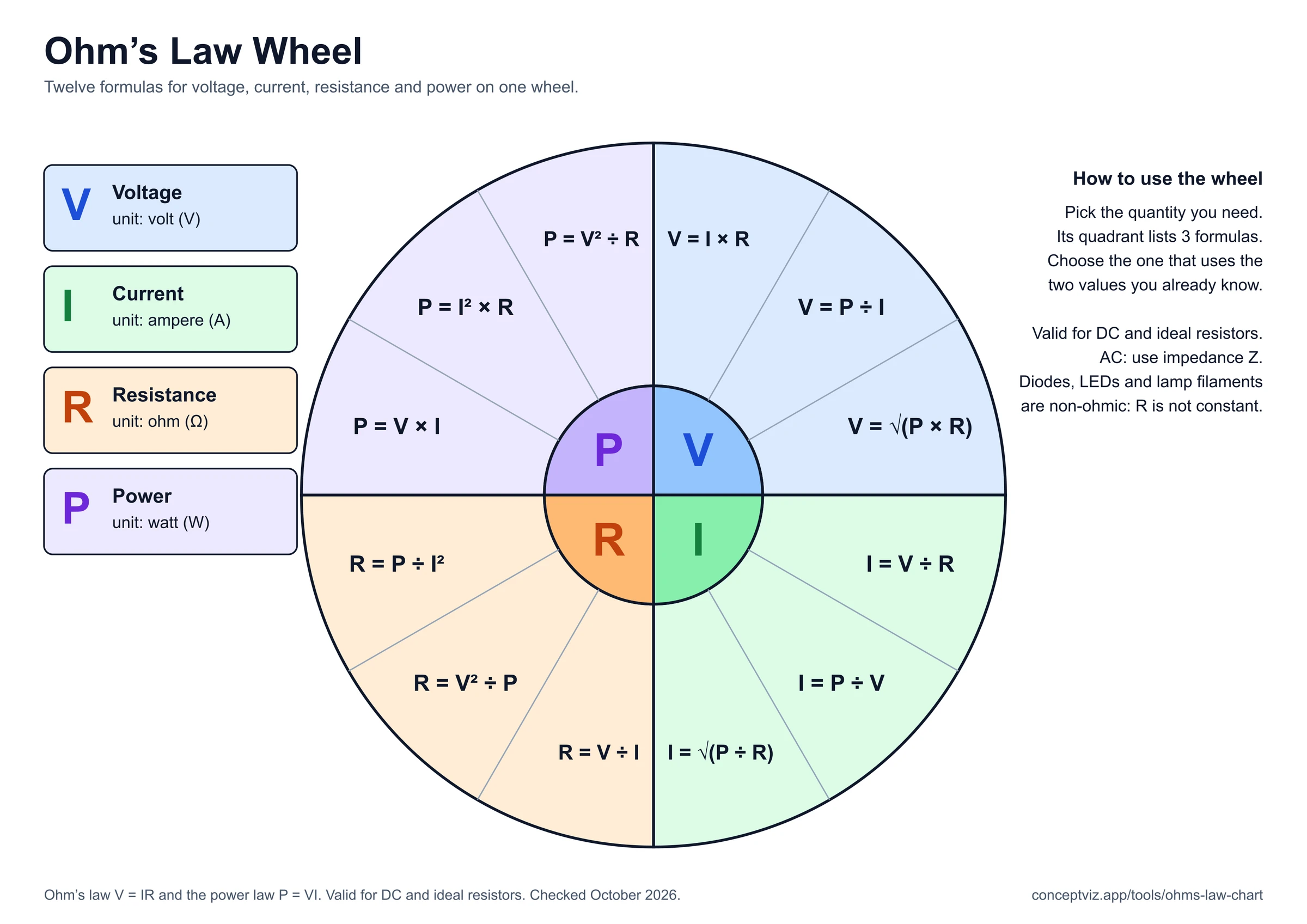
Ohm's Law Chart
The Ohm's law wheel with all 12 formulas and a voltage, current, resistance and power calculator.
 Engineering
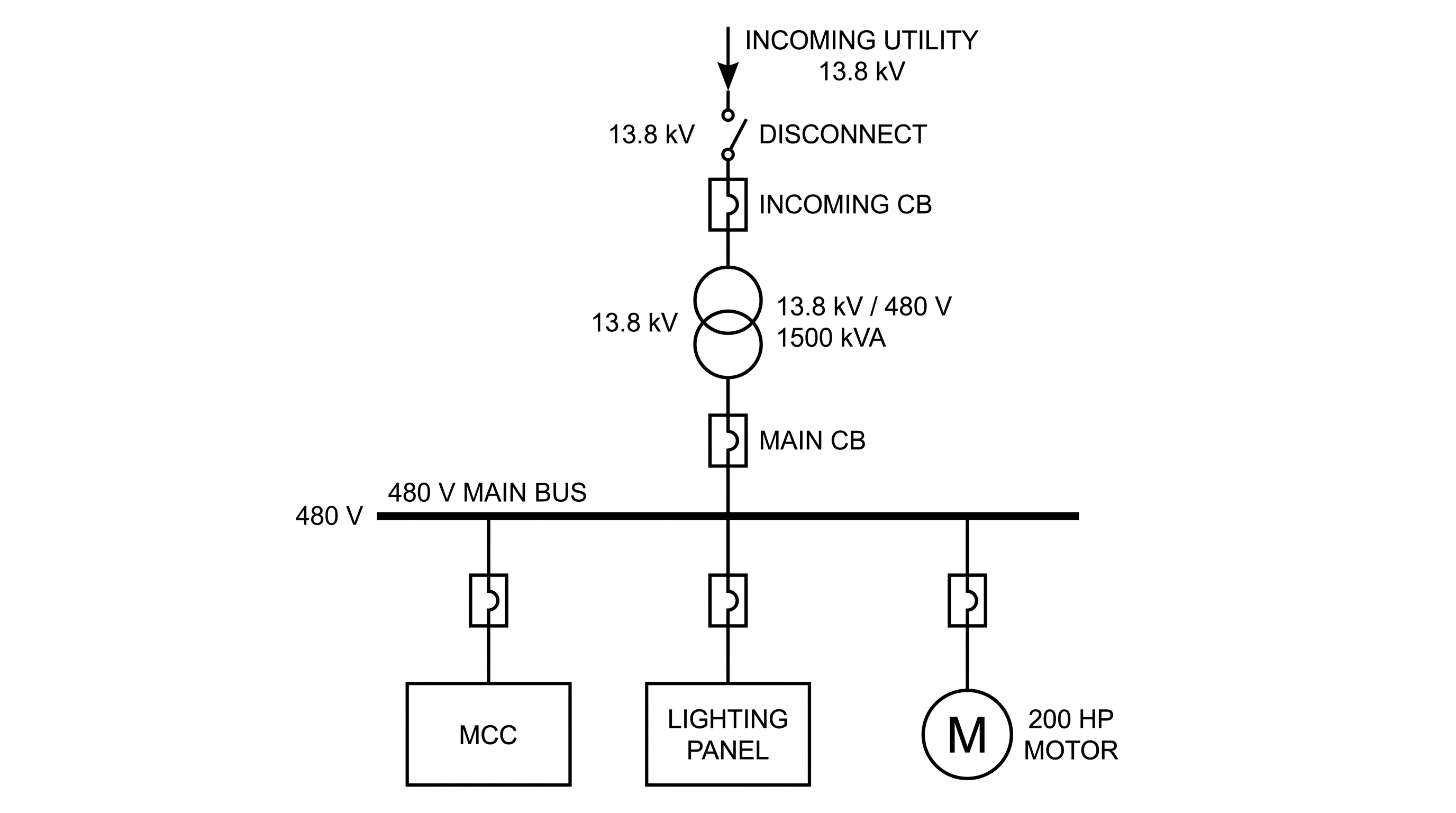
Single-Line Diagram Generator
Create electrical single-line diagrams showing utility, transformers, buses and loads.