Resistor Color Code Chart with 4, 5 and 6 Band Calculator
Resistor color code chart for 4, 5 and 6 band resistors: colors to value and value to colors, tolerance, temperature coefficient, E12/E24 values. Printable.
Number of bands
4.7 kΩ ±5%
- Exact value
- 4,700 Ω
- Tolerance range
- 4.465 kΩ to 4.935 kΩ
- Temperature coefficient
- not marked (add a 6th band)
- Bands
- Yellow, Violet, Red, Gold
Free Resistor Color Code Charts and Cheat Sheets
Every sheet below is drawn from the same data as the tool above. View, download and print them free, no sign-up.
Resistor Color Code Chart, 4, 5 and 6 Band
Every color with its digit, multiplier, tolerance and TCR, plus one worked resistor for each band count.
Reference charts
Printer friendly
Study aids
How to read a resistor color code
- Hold the resistor so the bands are at the left, then read toward the right. The first band is the one nearest to an end of the body. A gold or silver band is never a digit, so if you see one it marks the tail end and you start from the other side. The tolerance band is usually set a little apart from the others, or drawn slightly wider.
- On a 4 band resistor the first two bands are digits, the third is the multiplier and the fourth is the tolerance. Yellow, violet, red, gold is 4, 7, then ×100, so 4,700 Ω or 4.7 kΩ, at ±5%. On a 5 band resistor there is a third digit: brown, black, black, red, brown is 1, 0, 0, then ×100, so 10 kΩ at ±1%. If there is no tolerance band at all, the tolerance is ±20%.
4 band, 5 band and 6 band resistors
- A 4 band resistor has two significant digits, so it can only mark values like 47, 4.7 k or 470 k. It is the usual marking for ±5% and ±10% parts. A 5 band resistor adds a third digit and is used for ±1% and tighter parts, because values such as 4.75 k or 249 Ω need three digits. A 3 band resistor has no tolerance band and is ±20%.
- A 6 band resistor is a 5 band one plus a sixth band for the temperature coefficient, in ppm per kelvin. Red, yellow, white, orange, brown, red is 249 kΩ ±1% with 50 ppm/K, for example. 50 ppm/K means the value moves by at most about 0.005% for each degree of temperature change. Not every maker follows the IEC meaning of the sixth band, so check the datasheet when it matters.
Multiplier, tolerance and temperature coefficient
- Black to white as a multiplier is ×1 up to ×1,000,000,000, which is the power of ten equal to the color number. Gold is ×0.1 and silver is ×0.01, so brown, black, gold, gold is 1 Ω. IEC 60062:2016 also gives pink as ×0.001. It is rare in practice, and some makers use grey or white for the same job.
- The tolerance colors are brown ±1%, red ±2%, green ±0.5%, blue ±0.25%, violet ±0.1%, gold ±5% and silver ±10%. The 2016 edition of the standard added orange ±0.05%, yellow ±0.02% and grey ±0.01%. Before that, many makers used grey for ±0.05%, and some high-voltage parts use yellow or grey in place of gold and silver, so an old or unusual part is worth checking against its datasheet.
Why resistors come in E series values
- Resistors are not made in every value. IEC 60063 defines the E series, which divide each decade, from 1 to 10, into 6, 12, 24, 48, 96 or 192 steps. The series is chosen to match the tolerance so that neighbouring values just overlap: E6 for ±20%, E12 for ±10%, E24 for ±5%, E48 for ±2%, E96 for ±1% and E192 for anything tighter. In E6, 10 Ω plus 20% is 12 Ω, and 15 Ω minus 20% is also 12 Ω.
- Each step is the 6th, 12th, 24th and so on root of 10, but the E24 list is not simply rounded from that formula. The standard keeps the historic values 2.7, 3.0, 3.3, 3.6, 3.9, 4.3 and 4.7, and 8.2, because the series was in use before the first edition in 1952. For example, the formula gives 4.6 where the standard has 4.7. That is why the tool above writes out each list from the standard and does not calculate it. Many 1% resistors are also sold in E24 values.
SMD resistors, 0 Ω links and other exceptions
- Surface-mount chip resistors do not use color bands. They print a number code instead: three digits such as 472, meaning 47 and then two zeros, which is 4,700 Ω, or four digits on precision parts. An R marks the decimal point, so 4R7 is 4.7 Ω. Very small and precision sizes may use the EIA-96 code, a two-digit number that points to a value in the E96 list followed by a letter for the multiplier.
- A resistor with a single black band is a 0 Ω link, a piece of wire in a resistor body that automatic insertion machines can place on a board. Black as the first band of a longer code is a leading zero and is only seen on very low values. If a code gives a value that is not in any E series, suspect that you have read it from the wrong end.
Common reading mistakes
- The usual mistake is starting from the wrong end. A resistor with brown at both ends, such as brown, black, black, red, brown, is 10 kΩ one way and 120 Ω the other, and both are valid-looking numbers. The second most common is mixing up brown, red and orange in warm light or on an old, darkened body, and black with dark brown. Violet and blue can also look alike.
- Check the value in the tool above, because a valid E series value is a good sign, then confirm with a multimeter before you rely on it. Measure the resistor out of the circuit, and remember that a reading within the tolerance band is normal: a 4.7 kΩ ±5% resistor can measure anywhere from 4.465 kΩ to 4.935 kΩ.
Where the numbers come from
The color code follows IEC 60062:2016, Table 1, and the E series lists are written out from IEC 60063:2015, Tables 1 and 2. Values follow IEC 60062:2016 and IEC 60063:2015 and were cross-checked against the Wikipedia tables "Electronic color code" and "E series of preferred numbers". The colors on screen are illustrations, because the standard does not define exact shades. Checked October 2026.
Frequently Asked Questions
Related Electronics Tools
 Engineering
Ohm’s Law Chart
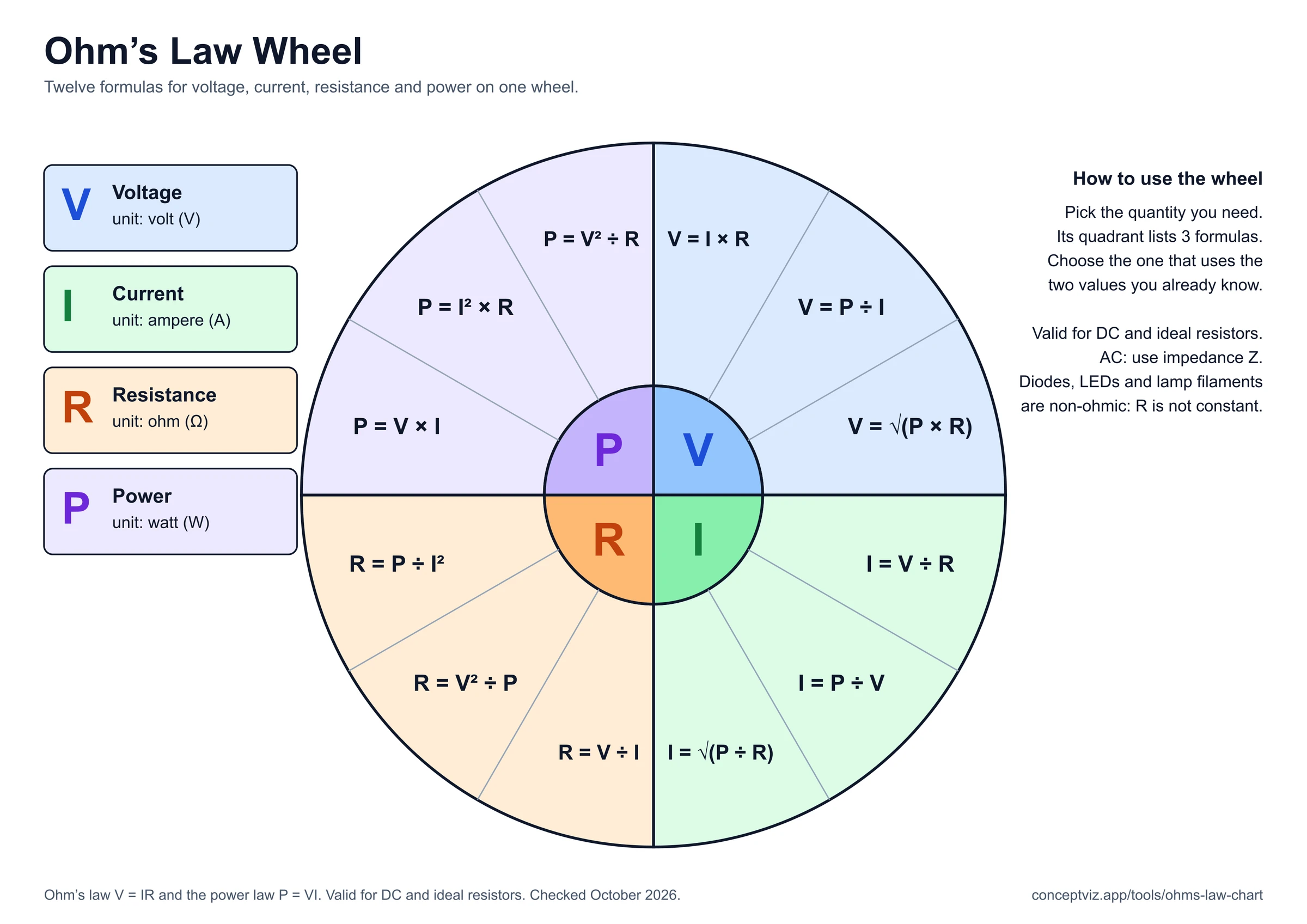
The 12 Ohm’s law and power formulas on one wheel, with a calculator and printable sheets.
 Engineering
Circuit Symbols Chart
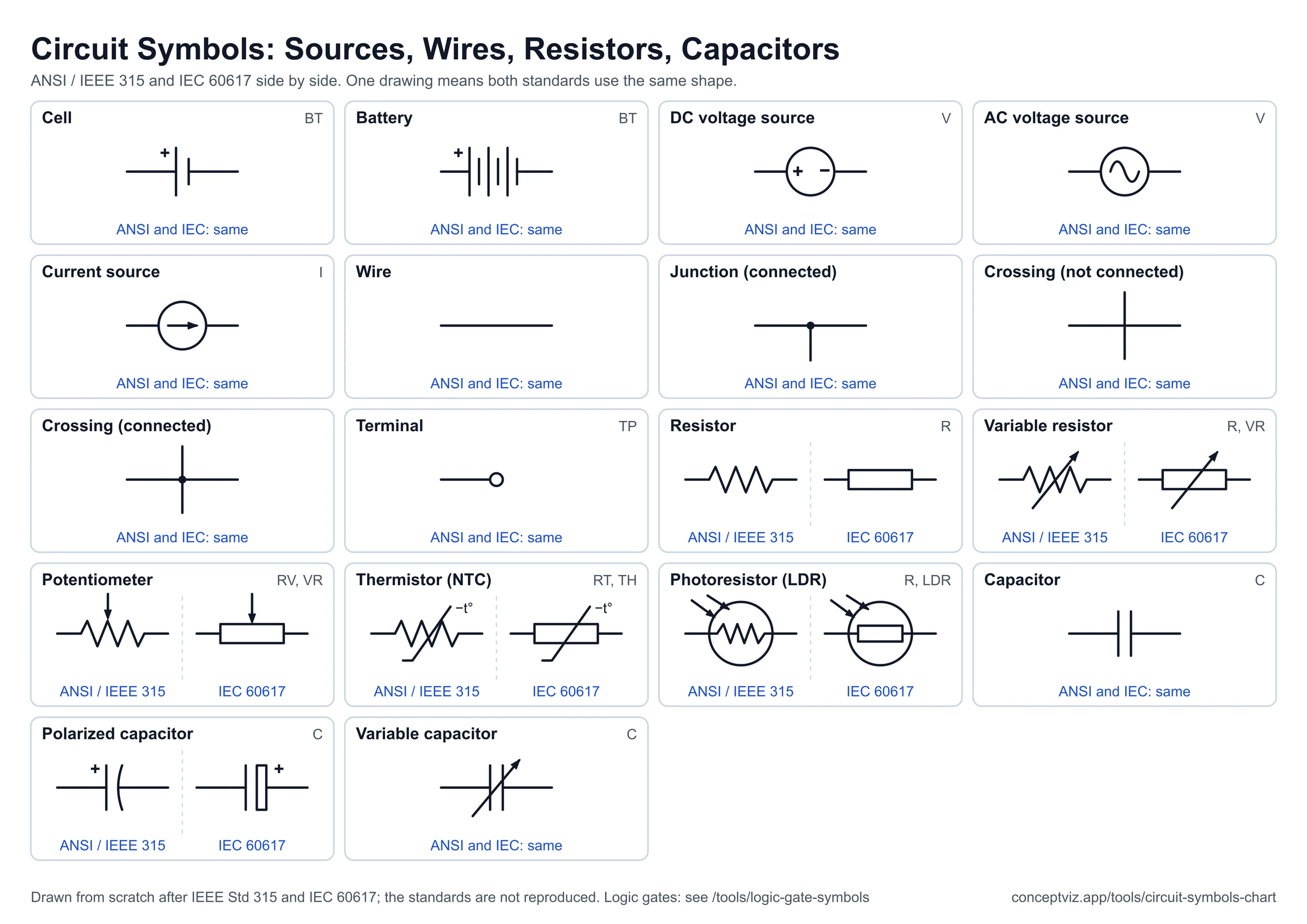
Resistor, capacitor, diode and transistor symbols in ANSI and IEC styles, with a printable cheat sheet.
 Engineering
AWG Wire Gauge Chart
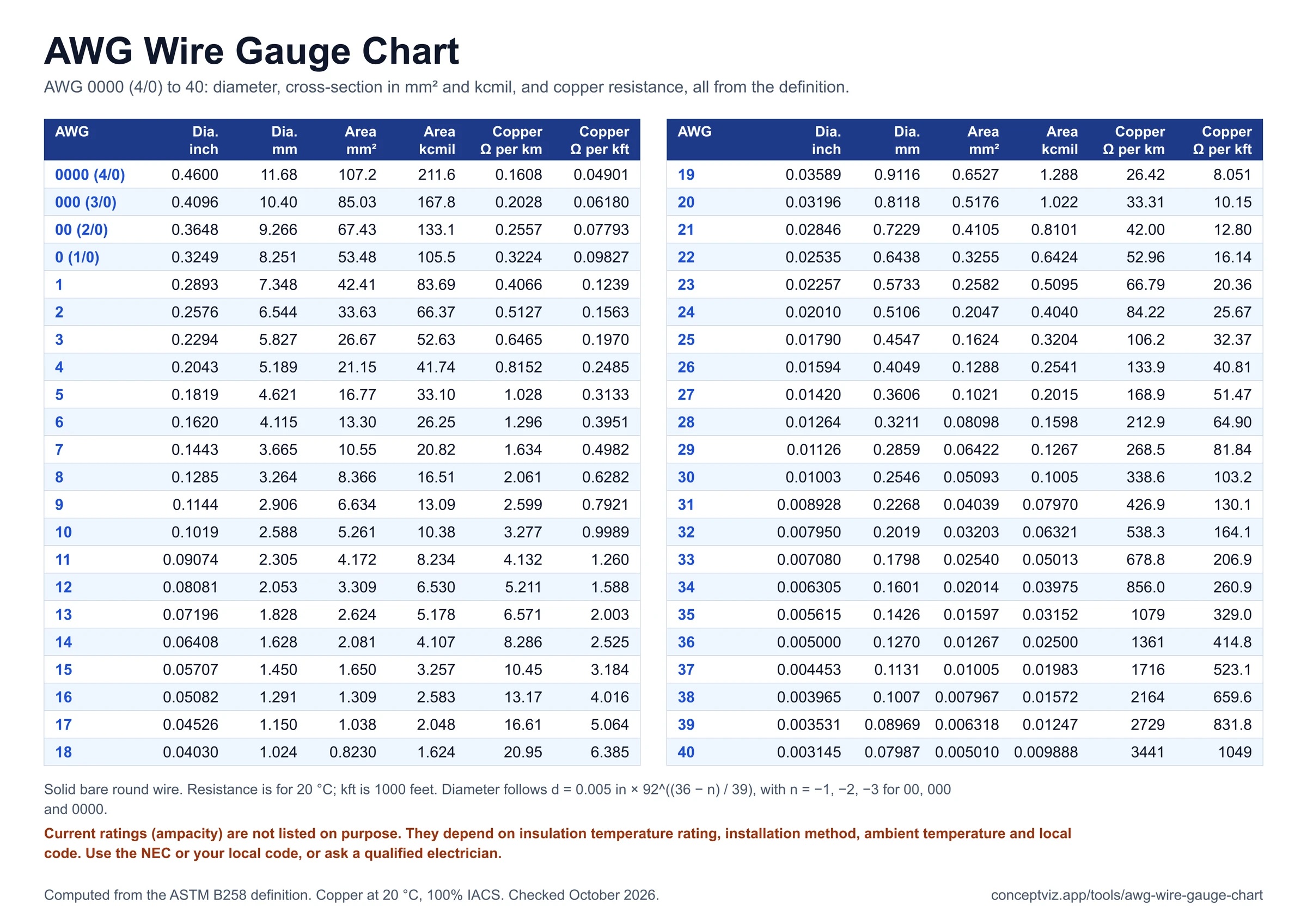
AWG sizes from 0000 to 40 with diameter, mm², copper resistance and a voltage drop calculator.
 Physics
Circuit Diagram Maker
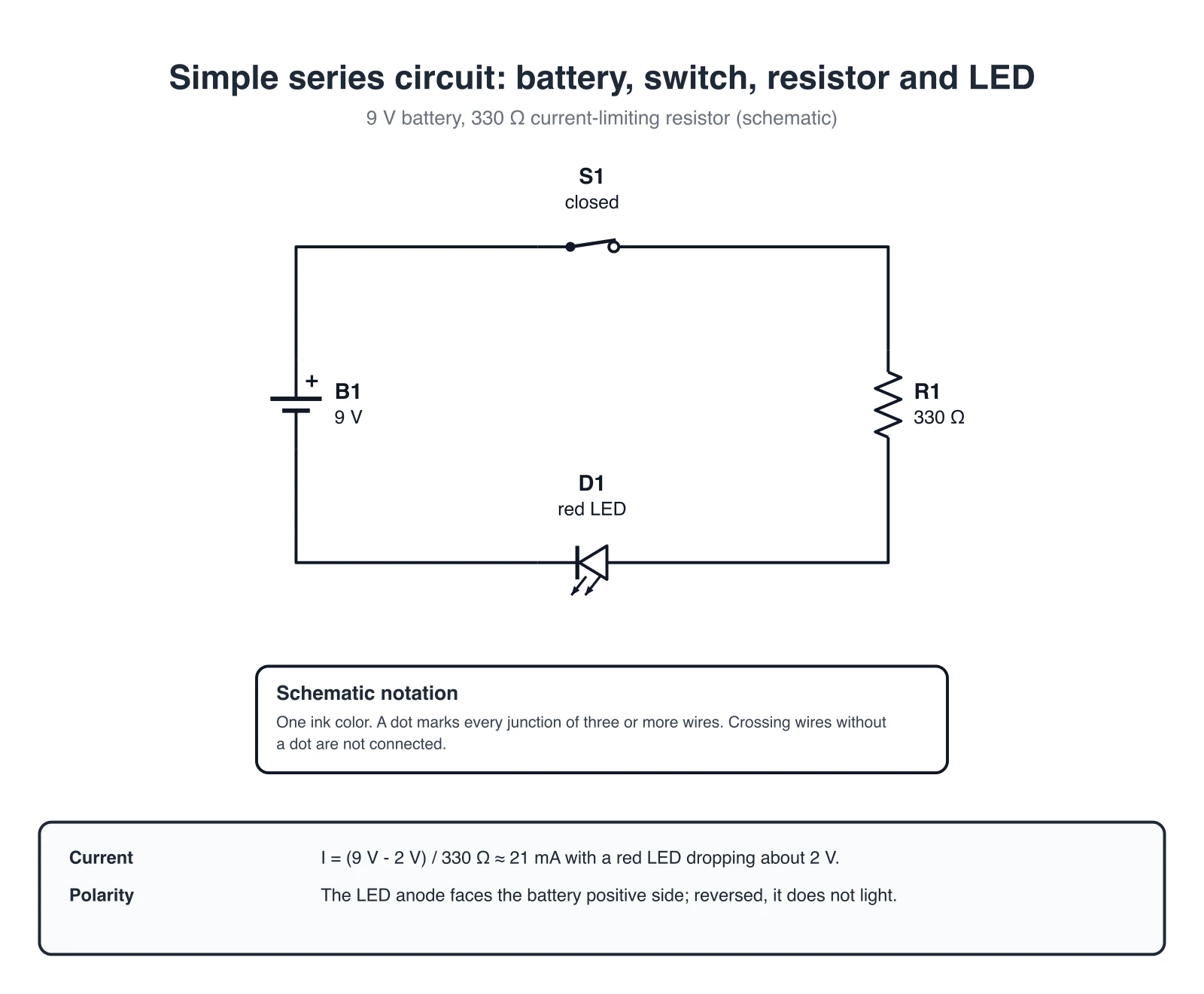
Create circuit diagrams for physics and electrical engineering with standard symbols.
 Engineering
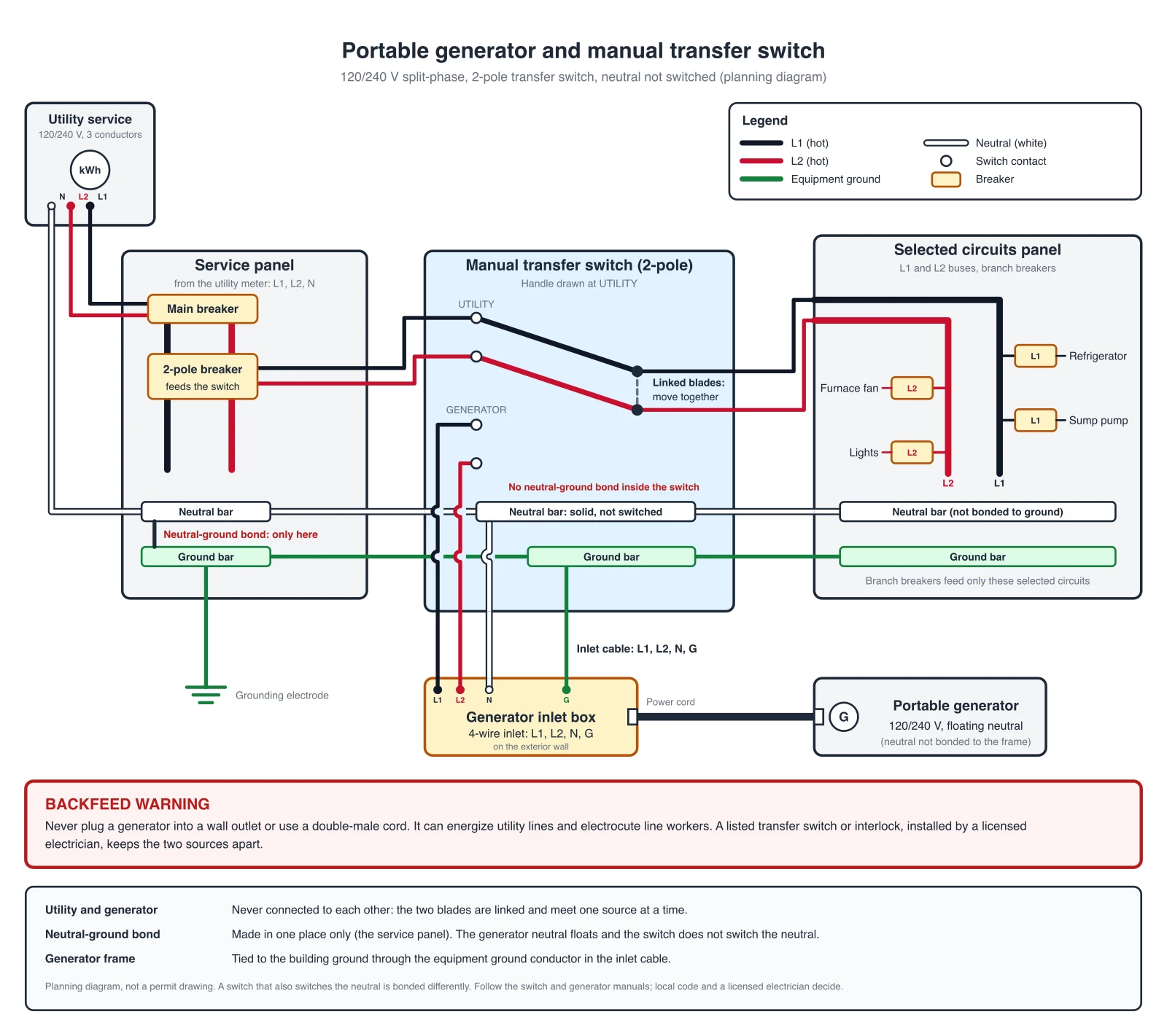
Wiring Diagram Maker
Create wiring diagrams and electrical schematics online, with exact reference diagrams to check them against.
 Education
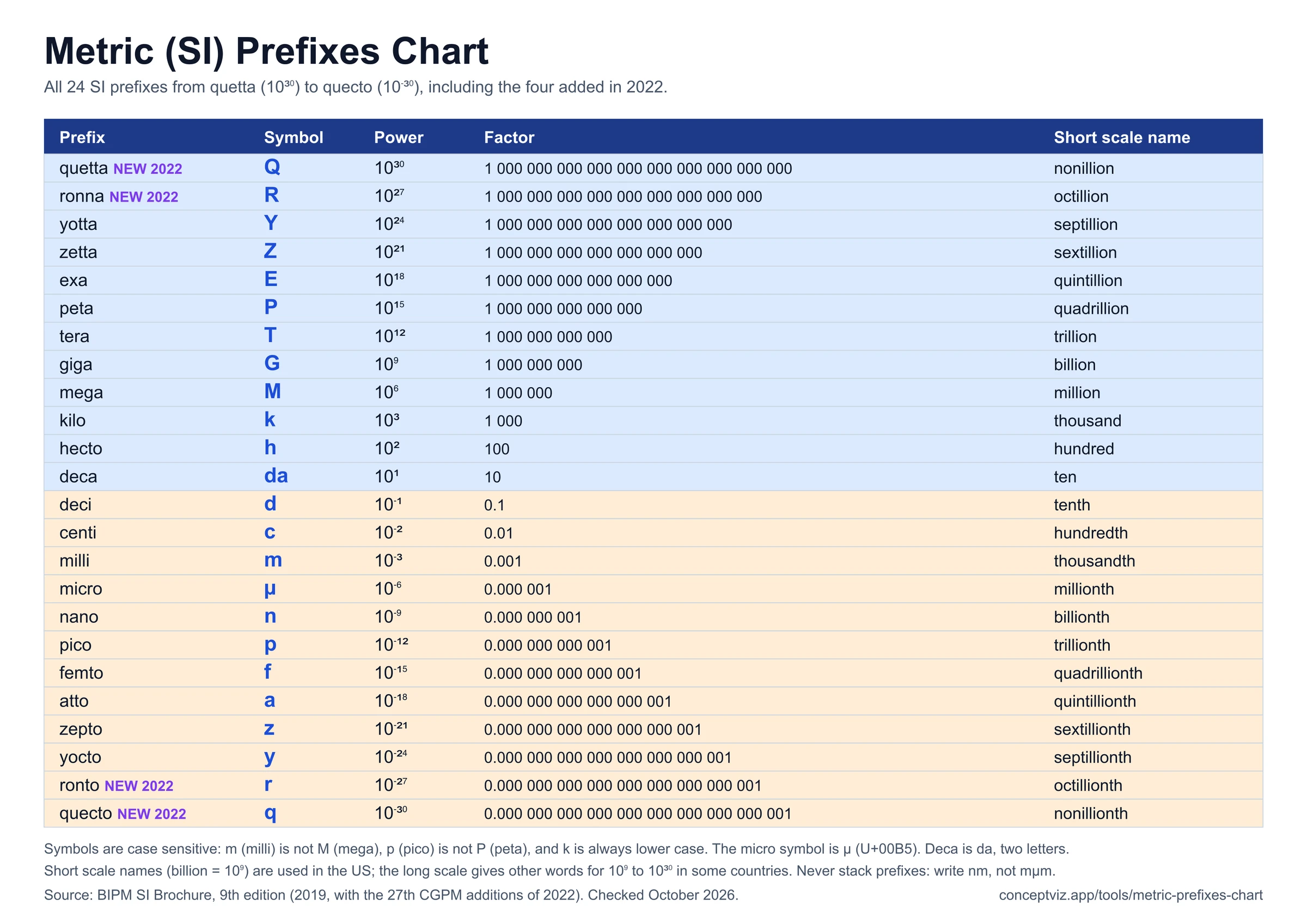
Metric Prefixes Chart
All 24 SI prefixes with an exact converter, handy for milliohms, kilohms and megohms.