Ohm's Law Chart with Wheel and Calculator
Ohm's law chart with the wheel and triangle, all 12 formulas for voltage, current, resistance and power, a calculator with unit prefixes and printable sheets.
Calculated. Type here to make it a known value.
Calculated. Type here to make it a known value.
- Current: 2 Ausing I = V ÷ RBase units: 2 A
- Power: 24 Wusing P = V² ÷ RBase units: 24 W
The formulas used are highlighted on the wheel. Prefixes follow SI: m is milli (0.001), µ is micro (0.000001), k is kilo (1000) and M is mega (1 000 000).
For DC circuits and ideal resistors. Values must be greater than zero. Results show up to 6 significant digits.
Free Ohm's Law Charts and Worksheets
Every sheet below is drawn from the same checked formulas as the calculator above. View, download and print them free, no sign-up.
Ohm's Law Wheel with 12 Formulas
Four quadrants, three formulas each: V = I × R, I = V ÷ R, R = V ÷ I and P = V × I with their variants.
Reference charts
Printer friendly
Study aids
Worksheets
What is Ohm's law?
Ohm's law says that the current through a conductor is proportional to the voltage across it: V = I × R. Voltage V is measured in volts, current I in amperes and resistance R in ohms (Ω). Georg Ohm published the relation in 1827. Electrical power P, in watts, is the rate at which energy is used: P = V × I. Put the two together and you get the 12 formulas on the wheel above: each of the four quantities can be found from any two of the others, and every pair has its own formula.
How to use the wheel and the triangle
- Decide which quantity you need, then look in its quadrant on the wheel. It lists three formulas. Choose the one that uses the two values you already know.
- The V-I-R triangle is the short version for the first law: put V on top and I and R side by side underneath. Cover the one you want. Side by side means multiply (V = I × R), top over bottom means divide (I = V ÷ R, R = V ÷ I). The P-I-V triangle works the same way for power.
- The calculator above does this for you: type any two values with their prefixes and it returns the other two and highlights the formulas it used on the wheel.
Worked example 1: a 12 V lamp
A 12 V battery is connected to a 6 Ω lamp. The current is I = V ÷ R = 12 ÷ 6 = 2 A. The power is P = V × I = 12 × 2 = 24 W. Check with the other power forms: I² × R = 2² × 6 = 24 W and V² ÷ R = 12² ÷ 6 = 24 W. Three formulas, one answer, which is a quick way to catch an arithmetic slip.
Worked example 2: a resistor for an LED
A 5 V supply drives an LED that drops 2 V and should carry 20 mA. The resistor sees the remaining 3 V, so R = V ÷ I = 3 V ÷ 20 mA = 150 Ω. It dissipates P = V × I = 3 V × 20 mA = 60 mW, so a small quarter-watt resistor is plenty. Ohm's law is applied to the resistor only: an LED is a non-linear part, so its voltage drop stays near its forward voltage instead of rising in proportion to current.
Worked example 3: a 1500 W heater
A heater is rated 1500 W at 120 V. Its current is I = P ÷ V = 1500 ÷ 120 = 12.5 A, and its resistance when hot is R = V² ÷ P = 14 400 ÷ 1500 = 9.6 Ω. Many regions limit a continuous load to 80 percent of the breaker rating, which is 12 A on a 15 A breaker, so 12.5 A is over that limit. Check your local electrical code and have a qualified electrician size the circuit. Prefixes matter too: a 10 kΩ pull-up resistor at 5 V passes only 500 µA, or 2.5 mW of power.
Where Ohm’s law applies and where it does not
The formulas on this page are for DC circuits and ideal resistors, and also for AC through a pure resistance when V and I are RMS values. With coils and capacitors the opposition to AC current is the impedance Z, and power also depends on the phase angle through the power factor, so P = V × I × cos φ. Non-linear parts such as diodes, LEDs and transistors do not have a constant resistance, and a cold lamp filament has far lower resistance than a hot one, so V = I × R with one fixed R does not describe them. Use the formulas for the resistors in the circuit and treat other parts with their datasheets.
Units and prefixes
Real circuits use small and large values: millivolts, milliamps, kilo-ohms, megohms and kilowatts. Convert to base units (volts, amperes, ohms, watts) before using the formulas, or pick the prefixes in the calculator and let it convert. Quick reference: 1 mA = 0.001 A, 1 µA = 0.000001 A, 1 kΩ = 1000 Ω and 1 MΩ = 1 000 000 Ω. A useful shortcut: kΩ with mA gives volts, and kΩ with V gives mA. When working on mains wiring, never measure live circuits yourself: leave it to a qualified electrician.
Frequently Asked Questions
Reading resistor values? Resistor color code chart.
Related Electronics Tools
 Engineering
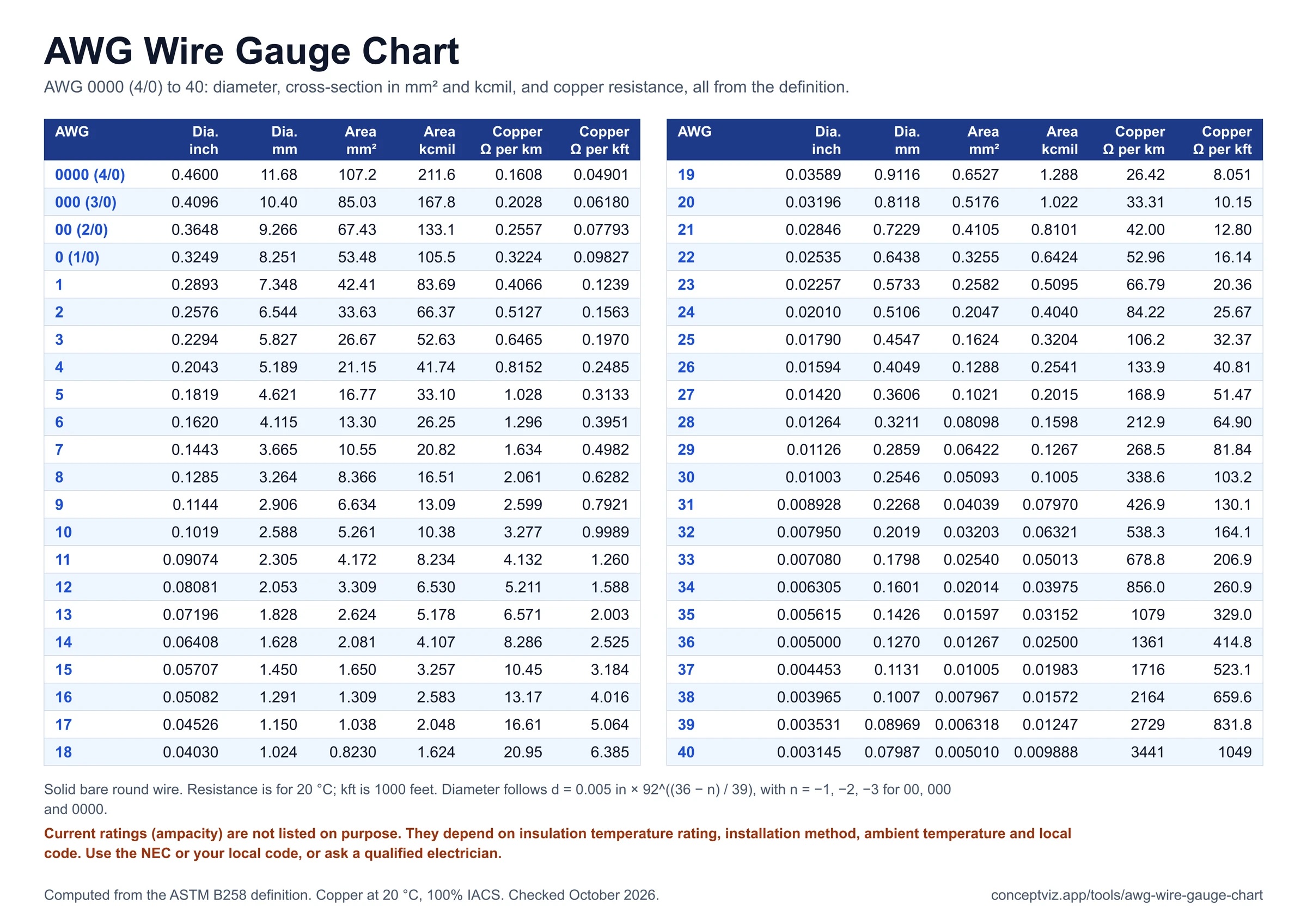
AWG Wire Gauge Chart
AWG wire sizes with diameter, mm², copper resistance and a voltage drop calculator that builds on Ohm’s law.
 Engineering
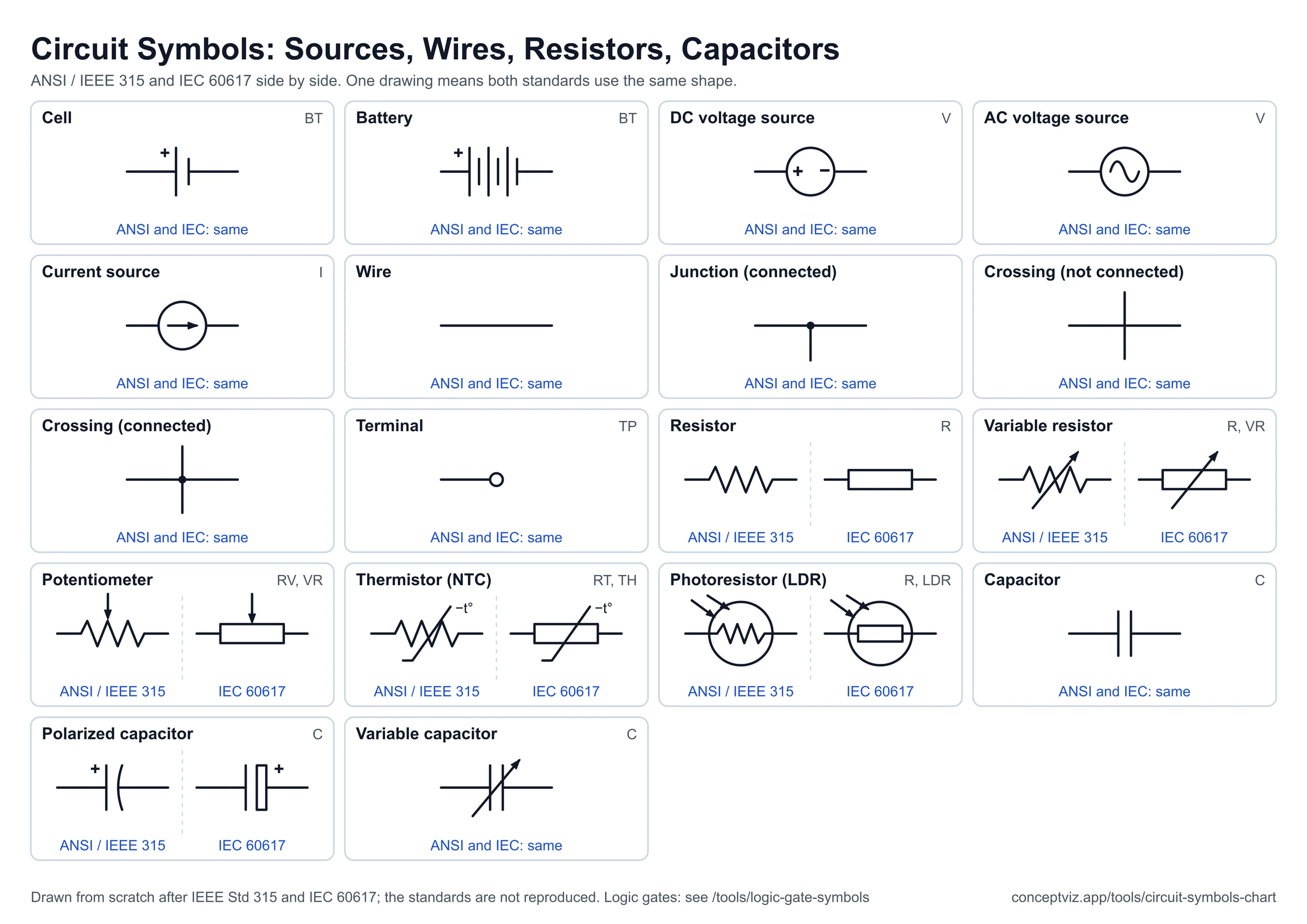
Circuit Symbols Chart
Resistor, capacitor, diode, transistor and more in ANSI and IEC styles, with a printable cheat sheet.
 Education
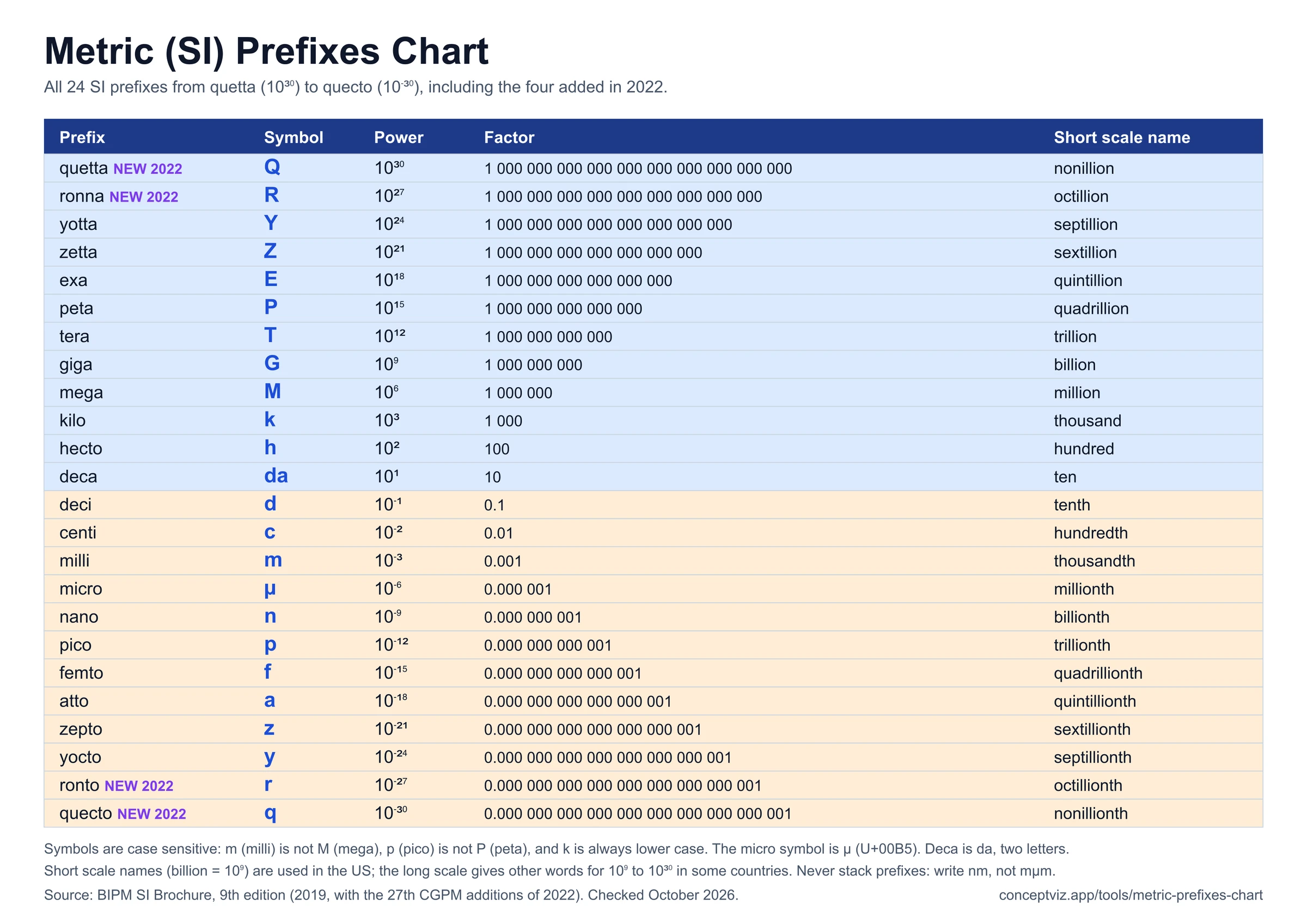
Metric Prefixes Chart
All 24 SI prefixes with an exact converter for milli, micro, kilo and mega values.