pKa Table of Common Acids in Water and DMSO
Searchable pKa table with 131 acids: aqueous and DMSO values, conjugate bases, sources and a deprotonation check. Printable.
Solvent
Export style
Showing 131 of 131 acids
| pKa | Acid | Conjugate base | Solvent | Type | Source |
|---|---|---|---|---|---|
| −14 | CF3SO3Hextrapolated | CF3SO3− | Water | Inorganic acids | E |
| −10 | HIextrapolated | I− | Water | Inorganic acids | W |
| −10 | HClO4extrapolated | ClO4− | Water | Inorganic acids | E, W |
| −9.0 | HBrextrapolated | Br− | Water | Inorganic acids | E, W |
| −8.0 | HClextrapolated | Cl− | Water | Inorganic acids | E |
| −7.8 | PhC(OH)2+extrapolated | PhCOOH | Water | Protonated species | E |
| −6.2 | PhC(OH)CH3+extrapolated | PhCOCH3 | Water | Protonated species | E |
| −3.8 | (CH3)2OH+extrapolated | (CH3)2O | Water | Protonated species | E |
| −3.0 | H2SO4extrapolatedFirst dissociation, complete in water. | HSO4− | Water | Inorganic acids | E, W |
| −2.6 | CH3SO3HextrapolatedWilliams prints -0.6. This page follows Ripin and Evans. | CH3SO3− | Water | Inorganic acids | E |
| −1.3 | HNO3extrapolated | NO3− | Water | Inorganic acids | E |
| −0.25 | CF3COOHextrapolated | CF3COO− | Water | Carboxylic acids | E |
| 0.0 | H3O+Ripin and Evans (2024) define H₃O⁺ as 0.0 on the same 1 M scale as every other row. Many organic textbooks print -1.74 (Kw divided by 55.5 M); that convention is inconsistent with how the other pKa values are defined. | H2O | Water | Inorganic acids | E |
| 0.3 | CF3SO3H | CF3SO3− | DMSO | Inorganic acids | E |
| 0.65 | Cl3CCOOH | Cl3CCOO− | Water | Carboxylic acids | E, W |
| 0.9 | HBr | Br− | DMSO | Inorganic acids | E, B |
| 1.23 | HOOC-COOH | HOOC-COO− | Water | Carboxylic acids | W |
| 1.29 | Cl2CHCOOH | Cl2CHCOO− | Water | Carboxylic acids | E |
| 1.6 | CH3SO3H | CH3SO3− | DMSO | Inorganic acids | E |
| 1.8 | HCl | Cl− | DMSO | Inorganic acids | E, B |
| 1.9 | H2SO3 | HSO3− | Water | Inorganic acids | E, W |
| 1.92 | cis-HOOCCH=CHCOOH | cis-HOOCCH=CHCOO− | Water | Carboxylic acids | E |
| 1.99 | HSO4− | SO42− | Water | Inorganic acids | E, W |
| 2.12 | H3PO4 | H2PO4− | Water | Inorganic acids | E, W |
| 2.86 | ClCH2COOH | ClCH2COO− | Water | Carboxylic acids | E |
| 3.17 | HF | F− | Water | Inorganic acids | E |
| 3.29 | HNO2 | NO2− | Water | Inorganic acids | E, W |
| 3.4 | Pyridine-H+ | Pyridine | DMSO | Ammonium and cations | E |
| 3.44 | p-O2NC6H4COOH | p-O2NC6H4COO− | Water | Carboxylic acids | E |
| 3.6 | PhNH3+Reich-Bordwell prints 3.8. | PhNH2 | DMSO | Ammonium and cations | E |
| 3.77 | HCOOH | HCOO− | Water | Carboxylic acids | E, W |
| 4.19 | HOOC-COO− | −OOC-COO− | Water | Carboxylic acids | W |
| 4.2 | PhCOOH | PhCOO− | Water | Carboxylic acids | E |
| 4.6 | PhNH3+Williams prints 4.19 for aniline. | PhNH2 | Water | Ammonium and cations | E |
| 4.72 | HN3 | N3− | Water | Inorganic acids | E, W |
| 4.76 | CH3COOH | CH3COO− | Water | Carboxylic acids | E, W |
| 5.21 | Pyridine-H+Williams lists 5.14 (thermodynamic). | Pyridine | Water | Ammonium and cations | E |
| 5.96 | HONH3+Williams: 5.97. | HONH2 | Water | Ammonium and cations | E |
| 6.3 | CF3SO2NH2 | CF3SO2NH− | Water | N-H acids | E |
| 6.35 | H2CO3Apparent value for dissolved CO₂ plus H₂CO₃. Williams also lists 3.58 for true H₂CO₃. | HCO3− | Water | Inorganic acids | W |
| 6.95 | Imidazole-H+ | Imidazole | Water | Ammonium and cations | E, W |
| 7.0 | H2S | HS− | Water | Inorganic acids | E, W |
| ≈7 | PhSHapproximatePrinted as ≈7. Williams lists 8.20, 7.8 and 6.52 from different studies. | PhS− | Water | Alcohols, phenols, thiols | E |
| 7.1 | p-O2NC6H4OH | p-O2NC6H4O− | Water | Alcohols, phenols, thiols | E |
| 7.21 | H2PO4− | HPO42− | Water | Inorganic acids | E, W |
| 7.21 | HSO3−Williams prints 7.21 as a thermodynamic value (7.0 in an older entry). | SO32− | Water | Inorganic acids | E, W |
| 7.5 | HOClWilliams: 7.53. | ClO− | Water | Inorganic acids | E, W |
| 7.9 | HN3 | N3− | DMSO | Inorganic acids | E, B |
| 8.12 | N2H5+Williams: 8.10. | N2H4 | Water | Ammonium and cations | E |
| 8.2 | CH3CO3H | CH3CO3− | Water | Alcohols, phenols, thiols | E, W |
| 8.3 | Phthalimide | Phthalimide anion | Water | N-H acids | E |
| 8.95 | CH3COCH2COCH3Ripin and Evans round this to 9. | CH3COCHCOCH3− | Water | C-H acids | E, W |
| 9.0 | Et3NH+ | Et3N | DMSO | Ammonium and cations | E |
| 9.23 | B(OH)3Lewis acid: it accepts HO⁻ rather than losing H⁺. | B(OH)4− | Water | Inorganic acids | E, W |
| 9.24 | NH4+Ripin and Evans print 9.2; Williams prints 9.24. | NH3 | Water | Ammonium and cations | E, W |
| 9.3 | (CF3)2CHOH | (CF3)2CHO− | Water | Alcohols, phenols, thiols | E |
| 9.4 | HCN | CN− | Water | Inorganic acids | E, W |
| 9.7 | CF3SO2NH2 | CF3SO2NH− | DMSO | N-H acids | E |
| 9.8 | Quinuclidine-H+ | Quinuclidine | DMSO | Ammonium and cations | E |
| 9.95 | PhOH | PhO− | Water | Alcohols, phenols, thiols | E |
| ≈10 | CH3NO2approximatePrinted as ≈10. | CH2NO2− | Water | C-H acids | E |
| 10.3 | PhSH | PhS− | DMSO | Alcohols, phenols, thiols | E |
| 10.33 | HCO3− | CO32− | Water | Inorganic acids | W |
| 10.5 | NH4+ | NH3 | DMSO | Ammonium and cations | E, B |
| 10.6 | EtNH3+ | EtNH2 | Water | Ammonium and cations | E |
| 10.75 | Et3NH+ | Et3N | Water | Ammonium and cations | E |
| 10.8 | p-O2NC6H4OH | p-O2NC6H4O− | DMSO | Alcohols, phenols, thiols | E, B |
| 11.0 | Quinuclidine-H+ | Quinuclidine | Water | Ammonium and cations | E |
| 11 | CH3COCH2CO2Et | CH3COCHCO2Et− | Water | C-H acids | E |
| 11.1 | PhCOOH | PhCOO− | DMSO | Carboxylic acids | E |
| 11.1 | CH2(CN)2 | CH(CN)2− | DMSO | C-H acids | E, B |
| 11.6 | H2O2 | HOO− | Water | Inorganic acids | E |
| 12 | DBU-H+estimatePrinted as "(12) estimate" in the source. | DBU | DMSO | Ammonium and cations | E |
| 12.3 | CH3COOH | CH3COO− | DMSO | Carboxylic acids | E |
| 12.32 | HPO42− | PO43− | Water | Inorganic acids | E, W |
| 12.5 | CF3CH2OH | CF3CH2O− | Water | Alcohols, phenols, thiols | E, W |
| 12.9 | HCN | CN− | DMSO | Inorganic acids | E, B |
| 12.92 | HS− | S2− | Water | Inorganic acids | W |
| 13 | CH2(CO2Me)2 | CH(CO2Me)2− | Water | C-H acids | E |
| 13.3 | CH3COCH2COCH3 | CH3COCHCOCH3− | DMSO | C-H acids | E, B |
| 13.9 | 1,2,3-Triazole | Triazolide | DMSO | N-H acids | E, B |
| 14.0 | H2ORipin and Evans (2024) and Williams (14.0*) give 14.0, on the same 1 M scale as the alcohols and phenols here. Many organic textbooks print 15.7 because they divide Kw by 55.5 M; Silverstein and Heller (J. Chem. Educ. 2017) argue that is inconsistent with how other pKa values are defined. | HO− | Water | Inorganic acids | E, W |
| 14.2 | CH3COCH2CO2Et | CH3COCHCO2Et− | DMSO | C-H acids | E, B |
| 14.7 | Succinimide | Succinimide anion | DMSO | N-H acids | E, B |
| 15 | Cyclopentadieneextrapolated | Cyclopentadienide | Water | C-H acids | E |
| 15 | HF | F− | DMSO | Inorganic acids | E, B |
| 15.1 | CH3CONH2extrapolated | CH3CONH− | Water | N-H acids | E |
| 15.5 | CH3OHextrapolatedWilliams: 15.54. | CH3O− | Water | Alcohols, phenols, thiols | E, W |
| 15.7 | CH2(CO2Me)2Reich-Bordwell prints 15.9 for the dimethyl malonate entry. | CH(CO2Me)2− | DMSO | C-H acids | E, B |
| 16.1 | PhSO2NH2 | PhSO2NH− | DMSO | N-H acids | E |
| 16.4 | Benzimidazole | Benzimidazolide | DMSO | N-H acids | E, B |
| 16.5 | (CH3)2CHOHextrapolated | (CH3)2CHO− | Water | Alcohols, phenols, thiols | E |
| 17.0 | (CH3)3COHextrapolated | (CH3)3CO− | Water | Alcohols, phenols, thiols | E |
| 17.2 | CH3NO2 | CH2NO2− | DMSO | C-H acids | E, B |
| 17.5 | CH3SO2NH2 | CH3SO2NH− | DMSO | N-H acids | E |
| 18.0 | PhOH | PhO− | DMSO | Alcohols, phenols, thiols | E, B |
| 18.0 | Cyclopentadiene | Cyclopentadienide | DMSO | C-H acids | E, B |
| 18.2 | (CF3)2CHOHReich-Bordwell prints 17.9 (Ripin and Evans: 18.2). | (CF3)2CHO− | DMSO | Alcohols, phenols, thiols | E |
| 18.6 | Imidazole | Imidazolide | DMSO | N-H acids | E, B |
| 19.8 | PyrazoleReich-Bordwell prints 19.9 in the azole block. | Pyrazolide | DMSO | N-H acids | E, B |
| 20.95 | Indole | Indolide | DMSO | N-H acids | E, B |
| 21.9 | PhCH2CN | PhCHCN− | DMSO | C-H acids | E, B |
| 22.6 | Fluorene | Fluorenide | DMSO | C-H acids | E, B |
| 23.0 | Pyrrole | Pyrrolide | DMSO | N-H acids | E, B |
| 23.3 | PhCONH2 | PhCONH− | DMSO | N-H acids | E, B |
| 23.5 | CF3CH2OH | CF3CH2O− | DMSO | Alcohols, phenols, thiols | E, B |
| 24 | HC≡CHextrapolated | HC≡C− | Water | C-H acids | E |
| 24.7 | PhCOCH3 | PhCOCH2− | DMSO | C-H acids | E, B |
| 25.0 | Ph2NH | Ph2N− | DMSO | N-H acids | E, B |
| 25.5 | CH3CONH2 | CH3CONH− | DMSO | N-H acids | E, B |
| 26.5 | CH3COCH3 | CH3COCH2− | DMSO | C-H acids | E, B |
| 27.9 | CH3OHReich-Bordwell currently prints 29.0 (Ripin and Evans: 27.9). | CH3O− | DMSO | Alcohols, phenols, thiols | E |
| 29.0 | PhSO2CH3 | PhSO2CH2− | DMSO | C-H acids | E, B |
| 29.3 | (CH3)2CHOHReich-Bordwell currently prints 30.3 (Ripin and Evans: 29.3). | (CH3)2CHO− | DMSO | Alcohols, phenols, thiols | E |
| 29.4 | (CH3)3COHReich-Bordwell currently prints 32.2 (Ripin and Evans: 29.4). | (CH3)3CO− | DMSO | Alcohols, phenols, thiols | E |
| 30.3 | CH3CO2-t-Bu | CH2CO2-t-Bu− | DMSO | C-H acids | E, B |
| 30.6 | PhNH2 | PhNH− | DMSO | N-H acids | E |
| 30.6 | Ph3CH | Ph3C− | DMSO | C-H acids | E, B |
| 31.2 | H2ORipin and Evans print 31.2 here and 32 in their inorganic section; Reich-Bordwell prints 31.4. | HO− | DMSO | Inorganic acids | E |
| 31.3 | CH3CN | CH2CN− | DMSO | C-H acids | E, B |
| 31.5 | Ph3CHextrapolated | Ph3C− | Water | C-H acids | E |
| 33.5 | Ph2CH2extrapolated | Ph2CH− | Water | C-H acids | E |
| 35.1 | (CH3)2SOextrapolated | CH3SOCH2− | DMSO | C-H acids | E, B |
| ≈36 | H2approximatePrinted as ~36. | H− | Water | C-H acids | E |
| 38 | NH3extrapolated | NH2− | Water | N-H acids | E |
| 41 | PhCH3extrapolated | PhCH2− | Water | C-H acids | E |
| 41 | NH3extrapolated | NH2− | DMSO | N-H acids | E, B |
| 43 | C6H6extrapolated | C6H5− | Water | C-H acids | E |
| 43 | PhCH3extrapolated | PhCH2− | DMSO | C-H acids | E |
| 48 | CH4extrapolated | CH3− | Water | C-H acids | E |
| 56 | CH4extrapolated | CH3− | DMSO | C-H acids | E, B |
−14extrapolatedWater, E
CF3SO3H→CF3SO3−
Inorganic acids
−10extrapolatedWater, W
HI→I−
Inorganic acids
−10extrapolatedWater, E, W
HClO4→ClO4−
Inorganic acids
−9.0extrapolatedWater, E, W
HBr→Br−
Inorganic acids
−8.0extrapolatedWater, E
HCl→Cl−
Inorganic acids
−7.8extrapolatedWater, E
PhC(OH)2+→PhCOOH
Protonated species
−6.2extrapolatedWater, E
PhC(OH)CH3+→PhCOCH3
Protonated species
−3.8extrapolatedWater, E
(CH3)2OH+→(CH3)2O
Protonated species
−3.0extrapolatedWater, E, W
H2SO4→HSO4−
Inorganic acids
First dissociation, complete in water.
−2.6extrapolatedWater, E
CH3SO3H→CH3SO3−
Inorganic acids
Williams prints -0.6. This page follows Ripin and Evans.
−1.3extrapolatedWater, E
HNO3→NO3−
Inorganic acids
−0.25extrapolatedWater, E
CF3COOH→CF3COO−
Carboxylic acids
0.0Water, E
H3O+→H2O
Inorganic acids
Ripin and Evans (2024) define H₃O⁺ as 0.0 on the same 1 M scale as every other row. Many organic textbooks print -1.74 (Kw divided by 55.5 M); that convention is inconsistent with how the other pKa values are defined.
0.3DMSO, E
CF3SO3H→CF3SO3−
Inorganic acids
0.65Water, E, W
Cl3CCOOH→Cl3CCOO−
Carboxylic acids
0.9DMSO, E, B
HBr→Br−
Inorganic acids
1.23Water, W
HOOC-COOH→HOOC-COO−
Carboxylic acids
1.29Water, E
Cl2CHCOOH→Cl2CHCOO−
Carboxylic acids
1.6DMSO, E
CH3SO3H→CH3SO3−
Inorganic acids
1.8DMSO, E, B
HCl→Cl−
Inorganic acids
1.9Water, E, W
H2SO3→HSO3−
Inorganic acids
1.92Water, E
cis-HOOCCH=CHCOOH→cis-HOOCCH=CHCOO−
Carboxylic acids
1.99Water, E, W
HSO4−→SO42−
Inorganic acids
2.12Water, E, W
H3PO4→H2PO4−
Inorganic acids
2.86Water, E
ClCH2COOH→ClCH2COO−
Carboxylic acids
3.17Water, E
HF→F−
Inorganic acids
3.29Water, E, W
HNO2→NO2−
Inorganic acids
3.4DMSO, E
Pyridine-H+→Pyridine
Ammonium and cations
3.44Water, E
p-O2NC6H4COOH→p-O2NC6H4COO−
Carboxylic acids
3.6DMSO, E
PhNH3+→PhNH2
Ammonium and cations
Reich-Bordwell prints 3.8.
3.77Water, E, W
HCOOH→HCOO−
Carboxylic acids
4.19Water, W
HOOC-COO−→−OOC-COO−
Carboxylic acids
4.2Water, E
PhCOOH→PhCOO−
Carboxylic acids
4.6Water, E
PhNH3+→PhNH2
Ammonium and cations
Williams prints 4.19 for aniline.
4.72Water, E, W
HN3→N3−
Inorganic acids
4.76Water, E, W
CH3COOH→CH3COO−
Carboxylic acids
5.21Water, E
Pyridine-H+→Pyridine
Ammonium and cations
Williams lists 5.14 (thermodynamic).
5.96Water, E
HONH3+→HONH2
Ammonium and cations
Williams: 5.97.
6.3Water, E
CF3SO2NH2→CF3SO2NH−
N-H acids
6.35Water, W
H2CO3→HCO3−
Inorganic acids
Apparent value for dissolved CO₂ plus H₂CO₃. Williams also lists 3.58 for true H₂CO₃.
6.95Water, E, W
Imidazole-H+→Imidazole
Ammonium and cations
7.0Water, E, W
H2S→HS−
Inorganic acids
≈7approximateWater, E
PhSH→PhS−
Alcohols, phenols, thiols
Printed as ≈7. Williams lists 8.20, 7.8 and 6.52 from different studies.
7.1Water, E
p-O2NC6H4OH→p-O2NC6H4O−
Alcohols, phenols, thiols
7.21Water, E, W
H2PO4−→HPO42−
Inorganic acids
7.21Water, E, W
HSO3−→SO32−
Inorganic acids
Williams prints 7.21 as a thermodynamic value (7.0 in an older entry).
7.5Water, E, W
HOCl→ClO−
Inorganic acids
Williams: 7.53.
7.9DMSO, E, B
HN3→N3−
Inorganic acids
8.12Water, E
N2H5+→N2H4
Ammonium and cations
Williams: 8.10.
8.2Water, E, W
CH3CO3H→CH3CO3−
Alcohols, phenols, thiols
8.3Water, E
Phthalimide→Phthalimide anion
N-H acids
8.95Water, E, W
CH3COCH2COCH3→CH3COCHCOCH3−
C-H acids
Ripin and Evans round this to 9.
9.0DMSO, E
Et3NH+→Et3N
Ammonium and cations
9.23Water, E, W
B(OH)3→B(OH)4−
Inorganic acids
Lewis acid: it accepts HO⁻ rather than losing H⁺.
9.24Water, E, W
NH4+→NH3
Ammonium and cations
Ripin and Evans print 9.2; Williams prints 9.24.
9.3Water, E
(CF3)2CHOH→(CF3)2CHO−
Alcohols, phenols, thiols
9.4Water, E, W
HCN→CN−
Inorganic acids
9.7DMSO, E
CF3SO2NH2→CF3SO2NH−
N-H acids
9.8DMSO, E
Quinuclidine-H+→Quinuclidine
Ammonium and cations
9.95Water, E
PhOH→PhO−
Alcohols, phenols, thiols
≈10approximateWater, E
CH3NO2→CH2NO2−
C-H acids
Printed as ≈10.
10.3DMSO, E
PhSH→PhS−
Alcohols, phenols, thiols
10.33Water, W
HCO3−→CO32−
Inorganic acids
10.5DMSO, E, B
NH4+→NH3
Ammonium and cations
10.6Water, E
EtNH3+→EtNH2
Ammonium and cations
10.75Water, E
Et3NH+→Et3N
Ammonium and cations
10.8DMSO, E, B
p-O2NC6H4OH→p-O2NC6H4O−
Alcohols, phenols, thiols
11.0Water, E
Quinuclidine-H+→Quinuclidine
Ammonium and cations
11Water, E
CH3COCH2CO2Et→CH3COCHCO2Et−
C-H acids
11.1DMSO, E
PhCOOH→PhCOO−
Carboxylic acids
11.1DMSO, E, B
CH2(CN)2→CH(CN)2−
C-H acids
11.6Water, E
H2O2→HOO−
Inorganic acids
12estimateDMSO, E
DBU-H+→DBU
Ammonium and cations
Printed as "(12) estimate" in the source.
12.3DMSO, E
CH3COOH→CH3COO−
Carboxylic acids
12.32Water, E, W
HPO42−→PO43−
Inorganic acids
12.5Water, E, W
CF3CH2OH→CF3CH2O−
Alcohols, phenols, thiols
12.9DMSO, E, B
HCN→CN−
Inorganic acids
12.92Water, W
HS−→S2−
Inorganic acids
13Water, E
CH2(CO2Me)2→CH(CO2Me)2−
C-H acids
13.3DMSO, E, B
CH3COCH2COCH3→CH3COCHCOCH3−
C-H acids
13.9DMSO, E, B
1,2,3-Triazole→Triazolide
N-H acids
14.0Water, E, W
H2O→HO−
Inorganic acids
Ripin and Evans (2024) and Williams (14.0*) give 14.0, on the same 1 M scale as the alcohols and phenols here. Many organic textbooks print 15.7 because they divide Kw by 55.5 M; Silverstein and Heller (J. Chem. Educ. 2017) argue that is inconsistent with how other pKa values are defined.
14.2DMSO, E, B
CH3COCH2CO2Et→CH3COCHCO2Et−
C-H acids
14.7DMSO, E, B
Succinimide→Succinimide anion
N-H acids
15extrapolatedWater, E
Cyclopentadiene→Cyclopentadienide
C-H acids
15DMSO, E, B
HF→F−
Inorganic acids
15.1extrapolatedWater, E
CH3CONH2→CH3CONH−
N-H acids
15.5extrapolatedWater, E, W
CH3OH→CH3O−
Alcohols, phenols, thiols
Williams: 15.54.
15.7DMSO, E, B
CH2(CO2Me)2→CH(CO2Me)2−
C-H acids
Reich-Bordwell prints 15.9 for the dimethyl malonate entry.
16.1DMSO, E
PhSO2NH2→PhSO2NH−
N-H acids
16.4DMSO, E, B
Benzimidazole→Benzimidazolide
N-H acids
16.5extrapolatedWater, E
(CH3)2CHOH→(CH3)2CHO−
Alcohols, phenols, thiols
17.0extrapolatedWater, E
(CH3)3COH→(CH3)3CO−
Alcohols, phenols, thiols
17.2DMSO, E, B
CH3NO2→CH2NO2−
C-H acids
17.5DMSO, E
CH3SO2NH2→CH3SO2NH−
N-H acids
18.0DMSO, E, B
PhOH→PhO−
Alcohols, phenols, thiols
18.0DMSO, E, B
Cyclopentadiene→Cyclopentadienide
C-H acids
18.2DMSO, E
(CF3)2CHOH→(CF3)2CHO−
Alcohols, phenols, thiols
Reich-Bordwell prints 17.9 (Ripin and Evans: 18.2).
18.6DMSO, E, B
Imidazole→Imidazolide
N-H acids
19.8DMSO, E, B
Pyrazole→Pyrazolide
N-H acids
Reich-Bordwell prints 19.9 in the azole block.
20.95DMSO, E, B
Indole→Indolide
N-H acids
21.9DMSO, E, B
PhCH2CN→PhCHCN−
C-H acids
22.6DMSO, E, B
Fluorene→Fluorenide
C-H acids
23.0DMSO, E, B
Pyrrole→Pyrrolide
N-H acids
23.3DMSO, E, B
PhCONH2→PhCONH−
N-H acids
23.5DMSO, E, B
CF3CH2OH→CF3CH2O−
Alcohols, phenols, thiols
24extrapolatedWater, E
HC≡CH→HC≡C−
C-H acids
24.7DMSO, E, B
PhCOCH3→PhCOCH2−
C-H acids
25.0DMSO, E, B
Ph2NH→Ph2N−
N-H acids
25.5DMSO, E, B
CH3CONH2→CH3CONH−
N-H acids
26.5DMSO, E, B
CH3COCH3→CH3COCH2−
C-H acids
27.9DMSO, E
CH3OH→CH3O−
Alcohols, phenols, thiols
Reich-Bordwell currently prints 29.0 (Ripin and Evans: 27.9).
29.0DMSO, E, B
PhSO2CH3→PhSO2CH2−
C-H acids
29.3DMSO, E
(CH3)2CHOH→(CH3)2CHO−
Alcohols, phenols, thiols
Reich-Bordwell currently prints 30.3 (Ripin and Evans: 29.3).
29.4DMSO, E
(CH3)3COH→(CH3)3CO−
Alcohols, phenols, thiols
Reich-Bordwell currently prints 32.2 (Ripin and Evans: 29.4).
30.3DMSO, E, B
CH3CO2-t-Bu→CH2CO2-t-Bu−
C-H acids
30.6DMSO, E
PhNH2→PhNH−
N-H acids
30.6DMSO, E, B
Ph3CH→Ph3C−
C-H acids
31.2DMSO, E
H2O→HO−
Inorganic acids
Ripin and Evans print 31.2 here and 32 in their inorganic section; Reich-Bordwell prints 31.4.
31.3DMSO, E, B
CH3CN→CH2CN−
C-H acids
31.5extrapolatedWater, E
Ph3CH→Ph3C−
C-H acids
33.5extrapolatedWater, E
Ph2CH2→Ph2CH−
C-H acids
35.1extrapolatedDMSO, E, B
(CH3)2SO→CH3SOCH2−
C-H acids
≈36approximateWater, E
H2→H−
C-H acids
Printed as ~36.
38extrapolatedWater, E
NH3→NH2−
N-H acids
41extrapolatedWater, E
PhCH3→PhCH2−
C-H acids
41extrapolatedDMSO, E, B
NH3→NH2−
N-H acids
43extrapolatedWater, E
C6H6→C6H5−
C-H acids
43extrapolatedDMSO, E
PhCH3→PhCH2−
C-H acids
48extrapolatedWater, E
CH4→CH3−
C-H acids
56extrapolatedDMSO, E, B
CH4→CH3−
C-H acids
Sources: E = Ripin and Evans pKa table (ACS Division of Organic Chemistry, updated 2024-04-16); B = Reich, Bordwell equilibrium pKa table in DMSO (updated 2024-07-26); W = Williams pKa data, compiled by Jencks and Westheimer (updated 2022-04-07). Water values are at 25 °C. Flagged values (below 0, or above 14 in water and above 35 in DMSO) are extrapolated in the source, not measured directly. Print splits the table into pages of 16 rows.
Free pKa Charts
Every chart below is drawn from the same data as the tool above. View, download and print them free, no sign-up.
pKa Table in Water: Strong and Moderate Acids
Aqueous pKa values below 10, strongest acid first, from triflic acid to phenol.
Reference tables
Comparison charts
Printable versions
Worked examples
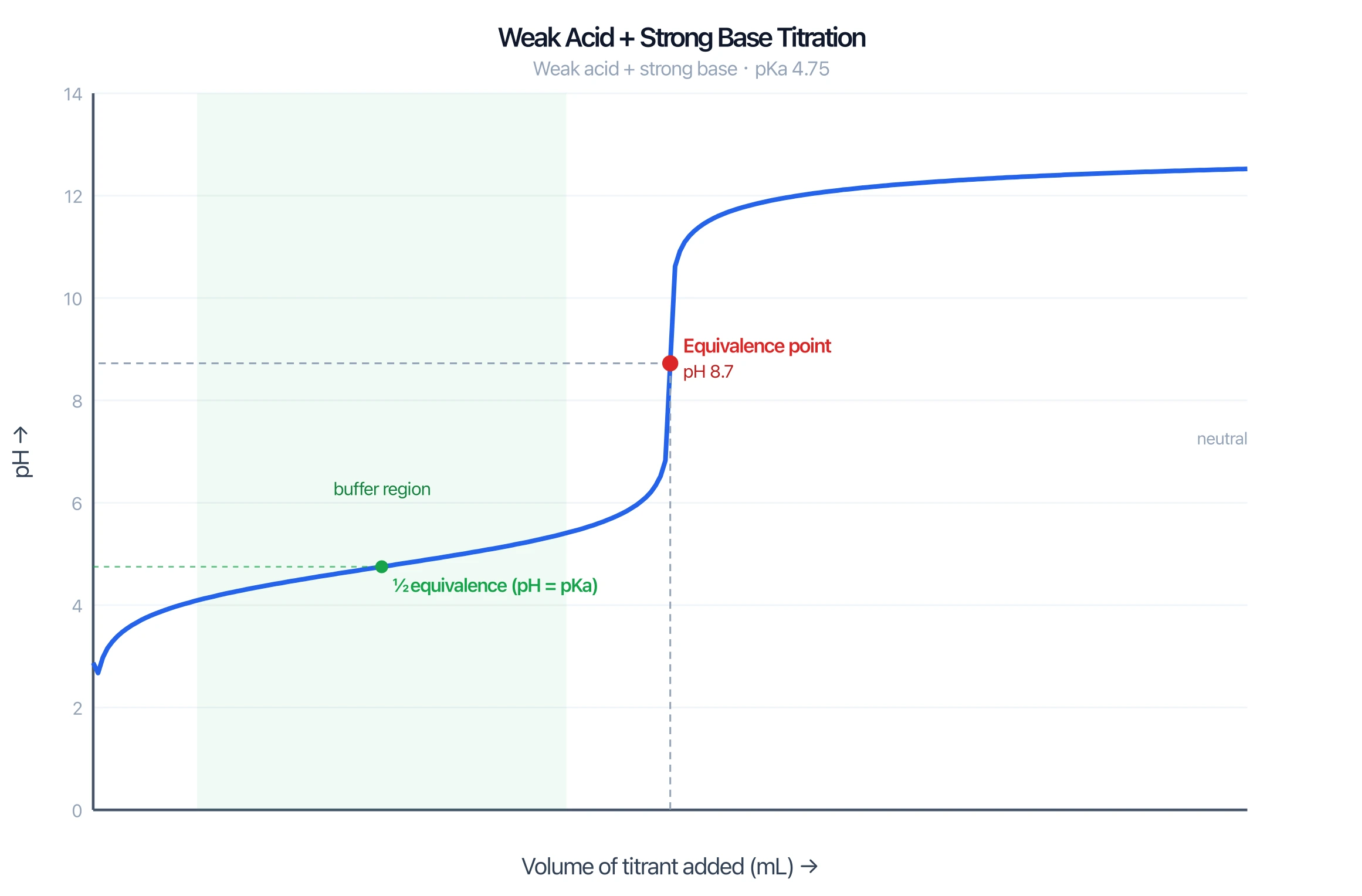
Studying pKa through titrations? See the titration curve guide for how the half-equivalence point gives pKa, or draw one with the titration curve generator.
How to read a pKa table
- The pKa of an acid HA is the pH at which half of it has lost its proton. It equals −log10 of the acid dissociation constant Ka, so every drop of one unit means the acid is ten times stronger. Hydrochloric acid, with a pKa near −8, gives up its proton far more readily than acetic acid at 4.76, which in turn is far stronger than methanol at 15.5.
- Each row here pairs the acid with its conjugate base, the species left after the proton leaves. The weaker the acid, the stronger and more reactive its conjugate base. That is why chloride is inert in water while methoxide, the conjugate base of a pKa 15.5 acid, deprotonates many organic compounds.
Why water and DMSO values differ
Water stabilizes small anions through hydrogen bonds, so acids that release an anion look strong in it. DMSO is a polar solvent that cannot donate hydrogen bonds. In DMSO, acetic acid rises from 4.76 to 12.3 and phenol from 9.95 to 18.0, while ammonium and triethylammonium barely move because they release a neutral base. Most organic carbon acids were measured in DMSO, where the pKa range reaches the mid-30s, because water cannot show acids weaker than about 14. Never subtract a water value from a DMSO value. The deprotonation check on this page only compares two values from the same solvent.
Using pKa to predict the direction of a reaction
For HA + B⁻ ⇌ A⁻ + HB, the equilibrium constant is K = 10^(pKa of HB − pKa of HA). A base can deprotonate an acid when the conjugate acid of the base has a higher pKa than the acid itself. A gap of three units or more means the reaction is close to complete, a gap of one unit gives about ten to one in favor of products, and a gap near zero leaves a mixture. For example, tert-butoxide deprotonates acetone in DMSO: with the Ripin and Evans values (tert-butanol 29.4, acetone 26.5) ΔpKa is +2.9 and K is near 800, and the newer Reich-Bordwell value for tert-butanol (32.2) makes the gap larger still. Either way the ketone is converted to its enolate. A hydroxide ion in water is a different case: with pKa 14.0 for water, it cannot fully deprotonate methanol (15.5), and ΔpKa is −1.5. Real reactions also depend on concentration, ion pairing and temperature, so use ΔpKa as a guide.
pKa and the titration curve
At the half-equivalence point of a weak acid titration, half the acid has been converted to its conjugate base, so pH equals pKa. Reading the flat buffer region of a titration curve is the standard way to measure a pKa in the lab. Polyprotic acids such as phosphoric acid show one half-equivalence point per proton, which is why H3PO4 has three rows here, at 2.12, 7.21 and 12.32.
Where the values come from and what is flagged
Every row names its source: the Ripin and Evans table and the Reich-Bordwell DMSO table, both hosted by the ACS Division of Organic Chemistry, and the Williams compilation by Jencks and Westheimer for aqueous values. Values below 0, above 14 in water and above 35 in DMSO are extrapolated in the source, not measured, and are flagged on every row. Where sources disagree, the row notes the other value. The pKa of water itself is the best-known case: this page uses 14.0 (and 0.0 for H3O⁺) from the 2024 Ripin and Evans table, on the same 1 M scale as the alcohol and phenol values, while many organic textbooks print 15.7 and −1.74.
Frequently Asked Questions
Related Chemistry Tools
 Chemistry
Titration Curve Generator
Generate acid–base titration curves with the equivalence point, half-equivalence point (pH = pKa), and buffer region marked.
 Chemistry
Standard Reduction Potential Table
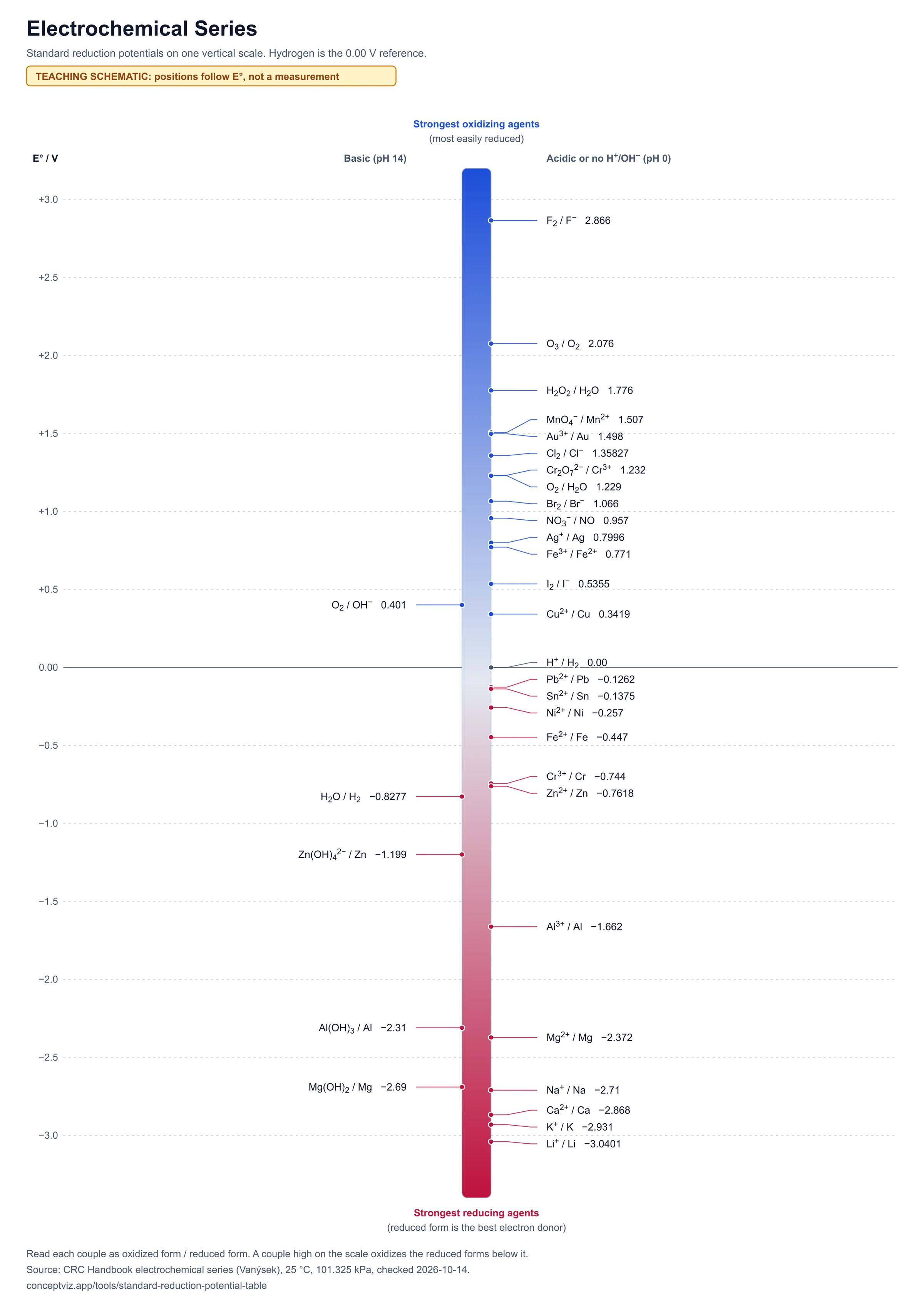
Free standard reduction potential table with 66 half-reactions from the CRC Handbook. Search, sort, then calculate cell potential and ΔG°, print or download.
 Chemistry
Solubility Rules Chart
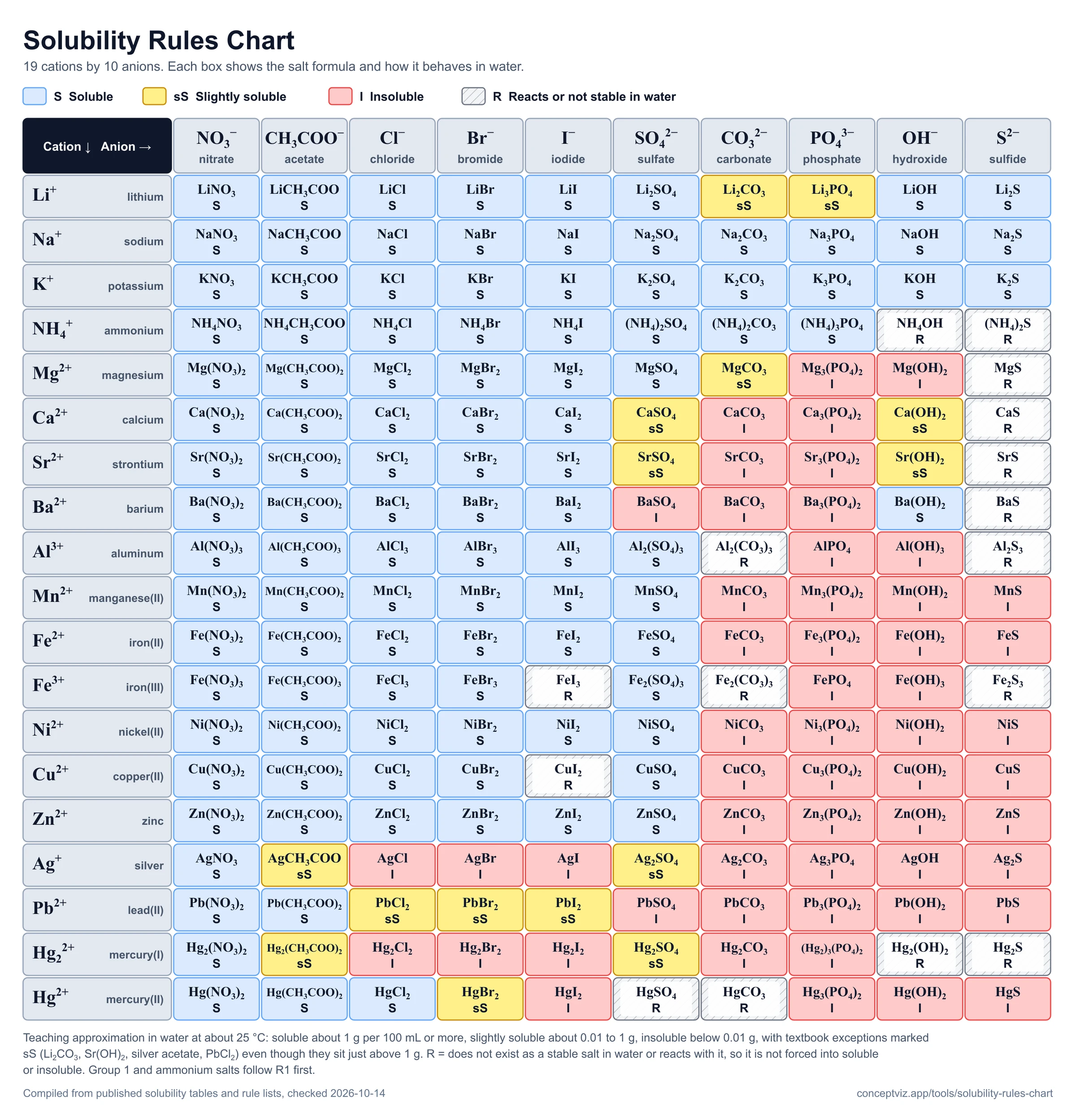
Free solubility rules chart with 190 salts, 8 rules and a precipitate checker with net ionic equations. Print or download.
 Chemistry
Functional Groups Chart
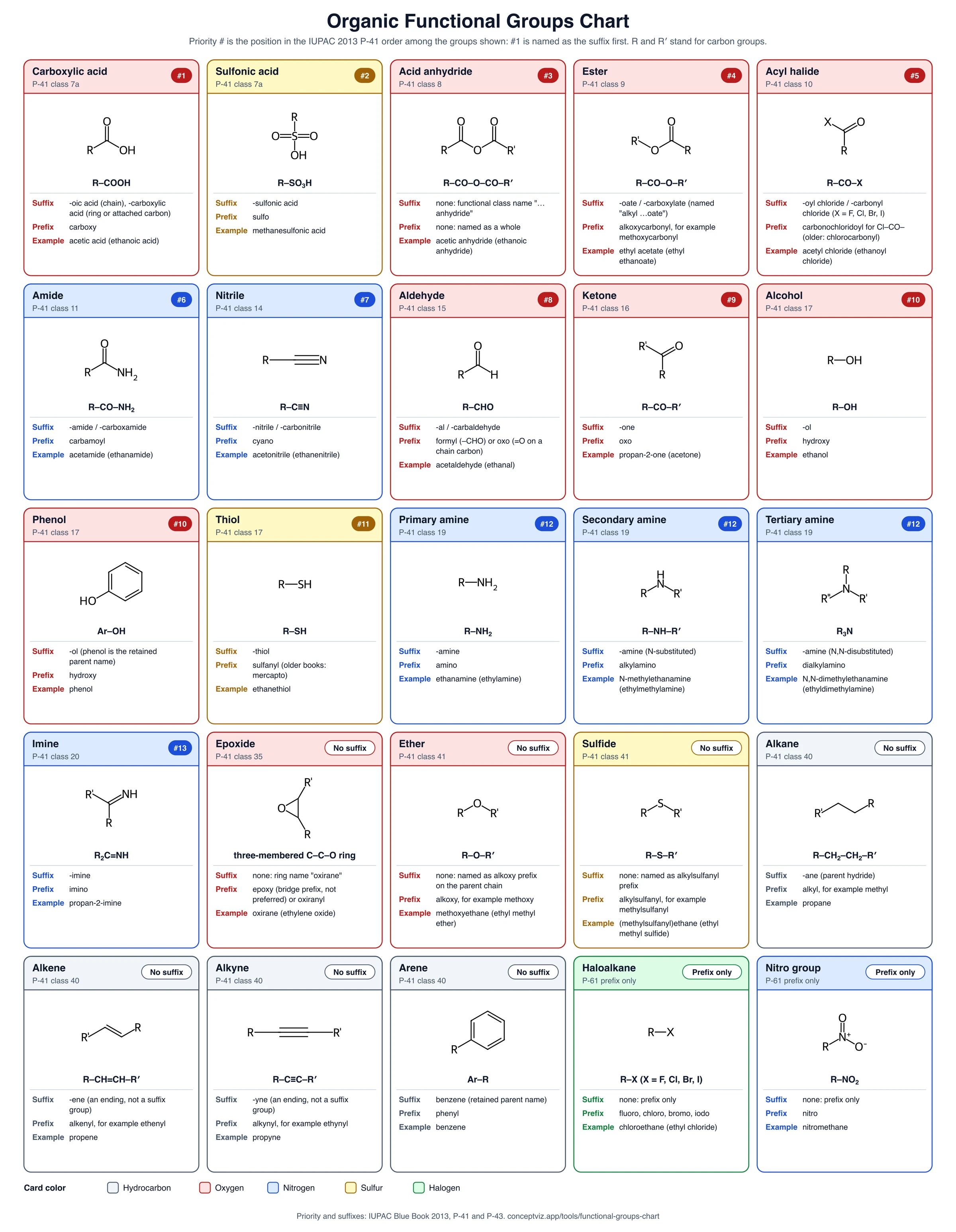
Free organic functional groups chart with 25 groups, structures, IUPAC suffixes and priority order. Filter, compare, print or download.
 Chemistry
Electronegativity Chart
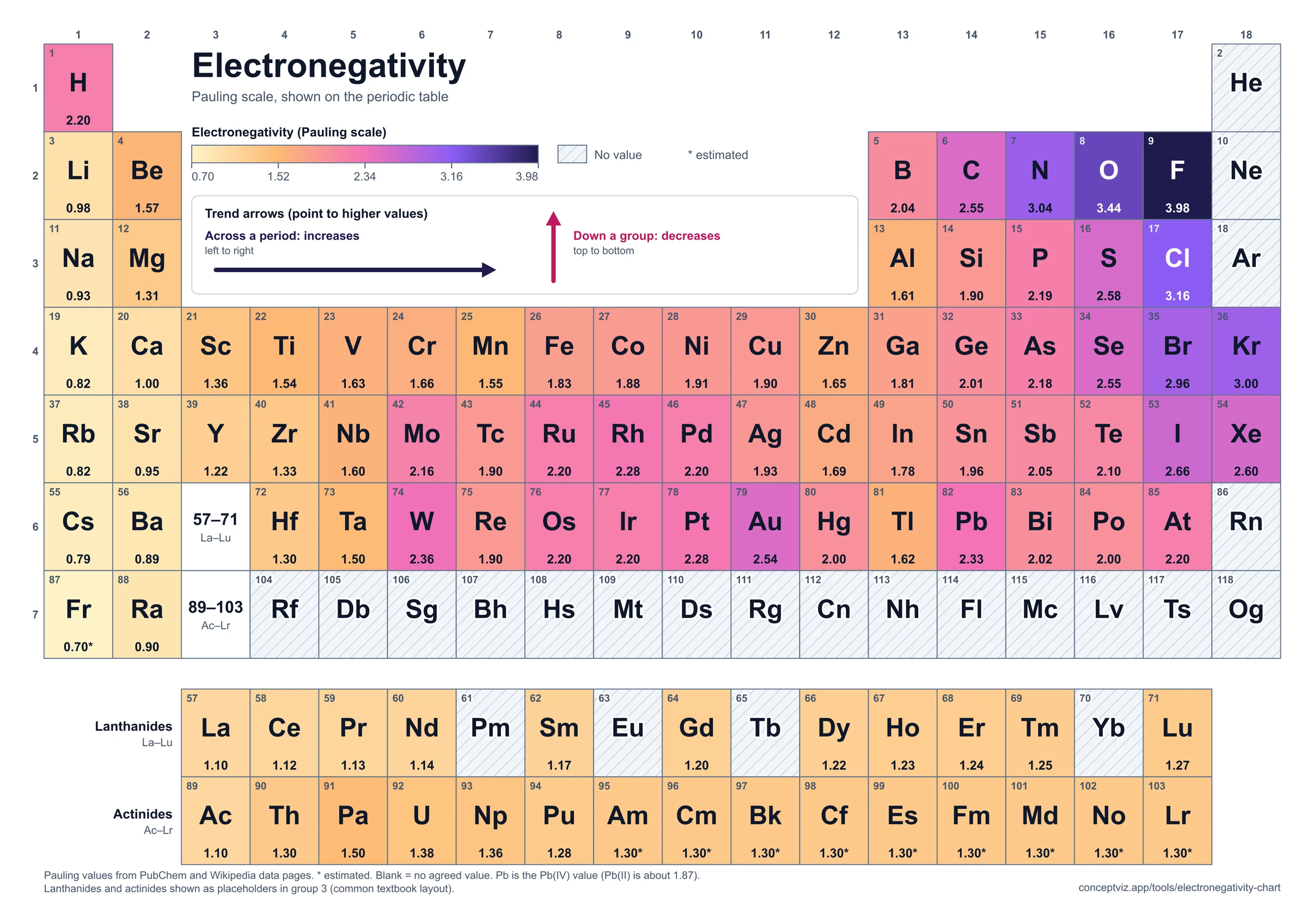
Periodic table heatmaps of electronegativity, atomic radius and ionization energy, with a sortable list and a bond type calculator.
 Chemistry
IR Spectroscopy Table
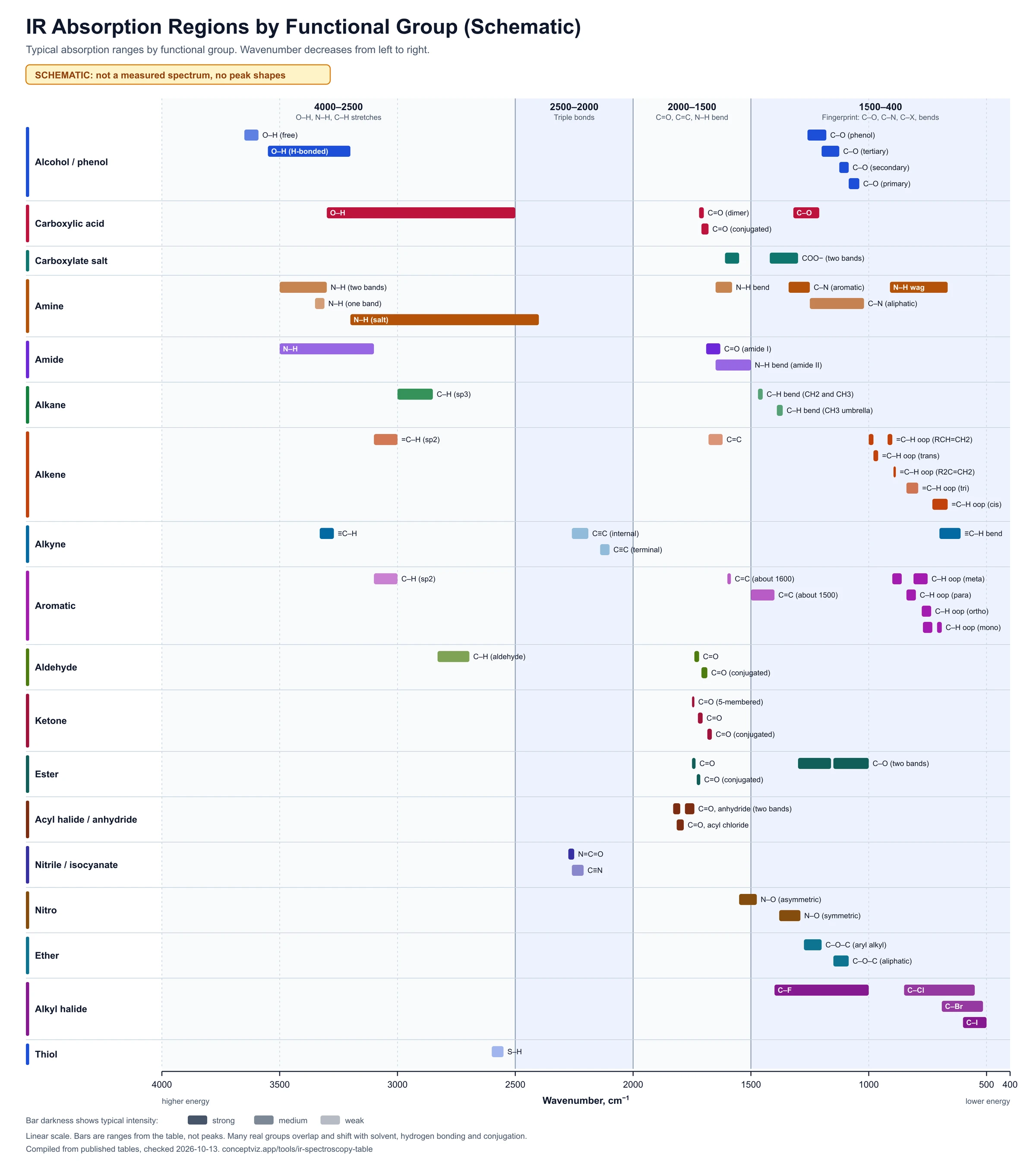
Free IR spectroscopy table with functional group absorptions. Look up a peak in cm-1, filter by region, print or download.