Standard Reduction Potential Table Electrochemical Series & Cell Calculator
Free standard reduction potential table with 66 half-reactions. Search, sort, filter by medium, then calculate cell potential and ΔG°.
Medium
Export style
Showing 66 of 66 half-reactions
| E° / V | Reduction half-reaction | Medium | e− | Calculator |
|---|---|---|---|---|
| 2.866 | F2(g) + 2e−⇌2F− | No H+/OH− | 2 | |
| 2.076 | O3(g) + 2H+ + 2e−⇌O2(g) + H2O(l) | Acidic | 2 | |
| 2.01 | S2O82− + 2e−⇌2SO42− | No H+/OH− | 2 | |
| 1.92 | Co3+ + e−⇌Co2+ | No H+/OH− | 1 | |
| 1.776 | H2O2(aq) + 2H+ + 2e−⇌2H2O(l) | Acidic | 2 | |
| 1.6913 | PbO2(s) + SO42− + 4H+ + 2e−⇌PbSO4(s) + 2H2O(l) | Acidic | 2 | |
| 1.679 | MnO4− + 4H+ + 3e−⇌MnO2(s) + 2H2O(l) | Acidic | 3 | |
| 1.507 | MnO4− + 8H+ + 5e−⇌Mn2+ + 4H2O(l) | Acidic | 5 | |
| 1.498 | Au3+ + 3e−⇌Au(s) | No H+/OH− | 3 | |
| 1.482 | HClO(aq) + H+ + 2e−⇌Cl− + H2O(l) | Acidic | 2 | |
| 1.455 | PbO2(s) + 4H+ + 2e−⇌Pb2+ + 2H2O(l) | Acidic | 2 | |
| 1.35827 | Cl2(g) + 2e−⇌2Cl− | No H+/OH− | 2 | |
| 1.24 | O3(g) + H2O(l) + 2e−⇌O2(g) + 2OH− | Basic | 2 | |
| 1.232 | Cr2O72− + 14H+ + 6e−⇌2Cr3+ + 7H2O(l)Many textbooks quote 1.33 V for this couple. This table keeps the CRC value. | Acidic | 6 | |
| 1.229 | O2(g) + 4H+ + 4e−⇌2H2O(l) | Acidic | 4 | |
| 1.224 | MnO2(s) + 4H+ + 2e−⇌Mn2+ + 2H2O(l) | Acidic | 2 | |
| 1.066 | Br2(l) + 2e−⇌2Br− | No H+/OH− | 2 | |
| 0.957 | NO3− + 4H+ + 3e−⇌NO(g) + 2H2O(l) | Acidic | 3 | |
| 0.951 | Pd2+ + 2e−⇌Pd(s) | No H+/OH− | 2 | |
| 0.851 | Hg2+ + 2e−⇌Hg(l) | No H+/OH− | 2 | |
| 0.7996 | Ag+ + e−⇌Ag(s) | No H+/OH− | 1 | |
| 0.7973 | Hg22+ + 2e−⇌2Hg(l) | No H+/OH− | 2 | |
| 0.771 | Fe3+ + e−⇌Fe2+ | No H+/OH− | 1 | |
| 0.695 | O2(g) + 2H+ + 2e−⇌H2O2(aq) | Acidic | 2 | |
| 0.595 | MnO4− + 2H2O(l) + 3e−⇌MnO2(s) + 4OH− | Basic | 3 | |
| 0.5355 | I2(s) + 2e−⇌2I− | No H+/OH− | 2 | |
| 0.521 | Cu+ + e−⇌Cu(s) | No H+/OH− | 1 | |
| 0.401 | O2(g) + 2H2O(l) + 4e−⇌4OH− | Basic | 4 | |
| 0.358 | [Fe(CN)6]3− + e−⇌[Fe(CN)6]4− | No H+/OH− | 1 | |
| 0.342 | Ag2O(s) + H2O(l) + 2e−⇌2Ag(s) + 2OH− | Basic | 2 | |
| 0.3419 | Cu2+ + 2e−⇌Cu(s) | No H+/OH− | 2 | |
| 0.26808 | Hg2Cl2(s) + 2e−⇌2Hg(l) + 2Cl− | No H+/OH− | 2 | |
| 0.22233 | AgCl(s) + e−⇌Ag(s) + Cl− | No H+/OH− | 1 | |
| 0.172 | SO42− + 4H+ + 2e−⇌H2SO3(aq) + H2O(l) | Acidic | 2 | |
| 0.153 | Cu2+ + e−⇌Cu+ | No H+/OH− | 1 | |
| 0.151 | Sn4+ + 2e−⇌Sn2+ | No H+/OH− | 2 | |
| 0.142 | S(s) + 2H+ + 2e−⇌H2S(aq) | Acidic | 2 | |
| 0.00 | 2H+ + 2e−⇌H2(g)Defines the zero of the scale. | Acidic | 2 | |
| −0.037 | Fe3+ + 3e−⇌Fe(s) | No H+/OH− | 3 | |
| −0.1262 | Pb2+ + 2e−⇌Pb(s) | No H+/OH− | 2 | |
| −0.1375 | Sn2+ + 2e−⇌Sn(s) | No H+/OH− | 2 | |
| −0.257 | Ni2+ + 2e−⇌Ni(s) | No H+/OH− | 2 | |
| −0.28 | Co2+ + 2e−⇌Co(s) | No H+/OH− | 2 | |
| −0.3588 | PbSO4(s) + 2e−⇌Pb(s) + SO42− | No H+/OH− | 2 | |
| −0.403 | Cd2+ + 2e−⇌Cd(s) | No H+/OH− | 2 | |
| −0.407 | Cr3+ + e−⇌Cr2+ | No H+/OH− | 1 | |
| −0.447 | Fe2+ + 2e−⇌Fe(s) | No H+/OH− | 2 | |
| −0.56 | Fe(OH)3(s) + e−⇌Fe(OH)2(s) + OH− | Basic | 1 | |
| −0.72 | Ni(OH)2(s) + 2e−⇌Ni(s) + 2OH− | Basic | 2 | |
| −0.744 | Cr3+ + 3e−⇌Cr(s) | No H+/OH− | 3 | |
| −0.7618 | Zn2+ + 2e−⇌Zn(s) | No H+/OH− | 2 | |
| −0.8277 | 2H2O(l) + 2e−⇌H2(g) + 2OH− | Basic | 2 | |
| −1.185 | Mn2+ + 2e−⇌Mn(s) | No H+/OH− | 2 | |
| −1.199 | Zn(OH)42− + 2e−⇌Zn(s) + 4OH− | Basic | 2 | |
| −1.662 | Al3+ + 3e−⇌Al(s) | No H+/OH− | 3 | |
| −2.31 | Al(OH)3(s) + 3e−⇌Al(s) + 3OH− | Basic | 3 | |
| −2.372 | Mg2+ + 2e−⇌Mg(s) | No H+/OH− | 2 | |
| −2.69 | Mg(OH)2(s) + 2e−⇌Mg(s) + 2OH− | Basic | 2 | |
| −2.71 | Na+ + e−⇌Na(s) | No H+/OH− | 1 | |
| −2.868 | Ca2+ + 2e−⇌Ca(s) | No H+/OH− | 2 | |
| −2.912 | Ba2+ + 2e−⇌Ba(s) | No H+/OH− | 2 | |
| −2.931 | K+ + e−⇌K(s) | No H+/OH− | 1 | |
| −2.98 | Rb+ + e−⇌Rb(s) | No H+/OH− | 1 | |
| −3.02 | Ca(OH)2(s) + 2e−⇌Ca(s) + 2OH− | Basic | 2 | |
| −3.026 | Cs+ + e−⇌Cs(s) | No H+/OH− | 1 | |
| −3.0401 | Li+ + e−⇌Li(s) | No H+/OH− | 1 |
2.866 VNo H+/OH−, 2 e−
F2(g) + 2e−⇌2F−
2.076 VAcidic, 2 e−
O3(g) + 2H+ + 2e−⇌O2(g) + H2O(l)
2.01 VNo H+/OH−, 2 e−
S2O82− + 2e−⇌2SO42−
1.92 VNo H+/OH−, 1 e−
Co3+ + e−⇌Co2+
1.776 VAcidic, 2 e−
H2O2(aq) + 2H+ + 2e−⇌2H2O(l)
1.6913 VAcidic, 2 e−
PbO2(s) + SO42− + 4H+ + 2e−⇌PbSO4(s) + 2H2O(l)
1.679 VAcidic, 3 e−
MnO4− + 4H+ + 3e−⇌MnO2(s) + 2H2O(l)
1.507 VAcidic, 5 e−
MnO4− + 8H+ + 5e−⇌Mn2+ + 4H2O(l)
1.498 VNo H+/OH−, 3 e−
Au3+ + 3e−⇌Au(s)
1.482 VAcidic, 2 e−
HClO(aq) + H+ + 2e−⇌Cl− + H2O(l)
1.455 VAcidic, 2 e−
PbO2(s) + 4H+ + 2e−⇌Pb2+ + 2H2O(l)
1.35827 VNo H+/OH−, 2 e−
Cl2(g) + 2e−⇌2Cl−
1.24 VBasic, 2 e−
O3(g) + H2O(l) + 2e−⇌O2(g) + 2OH−
1.232 VAcidic, 6 e−
Cr2O72− + 14H+ + 6e−⇌2Cr3+ + 7H2O(l)
Many textbooks quote 1.33 V for this couple. This table keeps the CRC value.
1.229 VAcidic, 4 e−
O2(g) + 4H+ + 4e−⇌2H2O(l)
1.224 VAcidic, 2 e−
MnO2(s) + 4H+ + 2e−⇌Mn2+ + 2H2O(l)
1.066 VNo H+/OH−, 2 e−
Br2(l) + 2e−⇌2Br−
0.957 VAcidic, 3 e−
NO3− + 4H+ + 3e−⇌NO(g) + 2H2O(l)
0.951 VNo H+/OH−, 2 e−
Pd2+ + 2e−⇌Pd(s)
0.851 VNo H+/OH−, 2 e−
Hg2+ + 2e−⇌Hg(l)
0.7996 VNo H+/OH−, 1 e−
Ag+ + e−⇌Ag(s)
0.7973 VNo H+/OH−, 2 e−
Hg22+ + 2e−⇌2Hg(l)
0.771 VNo H+/OH−, 1 e−
Fe3+ + e−⇌Fe2+
0.695 VAcidic, 2 e−
O2(g) + 2H+ + 2e−⇌H2O2(aq)
0.595 VBasic, 3 e−
MnO4− + 2H2O(l) + 3e−⇌MnO2(s) + 4OH−
0.5355 VNo H+/OH−, 2 e−
I2(s) + 2e−⇌2I−
0.521 VNo H+/OH−, 1 e−
Cu+ + e−⇌Cu(s)
0.401 VBasic, 4 e−
O2(g) + 2H2O(l) + 4e−⇌4OH−
0.358 VNo H+/OH−, 1 e−
[Fe(CN)6]3− + e−⇌[Fe(CN)6]4−
0.342 VBasic, 2 e−
Ag2O(s) + H2O(l) + 2e−⇌2Ag(s) + 2OH−
0.3419 VNo H+/OH−, 2 e−
Cu2+ + 2e−⇌Cu(s)
0.26808 VNo H+/OH−, 2 e−
Hg2Cl2(s) + 2e−⇌2Hg(l) + 2Cl−
0.22233 VNo H+/OH−, 1 e−
AgCl(s) + e−⇌Ag(s) + Cl−
0.172 VAcidic, 2 e−
SO42− + 4H+ + 2e−⇌H2SO3(aq) + H2O(l)
0.153 VNo H+/OH−, 1 e−
Cu2+ + e−⇌Cu+
0.151 VNo H+/OH−, 2 e−
Sn4+ + 2e−⇌Sn2+
0.142 VAcidic, 2 e−
S(s) + 2H+ + 2e−⇌H2S(aq)
0.00 VAcidic, 2 e−
2H+ + 2e−⇌H2(g)
Defines the zero of the scale.
−0.037 VNo H+/OH−, 3 e−
Fe3+ + 3e−⇌Fe(s)
−0.1262 VNo H+/OH−, 2 e−
Pb2+ + 2e−⇌Pb(s)
−0.1375 VNo H+/OH−, 2 e−
Sn2+ + 2e−⇌Sn(s)
−0.257 VNo H+/OH−, 2 e−
Ni2+ + 2e−⇌Ni(s)
−0.28 VNo H+/OH−, 2 e−
Co2+ + 2e−⇌Co(s)
−0.3588 VNo H+/OH−, 2 e−
PbSO4(s) + 2e−⇌Pb(s) + SO42−
−0.403 VNo H+/OH−, 2 e−
Cd2+ + 2e−⇌Cd(s)
−0.407 VNo H+/OH−, 1 e−
Cr3+ + e−⇌Cr2+
−0.447 VNo H+/OH−, 2 e−
Fe2+ + 2e−⇌Fe(s)
−0.56 VBasic, 1 e−
Fe(OH)3(s) + e−⇌Fe(OH)2(s) + OH−
−0.72 VBasic, 2 e−
Ni(OH)2(s) + 2e−⇌Ni(s) + 2OH−
−0.744 VNo H+/OH−, 3 e−
Cr3+ + 3e−⇌Cr(s)
−0.7618 VNo H+/OH−, 2 e−
Zn2+ + 2e−⇌Zn(s)
−0.8277 VBasic, 2 e−
2H2O(l) + 2e−⇌H2(g) + 2OH−
−1.185 VNo H+/OH−, 2 e−
Mn2+ + 2e−⇌Mn(s)
−1.199 VBasic, 2 e−
Zn(OH)42− + 2e−⇌Zn(s) + 4OH−
−1.662 VNo H+/OH−, 3 e−
Al3+ + 3e−⇌Al(s)
−2.31 VBasic, 3 e−
Al(OH)3(s) + 3e−⇌Al(s) + 3OH−
−2.372 VNo H+/OH−, 2 e−
Mg2+ + 2e−⇌Mg(s)
−2.69 VBasic, 2 e−
Mg(OH)2(s) + 2e−⇌Mg(s) + 2OH−
−2.71 VNo H+/OH−, 1 e−
Na+ + e−⇌Na(s)
−2.868 VNo H+/OH−, 2 e−
Ca2+ + 2e−⇌Ca(s)
−2.912 VNo H+/OH−, 2 e−
Ba2+ + 2e−⇌Ba(s)
−2.931 VNo H+/OH−, 1 e−
K+ + e−⇌K(s)
−2.98 VNo H+/OH−, 1 e−
Rb+ + e−⇌Rb(s)
−3.02 VBasic, 2 e−
Ca(OH)2(s) + 2e−⇌Ca(s) + 2OH−
−3.026 VNo H+/OH−, 1 e−
Cs+ + e−⇌Cs(s)
−3.0401 VNo H+/OH−, 1 e−
Li+ + e−⇌Li(s)
Values: CRC Handbook electrochemical series (Vanyýsek), 25 °C, 101.325 kPa, as printed there. Medium filters follow the equation: Acidic means H+ appears in it, Basic means OH− appears, and the rest, such as metal ions, have neither. Print splits the table into pages of 14 rows. The Cathode and Anode buttons send a row to the cell calculator.
Free Reduction Potential Charts
Every chart below is drawn from the same data as the tool above. View, download and print them free, no sign-up.
Electrochemical Series Chart (Teaching Schematic)
Common couples placed by standard reduction potential, strongest oxidizing agents on top. A teaching schematic, not a measurement.
Reference charts
Printable versions
Worked examples
How to read a standard reduction potential table
- Every row is a half-reaction written as a reduction: an oxidized species plus electrons on the left, the reduced species on the right. The number beside it, E° in volts, measures how strongly the left side wants those electrons compared with H⁺ in the standard hydrogen electrode, which is defined as 0.00 V. The more positive the value, the easier the species is to reduce, so the better it is as an oxidizing agent. The more negative the value, the harder it is to reduce, so the reduced form on the right is a strong reducing agent. Fluorine sits at the top near +2.87 V and lithium at the bottom near −3.04 V.
- Read down the table and the oxidizing agents on the left get weaker while the reducing agents on the right get stronger. A species on the left will oxidize any reduced form that sits below it in the table. Silver ions, for example, take electrons from copper metal, but copper ions do not take electrons from silver.
How to calculate cell potential step by step
- First pick the two half-reactions and decide which one is reduced. In a spontaneous galvanic cell the half-reaction with the higher E° runs as a reduction at the cathode, and the other runs in reverse as an oxidation at the anode. Then find the number of electrons for the balanced cell reaction. Take the least common multiple of the two electron counts and multiply each half-reaction by whole numbers so both transfer that many electrons. Add the two halves, cancel the electrons, and cancel any hydrogen ions, hydroxide ions or water that appear on both sides.
- Then calculate E°cell = E°cathode − E°anode. Do not multiply E° by the coefficients. Potential is a measure of energy per unit of charge, so it does not change when you scale the reaction. For zinc and copper, E°cell = 0.3419 − (−0.7618) = 1.1037 V. For free energy use ΔG° = −nFE°, with F = 96485 C/mol, which gives −213 kJ/mol for the zinc and copper cell. A positive E°cell means a negative ΔG° and a spontaneous reaction as written. Permanganate and iron(II) in acid is a good test of the method: n = 5, E°cell = 0.736 V and ΔG° = −355 kJ/mol.
Standard conditions and what E° does not tell you
Standard potentials refer to 25 °C, 101.325 kPa (1 atm) for gases, and an activity of 1 for every dissolved species, which is close to 1 M for dilute solutions. Acidic half-reactions assume 1 M hydrogen ion (pH 0) and basic ones assume 1 M hydroxide (pH 14), so do not mix an acidic and a basic half-reaction in one cell equation. Real cells rarely sit at those conditions, and the Nernst equation corrects E for concentration, pressure and temperature. E° also says nothing about speed. A reaction with a large positive E°cell can still be extremely slow, which is why hydrogen peroxide solutions keep for months even though decomposition is strongly favored.
Electrochemical series and the activity series
The electrochemical series is this table ordered by E°. The activity series taught in general chemistry is the same idea for metals, but it is usually written with the most reactive metal at the top, the opposite direction to this table. In this table a metal reduces the ions of any metal whose couple sits above it, and a metal whose couple sits below H⁺/H₂ (negative E°) dissolves in 1 M acid and releases H₂. The electrochemical series is more general because it also ranks nonmetals, polyatomic ions such as permanganate and dichromate, and ions in two oxidation states such as Fe³⁺ and Fe²⁺.
Where the values come from
All E° values on this page come from one source: the CRC Handbook of Chemistry and Physics electrochemical series compiled by Petr Vanýsek. Half-reactions are written out and checked for atom and charge balance, and the values are shown as printed, to as many decimals as the source gives. We compared the numbers with the open LibreTexts table and the Wikipedia data page. Different tables sometimes disagree, because they draw on different measurements and rounding, so a value in your textbook can differ slightly from this page. The dichromate couple is the best-known case, where many textbooks print 1.33 V and the CRC table gives 1.232 V. Follow the table your course uses for exams.
Frequently Asked Questions
Related Chemistry Tools
 Chemistry
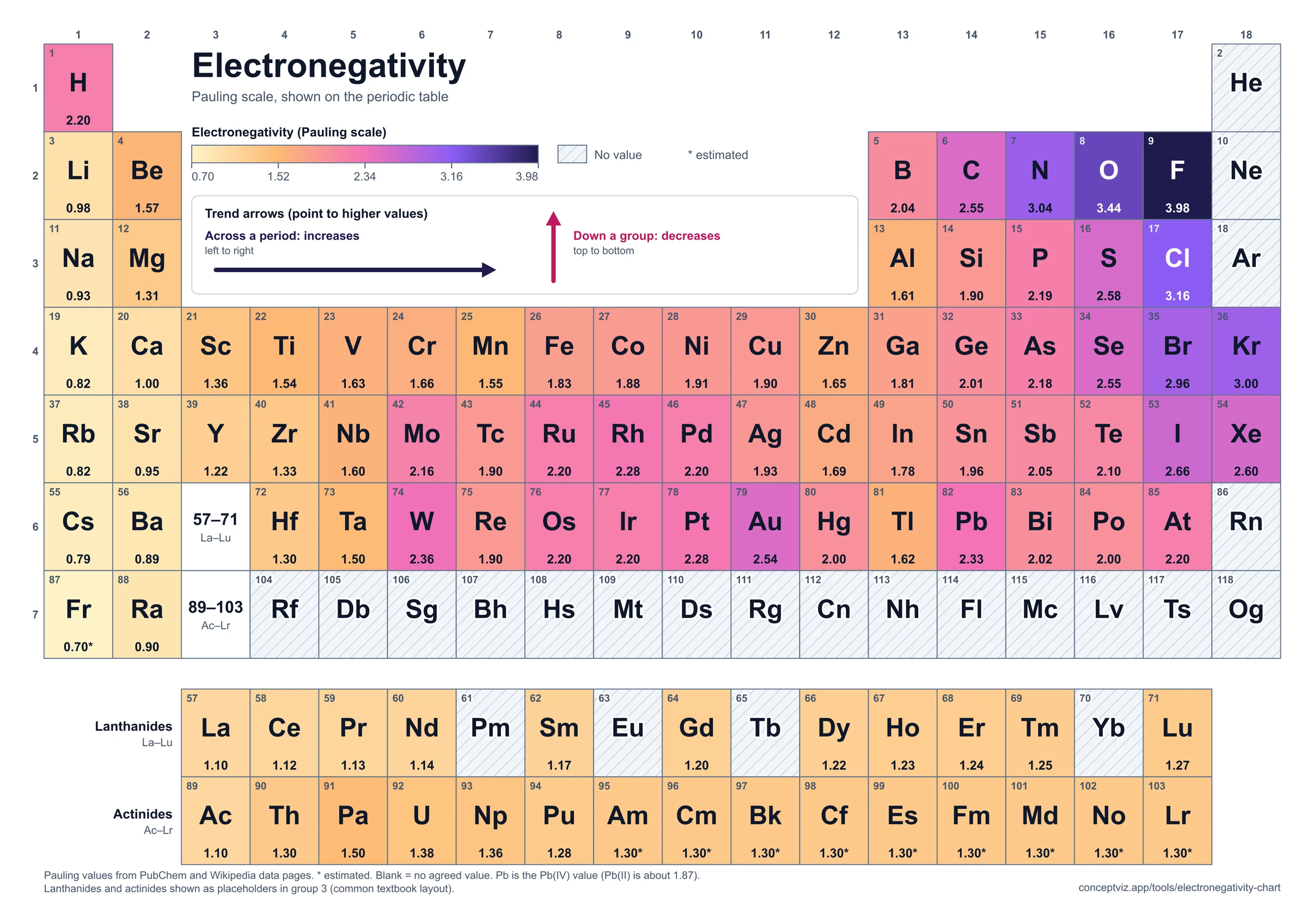
Electronegativity Chart
Periodic table heatmaps of electronegativity, atomic radius and ionization energy, with a sortable list and a bond type calculator.
 Chemistry
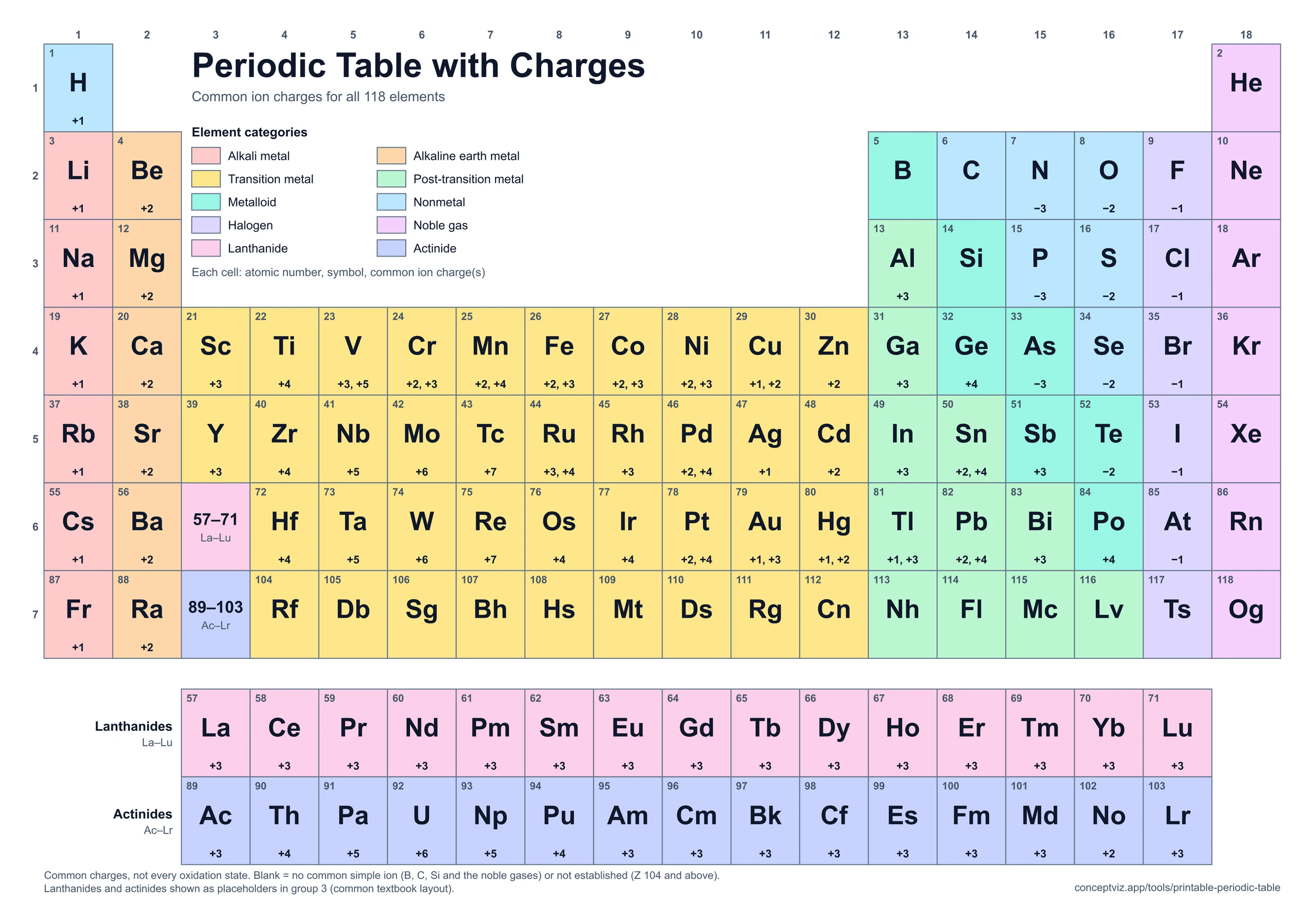
Printable Periodic Table
Periodic table with ion charges, atomic mass, and blank versions to print.
 Chemistry
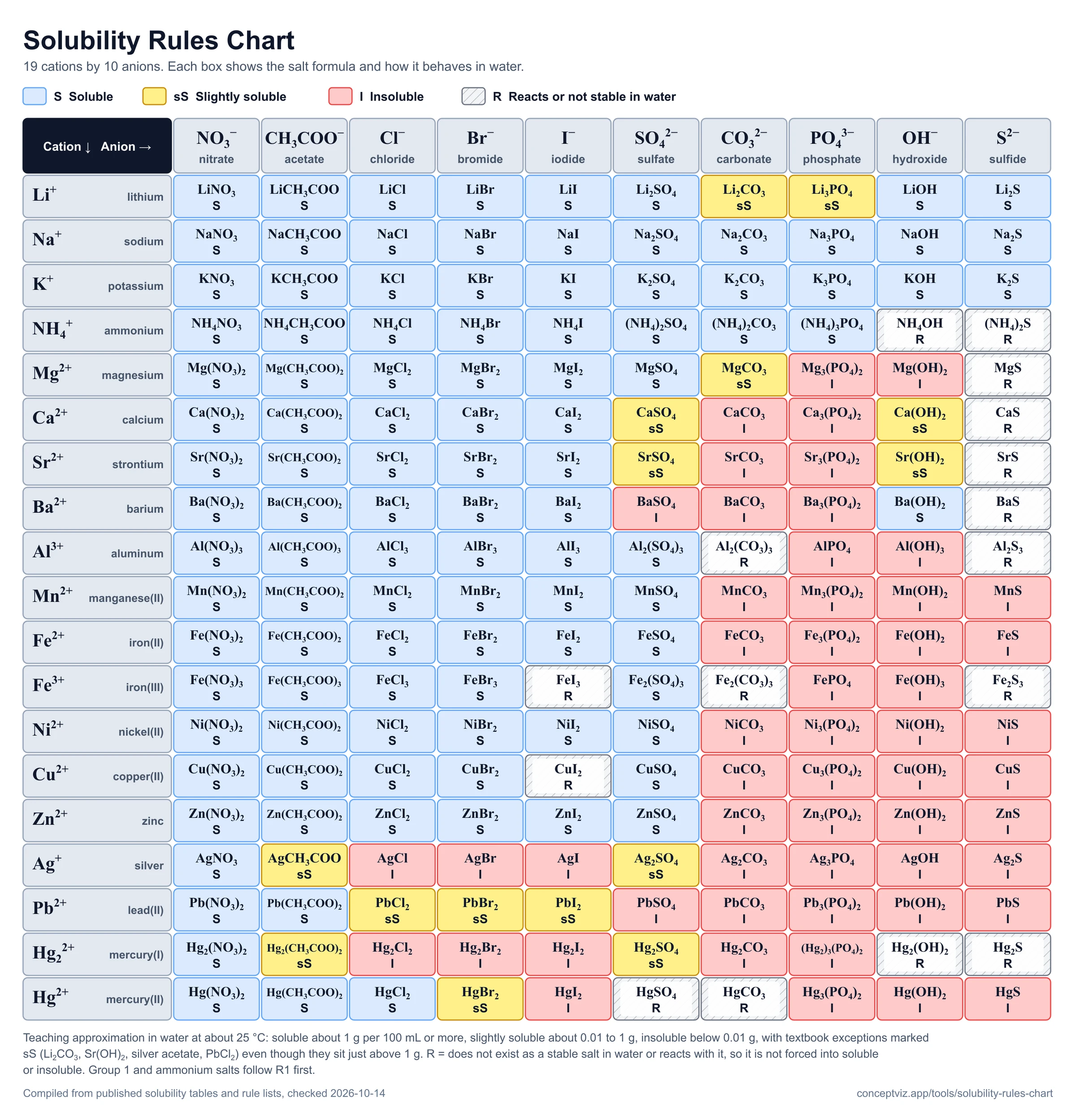
Solubility Rules Chart
Which salts dissolve? Cation by anion solubility chart with a precipitate checker.
 Chemistry
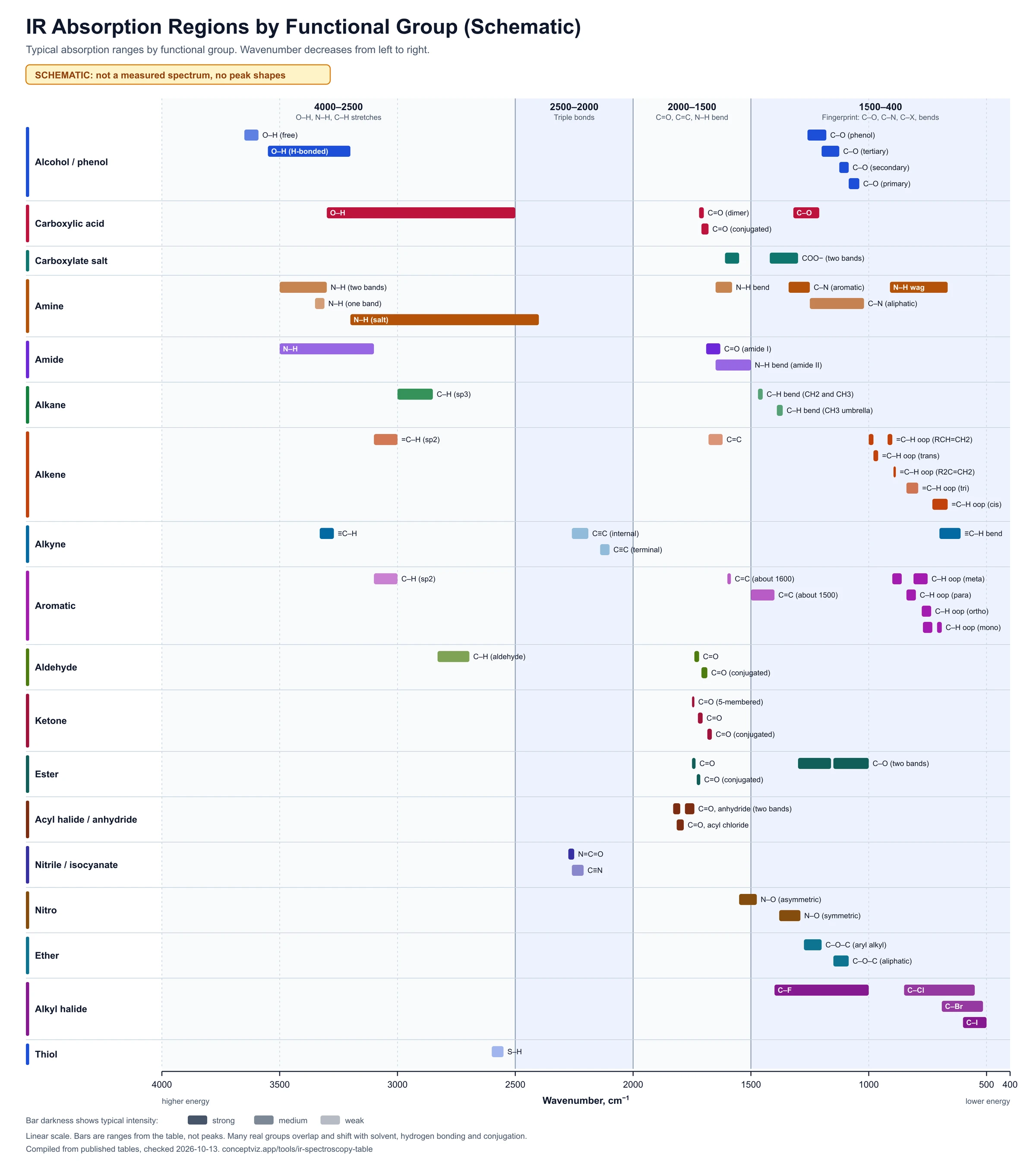
IR Spectroscopy Table
Free IR spectroscopy table with functional group absorptions. Look up a peak in cm-1, filter by region, print or download.