IR Spectroscopy Table Absorption Chart & Peak Finder
Free IR spectroscopy table with 64 functional group absorptions. Look up a peak in cm-1, filter by region, then print or download.
Type one or more peak positions, for example 1715 or 3300 1650. Ranges are inclusive; bands within 10 cm−1 of a range are listed as near matches.
Region, cm⁻¹
Showing 64 of 64 absorptions
Style
| Range, cm−1 | Bond / vibration | Group | Intensity | Shape | Note |
|---|---|---|---|---|---|
| 3650–3590 | O–H stretch (free) | Alcohol / phenol | Medium | Sharp | Seen only in dilute solution or gas phase, where nothing hydrogen-bonds. |
| 3550–3200 | O–H stretch (H-bonded) | Alcohol / phenol | Strong | Broad | The usual alcohol or phenol band in a neat liquid or solid. |
| 3500–3300 | N–H stretch (two bands) | Amine | Medium | Primary amine, R–NH2: an asymmetric and a symmetric stretch give two spikes. | |
| 3500–3100 | N–H stretch | Amide | Medium | Primary amides show two bands near 3350 and 3180, secondary amides one near 3300. Confirm with C=O near 1650. | |
| 3350–3310 | N–H stretch (one band) | Amine | Weak to medium | Secondary amine, R2NH: a single weak spike. Tertiary amines have no N–H band. | |
| 3330–3270 | ≡C–H stretch | Alkyne | Strong | Sharp | Terminal alkynes only. A sharp spike near 3300. |
| 3300–2500 | O–H stretch | Carboxylic acid | Strong | Broad | Extremely wide, centered near 3000, with C–H peaks riding on top. |
| 3200–2400 | N–H stretch (salt) | Amine | Strong | Broad | Ammonium salts: a broad, jagged envelope that overlaps the C–H region. |
| 3100–3000 | C–H stretch (sp2) | Aromatic | Weak to medium | Several small peaks just above 3000. | |
| 3100–3000 | =C–H stretch (sp2) | Alkene | Medium | Just above the 3000 line means C–H on an sp2 carbon. | |
| 3000–2850 | C–H stretch (sp3) | Alkane | Medium to strong | Just below 3000. CH3 and CH2 overlap into a cluster of peaks. | |
| 2830–2695 | C–H stretch (aldehyde) | Aldehyde | Medium | Often two bands, near 2820 and 2720. The 2720 one is the giveaway. | |
| 2600–2550 | S–H stretch | Thiol | Weak | Sharp | Weak and easy to miss, but it sits in an otherwise empty window. |
| 2275–2250 | N=C=O stretch | Nitrile / isocyanate | Strong | Broad | Overlaps the top of the nitrile range; the isocyanate band is much stronger and broader. |
| 2260–2210 | C≡N stretch | Nitrile / isocyanate | Weak to medium | Sharp | Weak to medium and sharp. Conjugation lowers it and makes it stronger. |
| 2260–2190 | C≡C stretch (internal) | Alkyne | Weak | Very weak, or absent when the alkyne is symmetric. | |
| 2140–2100 | C≡C stretch (terminal) | Alkyne | Weak | Pairs with the ≡C–H spike near 3300. | |
| 1830–1800 and 1780–1740 | C=O stretch, anhydride (two bands) | Acyl halide / anhydride | Strong | A strong pair roughly 60 cm⁻¹ apart, near 1820 and 1760. | |
| 1815–1785 | C=O stretch, acyl chloride | Acyl halide / anhydride | Strong | The highest ordinary carbonyl. Conjugation lowers it toward 1770. | |
| 1750–1735 | C=O stretch | Ester | Strong | About 20 cm⁻¹ above a ketone. Saturated esters only. | |
| 1750–1740 | C=O stretch (5-membered ring) | Ketone | Strong | Ring strain raises the carbonyl; cyclohexanone stays near 1715. | |
| 1740–1720 | C=O stretch | Aldehyde | Strong | Saturated aldehydes. Check for the C–H pair near 2820 and 2720. | |
| 1730–1715 | C=O stretch (conjugated) | Ester | Strong | α,β-unsaturated and aryl esters, shifted down by conjugation. | |
| 1725–1705 | C=O stretch | Ketone | Strong | Reference point: acetone absorbs near 1715. | |
| 1720–1700 | C=O stretch (dimer) | Carboxylic acid | Strong | The hydrogen-bonded dimer, which is how most acids appear. | |
| 1710–1685 | C=O stretch (conjugated) | Aldehyde | Strong | Conjugation to C=C or an aromatic ring lowers the carbonyl. | |
| 1710–1680 | C=O stretch (conjugated) | Carboxylic acid | Strong | Aromatic and α,β-unsaturated acids. | |
| 1690–1630 | C=O stretch (amide I) | Amide | Strong | Lower than ketones. Hydrogen bonding pushes it toward 1630. | |
| 1685–1666 | C=O stretch (conjugated) | Ketone | Strong | Aryl ketones and enones, about 30 to 50 cm⁻¹ below a saturated ketone. | |
| 1680–1620 | C=C stretch | Alkene | Variable | Weak or missing in symmetric alkenes. Conjugation lowers it. | |
| 1650–1500 | N–H bend (amide II) | Amide | Medium | Primary amides about 1650 to 1590, secondary about 1560 to 1500; this one range covers both. | |
| 1650–1580 | N–H bend | Amine | Medium | Primary amines only (NH2 scissoring). | |
| 1610–1550 and 1420–1300 | COO− stretch (two bands) | Carboxylate salt | Strong | Asymmetric stretch near 1580 and symmetric near 1400. Amino acid zwitterions show the same pair. | |
| 1600–1585 | C=C ring stretch (about 1600) | Aromatic | Medium | One of the two classic ring bands, paired with one near 1500. | |
| 1550–1475 | N–O stretch (asymmetric) | Nitro | Strong | Pairs with a second strong nitro band near 1350. | |
| 1500–1400 | C=C ring stretch (about 1500) | Aromatic | Medium | The second ring band; together with 1600 it points to an aromatic ring. | |
| 1470–1450 | C–H bend (CH2 and CH3) | Alkane | Medium | Scissoring of CH2 and the asymmetric CH3 bend. | |
| 1400–1000 | C–F stretch | Alkyl halide | Strong | Very strong; CF3 groups give two intense broad bands near 1100 to 1200. | |
| 1390–1365 | C–H bend (CH3 umbrella) | Alkane | Medium | A split pair here suggests a gem-dimethyl group such as isopropyl. | |
| 1380–1290 | N–O stretch (symmetric) | Nitro | Strong | The partner of the 1550 band; aromatic nitro sits lower. | |
| 1340–1250 | C–N stretch (aromatic) | Amine | Strong | Stronger and higher than aliphatic C–N because of ring conjugation. | |
| 1320–1210 | C–O stretch | Carboxylic acid | Strong | Companion to the broad O–H and the C=O near 1710. | |
| 1300–1160 and 1150–1000 | C–O stretch (two bands) | Ester | Strong | Two strong bands: the C(=O)–O stretch is higher, the O–C stretch lower. | |
| 1275–1200 | C–O–C stretch (aryl alkyl) | Ether | Strong | A second band for the alkyl side appears near 1075 to 1020. | |
| 1260–1180 | C–O stretch (phenol) | Alcohol / phenol | Strong | Phenols absorb higher than alcohols, near 1220. | |
| 1250–1020 | C–N stretch (aliphatic) | Amine | Medium | Medium and often overlapped by C–O bands, so it is weak evidence alone. | |
| 1200–1125 | C–O stretch (tertiary) | Alcohol / phenol | Strong | The highest alcohol C–O band, because the carbon is more substituted. | |
| 1150–1085 | C–O–C stretch (aliphatic) | Ether | Strong | One strong band and no O–H or C=O: that is how you spot a simple ether. | |
| 1125–1085 | C–O stretch (secondary) | Alcohol / phenol | Strong | Sits between primary and tertiary alcohols. | |
| 1085–1040 | C–O stretch (primary) | Alcohol / phenol | Strong | Primary alcohols absorb lowest of the three alcohol types. | |
| 1000–980 and 920–900 | =C–H out-of-plane bend (RCH=CH2) | Alkene | Strong | Monosubstituted (vinyl) alkenes: two bands, near 990 and 910. | |
| 980–960 | =C–H out-of-plane bend (trans) | Alkene | Strong | Trans-disubstituted alkenes: one band near 965. | |
| 910–665 | N–H wag | Amine | Strong | Broad | Primary and secondary amines. Broad and easy to confuse with C–H bends. |
| 900–860 and 810–750 | C–H out-of-plane bend (meta) | Aromatic | Strong | 1,3-Disubstituted ring: a band near 880 plus one near 780. | |
| 895–885 | =C–H out-of-plane bend (R2C=CH2) | Alkene | Strong | 1,1-Disubstituted (vinylidene) alkenes. | |
| 850–550 | C–Cl stretch | Alkyl halide | Medium to strong | Low in the fingerprint region, so it is hard to assign on its own. | |
| 840–790 | =C–H out-of-plane bend (trisubstituted) | Alkene | Medium | One lone vinyl hydrogen on the double bond. | |
| 840–800 | C–H out-of-plane bend (para) | Aromatic | Strong | 1,4-Disubstituted ring: one strong band near 820. | |
| 775–735 | C–H out-of-plane bend (ortho) | Aromatic | Strong | 1,2-Disubstituted ring: one strong band near 750. | |
| 770–730 and 710–690 | C–H out-of-plane bend (monosubstituted ring) | Aromatic | Strong | Two strong bands, near 750 and 700, point to a monosubstituted benzene. | |
| 730–665 | =C–H out-of-plane bend (cis) | Alkene | Strong | Cis-disubstituted alkenes, low and often broad. | |
| 700–610 | ≡C–H bend | Alkyne | Strong | Broad | Terminal alkynes; confirms the sharp 3300 stretch. |
| 690–515 | C–Br stretch | Alkyl halide | Medium to strong | Heavier halogen, lower wavenumber. | |
| 600–500 | C–I stretch | Alkyl halide | Strong | Heaviest common halogen, so the lowest wavenumber of the four. |
3650–3590 cm−1
Alcohol / phenol
O–H stretch (free)
Medium, sharp
Seen only in dilute solution or gas phase, where nothing hydrogen-bonds.
3550–3200 cm−1
Alcohol / phenol
O–H stretch (H-bonded)
Strong, broad
The usual alcohol or phenol band in a neat liquid or solid.
3500–3300 cm−1
Amine
N–H stretch (two bands)
Medium
Primary amine, R–NH2: an asymmetric and a symmetric stretch give two spikes.
3500–3100 cm−1
Amide
N–H stretch
Medium
Primary amides show two bands near 3350 and 3180, secondary amides one near 3300. Confirm with C=O near 1650.
3350–3310 cm−1
Amine
N–H stretch (one band)
Weak to medium
Secondary amine, R2NH: a single weak spike. Tertiary amines have no N–H band.
3330–3270 cm−1
Alkyne
≡C–H stretch
Strong, sharp
Terminal alkynes only. A sharp spike near 3300.
3300–2500 cm−1
Carboxylic acid
O–H stretch
Strong, broad
Extremely wide, centered near 3000, with C–H peaks riding on top.
3200–2400 cm−1
Amine
N–H stretch (salt)
Strong, broad
Ammonium salts: a broad, jagged envelope that overlaps the C–H region.
3100–3000 cm−1
Aromatic
C–H stretch (sp2)
Weak to medium
Several small peaks just above 3000.
3100–3000 cm−1
Alkene
=C–H stretch (sp2)
Medium
Just above the 3000 line means C–H on an sp2 carbon.
3000–2850 cm−1
Alkane
C–H stretch (sp3)
Medium to strong
Just below 3000. CH3 and CH2 overlap into a cluster of peaks.
2830–2695 cm−1
Aldehyde
C–H stretch (aldehyde)
Medium
Often two bands, near 2820 and 2720. The 2720 one is the giveaway.
2600–2550 cm−1
Thiol
S–H stretch
Weak, sharp
Weak and easy to miss, but it sits in an otherwise empty window.
2275–2250 cm−1
Nitrile / isocyanate
N=C=O stretch
Strong, broad
Overlaps the top of the nitrile range; the isocyanate band is much stronger and broader.
2260–2210 cm−1
Nitrile / isocyanate
C≡N stretch
Weak to medium, sharp
Weak to medium and sharp. Conjugation lowers it and makes it stronger.
2260–2190 cm−1
Alkyne
C≡C stretch (internal)
Weak
Very weak, or absent when the alkyne is symmetric.
2140–2100 cm−1
Alkyne
C≡C stretch (terminal)
Weak
Pairs with the ≡C–H spike near 3300.
1830–1800 and 1780–1740 cm−1
Acyl halide / anhydride
C=O stretch, anhydride (two bands)
Strong
A strong pair roughly 60 cm⁻¹ apart, near 1820 and 1760.
1815–1785 cm−1
Acyl halide / anhydride
C=O stretch, acyl chloride
Strong
The highest ordinary carbonyl. Conjugation lowers it toward 1770.
1750–1735 cm−1
Ester
C=O stretch
Strong
About 20 cm⁻¹ above a ketone. Saturated esters only.
1750–1740 cm−1
Ketone
C=O stretch (5-membered ring)
Strong
Ring strain raises the carbonyl; cyclohexanone stays near 1715.
1740–1720 cm−1
Aldehyde
C=O stretch
Strong
Saturated aldehydes. Check for the C–H pair near 2820 and 2720.
1730–1715 cm−1
Ester
C=O stretch (conjugated)
Strong
α,β-unsaturated and aryl esters, shifted down by conjugation.
1725–1705 cm−1
Ketone
C=O stretch
Strong
Reference point: acetone absorbs near 1715.
1720–1700 cm−1
Carboxylic acid
C=O stretch (dimer)
Strong
The hydrogen-bonded dimer, which is how most acids appear.
1710–1685 cm−1
Aldehyde
C=O stretch (conjugated)
Strong
Conjugation to C=C or an aromatic ring lowers the carbonyl.
1710–1680 cm−1
Carboxylic acid
C=O stretch (conjugated)
Strong
Aromatic and α,β-unsaturated acids.
1690–1630 cm−1
Amide
C=O stretch (amide I)
Strong
Lower than ketones. Hydrogen bonding pushes it toward 1630.
1685–1666 cm−1
Ketone
C=O stretch (conjugated)
Strong
Aryl ketones and enones, about 30 to 50 cm⁻¹ below a saturated ketone.
1680–1620 cm−1
Alkene
C=C stretch
Variable
Weak or missing in symmetric alkenes. Conjugation lowers it.
1650–1500 cm−1
Amide
N–H bend (amide II)
Medium
Primary amides about 1650 to 1590, secondary about 1560 to 1500; this one range covers both.
1650–1580 cm−1
Amine
N–H bend
Medium
Primary amines only (NH2 scissoring).
1610–1550 and 1420–1300 cm−1
Carboxylate salt
COO− stretch (two bands)
Strong
Asymmetric stretch near 1580 and symmetric near 1400. Amino acid zwitterions show the same pair.
1600–1585 cm−1
Aromatic
C=C ring stretch (about 1600)
Medium
One of the two classic ring bands, paired with one near 1500.
1550–1475 cm−1
Nitro
N–O stretch (asymmetric)
Strong
Pairs with a second strong nitro band near 1350.
1500–1400 cm−1
Aromatic
C=C ring stretch (about 1500)
Medium
The second ring band; together with 1600 it points to an aromatic ring.
1470–1450 cm−1
Alkane
C–H bend (CH2 and CH3)
Medium
Scissoring of CH2 and the asymmetric CH3 bend.
1400–1000 cm−1
Alkyl halide
C–F stretch
Strong
Very strong; CF3 groups give two intense broad bands near 1100 to 1200.
1390–1365 cm−1
Alkane
C–H bend (CH3 umbrella)
Medium
A split pair here suggests a gem-dimethyl group such as isopropyl.
1380–1290 cm−1
Nitro
N–O stretch (symmetric)
Strong
The partner of the 1550 band; aromatic nitro sits lower.
1340–1250 cm−1
Amine
C–N stretch (aromatic)
Strong
Stronger and higher than aliphatic C–N because of ring conjugation.
1320–1210 cm−1
Carboxylic acid
C–O stretch
Strong
Companion to the broad O–H and the C=O near 1710.
1300–1160 and 1150–1000 cm−1
Ester
C–O stretch (two bands)
Strong
Two strong bands: the C(=O)–O stretch is higher, the O–C stretch lower.
1275–1200 cm−1
Ether
C–O–C stretch (aryl alkyl)
Strong
A second band for the alkyl side appears near 1075 to 1020.
1260–1180 cm−1
Alcohol / phenol
C–O stretch (phenol)
Strong
Phenols absorb higher than alcohols, near 1220.
1250–1020 cm−1
Amine
C–N stretch (aliphatic)
Medium
Medium and often overlapped by C–O bands, so it is weak evidence alone.
1200–1125 cm−1
Alcohol / phenol
C–O stretch (tertiary)
Strong
The highest alcohol C–O band, because the carbon is more substituted.
1150–1085 cm−1
Ether
C–O–C stretch (aliphatic)
Strong
One strong band and no O–H or C=O: that is how you spot a simple ether.
1125–1085 cm−1
Alcohol / phenol
C–O stretch (secondary)
Strong
Sits between primary and tertiary alcohols.
1085–1040 cm−1
Alcohol / phenol
C–O stretch (primary)
Strong
Primary alcohols absorb lowest of the three alcohol types.
1000–980 and 920–900 cm−1
Alkene
=C–H out-of-plane bend (RCH=CH2)
Strong
Monosubstituted (vinyl) alkenes: two bands, near 990 and 910.
980–960 cm−1
Alkene
=C–H out-of-plane bend (trans)
Strong
Trans-disubstituted alkenes: one band near 965.
910–665 cm−1
Amine
N–H wag
Strong, broad
Primary and secondary amines. Broad and easy to confuse with C–H bends.
900–860 and 810–750 cm−1
Aromatic
C–H out-of-plane bend (meta)
Strong
1,3-Disubstituted ring: a band near 880 plus one near 780.
895–885 cm−1
Alkene
=C–H out-of-plane bend (R2C=CH2)
Strong
1,1-Disubstituted (vinylidene) alkenes.
850–550 cm−1
Alkyl halide
C–Cl stretch
Medium to strong
Low in the fingerprint region, so it is hard to assign on its own.
840–790 cm−1
Alkene
=C–H out-of-plane bend (trisubstituted)
Medium
One lone vinyl hydrogen on the double bond.
840–800 cm−1
Aromatic
C–H out-of-plane bend (para)
Strong
1,4-Disubstituted ring: one strong band near 820.
775–735 cm−1
Aromatic
C–H out-of-plane bend (ortho)
Strong
1,2-Disubstituted ring: one strong band near 750.
770–730 and 710–690 cm−1
Aromatic
C–H out-of-plane bend (monosubstituted ring)
Strong
Two strong bands, near 750 and 700, point to a monosubstituted benzene.
730–665 cm−1
Alkene
=C–H out-of-plane bend (cis)
Strong
Cis-disubstituted alkenes, low and often broad.
700–610 cm−1
Alkyne
≡C–H bend
Strong, broad
Terminal alkynes; confirms the sharp 3300 stretch.
690–515 cm−1
Alkyl halide
C–Br stretch
Medium to strong
Heavier halogen, lower wavenumber.
600–500 cm−1
Alkyl halide
C–I stretch
Strong
Heaviest common halogen, so the lowest wavenumber of the four.
Yellow rows match the wavenumber finder above. Print splits long tables into pages of 12 rows.
Free IR Spectroscopy Charts
Every chart below is drawn from the same compiled data as the tool above. View, download and print them free, no sign-up.
IR Absorption Regions Chart (Schematic)
Where each functional group absorbs, drawn as bars on a 4000 to 400 axis. Schematic only, not a measured spectrum.
Reference charts
Printable versions
Practice sheets
How to read an IR spectrum
- Infrared spectra plot how much light a sample absorbs against wavenumber, in cm⁻¹, which is simply 1 divided by the wavelength in centimeters. A typical organic spectrum runs from 4000 to 400 cm⁻¹, and by convention the axis is drawn with 4000 on the left. Work through the spectrum in the same order every time and most exam problems become routine.
- First draw a line at 3000. Peaks just below it come from sp3 C–H, peaks just above it come from sp2 C–H, and a sharp peak near 3300 points to a terminal alkyne. Next look from 3200 to 3600 for a broad O–H or N–H band. Then check around 1700 for a strong C=O peak. Finally use the pair near 2820 and 2720 for aldehydes, and the strong C–O bands between 1000 and 1300 for esters and ethers.
The four regions of the table
- Between 4000 and 2500 cm⁻¹ you see X–H stretches: O–H, N–H and C–H. Between 2500 and 2000 mostly triple bonds and cumulated bonds absorb, so a peak here is a strong clue: nitriles near 2250, alkynes near 2100 to 2260, isocyanates near 2270.
- Between 2000 and 1500 the double bonds appear. Carbonyls dominate, and their exact position tells you the family: acyl halides and anhydrides highest, then esters, aldehydes, ketones, acids and finally amides. Below about 1500 is the fingerprint region. It is crowded and hard to assign peak by peak, but it is unique to each molecule, so it is what you match when you compare an unknown with a reference spectrum.
Common mix-ups to avoid
- Alcohol versus carboxylic acid: both have a broad O–H. An alcohol band spans roughly 3550 to 3200, while an acid is far wider, 3300 to 2500, and often hides the C–H peaks. An acid also has a C=O near 1710, which an alcohol lacks.
- Primary versus secondary amine: a primary amine shows two N–H spikes between 3500 and 3300, a secondary amine shows one, and a tertiary amine shows none. Amines look sharper and weaker than alcohols.
- Ketone versus ester versus conjugated carbonyl: a saturated ketone sits near 1715, an ester near 1740, and conjugation to a double bond or ring lowers a carbonyl by roughly 20 to 50 cm⁻¹. Ring strain raises it, so cyclopentanone is near 1745.
How this table was compiled
Every row was assembled by hand from published group-frequency tables and checked against two or more sources where available, among them university chemistry course charts, an open reference table and the Wikipedia correlation table. Where sources disagree by more than about 10 cm⁻¹ or call the same band strong in one place and weak in another, we kept the range covered by the closest sources and rounded it to 5 cm⁻¹. The ranges are typical values for ordinary samples. Solvent, concentration, hydrogen bonding, ring size and conjugation all move a peak, so treat a match as a hypothesis and confirm it with other evidence such as NMR, mass spectrometry or a reference spectrum. The region map is a schematic of these ranges and not a real spectrum.
Frequently Asked Questions
Related Chemistry Tools
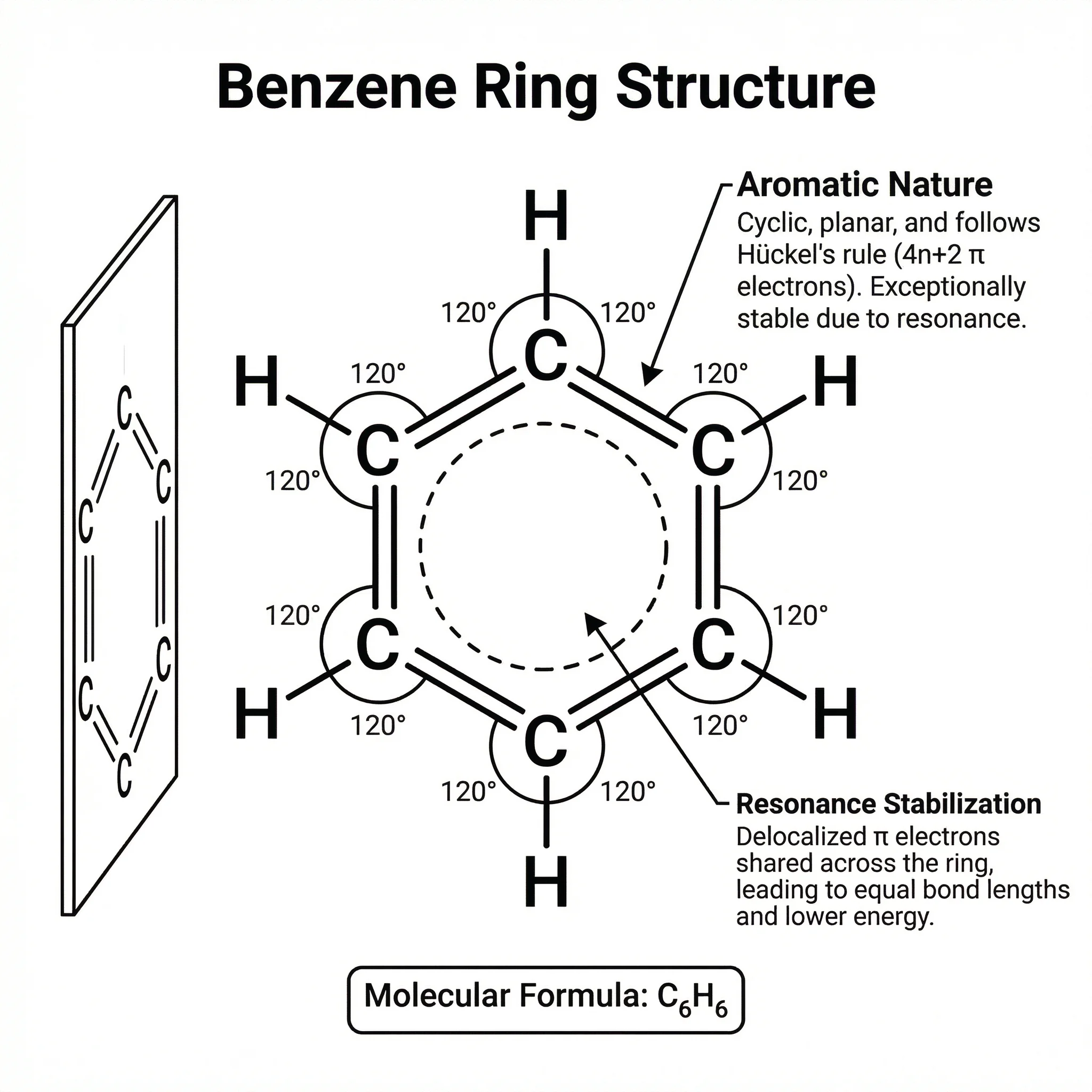 Chemistry
Chemistry Structure Generator
Create molecular structures and chemical diagrams for reports and worksheets.
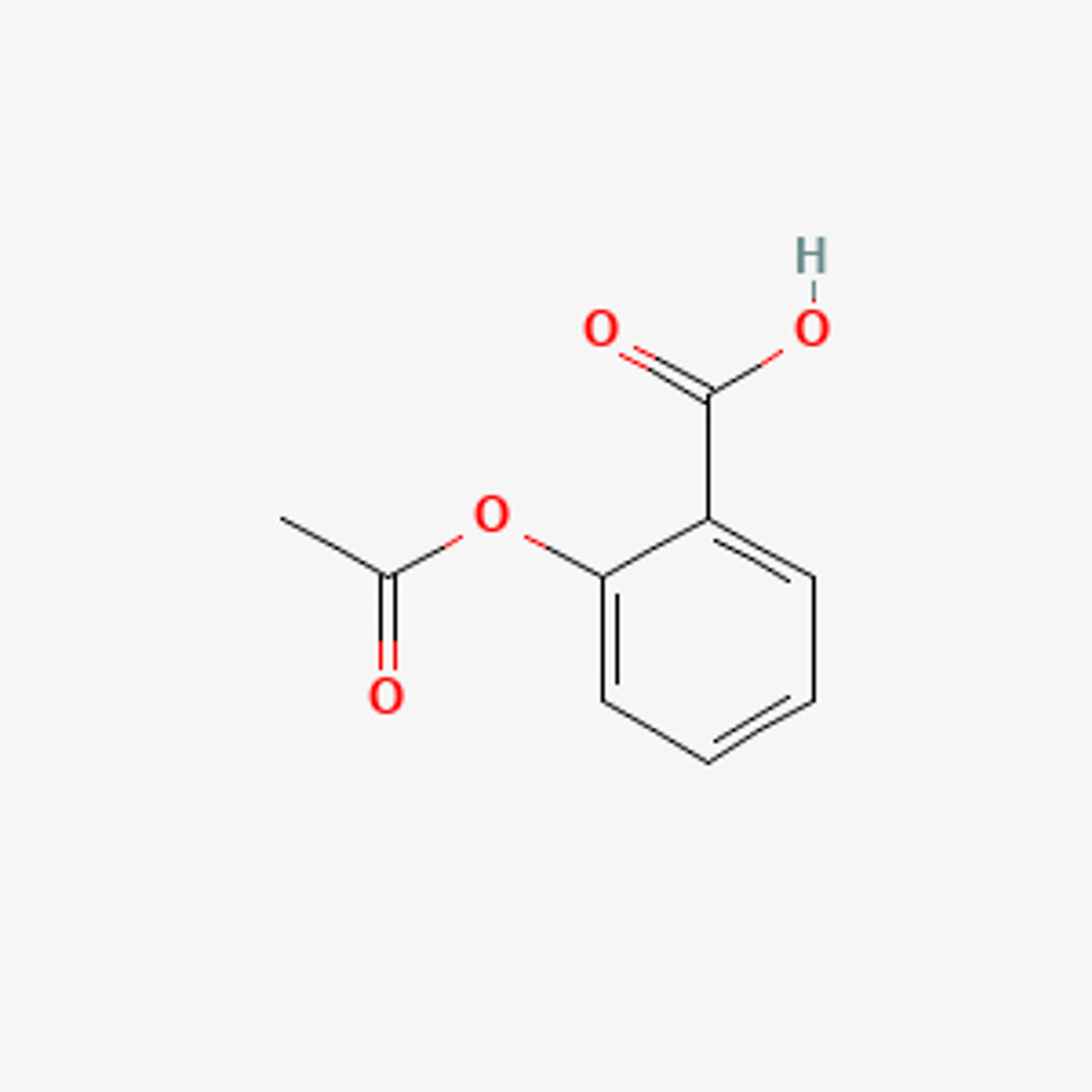 Chemistry
Molecule Generator from Description
Generate molecule structure diagrams from names, formulas or plain-English descriptions.
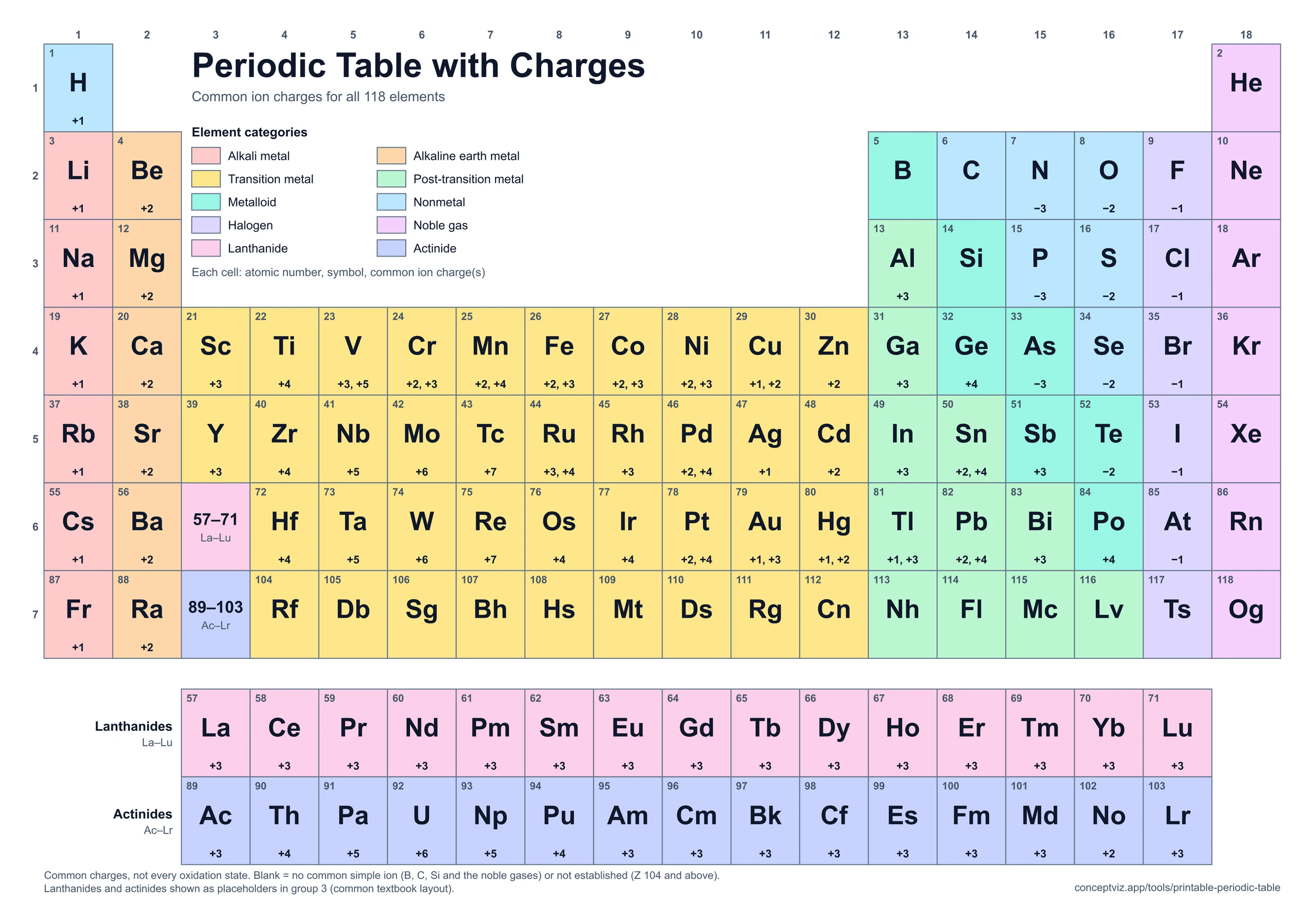 Chemistry
Printable Periodic Table
Periodic table with ion charges, atomic mass, and blank versions to print.
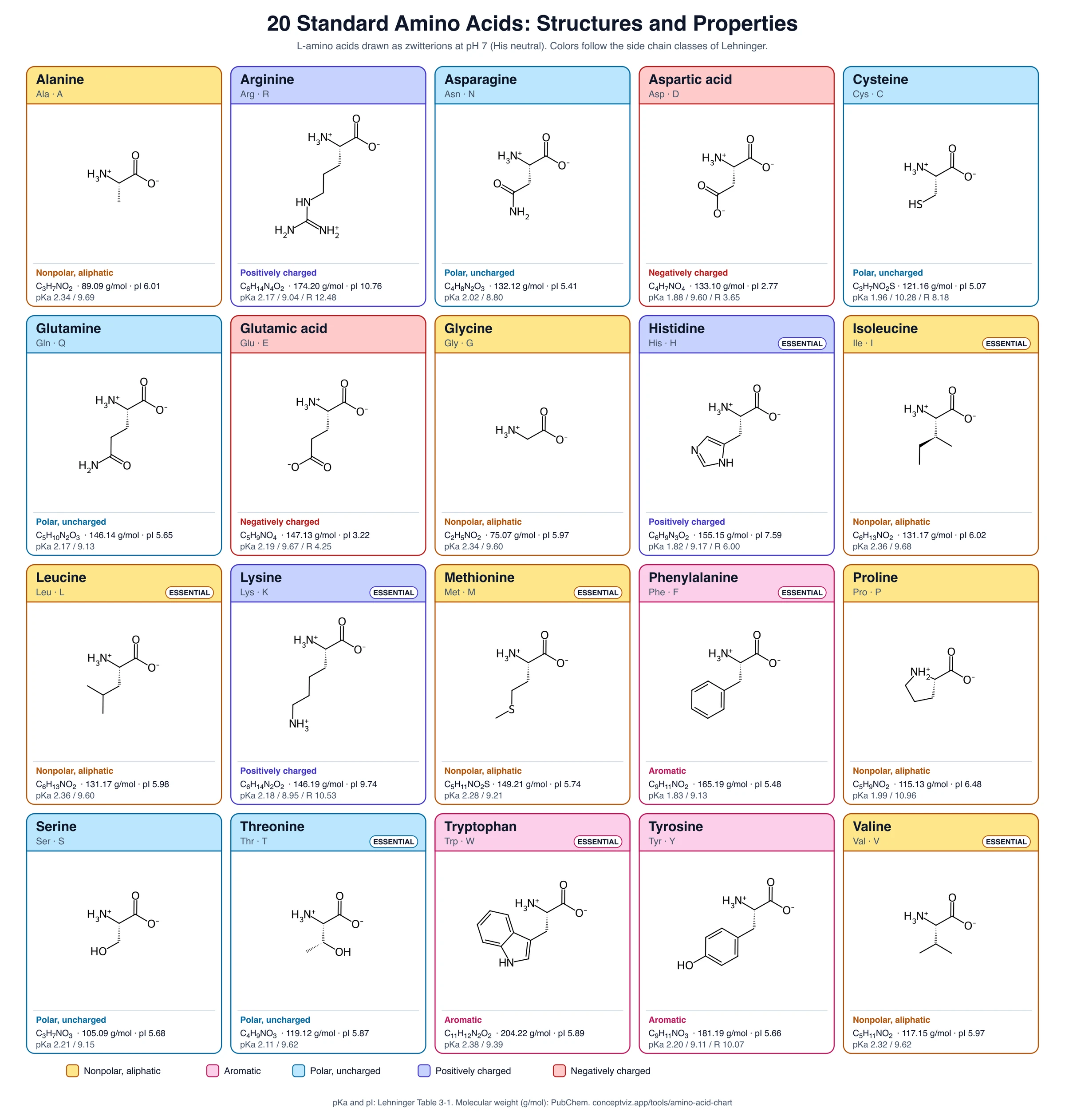 Biology
Amino Acid Chart
All 20 amino acid structures at pH 7 with names, codes, pKa, pI and essential amino acids.