Calculus Reference

Table of Integrals

Table of integrals with 100 formulas: basic, trig, exponential, log, inverse trig, hyperbolic, definite. Search, copy LaTeX, printable.

100 formulas in 8 groups, conditions beside eachSearch by sin, ln, sqrt, arctan and more

How to read this table

  • Every indefinite integral ends with +C+C, the constant of integration. Definite integrals have no constant.
  • ln⁡∣x∣\ln|x| always carries the absolute value bars, so the formula holds for negative xx too.
  • a,b,c,ka, b, c, k are constants and nn is a number. The conditions, such as a≠0a \ne 0, n≠−1n \ne -1 or ∣x∣<a|x|<a, are written under each formula.
  • Inverse functions use the principal values: arcsin and arctan are the usual branches, and arccot x lies in (0, π). The arcsec rows are stated only for x > 1 (or x > a), where the common conventions agree.
  • Where a condition removes a point, such as x ≠ 0, the constant CC may differ on each side of it.
  • “Verified” means: every antiderivative was differentiated in SymPy and every definite integral was evaluated in SymPy. The conditions are written by hand and were tested only by checking points inside them, so a condition may not be the widest possible.
Filter by type

Showing 100 of 100 formulas.

Basic forms (8)

  • Power rule

    ∫xn dx=xn+1n+1+C\int x^n\,dx = \frac{x^{n+1}}{n+1}+C

    Valid for n≠−1n \ne -1, for non-integer n, x > 0

  • Reciprocal

    ∫1x dx=ln⁡∣x∣+C\int \frac{1}{x}\,dx = \ln|x|+C

    Valid for x≠0x \ne 0

  • Square root

    ∫x dx=23x3/2+C\int \sqrt{x}\,dx = \frac{2}{3}x^{3/2}+C

    Valid for x>0x > 0

  • Reciprocal square root

    ∫1x dx=2x+C\int \frac{1}{\sqrt{x}}\,dx = 2\sqrt{x}+C

    Valid for x>0x > 0

  • Linear substitution, power

    ∫(ax+b)n dx=(ax+b)n+1a(n+1)+C\int (ax+b)^n\,dx = \frac{(ax+b)^{n+1}}{a(n+1)}+C

    Valid for a≠0,  n≠−1a \ne 0,\ \ n \ne -1, for non-integer n, ax + b > 0

  • Linear substitution, reciprocal

    ∫1ax+b dx=1aln⁡∣ax+b∣+C\int \frac{1}{ax+b}\,dx = \frac{1}{a}\ln|ax+b|+C

    Valid for a≠0,  ax+b≠0a \ne 0,\ \ ax+b \ne 0

  • x over a linear term

    ∫xax+b dx=xa−ba2ln⁡∣ax+b∣+C\int \frac{x}{ax+b}\,dx = \frac{x}{a}-\frac{b}{a^2}\ln|ax+b|+C

    Valid for a≠0,  ax+b≠0a \ne 0,\ \ ax+b \ne 0

  • Reciprocal of x(ax+b)

    ∫1x(ax+b) dx=1bln⁡∣xax+b∣+C\int \frac{1}{x(ax+b)}\,dx = \frac{1}{b}\ln\left|\frac{x}{ax+b}\right|+C

    Valid for b≠0,  x≠0,  ax+b≠0b \ne 0,\ \ x \ne 0,\ \ ax+b \ne 0

Rational functions (9)

  • Sum of squares

    ∫1x2+a2 dx=1aarctan⁡xa+C\int \frac{1}{x^2+a^2}\,dx = \frac{1}{a}\arctan\frac{x}{a}+C

    Valid for a≠0a \ne 0

  • Difference of squares

    ∫1x2−a2 dx=12aln⁡∣x−ax+a∣+C\int \frac{1}{x^2-a^2}\,dx = \frac{1}{2a}\ln\left|\frac{x-a}{x+a}\right|+C

    Valid for a≠0,  x≠a,  x≠−aa \ne 0,\ \ x \ne a,\ \ x \ne -a

  • Difference of squares, reversed

    ∫1a2−x2 dx=12aln⁡∣a+xa−x∣+C\int \frac{1}{a^2-x^2}\,dx = \frac{1}{2a}\ln\left|\frac{a+x}{a-x}\right|+C

    Valid for a≠0,  x≠a,  x≠−aa \ne 0,\ \ x \ne a,\ \ x \ne -a

  • x over a sum of squares

    ∫xx2+a2 dx=12ln⁡(x2+a2)+C\int \frac{x}{x^2+a^2}\,dx = \frac{1}{2}\ln(x^2+a^2)+C

    Valid for a≠0a \ne 0

  • x over a difference of squares

    ∫xx2−a2 dx=12ln⁡∣x2−a2∣+C\int \frac{x}{x^2-a^2}\,dx = \frac{1}{2}\ln|x^2-a^2|+C

    Valid for a≠0,  x≠a,  x≠−aa \ne 0,\ \ x \ne a,\ \ x \ne -a

  • x squared over a sum of squares

    ∫x2x2+a2 dx=x−aarctan⁡xa+C\int \frac{x^2}{x^2+a^2}\,dx = x-a\arctan\frac{x}{a}+C

    Valid for a≠0a \ne 0

  • Sum of squares, squared

    ∫1(x2+a2)2 dx=x2a2(x2+a2)+12a3arctan⁡xa+C\int \frac{1}{(x^2+a^2)^2}\,dx = \frac{x}{2a^2(x^2+a^2)}+\frac{1}{2a^3}\arctan\frac{x}{a}+C

    Valid for a≠0a \ne 0

  • General quadratic, no real roots

    ∫1ax2+bx+c dx=24ac−b2arctan⁡2ax+b4ac−b2+C\int \frac{1}{ax^2+bx+c}\,dx = \frac{2}{\sqrt{4ac-b^2}}\arctan\frac{2ax+b}{\sqrt{4ac-b^2}}+C

    Valid for a≠0,  4ac−b2>0a \ne 0,\ \ 4ac-b^2>0

  • Two distinct linear factors

    ∫1(x+a)(x+b) dx=1b−aln⁡∣x+ax+b∣+C\int \frac{1}{(x+a)(x+b)}\,dx = \frac{1}{b-a}\ln\left|\frac{x+a}{x+b}\right|+C

    Valid for a≠b,  x≠−a,  x≠−ba \ne b,\ \ x \ne -a,\ \ x \ne -b

Square roots (13)

  • Square root of a² - x²

    ∫a2−x2 dx=x2a2−x2+a22arcsin⁡xa+C\int \sqrt{a^2-x^2}\,dx = \frac{x}{2}\sqrt{a^2-x^2}+\frac{a^2}{2}\arcsin\frac{x}{a}+C

    Valid for a>0,  ∣x∣<aa > 0,\ \ |x|<a

  • Square root of x² + a²

    ∫x2+a2 dx=x2x2+a2+a22ln⁡(x+x2+a2)+C\int \sqrt{x^2+a^2}\,dx = \frac{x}{2}\sqrt{x^2+a^2}+\frac{a^2}{2}\ln\left(x+\sqrt{x^2+a^2}\right)+C

    Valid for a≠0a \ne 0

  • Square root of x² - a²

    ∫x2−a2 dx=x2x2−a2−a22ln⁡∣x+x2−a2∣+C\int \sqrt{x^2-a^2}\,dx = \frac{x}{2}\sqrt{x^2-a^2}-\frac{a^2}{2}\ln\left|x+\sqrt{x^2-a^2}\right|+C

    Valid for a≠0,  ∣x∣>∣a∣a \ne 0,\ \ |x|>|a|

  • Reciprocal of √(a² - x²)

    ∫1a2−x2 dx=arcsin⁡xa+C\int \frac{1}{\sqrt{a^2-x^2}}\,dx = \arcsin\frac{x}{a}+C

    Valid for a>0,  ∣x∣<aa > 0,\ \ |x|<a

  • Reciprocal of √(x² + a²)

    ∫1x2+a2 dx=ln⁡(x+x2+a2)+C\int \frac{1}{\sqrt{x^2+a^2}}\,dx = \ln\left(x+\sqrt{x^2+a^2}\right)+C

    Valid for a≠0a \ne 0

  • Reciprocal of √(x² - a²)

    ∫1x2−a2 dx=ln⁡∣x+x2−a2∣+C\int \frac{1}{\sqrt{x^2-a^2}}\,dx = \ln\left|x+\sqrt{x^2-a^2}\right|+C

    Valid for a≠0,  ∣x∣>∣a∣a \ne 0,\ \ |x|>|a|

  • x over √(x² + a²)

    ∫xx2+a2 dx=x2+a2+C\int \frac{x}{\sqrt{x^2+a^2}}\,dx = \sqrt{x^2+a^2}+C

    Valid for a≠0a \ne 0

  • x over √(x² - a²)

    ∫xx2−a2 dx=x2−a2+C\int \frac{x}{\sqrt{x^2-a^2}}\,dx = \sqrt{x^2-a^2}+C

    Valid for a≠0,  ∣x∣>∣a∣a \ne 0,\ \ |x|>|a|

  • x over √(a² - x²)

    ∫xa2−x2 dx=−a2−x2+C\int \frac{x}{\sqrt{a^2-x^2}}\,dx = -\sqrt{a^2-x^2}+C

    Valid for a>0,  ∣x∣<aa > 0,\ \ |x|<a

  • x times √(x² + a²)

    ∫xx2+a2 dx=13(x2+a2)3/2+C\int x\sqrt{x^2+a^2}\,dx = \frac{1}{3}(x^2+a^2)^{3/2}+C

    Valid for a≠0a \ne 0

  • Reciprocal of (x² + a²) to the 3/2

    ∫1(x2+a2)3/2 dx=xa2x2+a2+C\int \frac{1}{(x^2+a^2)^{3/2}}\,dx = \frac{x}{a^2\sqrt{x^2+a^2}}+C

    Valid for a≠0a \ne 0

  • Square root of a linear term

    ∫ax+b dx=23a(ax+b)3/2+C\int \sqrt{ax+b}\,dx = \frac{2}{3a}(ax+b)^{3/2}+C

    Valid for a≠0,  ax+b>0a \ne 0,\ \ ax+b>0

  • Reciprocal of x √(x² - a²)

    ∫1xx2−a2 dx=1aarcsec⁡xa+C\int \frac{1}{x\sqrt{x^2-a^2}}\,dx = \frac{1}{a}\operatorname{arcsec}\frac{x}{a}+C

    Valid for a>0,  x>aa > 0,\ \ x > a

Trigonometric (22)

  • Sine

    ∫sin⁡x dx=−cos⁡x+C\int \sin x\,dx = -\cos x+C
  • Cosine

    ∫cos⁡x dx=sin⁡x+C\int \cos x\,dx = \sin x+C
  • Tangent

    ∫tan⁡x dx=−ln⁡∣cos⁡x∣+C\int \tan x\,dx = -\ln|\cos x|+C

    Valid for cos⁡x≠0\cos x \ne 0

  • Cotangent

    ∫cot⁡x dx=ln⁡∣sin⁡x∣+C\int \cot x\,dx = \ln|\sin x|+C

    Valid for sin⁡x≠0\sin x \ne 0

  • Secant

    ∫sec⁡x dx=ln⁡∣sec⁡x+tan⁡x∣+C\int \sec x\,dx = \ln|\sec x+\tan x|+C

    Valid for cos⁡x≠0\cos x \ne 0

  • Cosecant

    ∫csc⁡x dx=−ln⁡∣csc⁡x+cot⁡x∣+C\int \csc x\,dx = -\ln|\csc x+\cot x|+C

    Valid for sin⁡x≠0\sin x \ne 0

  • Secant squared

    ∫sec⁡2x dx=tan⁡x+C\int \sec^2 x\,dx = \tan x+C

    Valid for cos⁡x≠0\cos x \ne 0

  • Cosecant squared

    ∫csc⁡2x dx=−cot⁡x+C\int \csc^2 x\,dx = -\cot x+C

    Valid for sin⁡x≠0\sin x \ne 0

  • Secant times tangent

    ∫sec⁡xtan⁡x dx=sec⁡x+C\int \sec x\tan x\,dx = \sec x+C

    Valid for cos⁡x≠0\cos x \ne 0

  • Sine squared

    ∫sin⁡2x dx=x2−sin⁡2x4+C\int \sin^2 x\,dx = \frac{x}{2}-\frac{\sin 2x}{4}+C
  • Cosine squared

    ∫cos⁡2x dx=x2+sin⁡2x4+C\int \cos^2 x\,dx = \frac{x}{2}+\frac{\sin 2x}{4}+C
  • Tangent squared

    ∫tan⁡2x dx=tan⁡x−x+C\int \tan^2 x\,dx = \tan x-x+C

    Valid for cos⁡x≠0\cos x \ne 0

  • Sine cubed

    ∫sin⁡3x dx=−cos⁡x+cos⁡3x3+C\int \sin^3 x\,dx = -\cos x+\frac{\cos^3 x}{3}+C
  • Cosine cubed

    ∫cos⁡3x dx=sin⁡x−sin⁡3x3+C\int \cos^3 x\,dx = \sin x-\frac{\sin^3 x}{3}+C
  • Secant cubed

    ∫sec⁡3x dx=12sec⁡xtan⁡x+12ln⁡∣sec⁡x+tan⁡x∣+C\int \sec^3 x\,dx = \frac{1}{2}\sec x\tan x+\frac{1}{2}\ln|\sec x+\tan x|+C

    Valid for cos⁡x≠0\cos x \ne 0

  • Sine of ax times sine of bx

    ∫sin⁡ax sin⁡bx dx=sin⁡((a−b)x)2(a−b)−sin⁡((a+b)x)2(a+b)+C\int \sin ax\,\sin bx\,dx = \frac{\sin\left((a-b)x\right)}{2(a-b)}-\frac{\sin\left((a+b)x\right)}{2(a+b)}+C

    Valid for a≠b,  a≠−ba \ne b,\ \ a \ne -b

  • Sine of ax times cosine of bx

    ∫sin⁡ax cos⁡bx dx=−cos⁡((a−b)x)2(a−b)−cos⁡((a+b)x)2(a+b)+C\int \sin ax\,\cos bx\,dx = -\frac{\cos\left((a-b)x\right)}{2(a-b)}-\frac{\cos\left((a+b)x\right)}{2(a+b)}+C

    Valid for a≠b,  a≠−ba \ne b,\ \ a \ne -b

  • Sine of ax

    ∫sin⁡ax dx=−cos⁡axa+C\int \sin ax\,dx = -\frac{\cos ax}{a}+C

    Valid for a≠0a \ne 0

  • Cosine of ax

    ∫cos⁡ax dx=sin⁡axa+C\int \cos ax\,dx = \frac{\sin ax}{a}+C

    Valid for a≠0a \ne 0

  • x times sine

    ∫xsin⁡x dx=sin⁡x−xcos⁡x+C\int x\sin x\,dx = \sin x-x\cos x+C
  • x times cosine

    ∫xcos⁡x dx=cos⁡x+xsin⁡x+C\int x\cos x\,dx = \cos x+x\sin x+C
  • One over 1 + cos x

    ∫11+cos⁡x dx=tan⁡x2+C\int \frac{1}{1+\cos x}\,dx = \tan\frac{x}{2}+C

    Valid for cos⁡x≠−1\cos x \ne -1

Inverse trigonometric (8)

  • Arcsine

    ∫arcsin⁡x dx=xarcsin⁡x+1−x2+C\int \arcsin x\,dx = x\arcsin x+\sqrt{1-x^2}+C

    Valid for ∣x∣<1|x|<1

  • Arccosine

    ∫arccos⁡x dx=xarccos⁡x−1−x2+C\int \arccos x\,dx = x\arccos x-\sqrt{1-x^2}+C

    Valid for ∣x∣<1|x|<1

  • Arctangent

    ∫arctan⁡x dx=xarctan⁡x−12ln⁡(1+x2)+C\int \arctan x\,dx = x\arctan x-\frac{1}{2}\ln(1+x^2)+C
  • Arccotangent

    ∫arccot⁡x dx=xarccot⁡x+12ln⁡(1+x2)+C\int \operatorname{arccot} x\,dx = x\operatorname{arccot} x+\frac{1}{2}\ln(1+x^2)+C

    with arccot x in (0, π)

  • Arcsecant

    ∫arcsec⁡x dx=xarcsec⁡x−ln⁡(x+x2−1)+C\int \operatorname{arcsec} x\,dx = x\operatorname{arcsec} x-\ln\left(x+\sqrt{x^2-1}\right)+C

    Valid for x>1x > 1

  • Arcsine of x/a

    ∫arcsin⁡xa dx=xarcsin⁡xa+a2−x2+C\int \arcsin\frac{x}{a}\,dx = x\arcsin\frac{x}{a}+\sqrt{a^2-x^2}+C

    Valid for a>0,  ∣x∣<aa > 0,\ \ |x|<a

  • Arctangent of x/a

    ∫arctan⁡xa dx=xarctan⁡xa−a2ln⁡(a2+x2)+C\int \arctan\frac{x}{a}\,dx = x\arctan\frac{x}{a}-\frac{a}{2}\ln(a^2+x^2)+C

    Valid for a≠0a \ne 0

  • x times arctangent

    ∫xarctan⁡x dx=x2+12arctan⁡x−x2+C\int x\arctan x\,dx = \frac{x^2+1}{2}\arctan x-\frac{x}{2}+C

Exponential and logarithmic (14)

  • Exponential

    ∫ex dx=ex+C\int e^x\,dx = e^x+C
  • Exponential, rate a

    ∫eax dx=eaxa+C\int e^{ax}\,dx = \frac{e^{ax}}{a}+C

    Valid for a≠0a \ne 0

  • a to the x

    ∫ax dx=axln⁡a+C\int a^x\,dx = \frac{a^x}{\ln a}+C

    Valid for a>0,  a≠1a > 0,\ \ a \ne 1

  • x times exponential

    ∫xeax dx=eax(ax−1)a2+C\int xe^{ax}\,dx = \frac{e^{ax}(ax-1)}{a^2}+C

    Valid for a≠0a \ne 0

  • x squared times exponential

    ∫x2eax dx=eax(a2x2−2ax+2)a3+C\int x^2e^{ax}\,dx = \frac{e^{ax}(a^2x^2-2ax+2)}{a^3}+C

    Valid for a≠0a \ne 0

  • Exponential times sine

    ∫eaxsin⁡bx dx=eax(asin⁡bx−bcos⁡bx)a2+b2+C\int e^{ax}\sin bx\,dx = \frac{e^{ax}(a\sin bx-b\cos bx)}{a^2+b^2}+C

    Valid for a2+b2≠0a^2+b^2 \ne 0

  • Exponential times cosine

    ∫eaxcos⁡bx dx=eax(acos⁡bx+bsin⁡bx)a2+b2+C\int e^{ax}\cos bx\,dx = \frac{e^{ax}(a\cos bx+b\sin bx)}{a^2+b^2}+C

    Valid for a2+b2≠0a^2+b^2 \ne 0

  • One over 1 + eˣ

    ∫11+ex dx=x−ln⁡(1+ex)+C\int \frac{1}{1+e^x}\,dx = x-\ln(1+e^x)+C
  • Natural logarithm

    ∫ln⁡x dx=xln⁡x−x+C\int \ln x\,dx = x\ln x-x+C

    Valid for x>0x > 0

  • xⁿ times ln x

    ∫xnln⁡x dx=xn+1n+1(ln⁡x−1n+1)+C\int x^n\ln x\,dx = \frac{x^{n+1}}{n+1}\left(\ln x-\frac{1}{n+1}\right)+C

    Valid for n≠−1,  x>0n \ne -1,\ \ x > 0

  • ln x squared

    ∫(ln⁡x)2 dx=x(ln⁡x)2−2xln⁡x+2x+C\int (\ln x)^2\,dx = x(\ln x)^2-2x\ln x+2x+C

    Valid for x>0x > 0

  • ln x over x

    ∫ln⁡xx dx=(ln⁡x)22+C\int \frac{\ln x}{x}\,dx = \frac{(\ln x)^2}{2}+C

    Valid for x>0x > 0

  • One over x ln x

    ∫1xln⁡x dx=ln⁡∣ln⁡x∣+C\int \frac{1}{x\ln x}\,dx = \ln|\ln x|+C

    Valid for x>0,  x≠1x > 0,\ \ x \ne 1

  • ln of x² + a²

    ∫ln⁡(x2+a2) dx=xln⁡(x2+a2)−2x+2aarctan⁡xa+C\int \ln(x^2+a^2)\,dx = x\ln(x^2+a^2)-2x+2a\arctan\frac{x}{a}+C

    Valid for a≠0a \ne 0

Hyperbolic (11)

  • Hyperbolic sine

    ∫sinh⁡x dx=cosh⁡x+C\int \sinh x\,dx = \cosh x+C
  • Hyperbolic cosine

    ∫cosh⁡x dx=sinh⁡x+C\int \cosh x\,dx = \sinh x+C
  • Hyperbolic tangent

    ∫tanh⁡x dx=ln⁡cosh⁡x+C\int \tanh x\,dx = \ln\cosh x+C
  • Hyperbolic cotangent

    ∫coth⁡x dx=ln⁡∣sinh⁡x∣+C\int \coth x\,dx = \ln|\sinh x|+C

    Valid for x≠0x \ne 0

  • Hyperbolic secant squared

    ∫sech⁡2x dx=tanh⁡x+C\int \operatorname{sech}^2 x\,dx = \tanh x+C
  • Hyperbolic cosecant squared

    ∫csch⁡2x dx=−coth⁡x+C\int \operatorname{csch}^2 x\,dx = -\coth x+C

    Valid for x≠0x \ne 0

  • Hyperbolic secant

    ∫sech⁡x dx=arctan⁡(sinh⁡x)+C\int \operatorname{sech} x\,dx = \arctan(\sinh x)+C
  • Hyperbolic cosecant

    ∫csch⁡x dx=ln⁡∣tanh⁡x2∣+C\int \operatorname{csch} x\,dx = \ln\left|\tanh\frac{x}{2}\right|+C

    Valid for x≠0x \ne 0

  • Inverse hyperbolic sine

    ∫arsinh⁡x dx=xarsinh⁡x−x2+1+C\int \operatorname{arsinh} x\,dx = x\operatorname{arsinh} x-\sqrt{x^2+1}+C
  • Inverse hyperbolic cosine

    ∫arcosh⁡x dx=xarcosh⁡x−x2−1+C\int \operatorname{arcosh} x\,dx = x\operatorname{arcosh} x-\sqrt{x^2-1}+C

    Valid for x>1x > 1

  • Inverse hyperbolic tangent

    ∫artanh⁡x dx=xartanh⁡x+12ln⁡(1−x2)+C\int \operatorname{artanh} x\,dx = x\operatorname{artanh} x+\frac{1}{2}\ln(1-x^2)+C

    Valid for ∣x∣<1|x|<1

Common definite integrals (15)

  • Gaussian, half line

    ∫0∞e−x2 dx=π2\int_{0}^{\infty} e^{-x^2}\,dx = \frac{\sqrt{\pi}}{2}
  • Gaussian, whole line

    ∫−∞∞e−x2 dx=π\int_{-\infty}^{\infty} e^{-x^2}\,dx = \sqrt{\pi}
  • Gaussian with width a

    ∫0∞e−ax2 dx=12πa\int_{0}^{\infty} e^{-ax^2}\,dx = \frac{1}{2}\sqrt{\frac{\pi}{a}}

    Valid for a>0a > 0

  • x times Gaussian

    ∫0∞x e−x2 dx=12\int_{0}^{\infty} x\,e^{-x^2}\,dx = \frac{1}{2}
  • Exponential decay

    ∫0∞e−ax dx=1a\int_{0}^{\infty} e^{-ax}\,dx = \frac{1}{a}

    Valid for a>0a > 0

  • Gamma integral, whole numbers

    ∫0∞xne−ax dx=n!an+1\int_{0}^{\infty} x^n e^{-ax}\,dx = \frac{n!}{a^{n+1}}

    Valid for a>0,  n=0,1,2,…a > 0,\ \ n=0,1,2,\ldots

  • Arctangent integral, half line

    ∫0∞11+x2 dx=π2\int_{0}^{\infty} \frac{1}{1+x^2}\,dx = \frac{\pi}{2}
  • Arctangent integral, whole line

    ∫−∞∞11+x2 dx=π\int_{-\infty}^{\infty} \frac{1}{1+x^2}\,dx = \pi
  • Dirichlet integral

    ∫0∞sin⁡xx dx=π2\int_{0}^{\infty} \frac{\sin x}{x}\,dx = \frac{\pi}{2}

    improper, converges conditionally

  • One arch of the sine

    ∫0πsin⁡x dx=2\int_{0}^{\pi} \sin x\,dx = 2
  • Sine squared over a quarter period

    ∫0π2sin⁡2x dx=π4\int_{0}^{\frac{\pi}{2}} \sin^2 x\,dx = \frac{\pi}{4}
  • Power on the unit interval

    ∫01xn dx=1n+1\int_{0}^{1} x^n\,dx = \frac{1}{n+1}

    Valid for n>−1n > -1

  • Logarithm on the unit interval

    ∫01ln⁡x dx=−1\int_{0}^{1} \ln x\,dx = -1
  • Reciprocal of √(1 - x²)

    ∫0111−x2 dx=π2\int_{0}^{1} \frac{1}{\sqrt{1-x^2}}\,dx = \frac{\pi}{2}
  • Area of a half disc

    ∫−aaa2−x2 dx=πa22\int_{-a}^{a} \sqrt{a^2-x^2}\,dx = \frac{\pi a^2}{2}

    Valid for a>0a > 0

How to use the table: three worked examples

Each answer below was differentiated with SymPy and gives the integrand back. Every example ends on a row of the table above.

Example 1: Substitute u = x²

∫xcos⁡(x2) dx\int x\cos(x^2)\,dx
  1. u=x2,du=2x dxu=x^2,\quad du=2x\,dx
  2. ∫xcos⁡(x2) dx=12∫cos⁡u du\int x\cos(x^2)\,dx=\frac{1}{2}\int\cos u\,du
  3. =12sin⁡u+C=\frac{1}{2}\sin u+C

Answer

∫xcos⁡(x2) dx=12sin⁡(x2)+C\int x\cos(x^2)\,dx = \frac{1}{2}\sin(x^2)+C

Table row: Cosine

Example 2: Scale to the arcsine row

∫14−9x2 dx\int \frac{1}{\sqrt{4-9x^2}}\,dx
  1. u=3x,du=3 dxu=3x,\quad du=3\,dx
  2. ∫dx4−9x2=13∫du22−u2\int\frac{dx}{\sqrt{4-9x^2}}=\frac{1}{3}\int\frac{du}{\sqrt{2^2-u^2}}
  3. =13arcsin⁡u2+C=\frac{1}{3}\arcsin\frac{u}{2}+C

Answer

∫14−9x2 dx=13arcsin⁡3x2+C\int \frac{1}{\sqrt{4-9x^2}}\,dx = \frac{1}{3}\arcsin\frac{3x}{2}+C

Valid for ∣x∣<23|x|<\tfrac{2}{3}

Table row: Reciprocal of √(a² - x²)

Example 3: Complete the square first

∫1x2+4x+13 dx\int \frac{1}{x^2+4x+13}\,dx
  1. x2+4x+13=(x+2)2+32x^2+4x+13=(x+2)^2+3^2
  2. u=x+2,du=dxu=x+2,\quad du=dx
  3. ∫duu2+32=13arctan⁡u3+C\int\frac{du}{u^2+3^2}=\frac{1}{3}\arctan\frac{u}{3}+C

Answer

∫1x2+4x+13 dx=13arctan⁡x+23+C\int \frac{1}{x^2+4x+13}\,dx = \frac{1}{3}\arctan\frac{x+2}{3}+C

Table row: Sum of squares

Free Table of Integrals Cards

Every card below is drawn from the same formula data as the table above. View, download and print them free, no sign-up.

Basic and trig

Integral Table: Basic and Trigonometric Formulas

Power rule, 1/x, linear substitution and the standard trigonometric antiderivatives, with the conditions printed under each formula.

1 / 6

Formula cards

Printable versions

How to use

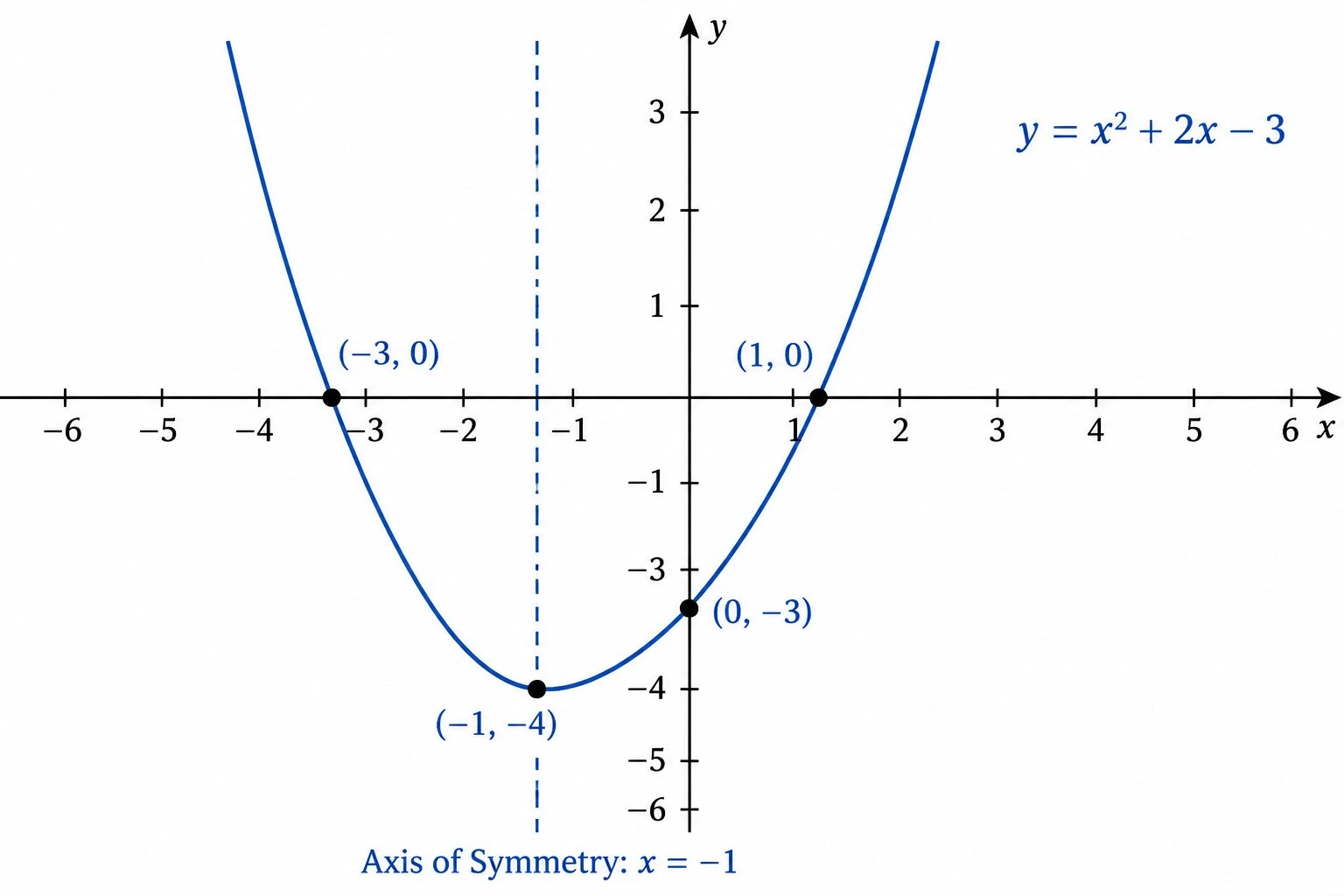
Working with trigonometric functions? Look up values in the trig table, plot them with the sine graph generator or sketch a quadratic with the parabola graph generator.
How to look up an integral

  • Write the integrand in its simplest form, then compare it with the left-hand side of each row. The groups are ordered by the shape of the integrand: basic powers and reciprocals, rational functions, square roots, trigonometric, inverse trigonometric, exponential and logarithmic, hyperbolic, and definite integrals. The search box matches words such as sin, ln, sqrt or arctan, and the buttons above the list narrow it to one group.
  • When the integrand almost matches a row, change it until it does. A linear substitution u = ax + b turns (ax + b)^n into u^n. Completing the square turns x² + 4x + 13 into (x + 2)² + 9, which is the arctangent row. Rewriting a product as a sum, or splitting a fraction, often lands on two rows instead of none. The three worked examples above show each move once.

Constants, absolute values and conditions

  • Every indefinite integral is written as an antiderivative plus C. The constant is shown once at the end of each line and never repeated, and the definite integrals have no constant because the limits fix the value. The integral of 1/x is ln|x| + C, with absolute value bars, because 1/x is defined for negative x as well and the derivative of ln|x| is 1/x on both sides of zero. Dropping the bars is a common error in this part of calculus.
  • The parameters a, b, c, k and n stand for constants. The condition under a formula says where it holds: n ≠ −1 keeps the power rule away from the reciprocal, a ≠ 0 keeps a division by a from blowing up, and |x| < a keeps a square root real. A formula that needs x > 0 says so. If your integral sits outside the stated condition, the same antiderivative may still work on an interval where the integrand is defined, but check by differentiating.

Why different books print different answers

  • Two antiderivatives of the same function differ by a constant, so correct tables can disagree in appearance. The integral of sec x is printed as ln|sec x + tan x| here, and as ln|tan(x/2 + π/4)| elsewhere. The integral of sin x cos x can be sin²x/2 or −cos²x/2 or −cos(2x)/4. All of them differentiate to the integrand. When a result does not match the back of your textbook, differentiate yours: if you get the integrand back, your answer is right.

Common mistakes with the table

  • Forgetting the chain factor is the first one. The integral of cos(3x) is sin(3x)/3, not sin(3x), which the rows with ax in them handle for you. The second is applying a row outside its condition, for example using the arcsine row for 1/√(a² − x²) when a is negative. The third is mixing up the three square-root patterns: 1/√(a² − x²) leads to arcsine, 1/√(x² + a²) leads to a logarithm, and 1/√(x² − a²) also leads to a logarithm but with absolute value bars. The fourth is trusting a formula without a derivative check, which is why every antiderivative here has been checked that way.

What the table does not cover

  • A table of integrals covers antiderivatives that exist in closed form. Some integrands, such as e^(−x²) or sin(x)/x, have no elementary antiderivative, so they appear only as definite integrals with specific limits. Reduction formulas for sin^n x and similar powers are not listed because they replace one integral with another instead of giving a closed answer. For those, use integration by parts or a numerical method.

Frequently Asked Questions