Standard Enthalpy of Formation Table ΔHf°, ΔGf°, S° & Reaction Calculator
Searchable enthalpy of formation table: 177 substances with ΔHf°, ΔGf° and S° at 298.15 K, plus a reaction enthalpy calculator. Printable.
Category
State
Export style
Showing 177 of 177 substances
| Substance | Formula | State | ΔHf° kJ/mol | ΔGf° kJ/mol | S° J/(mol·K) | Calculator |
|---|---|---|---|---|---|---|
| Aluminum | Al | solid | 0 | 0 | 28.33 | |
| Bromine | Br2 | liquid | 0 | 0 | 152.231 | |
| BromineGas phase, not the reference state of bromine | Br2 | gas | 30.907 | 3.110 | 245.463 | |
| Bromine atomGaseous atom, used for atomization enthalpies | Br | gas | 111.884 | 82.396 | 175.022 | |
| Calcium (α) | Ca | solid | 0 | 0 | 41.42 | |
| Carbon (graphite)Reference state of carbon | C | solid | 0 | 0 | 5.740 | |
| Carbon (diamond)Not the reference state, so ΔHf° is not zero | C | solid | 1.895 | 2.900 | 2.377 | |
| Carbon atomGaseous atom, used for atomization enthalpies | C | gas | 716.682 | 671.257 | 158.096 | |
| Chlorine | Cl2 | gas | 0 | 0 | 223.066 | |
| Chlorine atomGaseous atom, used for atomization enthalpies | Cl | gas | 121.679 | 105.680 | 165.198 | |
| Copper | Cu | solid | 0 | 0 | 33.150 | |
| Fluorine | F2 | gas | 0 | 0 | 202.78 | |
| Fluorine atomGaseous atom, used for atomization enthalpies | F | gas | 78.99 | 61.91 | 158.754 | |
| Hydrogen | H2 | gas | 0 | 0 | 130.684 | |
| Hydrogen atomGaseous atom, used for atomization enthalpies | H | gas | 217.965 | 203.247 | 114.713 | |
| Iodine | I2 | solid | 0 | 0 | 116.135 | |
| IodineGas phase, not the reference state of iodine | I2 | gas | 62.438 | 19.327 | 260.69 | |
| Iron | Fe | solid | 0 | 0 | 27.28 | |
| Lead | Pb | solid | 0 | 0 | 64.81 | |
| Lithium | Li | solid | 0 | 0 | 29.12 | |
| Magnesium | Mg | solid | 0 | 0 | 32.68 | |
| Manganese | Mn | solid | 0 | 0 | 32.01 | |
| Mercury | Hg | liquid | 0 | 0 | 76.02 | |
| Nitrogen | N2 | gas | 0 | 0 | 191.61 | |
| Nitrogen atomGaseous atom, used for atomization enthalpies | N | gas | 472.704 | 455.563 | 153.298 | |
| Oxygen | O2 | gas | 0 | 0 | 205.138 | |
| Oxygen atomGaseous atom, used for atomization enthalpies | O | gas | 249.170 | 231.731 | 161.055 | |
| OzoneAllotrope of O2, not the reference state | O3 | gas | 142.7 | 163.2 | 238.93 | |
| Phosphorus (white)Reference state of phosphorus (white); formula written as P | P | solid | 0 | 0 | 41.09 | |
| Potassium | K | solid | 0 | 0 | 64.18 | |
| Silicon | Si | solid | 0 | 0 | 18.83 | |
| Silver | Ag | solid | 0 | 0 | 42.55 | |
| Sodium | Na | solid | 0 | 0 | 51.21 | |
| Sulfur (rhombic) | S | solid | 0 | 0 | 31.80 | |
| Tin (white) | Sn | solid | 0 | 0 | 51.55 | |
| Zinc | Zn | solid | 0 | 0 | 41.63 | |
| Aluminum oxide (corundum) | Al2O3 | solid | −1675.7 | −1582.3 | 50.92 | |
| Calcium oxide | CaO | solid | −635.09 | −604.03 | 39.75 | |
| Carbon dioxide | CO2 | gas | −393.509 | −394.359 | 213.74 | |
| Carbon monoxide | CO | gas | −110.525 | −137.168 | 197.674 | |
| Copper(I) oxideNIST WebBook lists −170.71 kJ/mol from a different source | Cu2O | solid | −168.6 | −146.0 | 93.14 | |
| Copper(II) oxideNIST WebBook lists −156.06 kJ/mol from a different source | CuO | solid | −157.3 | −129.7 | 42.63 | |
| Dinitrogen monoxide | N2O | gas | 82.05 | 104.20 | 219.85 | |
| Dinitrogen tetroxide | N2O4 | gas | 9.16 | 97.89 | 304.29 | |
| Hydrogen peroxide | H2O2 | liquid | −187.78 | −120.35 | 109.6 | |
| Iron(II,III) oxide (magnetite) | Fe3O4 | solid | −1118.4 | −1015.4 | 146.4 | |
| Iron(III) oxide (hematite) | Fe2O3 | solid | −824.2 | −742.2 | 87.40 | |
| Lead(II) oxide (red) | PbO | solid | −218.99 | −188.93 | 66.5 | |
| Lead(II) oxide (yellow) | PbO | solid | −217.32 | −187.89 | 68.70 | |
| Lithium oxide | Li2O | solid | −597.94 | −561.18 | 37.57 | |
| Magnesium oxide (periclase) | MgO | solid | −601.70 | −569.43 | 26.94 | |
| Manganese(IV) oxide | MnO2 | solid | −520.03 | −465.14 | 53.05 | |
| Mercury(II) oxide (red) | HgO | solid | −90.83 | −58.539 | 70.29 | |
| Nitrogen dioxide | NO2 | gas | 33.18 | 51.31 | 240.06 | |
| Nitrogen monoxide | NO | gas | 90.25 | 86.55 | 210.761 | |
| Silicon dioxide (quartz) | SiO2 | solid | −910.94 | −856.64 | 41.84 | |
| Silver oxide | Ag2O | solid | −31.05 | −11.20 | 121.3 | |
| Sodium oxideNIST WebBook lists −417.98 kJ/mol | Na2O | solid | −414.22 | −375.46 | 75.06 | |
| Sulfur dioxide | SO2 | gas | −296.830 | −300.194 | 248.22 | |
| Sulfur trioxide | SO3 | gas | −395.72 | −371.06 | 256.76 | |
| Water | H2O | liquid | −285.830 | −237.129 | 69.91 | |
| Water vapor | H2O | gas | −241.818 | −228.572 | 188.825 | |
| Zinc oxideNIST WebBook lists −350.46 kJ/mol from a different source | ZnO | solid | −348.28 | −318.30 | 43.64 | |
| Ammonia | NH3 | gas | −46.11 | −16.45 | 192.45 | |
| Hydrazine | N2H4 | liquid | 50.63 | 149.34 | 121.21 | |
| Hydrogen bromide | HBr | gas | −36.40 | −53.45 | 198.695 | |
| Hydrogen chloride | HCl | gas | −92.307 | −95.299 | 186.908 | |
| Hydrogen cyanide | HCN | gas | 135.1 | 124.7 | 201.78 | |
| Hydrogen fluorideNewer evaluations give about −273.3 kJ/mol (NIST WebBook) | HF | gas | −271.1 | −273.2 | 173.779 | |
| Hydrogen iodide | HI | gas | 26.48 | 1.70 | 206.594 | |
| Hydrogen sulfide | H2S | gas | −20.63 | −33.56 | 205.79 | |
| Nitric acid | HNO3 | liquid | −174.10 | −80.71 | 155.60 | |
| Phosphine | PH3 | gas | 5.4 | 13.4 | 210.23 | |
| Silane | SiH4 | gas | 34.3 | 56.9 | 204.62 | |
| Sulfuric acid | H2SO4 | liquid | −813.989 | −690.003 | 156.904 | |
| Ammonium chloride | NH4Cl | solid | −314.43 | −202.87 | 94.6 | |
| Ammonium nitrate | NH4NO3 | solid | −365.56 | −183.87 | 151.08 | |
| Ammonium sulfate | (NH4)2SO4 | solid | −1180.85 | −901.67 | 220.1 | |
| Calcium carbonate (calcite) | CaCO3 | solid | −1206.92 | −1128.79 | 92.9 | |
| Calcium carbonate (aragonite) | CaCO3 | solid | −1207.13 | −1127.75 | 88.7 | |
| Calcium chloride | CaCl2 | solid | −795.8 | −748.1 | 104.6 | |
| Calcium fluorideNIST WebBook lists −1225.91 kJ/mol | CaF2 | solid | −1219.6 | −1167.3 | 68.87 | |
| Calcium hydroxide | Ca(OH)2 | solid | −986.09 | −898.49 | 83.39 | |
| Calcium sulfate (anhydrite) | CaSO4 | solid | −1434.11 | −1321.79 | 106.7 | |
| Copper(II) sulfate | CuSO4 | solid | −771.36 | −661.8 | 109 | |
| Copper(II) sulfide | CuS | solid | −53.1 | −53.6 | 66.5 | |
| Iron disulfide (pyrite) | FeS2 | solid | −178.2 | −166.9 | 52.93 | |
| Lead(II) sulfate | PbSO4 | solid | −919.94 | −813.14 | 148.57 | |
| Lead(II) sulfideNIST WebBook lists −98.32 kJ/mol from a different source | PbS | solid | −100.4 | −98.7 | 91.2 | |
| Lithium chloride | LiCl | solid | −408.61 | −384.37 | 59.33 | |
| Magnesium carbonate (magnesite)NIST WebBook lists −1111.69 kJ/mol | MgCO3 | solid | −1095.8 | −1012.1 | 65.7 | |
| Magnesium chloride | MgCl2 | solid | −641.32 | −591.79 | 89.62 | |
| Magnesium hydroxide | Mg(OH)2 | solid | −924.54 | −833.51 | 63.18 | |
| Phosphorus pentachloride | PCl5 | gas | −374.9 | −305.0 | 364.58 | |
| Phosphorus trichloride | PCl3 | liquid | −319.7 | −272.3 | 217.1 | |
| Phosphorus trichlorideNIST WebBook lists −288.7 kJ/mol | PCl3 | gas | −287.0 | −267.8 | 311.78 | |
| Potassium bromide | KBr | solid | −393.798 | −380.66 | 95.90 | |
| Potassium chlorate | KClO3 | solid | −397.73 | −296.25 | 143.1 | |
| Potassium chloride | KCl | solid | −436.747 | −409.14 | 82.59 | |
| Potassium fluoride | KF | solid | −567.27 | −537.75 | 66.57 | |
| Potassium hydroxide | KOH | solid | −424.764 | −379.08 | 78.9 | |
| Potassium iodideNBS relaxes the G-H-S constraint for this row: ΔGf° is not exactly ΔHf° − TΔSf° | KI | solid | −327.900 | −324.892 | 106.32 | |
| Potassium nitrate | KNO3 | solid | −494.63 | −394.86 | 133.05 | |
| Potassium sulfateNBS relaxes the G-H-S constraint for this row: ΔGf° is not exactly ΔHf° − TΔSf° | K2SO4 | solid | −1437.79 | −1321.37 | 175.56 | |
| Silicon tetrachloride | SiCl4 | liquid | −687.0 | −619.84 | 239.7 | |
| Silicon tetrafluoride | SiF4 | gas | −1614.94 | −1572.65 | 282.49 | |
| Silver bromide | AgBr | solid | −100.37 | −96.90 | 107.1 | |
| Silver chloride | AgCl | solid | −127.068 | −109.789 | 96.2 | |
| Silver iodide | AgI | solid | −61.84 | −66.19 | 115.5 | |
| Silver nitrate | AgNO3 | solid | −124.39 | −33.41 | 140.92 | |
| Sodium bicarbonateNBS relaxes the G-H-S constraint for this row: ΔGf° is not exactly ΔHf° − TΔSf° | NaHCO3 | solid | −950.81 | −851.0 | 101.7 | |
| Sodium bromide | NaBr | solid | −361.062 | −348.983 | 86.82 | |
| Sodium carbonateNBS relaxes the G-H-S constraint for this row: ΔGf° is not exactly ΔHf° − TΔSf° | Na2CO3 | solid | −1130.68 | −1044.44 | 134.98 | |
| Sodium chloride | NaCl | solid | −411.153 | −384.138 | 72.13 | |
| Sodium fluorideNIST WebBook lists −575.38 kJ/mol | NaF | solid | −573.647 | −543.494 | 51.46 | |
| Sodium hydroxide | NaOH | solid | −425.609 | −379.494 | 64.455 | |
| Sodium iodideNBS relaxes the G-H-S constraint for this row: ΔGf° is not exactly ΔHf° − TΔSf° | NaI | solid | −287.78 | −286.06 | 98.53 | |
| Sodium nitrate | NaNO3 | solid | −467.85 | −367.00 | 116.52 | |
| Sodium nitrite | NaNO2 | solid | −358.65 | −284.55 | 103.8 | |
| Sodium sulfateNBS relaxes the G-H-S constraint for this row: ΔGf° is not exactly ΔHf° − TΔSf° | Na2SO4 | solid | −1387.08 | −1270.16 | 149.58 | |
| Zinc sulfateNIST WebBook lists −980.14 kJ/mol from a different source | ZnSO4 | solid | −982.8 | −871.5 | 110.5 | |
| Zinc sulfide (sphalerite) | ZnS | solid | −205.98 | −201.29 | 57.7 | |
| BenzeneΔHf° and S° from NIST WebBook; ΔGf° computed from them; ΔHf° is the WebBook review value, consistent with the two combustion measurements | C6H6 | liquid | 49.0 | 124.5 | 173.26 | |
| Ethane | C2H6 | gas | −84.68 | −32.82 | 229.60 | |
| Ethene (ethylene) | C2H4 | gas | 52.26 | 68.15 | 219.56 | |
| Ethyne (acetylene) | C2H2 | gas | 226.73 | 209.20 | 200.94 | |
| HexaneΔHf° and S° from NIST WebBook; ΔGf° computed from them | C6H14 | liquid | −198.7 | −4.0 | 296.06 | |
| HexaneΔHf° and S° from NIST WebBook; ΔGf° computed from them | C6H14 | gas | −167.1 | 0 | 388.82 | |
| Methane | CH4 | gas | −74.81 | −50.72 | 186.264 | |
| OctaneΔHf° and S° from NIST WebBook; ΔGf° computed from them | C8H18 | liquid | −250.3 | 6.4 | 361.20 | |
| OctaneΔHf° and S° from NIST WebBook; ΔGf° computed from them | C8H18 | gas | −208.7 | 16.4 | 467.06 | |
| PentaneΔHf° and S° from NIST WebBook; ΔGf° computed from them | C5H12 | liquid | −173.5 | −9.7 | 263.47 | |
| PentaneΔHf° and S° from NIST WebBook; ΔGf° computed from them | C5H12 | gas | −146.8 | −8.2 | 347.82 | |
| TolueneΔHf° and S° from NIST WebBook; ΔGf° computed from them; ΔHf° is the WebBook review value | C7H8 | liquid | 12.0 | 114.0 | 220.96 | |
| 1-PropanolΔHf° and S° from NIST WebBook; ΔGf° computed from them; WebBook lists S° of 192.8 and 214.2 J/(mol·K) from different studies, the first listed is used | C3H7OH | liquid | −302.54 | −168.5 | 192.8 | |
| AcetaldehydeNIST WebBook lists −170.7 kJ/mol | CH3CHO | gas | −166.19 | −128.86 | 250.3 | |
| Acetic acid | CH3COOH | liquid | −484.5 | −389.9 | 159.8 | |
| AcetoneΔHf° and S° from NIST WebBook; ΔGf° computed from them; WebBook lists several S° values between 200.0 and 217.6, the first listed is used | C3H6O | liquid | −249.4 | −156.5 | 200.4 | |
| Carbon disulfide | CS2 | liquid | 89.70 | 65.27 | 151.34 | |
| Carbon tetrachlorideNewer evaluations give about −128 kJ/mol (NIST WebBook) | CCl4 | liquid | −135.44 | −65.21 | 216.40 | |
| Chloroform | CHCl3 | liquid | −134.47 | −73.66 | 201.7 | |
| Chloromethane | CH3Cl | gas | −80.83 | −57.37 | 234.58 | |
| EthanolNIST WebBook lists −276.0 kJ/mol | C2H5OH | liquid | −277.69 | −174.78 | 160.7 | |
| Ethanol | C2H5OH | gas | −235.10 | −168.49 | 282.70 | |
| Ethylene glycol | (CH2OH)2 | liquid | −454.80 | −323.08 | 166.9 | |
| Formaldehyde | HCHO | gas | −108.57 | −102.53 | 218.77 | |
| Formic acid | HCOOH | liquid | −424.72 | −361.35 | 128.95 | |
| Methanol | CH3OH | liquid | −238.66 | −166.27 | 126.8 | |
| MethanolNIST WebBook lists −205.0 kJ/mol | CH3OH | gas | −200.66 | −161.96 | 239.81 | |
| Methylamine | CH3NH2 | gas | −22.97 | 32.16 | 243.41 | |
| SucroseΔHf° and S° from NIST WebBook; ΔGf° computed from them; ΔHf° is a single combustion measurement (1939) | C12H22O11 | solid | −2221.2 | −1552.7 | 392.4 | |
| Urea | CO(NH2)2 | solid | −333.51 | −197.33 | 104.60 | |
| Acetate ion | CH3COO− | aqueous | −486.01 | −369.31 | 86.6 | |
| Aluminum ionNBS lists ΔHf° and ΔGf° to the nearest kJ/mol | Al3+ | aqueous | −531 | −485 | −321.7 | |
| Ammonium ion | NH4+ | aqueous | −132.51 | −79.31 | 113.4 | |
| Bromide ion | Br− | aqueous | −121.55 | −103.96 | 82.4 | |
| Calcium ion | Ca2+ | aqueous | −542.83 | −553.58 | −53.1 | |
| Carbonate ion | CO32− | aqueous | −677.14 | −527.81 | −56.9 | |
| Chloride ion | Cl− | aqueous | −167.159 | −131.228 | 56.5 | |
| Copper(II) ion | Cu2+ | aqueous | 64.77 | 65.49 | −99.6 | |
| Fluoride ion | F− | aqueous | −332.63 | −278.79 | −13.8 | |
| Hydrogen carbonate ion | HCO3− | aqueous | −691.99 | −586.77 | 91.2 | |
| Hydrogen ionDefined as zero for every property (1 mol/kg standard state) | H+ | aqueous | 0 | 0 | 0 | |
| Hydrogen sulfate ion | HSO4− | aqueous | −887.34 | −755.91 | 131.8 | |
| Hydroxide ion | OH− | aqueous | −229.994 | −157.244 | −10.75 | |
| Iodide ion | I− | aqueous | −55.19 | −51.57 | 111.3 | |
| Iron(II) ion | Fe2+ | aqueous | −89.1 | −78.90 | −137.7 | |
| Iron(III) ion | Fe3+ | aqueous | −48.5 | −4.7 | −315.9 | |
| Lithium ion | Li+ | aqueous | −278.49 | −293.31 | 13.4 | |
| Magnesium ion | Mg2+ | aqueous | −466.85 | −454.8 | −138.1 | |
| Nitrate ion | NO3− | aqueous | −205.0 | −108.74 | 146.4 | |
| Phosphate ionNBS lists S° to the nearest J/(mol·K); newer tables differ by a joule or two | PO43− | aqueous | −1277.4 | −1018.7 | −222 | |
| Potassium ion | K+ | aqueous | −252.38 | −283.27 | 102.5 | |
| Silver ion | Ag+ | aqueous | 105.579 | 77.107 | 72.68 | |
| Sodium ionS° follows the NBS 1982 evaluation; newer tables differ by about a joule | Na+ | aqueous | −240.12 | −261.905 | 59.0 | |
| Sulfate ion | SO42− | aqueous | −909.27 | −744.53 | 20.1 | |
| Zinc ion | Zn2+ | aqueous | −153.89 | −147.06 | −112.1 |
AluminumAl (s)
- ΔHf°
- 0
- ΔGf°
- 0
- S°
- 28.33
BromineBr2 (l)
- ΔHf°
- 0
- ΔGf°
- 0
- S°
- 152.231
BromineBr2 (g)
- ΔHf°
- 30.907
- ΔGf°
- 3.110
- S°
- 245.463
Gas phase, not the reference state of bromine
Bromine atomBr (g)
- ΔHf°
- 111.884
- ΔGf°
- 82.396
- S°
- 175.022
Gaseous atom, used for atomization enthalpies
Calcium (α)Ca (s)
- ΔHf°
- 0
- ΔGf°
- 0
- S°
- 41.42
Carbon (graphite)C (s)
- ΔHf°
- 0
- ΔGf°
- 0
- S°
- 5.740
Reference state of carbon
Carbon (diamond)C (s)
- ΔHf°
- 1.895
- ΔGf°
- 2.900
- S°
- 2.377
Not the reference state, so ΔHf° is not zero
Carbon atomC (g)
- ΔHf°
- 716.682
- ΔGf°
- 671.257
- S°
- 158.096
Gaseous atom, used for atomization enthalpies
ChlorineCl2 (g)
- ΔHf°
- 0
- ΔGf°
- 0
- S°
- 223.066
Chlorine atomCl (g)
- ΔHf°
- 121.679
- ΔGf°
- 105.680
- S°
- 165.198
Gaseous atom, used for atomization enthalpies
CopperCu (s)
- ΔHf°
- 0
- ΔGf°
- 0
- S°
- 33.150
FluorineF2 (g)
- ΔHf°
- 0
- ΔGf°
- 0
- S°
- 202.78
Fluorine atomF (g)
- ΔHf°
- 78.99
- ΔGf°
- 61.91
- S°
- 158.754
Gaseous atom, used for atomization enthalpies
HydrogenH2 (g)
- ΔHf°
- 0
- ΔGf°
- 0
- S°
- 130.684
Hydrogen atomH (g)
- ΔHf°
- 217.965
- ΔGf°
- 203.247
- S°
- 114.713
Gaseous atom, used for atomization enthalpies
IodineI2 (s)
- ΔHf°
- 0
- ΔGf°
- 0
- S°
- 116.135
IodineI2 (g)
- ΔHf°
- 62.438
- ΔGf°
- 19.327
- S°
- 260.69
Gas phase, not the reference state of iodine
IronFe (s)
- ΔHf°
- 0
- ΔGf°
- 0
- S°
- 27.28
LeadPb (s)
- ΔHf°
- 0
- ΔGf°
- 0
- S°
- 64.81
LithiumLi (s)
- ΔHf°
- 0
- ΔGf°
- 0
- S°
- 29.12
MagnesiumMg (s)
- ΔHf°
- 0
- ΔGf°
- 0
- S°
- 32.68
ManganeseMn (s)
- ΔHf°
- 0
- ΔGf°
- 0
- S°
- 32.01
MercuryHg (l)
- ΔHf°
- 0
- ΔGf°
- 0
- S°
- 76.02
NitrogenN2 (g)
- ΔHf°
- 0
- ΔGf°
- 0
- S°
- 191.61
Nitrogen atomN (g)
- ΔHf°
- 472.704
- ΔGf°
- 455.563
- S°
- 153.298
Gaseous atom, used for atomization enthalpies
OxygenO2 (g)
- ΔHf°
- 0
- ΔGf°
- 0
- S°
- 205.138
Oxygen atomO (g)
- ΔHf°
- 249.170
- ΔGf°
- 231.731
- S°
- 161.055
Gaseous atom, used for atomization enthalpies
OzoneO3 (g)
- ΔHf°
- 142.7
- ΔGf°
- 163.2
- S°
- 238.93
Allotrope of O2, not the reference state
Phosphorus (white)P (s)
- ΔHf°
- 0
- ΔGf°
- 0
- S°
- 41.09
Reference state of phosphorus (white); formula written as P
PotassiumK (s)
- ΔHf°
- 0
- ΔGf°
- 0
- S°
- 64.18
SiliconSi (s)
- ΔHf°
- 0
- ΔGf°
- 0
- S°
- 18.83
SilverAg (s)
- ΔHf°
- 0
- ΔGf°
- 0
- S°
- 42.55
SodiumNa (s)
- ΔHf°
- 0
- ΔGf°
- 0
- S°
- 51.21
Sulfur (rhombic)S (s)
- ΔHf°
- 0
- ΔGf°
- 0
- S°
- 31.80
Tin (white)Sn (s)
- ΔHf°
- 0
- ΔGf°
- 0
- S°
- 51.55
ZincZn (s)
- ΔHf°
- 0
- ΔGf°
- 0
- S°
- 41.63
Aluminum oxide (corundum)Al2O3 (s)
- ΔHf°
- −1675.7
- ΔGf°
- −1582.3
- S°
- 50.92
Calcium oxideCaO (s)
- ΔHf°
- −635.09
- ΔGf°
- −604.03
- S°
- 39.75
Carbon dioxideCO2 (g)
- ΔHf°
- −393.509
- ΔGf°
- −394.359
- S°
- 213.74
Carbon monoxideCO (g)
- ΔHf°
- −110.525
- ΔGf°
- −137.168
- S°
- 197.674
Copper(I) oxideCu2O (s)
- ΔHf°
- −168.6
- ΔGf°
- −146.0
- S°
- 93.14
NIST WebBook lists −170.71 kJ/mol from a different source
Copper(II) oxideCuO (s)
- ΔHf°
- −157.3
- ΔGf°
- −129.7
- S°
- 42.63
NIST WebBook lists −156.06 kJ/mol from a different source
Dinitrogen monoxideN2O (g)
- ΔHf°
- 82.05
- ΔGf°
- 104.20
- S°
- 219.85
Dinitrogen tetroxideN2O4 (g)
- ΔHf°
- 9.16
- ΔGf°
- 97.89
- S°
- 304.29
Hydrogen peroxideH2O2 (l)
- ΔHf°
- −187.78
- ΔGf°
- −120.35
- S°
- 109.6
Iron(II,III) oxide (magnetite)Fe3O4 (s)
- ΔHf°
- −1118.4
- ΔGf°
- −1015.4
- S°
- 146.4
Iron(III) oxide (hematite)Fe2O3 (s)
- ΔHf°
- −824.2
- ΔGf°
- −742.2
- S°
- 87.40
Lead(II) oxide (red)PbO (s)
- ΔHf°
- −218.99
- ΔGf°
- −188.93
- S°
- 66.5
Lead(II) oxide (yellow)PbO (s)
- ΔHf°
- −217.32
- ΔGf°
- −187.89
- S°
- 68.70
Lithium oxideLi2O (s)
- ΔHf°
- −597.94
- ΔGf°
- −561.18
- S°
- 37.57
Magnesium oxide (periclase)MgO (s)
- ΔHf°
- −601.70
- ΔGf°
- −569.43
- S°
- 26.94
Manganese(IV) oxideMnO2 (s)
- ΔHf°
- −520.03
- ΔGf°
- −465.14
- S°
- 53.05
Mercury(II) oxide (red)HgO (s)
- ΔHf°
- −90.83
- ΔGf°
- −58.539
- S°
- 70.29
Nitrogen dioxideNO2 (g)
- ΔHf°
- 33.18
- ΔGf°
- 51.31
- S°
- 240.06
Nitrogen monoxideNO (g)
- ΔHf°
- 90.25
- ΔGf°
- 86.55
- S°
- 210.761
Silicon dioxide (quartz)SiO2 (s)
- ΔHf°
- −910.94
- ΔGf°
- −856.64
- S°
- 41.84
Silver oxideAg2O (s)
- ΔHf°
- −31.05
- ΔGf°
- −11.20
- S°
- 121.3
Sodium oxideNa2O (s)
- ΔHf°
- −414.22
- ΔGf°
- −375.46
- S°
- 75.06
NIST WebBook lists −417.98 kJ/mol
Sulfur dioxideSO2 (g)
- ΔHf°
- −296.830
- ΔGf°
- −300.194
- S°
- 248.22
Sulfur trioxideSO3 (g)
- ΔHf°
- −395.72
- ΔGf°
- −371.06
- S°
- 256.76
WaterH2O (l)
- ΔHf°
- −285.830
- ΔGf°
- −237.129
- S°
- 69.91
Water vaporH2O (g)
- ΔHf°
- −241.818
- ΔGf°
- −228.572
- S°
- 188.825
Zinc oxideZnO (s)
- ΔHf°
- −348.28
- ΔGf°
- −318.30
- S°
- 43.64
NIST WebBook lists −350.46 kJ/mol from a different source
AmmoniaNH3 (g)
- ΔHf°
- −46.11
- ΔGf°
- −16.45
- S°
- 192.45
HydrazineN2H4 (l)
- ΔHf°
- 50.63
- ΔGf°
- 149.34
- S°
- 121.21
Hydrogen bromideHBr (g)
- ΔHf°
- −36.40
- ΔGf°
- −53.45
- S°
- 198.695
Hydrogen chlorideHCl (g)
- ΔHf°
- −92.307
- ΔGf°
- −95.299
- S°
- 186.908
Hydrogen cyanideHCN (g)
- ΔHf°
- 135.1
- ΔGf°
- 124.7
- S°
- 201.78
Hydrogen fluorideHF (g)
- ΔHf°
- −271.1
- ΔGf°
- −273.2
- S°
- 173.779
Newer evaluations give about −273.3 kJ/mol (NIST WebBook)
Hydrogen iodideHI (g)
- ΔHf°
- 26.48
- ΔGf°
- 1.70
- S°
- 206.594
Hydrogen sulfideH2S (g)
- ΔHf°
- −20.63
- ΔGf°
- −33.56
- S°
- 205.79
Nitric acidHNO3 (l)
- ΔHf°
- −174.10
- ΔGf°
- −80.71
- S°
- 155.60
PhosphinePH3 (g)
- ΔHf°
- 5.4
- ΔGf°
- 13.4
- S°
- 210.23
SilaneSiH4 (g)
- ΔHf°
- 34.3
- ΔGf°
- 56.9
- S°
- 204.62
Sulfuric acidH2SO4 (l)
- ΔHf°
- −813.989
- ΔGf°
- −690.003
- S°
- 156.904
Ammonium chlorideNH4Cl (s)
- ΔHf°
- −314.43
- ΔGf°
- −202.87
- S°
- 94.6
Ammonium nitrateNH4NO3 (s)
- ΔHf°
- −365.56
- ΔGf°
- −183.87
- S°
- 151.08
Ammonium sulfate(NH4)2SO4 (s)
- ΔHf°
- −1180.85
- ΔGf°
- −901.67
- S°
- 220.1
Calcium carbonate (calcite)CaCO3 (s)
- ΔHf°
- −1206.92
- ΔGf°
- −1128.79
- S°
- 92.9
Calcium carbonate (aragonite)CaCO3 (s)
- ΔHf°
- −1207.13
- ΔGf°
- −1127.75
- S°
- 88.7
Calcium chlorideCaCl2 (s)
- ΔHf°
- −795.8
- ΔGf°
- −748.1
- S°
- 104.6
Calcium fluorideCaF2 (s)
- ΔHf°
- −1219.6
- ΔGf°
- −1167.3
- S°
- 68.87
NIST WebBook lists −1225.91 kJ/mol
Calcium hydroxideCa(OH)2 (s)
- ΔHf°
- −986.09
- ΔGf°
- −898.49
- S°
- 83.39
Calcium sulfate (anhydrite)CaSO4 (s)
- ΔHf°
- −1434.11
- ΔGf°
- −1321.79
- S°
- 106.7
Copper(II) sulfateCuSO4 (s)
- ΔHf°
- −771.36
- ΔGf°
- −661.8
- S°
- 109
Copper(II) sulfideCuS (s)
- ΔHf°
- −53.1
- ΔGf°
- −53.6
- S°
- 66.5
Iron disulfide (pyrite)FeS2 (s)
- ΔHf°
- −178.2
- ΔGf°
- −166.9
- S°
- 52.93
Lead(II) sulfatePbSO4 (s)
- ΔHf°
- −919.94
- ΔGf°
- −813.14
- S°
- 148.57
Lead(II) sulfidePbS (s)
- ΔHf°
- −100.4
- ΔGf°
- −98.7
- S°
- 91.2
NIST WebBook lists −98.32 kJ/mol from a different source
Lithium chlorideLiCl (s)
- ΔHf°
- −408.61
- ΔGf°
- −384.37
- S°
- 59.33
Magnesium carbonate (magnesite)MgCO3 (s)
- ΔHf°
- −1095.8
- ΔGf°
- −1012.1
- S°
- 65.7
NIST WebBook lists −1111.69 kJ/mol
Magnesium chlorideMgCl2 (s)
- ΔHf°
- −641.32
- ΔGf°
- −591.79
- S°
- 89.62
Magnesium hydroxideMg(OH)2 (s)
- ΔHf°
- −924.54
- ΔGf°
- −833.51
- S°
- 63.18
Phosphorus pentachloridePCl5 (g)
- ΔHf°
- −374.9
- ΔGf°
- −305.0
- S°
- 364.58
Phosphorus trichloridePCl3 (l)
- ΔHf°
- −319.7
- ΔGf°
- −272.3
- S°
- 217.1
Phosphorus trichloridePCl3 (g)
- ΔHf°
- −287.0
- ΔGf°
- −267.8
- S°
- 311.78
NIST WebBook lists −288.7 kJ/mol
Potassium bromideKBr (s)
- ΔHf°
- −393.798
- ΔGf°
- −380.66
- S°
- 95.90
Potassium chlorateKClO3 (s)
- ΔHf°
- −397.73
- ΔGf°
- −296.25
- S°
- 143.1
Potassium chlorideKCl (s)
- ΔHf°
- −436.747
- ΔGf°
- −409.14
- S°
- 82.59
Potassium fluorideKF (s)
- ΔHf°
- −567.27
- ΔGf°
- −537.75
- S°
- 66.57
Potassium hydroxideKOH (s)
- ΔHf°
- −424.764
- ΔGf°
- −379.08
- S°
- 78.9
Potassium iodideKI (s)
- ΔHf°
- −327.900
- ΔGf°
- −324.892
- S°
- 106.32
NBS relaxes the G-H-S constraint for this row: ΔGf° is not exactly ΔHf° − TΔSf°
Potassium nitrateKNO3 (s)
- ΔHf°
- −494.63
- ΔGf°
- −394.86
- S°
- 133.05
Potassium sulfateK2SO4 (s)
- ΔHf°
- −1437.79
- ΔGf°
- −1321.37
- S°
- 175.56
NBS relaxes the G-H-S constraint for this row: ΔGf° is not exactly ΔHf° − TΔSf°
Silicon tetrachlorideSiCl4 (l)
- ΔHf°
- −687.0
- ΔGf°
- −619.84
- S°
- 239.7
Silicon tetrafluorideSiF4 (g)
- ΔHf°
- −1614.94
- ΔGf°
- −1572.65
- S°
- 282.49
Silver bromideAgBr (s)
- ΔHf°
- −100.37
- ΔGf°
- −96.90
- S°
- 107.1
Silver chlorideAgCl (s)
- ΔHf°
- −127.068
- ΔGf°
- −109.789
- S°
- 96.2
Silver iodideAgI (s)
- ΔHf°
- −61.84
- ΔGf°
- −66.19
- S°
- 115.5
Silver nitrateAgNO3 (s)
- ΔHf°
- −124.39
- ΔGf°
- −33.41
- S°
- 140.92
Sodium bicarbonateNaHCO3 (s)
- ΔHf°
- −950.81
- ΔGf°
- −851.0
- S°
- 101.7
NBS relaxes the G-H-S constraint for this row: ΔGf° is not exactly ΔHf° − TΔSf°
Sodium bromideNaBr (s)
- ΔHf°
- −361.062
- ΔGf°
- −348.983
- S°
- 86.82
Sodium carbonateNa2CO3 (s)
- ΔHf°
- −1130.68
- ΔGf°
- −1044.44
- S°
- 134.98
NBS relaxes the G-H-S constraint for this row: ΔGf° is not exactly ΔHf° − TΔSf°
Sodium chlorideNaCl (s)
- ΔHf°
- −411.153
- ΔGf°
- −384.138
- S°
- 72.13
Sodium fluorideNaF (s)
- ΔHf°
- −573.647
- ΔGf°
- −543.494
- S°
- 51.46
NIST WebBook lists −575.38 kJ/mol
Sodium hydroxideNaOH (s)
- ΔHf°
- −425.609
- ΔGf°
- −379.494
- S°
- 64.455
Sodium iodideNaI (s)
- ΔHf°
- −287.78
- ΔGf°
- −286.06
- S°
- 98.53
NBS relaxes the G-H-S constraint for this row: ΔGf° is not exactly ΔHf° − TΔSf°
Sodium nitrateNaNO3 (s)
- ΔHf°
- −467.85
- ΔGf°
- −367.00
- S°
- 116.52
Sodium nitriteNaNO2 (s)
- ΔHf°
- −358.65
- ΔGf°
- −284.55
- S°
- 103.8
Sodium sulfateNa2SO4 (s)
- ΔHf°
- −1387.08
- ΔGf°
- −1270.16
- S°
- 149.58
NBS relaxes the G-H-S constraint for this row: ΔGf° is not exactly ΔHf° − TΔSf°
Zinc sulfateZnSO4 (s)
- ΔHf°
- −982.8
- ΔGf°
- −871.5
- S°
- 110.5
NIST WebBook lists −980.14 kJ/mol from a different source
Zinc sulfide (sphalerite)ZnS (s)
- ΔHf°
- −205.98
- ΔGf°
- −201.29
- S°
- 57.7
BenzeneC6H6 (l)
- ΔHf°
- 49.0
- ΔGf°
- 124.5
- S°
- 173.26
ΔHf° and S° from NIST WebBook; ΔGf° computed from them; ΔHf° is the WebBook review value, consistent with the two combustion measurements
EthaneC2H6 (g)
- ΔHf°
- −84.68
- ΔGf°
- −32.82
- S°
- 229.60
Ethene (ethylene)C2H4 (g)
- ΔHf°
- 52.26
- ΔGf°
- 68.15
- S°
- 219.56
Ethyne (acetylene)C2H2 (g)
- ΔHf°
- 226.73
- ΔGf°
- 209.20
- S°
- 200.94
HexaneC6H14 (l)
- ΔHf°
- −198.7
- ΔGf°
- −4.0
- S°
- 296.06
ΔHf° and S° from NIST WebBook; ΔGf° computed from them
HexaneC6H14 (g)
- ΔHf°
- −167.1
- ΔGf°
- 0
- S°
- 388.82
ΔHf° and S° from NIST WebBook; ΔGf° computed from them
MethaneCH4 (g)
- ΔHf°
- −74.81
- ΔGf°
- −50.72
- S°
- 186.264
OctaneC8H18 (l)
- ΔHf°
- −250.3
- ΔGf°
- 6.4
- S°
- 361.20
ΔHf° and S° from NIST WebBook; ΔGf° computed from them
OctaneC8H18 (g)
- ΔHf°
- −208.7
- ΔGf°
- 16.4
- S°
- 467.06
ΔHf° and S° from NIST WebBook; ΔGf° computed from them
PentaneC5H12 (l)
- ΔHf°
- −173.5
- ΔGf°
- −9.7
- S°
- 263.47
ΔHf° and S° from NIST WebBook; ΔGf° computed from them
PentaneC5H12 (g)
- ΔHf°
- −146.8
- ΔGf°
- −8.2
- S°
- 347.82
ΔHf° and S° from NIST WebBook; ΔGf° computed from them
TolueneC7H8 (l)
- ΔHf°
- 12.0
- ΔGf°
- 114.0
- S°
- 220.96
ΔHf° and S° from NIST WebBook; ΔGf° computed from them; ΔHf° is the WebBook review value
1-PropanolC3H7OH (l)
- ΔHf°
- −302.54
- ΔGf°
- −168.5
- S°
- 192.8
ΔHf° and S° from NIST WebBook; ΔGf° computed from them; WebBook lists S° of 192.8 and 214.2 J/(mol·K) from different studies, the first listed is used
AcetaldehydeCH3CHO (g)
- ΔHf°
- −166.19
- ΔGf°
- −128.86
- S°
- 250.3
NIST WebBook lists −170.7 kJ/mol
Acetic acidCH3COOH (l)
- ΔHf°
- −484.5
- ΔGf°
- −389.9
- S°
- 159.8
AcetoneC3H6O (l)
- ΔHf°
- −249.4
- ΔGf°
- −156.5
- S°
- 200.4
ΔHf° and S° from NIST WebBook; ΔGf° computed from them; WebBook lists several S° values between 200.0 and 217.6, the first listed is used
Carbon disulfideCS2 (l)
- ΔHf°
- 89.70
- ΔGf°
- 65.27
- S°
- 151.34
Carbon tetrachlorideCCl4 (l)
- ΔHf°
- −135.44
- ΔGf°
- −65.21
- S°
- 216.40
Newer evaluations give about −128 kJ/mol (NIST WebBook)
ChloroformCHCl3 (l)
- ΔHf°
- −134.47
- ΔGf°
- −73.66
- S°
- 201.7
ChloromethaneCH3Cl (g)
- ΔHf°
- −80.83
- ΔGf°
- −57.37
- S°
- 234.58
EthanolC2H5OH (l)
- ΔHf°
- −277.69
- ΔGf°
- −174.78
- S°
- 160.7
NIST WebBook lists −276.0 kJ/mol
EthanolC2H5OH (g)
- ΔHf°
- −235.10
- ΔGf°
- −168.49
- S°
- 282.70
Ethylene glycol(CH2OH)2 (l)
- ΔHf°
- −454.80
- ΔGf°
- −323.08
- S°
- 166.9
FormaldehydeHCHO (g)
- ΔHf°
- −108.57
- ΔGf°
- −102.53
- S°
- 218.77
Formic acidHCOOH (l)
- ΔHf°
- −424.72
- ΔGf°
- −361.35
- S°
- 128.95
MethanolCH3OH (l)
- ΔHf°
- −238.66
- ΔGf°
- −166.27
- S°
- 126.8
MethanolCH3OH (g)
- ΔHf°
- −200.66
- ΔGf°
- −161.96
- S°
- 239.81
NIST WebBook lists −205.0 kJ/mol
MethylamineCH3NH2 (g)
- ΔHf°
- −22.97
- ΔGf°
- 32.16
- S°
- 243.41
SucroseC12H22O11 (s)
- ΔHf°
- −2221.2
- ΔGf°
- −1552.7
- S°
- 392.4
ΔHf° and S° from NIST WebBook; ΔGf° computed from them; ΔHf° is a single combustion measurement (1939)
UreaCO(NH2)2 (s)
- ΔHf°
- −333.51
- ΔGf°
- −197.33
- S°
- 104.60
Acetate ionCH3COO− (aq)
- ΔHf°
- −486.01
- ΔGf°
- −369.31
- S°
- 86.6
Aluminum ionAl3+ (aq)
- ΔHf°
- −531
- ΔGf°
- −485
- S°
- −321.7
NBS lists ΔHf° and ΔGf° to the nearest kJ/mol
Ammonium ionNH4+ (aq)
- ΔHf°
- −132.51
- ΔGf°
- −79.31
- S°
- 113.4
Bromide ionBr− (aq)
- ΔHf°
- −121.55
- ΔGf°
- −103.96
- S°
- 82.4
Calcium ionCa2+ (aq)
- ΔHf°
- −542.83
- ΔGf°
- −553.58
- S°
- −53.1
Carbonate ionCO32− (aq)
- ΔHf°
- −677.14
- ΔGf°
- −527.81
- S°
- −56.9
Chloride ionCl− (aq)
- ΔHf°
- −167.159
- ΔGf°
- −131.228
- S°
- 56.5
Copper(II) ionCu2+ (aq)
- ΔHf°
- 64.77
- ΔGf°
- 65.49
- S°
- −99.6
Fluoride ionF− (aq)
- ΔHf°
- −332.63
- ΔGf°
- −278.79
- S°
- −13.8
Hydrogen carbonate ionHCO3− (aq)
- ΔHf°
- −691.99
- ΔGf°
- −586.77
- S°
- 91.2
Hydrogen ionH+ (aq)
- ΔHf°
- 0
- ΔGf°
- 0
- S°
- 0
Defined as zero for every property (1 mol/kg standard state)
Hydrogen sulfate ionHSO4− (aq)
- ΔHf°
- −887.34
- ΔGf°
- −755.91
- S°
- 131.8
Hydroxide ionOH− (aq)
- ΔHf°
- −229.994
- ΔGf°
- −157.244
- S°
- −10.75
Iodide ionI− (aq)
- ΔHf°
- −55.19
- ΔGf°
- −51.57
- S°
- 111.3
Iron(II) ionFe2+ (aq)
- ΔHf°
- −89.1
- ΔGf°
- −78.90
- S°
- −137.7
Iron(III) ionFe3+ (aq)
- ΔHf°
- −48.5
- ΔGf°
- −4.7
- S°
- −315.9
Lithium ionLi+ (aq)
- ΔHf°
- −278.49
- ΔGf°
- −293.31
- S°
- 13.4
Magnesium ionMg2+ (aq)
- ΔHf°
- −466.85
- ΔGf°
- −454.8
- S°
- −138.1
Nitrate ionNO3− (aq)
- ΔHf°
- −205.0
- ΔGf°
- −108.74
- S°
- 146.4
Phosphate ionPO43− (aq)
- ΔHf°
- −1277.4
- ΔGf°
- −1018.7
- S°
- −222
NBS lists S° to the nearest J/(mol·K); newer tables differ by a joule or two
Potassium ionK+ (aq)
- ΔHf°
- −252.38
- ΔGf°
- −283.27
- S°
- 102.5
Silver ionAg+ (aq)
- ΔHf°
- 105.579
- ΔGf°
- 77.107
- S°
- 72.68
Sodium ionNa+ (aq)
- ΔHf°
- −240.12
- ΔGf°
- −261.905
- S°
- 59.0
S° follows the NBS 1982 evaluation; newer tables differ by about a joule
Sulfate ionSO42− (aq)
- ΔHf°
- −909.27
- ΔGf°
- −744.53
- S°
- 20.1
Zinc ionZn2+ (aq)
- ΔHf°
- −153.89
- ΔGf°
- −147.06
- S°
- −112.1
Source: NBS Tables of Chemical Thermodynamic Properties (Wagman et al., 1982), 298.15 K and 1 bar. ΔHf° and S° of the larger organic compounds are from the NIST Chemistry WebBook; their ΔGf° is computed from them. ΔHf° and ΔGf° in kJ/mol, S° in J/(mol·K). Aqueous ions are in the standard state of 1 mol/kg with H⁺(aq) defined as zero, and their S° values follow the NBS evaluation. Print splits the table into pages of 16 rows. The Reactant and Product buttons send a row to the reaction calculator.
Free Enthalpy of Formation Charts
Every chart below is drawn from the same data as the tool above. View, download and print them free, no sign-up.
Enthalpy of Formation Quick Reference: Common Substances
The substances students meet most often, one sheet, with ΔHf°, ΔGf° and S° at 298.15 K.
Reference charts
Worked examples
Printable versions
What the standard enthalpy of formation is
- The standard enthalpy of formation, ΔHf°, is the heat change when one mole of a compound forms from its elements, each in its reference state (usually its most stable form) at 298.15 K and 1 bar. Forming liquid water from hydrogen gas and oxygen gas releases heat, so ΔHf°(H₂O, l) is −285.830 kJ/mol. Forming carbon dioxide from graphite and oxygen gives −393.509 kJ/mol. A negative value means the compound is lower in enthalpy than its elements, and a positive value, such as 226.73 kJ/mol for ethyne, means it is higher.
- An element in its reference state has ΔHf° = 0 by definition, because nothing has to happen to make it. That is why O₂(g), H₂(g), Br₂(l) and graphite are zero. Other forms of the same element are not: diamond is 1.895 kJ/mol and ozone is 142.7 kJ/mol relative to graphite and O₂. The state matters too. Water vapor is −241.818 kJ/mol and liquid water is −285.830 kJ/mol, and the gap is the heat of vaporization at 298 K.
How to calculate a reaction enthalpy from the table
- Write the balanced equation, look up ΔHf° for every species in the right state, multiply each by its coefficient, and subtract: ΔH°rxn = ΣnΔHf°(products) − ΣnΔHf°(reactants). The same pattern works for ΔG° with the ΔGf° column and for ΔS° with the S° column, except that S° of an element is not zero.
- Example 1, methane burning to liquid water: CH₄(g) + 2O₂(g) → CO₂(g) + 2H₂O(l). The products sum to −965.2 kJ/mol and the reactants to −74.8 kJ/mol, so ΔH° = −890.4 kJ/mol. If the water leaves as vapor, the same fuel gives −802.3 kJ/mol, which is why a fuel has a higher and a lower heating value.
- Example 2, the thermite reaction: Fe₂O₃(s) + 2Al(s) → Al₂O₃(s) + 2Fe(s). The elements Al and Fe are zero, so ΔH° = −1675.7 − (−824.2) = −851.5 kJ/mol, with ΔG° of −840.1 kJ/mol. The calculator on this page does the same sums and refuses an unbalanced equation.
Gibbs energy, entropy and spontaneity
The ΔGf° column tells you whether a reaction is spontaneous at 298 K: a negative ΔG°rxn means the reaction runs as written under standard conditions. The two are linked by ΔG° = ΔH° − TΔS°, so you can check a table row yourself. For the methane example the calculator shows ΔS° = −243.0 J/(mol·K), and ΔH° − TΔS° at 298.15 K gives −817.9 kJ/mol, matching the ΔG° from the ΔGf° column to rounding. A reaction can be exothermic and still non-spontaneous at high temperature if ΔS° is very negative, and an endothermic one can run when ΔS° is large and positive.
Formation enthalpies versus bond energies
Bond energies are averages taken over many molecules in the gas phase, so they give a quick estimate. Formation enthalpies are measured for the specific compound and are far more reliable. The table can also give you bond information: atomizing methane, CH₄(g) → C(g) + 4H(g), costs 716.682 + 4 × 217.965 − (−74.81) = 1663.4 kJ/mol, which is about 415.8 kJ/mol per C–H bond. Use the table whenever the compounds are listed, and bond energies only when they are not.
1 bar versus 1 atm, and where the values come from
Current convention sets the standard pressure at 1 bar (0.1 MPa). Older textbooks used 1 atm (101.325 kPa). The difference is 1.3 percent in pressure, and it changes ΔHf° of gases by a negligible amount and S° of a gas by only about 0.1 J/(mol·K), so the two sets of values can be used together for coursework. Most values here come from the NBS Tables of Chemical Thermodynamic Properties (Wagman and co-authors, 1982), the standard evaluated source, cross-checked against the NIST Chemistry WebBook where it lists the substance. The NBS tables cover few organic compounds beyond C2, so ΔHf° and S° of pentane, hexane, octane, benzene, toluene, acetone, 1-propanol and sucrose are taken from the NIST Chemistry WebBook, and their ΔGf° is computed from ΔHf°, S° and the entropies of the elements. Newer evaluations differ for a few species by a kilojoule or two, and aqueous ions use the convention that H⁺(aq) is zero. If your course gives its own table, use that one for exams.
Frequently Asked Questions
Related Chemistry Tools
 Chemistry
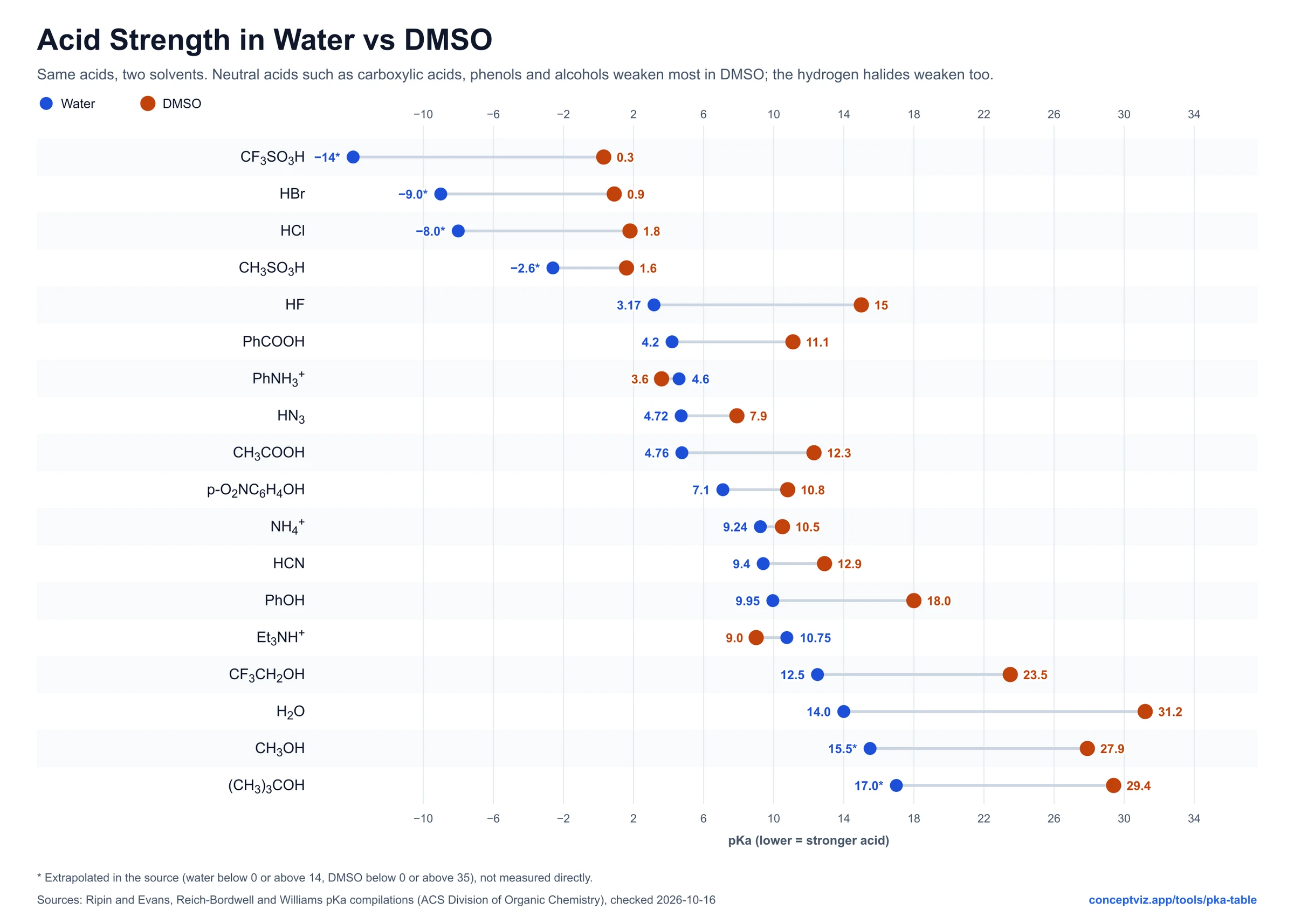
pKa Table
Searchable pKa table with aqueous and DMSO values, conjugate bases and a deprotonation check. Print or download.
 Chemistry
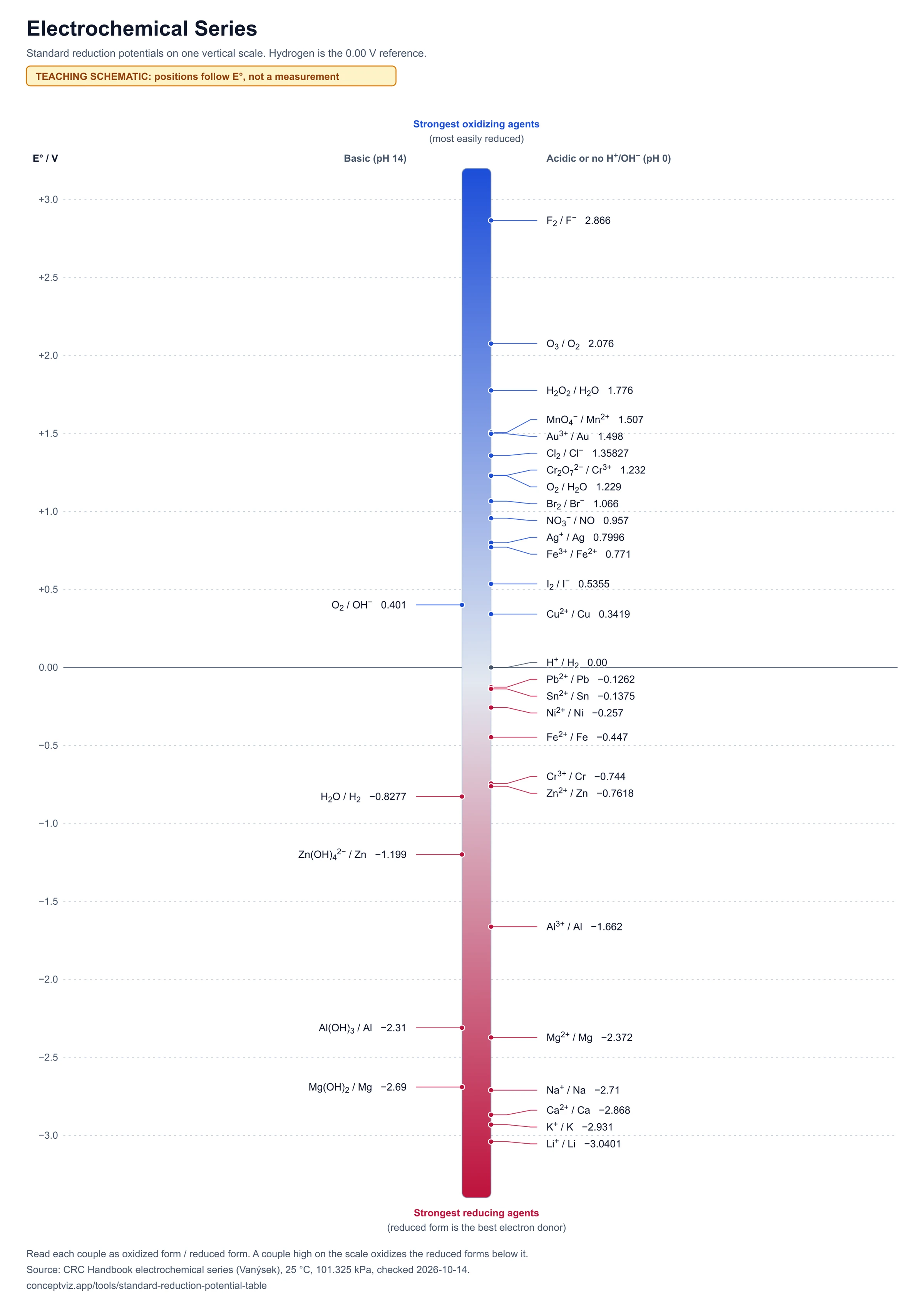
Standard Reduction Potential Table
Half-reactions with E° values, plus a cell potential and ΔG° calculator. Search, sort, print or download.
 Chemistry
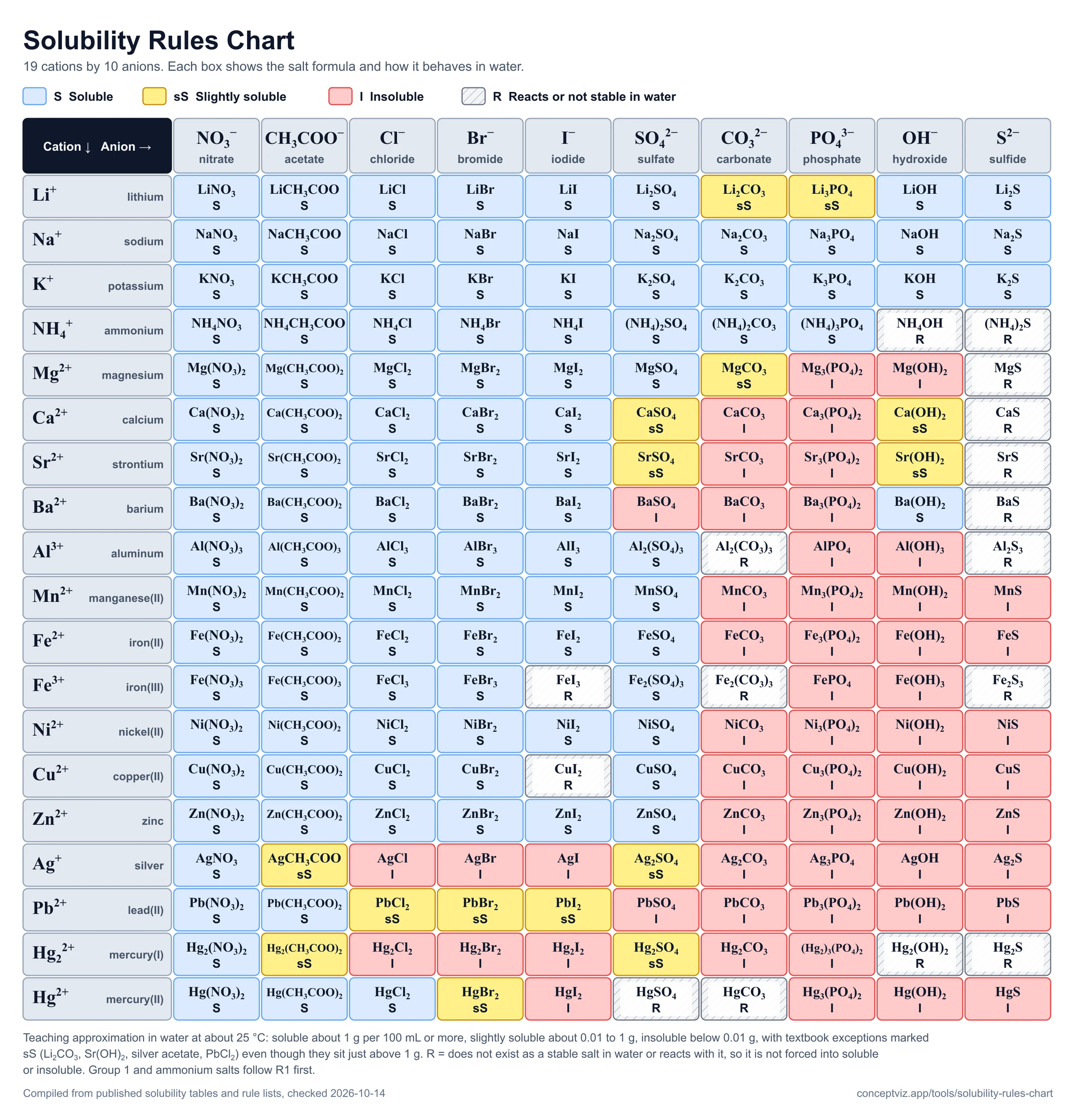
Solubility Rules Chart
Which salts dissolve? Cation by anion solubility chart with a precipitate checker.
 Chemistry
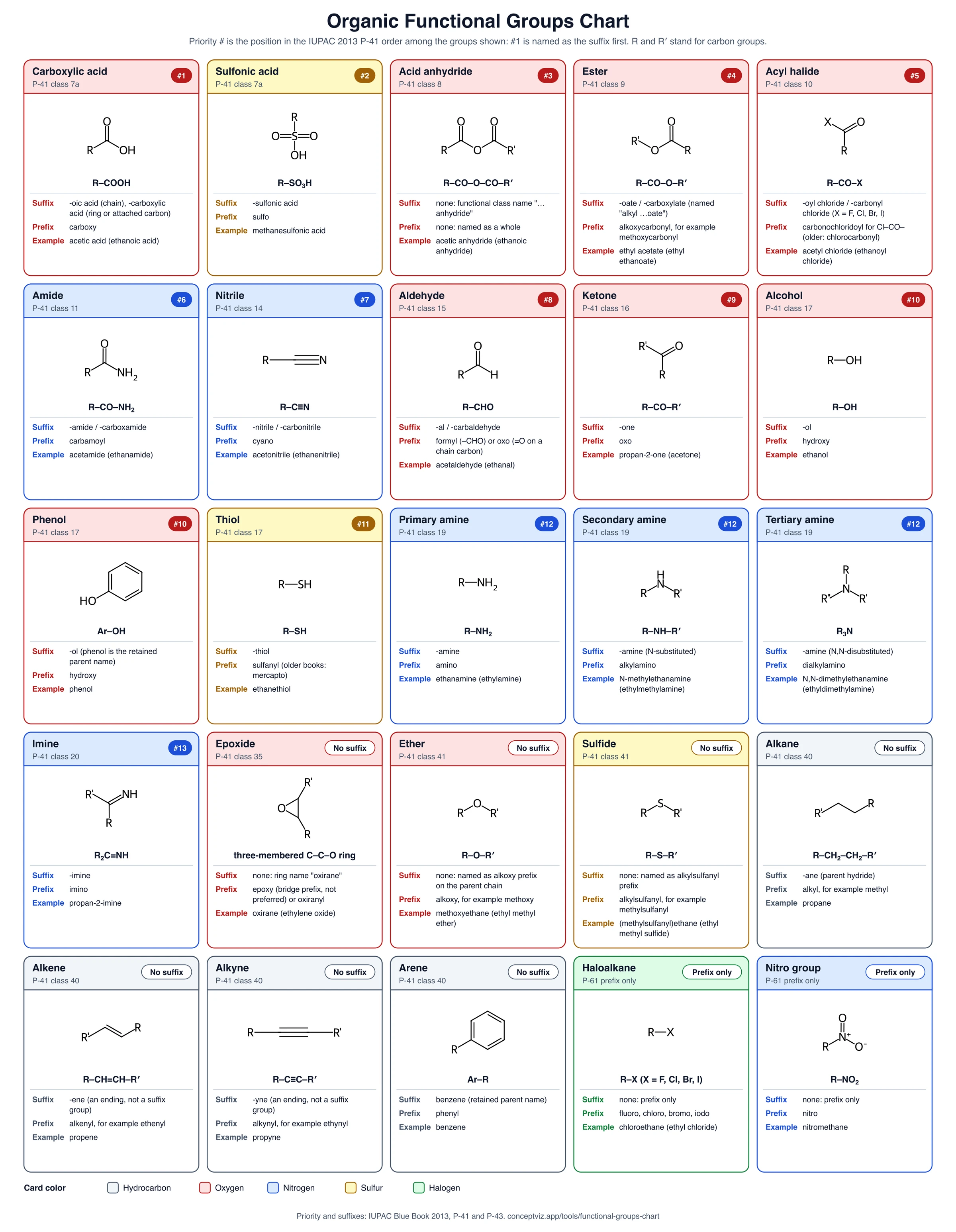
Functional Groups Chart
Organic functional groups ordered by IUPAC priority, with structures, suffixes and examples.