Prime Numbers Chart
Prime numbers chart for 1 to 100, 200 and 1000: prime vs composite, sieve of Eratosthenes steps, prime factorization, a prime checker and printable sheets.
Range
Composite numbers
25 primes from 1 to 100. Select a number to see its factors.
Prime numbers from 1 to 100
2, 3, 5, 7, 11, 13, 17, 19, 23, 29, 31, 37, 41, 43, 47, 53, 59, 61, 67, 71, 73, 79, 83, 89, 97
Free Prime Numbers Charts
Every chart below is drawn by the same code as the tool above. View, download and print them free, no sign-up.
Prime Numbers Chart 1 to 100
The 25 primes up to 100 in a 10 by 10 grid, with the list of primes beside it.
Charts
Lists
How it works
Printable versions
Looking for a plain 1 to 100 grid to color in? Use the hundreds chart generator. To see products and multiples, try the multiplication chart generator, or place numbers on the number line generator. Quick checks: 25 primes up to 100, 97 is the largest, and 91 = 7 × 13.
What is a prime number?
- A prime number is a whole number greater than 1 with exactly two divisors: 1 and itself. The first primes are 2, 3, 5, 7, 11, 13, 17, 19, 23, 29. A number greater than 1 that has more divisors is composite, and it can always be built by multiplying primes. There are 25 primes from 1 to 100, 46 from 1 to 200 and 168 from 1 to 1000, so primes thin out as numbers grow: the first hundred holds 25 of them and the last hundred up to 1000 holds 14.
- The chart shades every prime, leaves composites pale and marks 1 on its own. That is deliberate, because 1 is neither prime nor composite.
Why 1 is not prime, and why 2 is the only even prime
A prime needs two different divisors, and 1 has only one. There is also a deeper reason: if 1 counted as prime, 6 could be written as 2 × 3, 1 × 2 × 3, 1 × 1 × 2 × 3 and so on, and the fundamental theorem of arithmetic (every whole number above 1 has exactly one prime factorization) would be false. Every other even number is divisible by 2, so it has at least three divisors; that makes 2 the only even prime. Zero is not prime either, since every number divides it.
How to tell if a number is prime
- Trial division is the standard test: divide by each prime up to the square root of the number. If none divides it evenly, it is prime. The square root is enough because a composite number n = a × b has one factor at most √n. For 91 the square root is about 9.5, so only 2, 3, 5 and 7 need checking, and 7 divides it: 91 = 7 × 13. That is why 91 looks prime but is not.
- The Prime checker tab runs this test for any whole number up to 1,000,000,000,000 and shows the factorization. For example 360 = 2^3 × 3^2 × 5, 600851475143 has 4 prime factors (71 × 839 × 1471 × 6857) and 999999000001 is prime.
The sieve of Eratosthenes
The sieve finds every prime up to a limit without any division. Write the numbers from 2 up, keep the first uncrossed number, cross out its multiples starting from its square, then move to the next uncrossed number. For 1 to 100 you stop after 7, because the next prime, 11, has a square above 100 and every composite up to 100 has a prime factor of at most 10. The Sieve tab animates each step, and you can pause it or step with Next. If your device asks for reduced motion, autoplay is off and you step by hand.
Patterns in the primes
Twin primes are primes two apart, such as 11 and 13. There are 8 twin prime pairs up to 100 and 35 up to 1000. Primes can also leave long gaps: the widest gap below 1000 is 20, between 887 and 907. Apart from 2 and 3, every prime is one more or one less than a multiple of 6, and every prime above 5 ends in 1, 3, 7 or 9. Among the 168 primes to 1000 the last digits split as 40 ending in 1, 42 in 3, 46 in 7 and 38 in 9.
Prime factorization and the fundamental theorem
Every whole number above 1 is either prime or a product of primes in exactly one way, apart from the order. Factor trees and repeated division both find it. Writing repeated primes with exponents gives the short form, so 360 is 2^3 × 3^2 × 5 and has 24 divisors. Prime factorizations are how you find a greatest common factor or a least common multiple, and they underlie the encryption that protects online payments. The factorization sheet in the Printables tab lists every number from 2 to 100.
Frequently Asked Questions
Related Math Tools
 Education
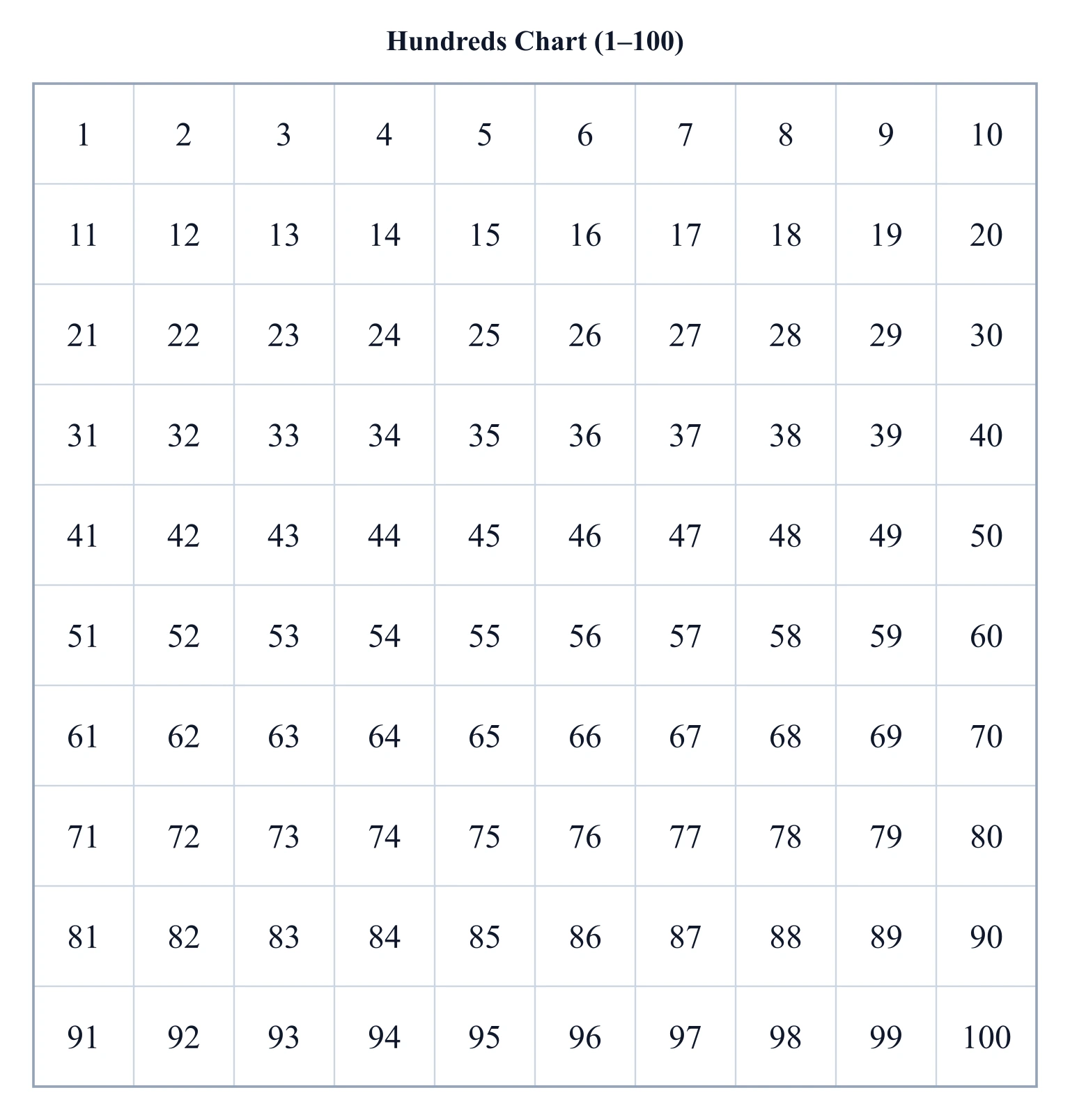
Hundreds Chart Generator
Make a printable hundreds chart, a 10 by 10 grid of 1 to 100. Skip count, highlight multiples or primes, or print a blank chart.
 Education
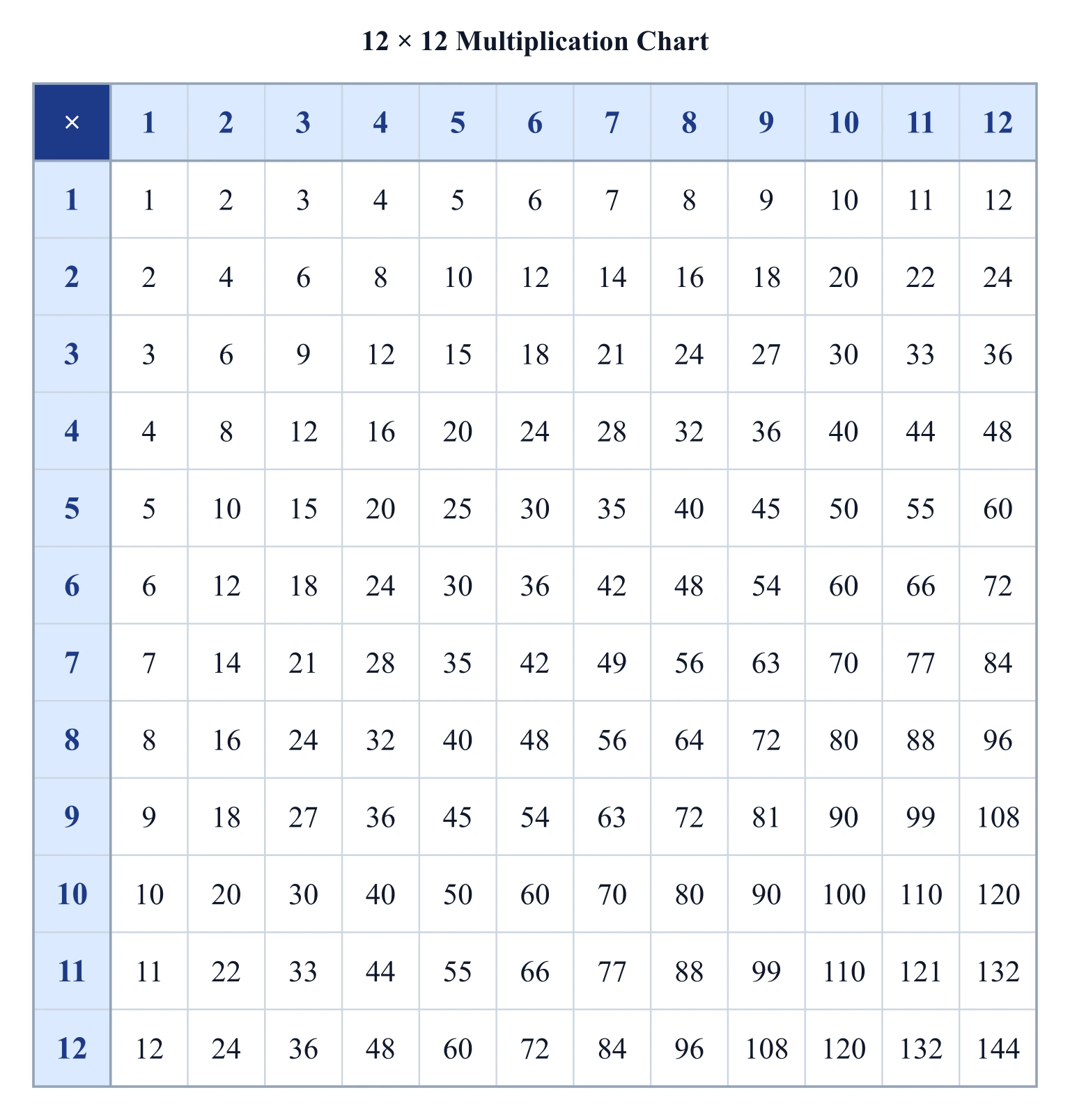
Multiplication Chart Generator
Create a printable multiplication chart, pick the grid size, highlight any times table, and export a clean SVG or PNG.
 Education
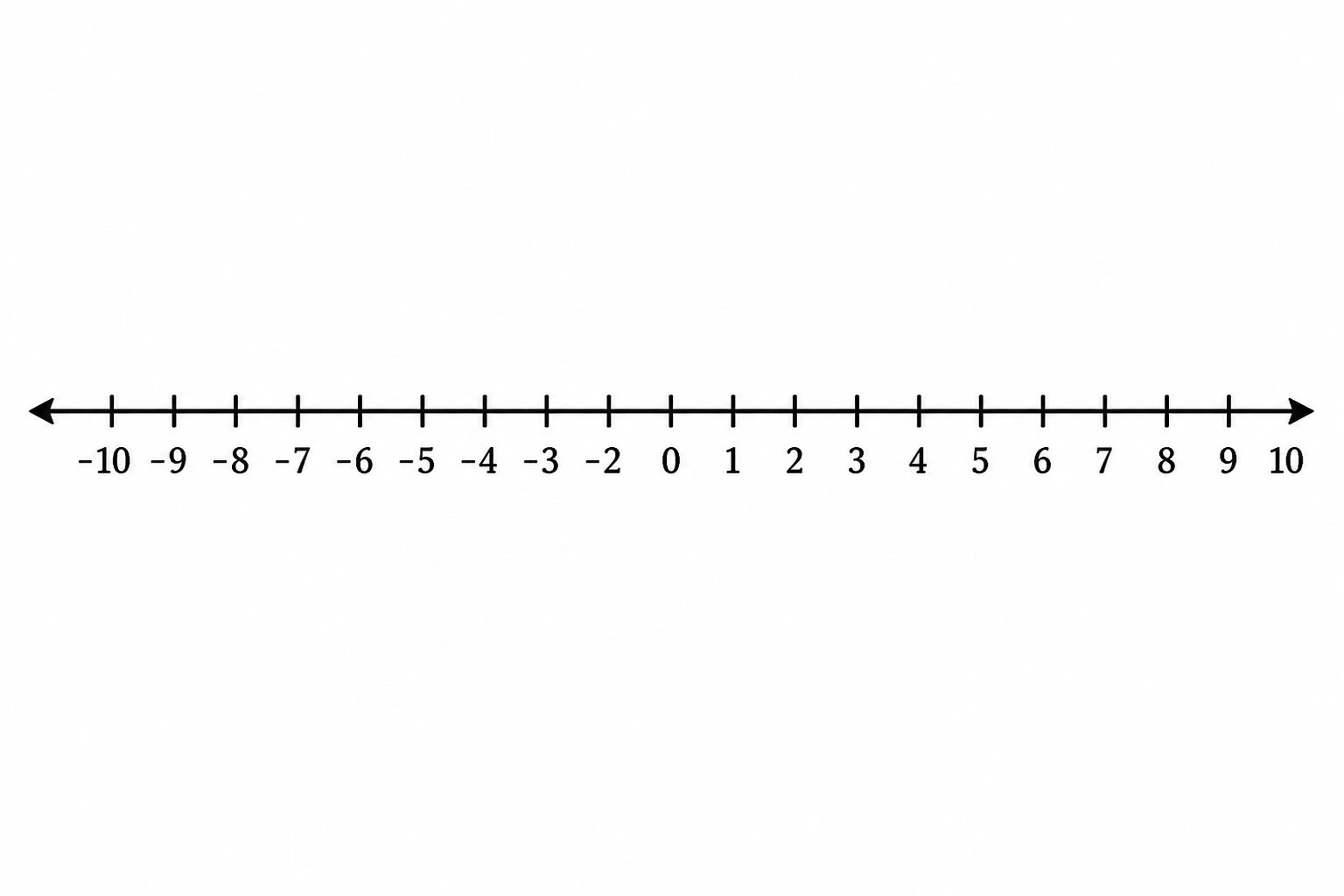
Number Line Generator
Create clean, printable number lines: plot points, graph inequalities and intervals, and mark fractions or decimals.