Printable Periodic Table With Charges & Atomic Mass
Free printable periodic table with ion charges, atomic mass, blank and color versions. A4 and Letter landscape, color or black and white. PNG, SVG or print.
Version
Paper (landscape)
Printing
Group 3 and the f-block
Print on A4 landscape. PNG is about 300 dpi.
Scroll sideways on small screens. Click an element for its details.
Click any element in the table to see its atomic weight, common ion charges, group, period and periodic trend values.
Free Printable Periodic Tables
Every table below is drawn from the same checked data as the tool above. View, download and print them free, no sign-up.
Periodic Table with Charges
All 118 elements with the common ion charges, such as +1 for sodium and −2 for oxygen.
Reference tables
Printer friendly
Practice sheets
What is on a periodic table with charges?
A periodic table with charges prints the usual ion charge under each element symbol, so you can read that sodium forms Na+, oxygen forms O2−, and iron forms Fe2+ or Fe3+ without working it out from the group. The charge shown is the common charge an element shows in compounds, as taught in general chemistry. It is common charges, not every oxidation state. Most main group metals show one charge (tin, lead and thallium show two), most nonmetals show the negative charge of their ion, and many transition metals show two. Boron, carbon and silicon are left blank because they usually form covalent bonds and have no common simple ion, and so are the noble gases, which rarely form ions. Elements from rutherfordium onward are blank too because their chemistry is not established well enough to teach.
Which version should you print?
- With charges: for ionic compounds, naming and writing formulas.
- With atomic mass: for molar mass, stoichiometry and percent composition. Values are IUPAC abridged standard atomic weights. Elements with no standard value show the mass number of their longest-lived isotope in square brackets.
- Category colors: for learning families such as alkali metals, halogens and noble gases. The black and white option replaces colors with grays and light patterns.
- Blank with numbers or blank grid: for quizzes, homework and labeling practice. Print the filled version next to it as an answer key.
How to print it so the symbols stay readable
- Pick the paper size first, A4 or US Letter, then print in landscape. The chart is drawn for that exact page, so the symbols print at about 16 pt and the atomic numbers, charges and masses at about 7 pt on either size.
- In the print dialog choose 100 percent or fit to page, turn margins to default and enable background graphics if you use the color version. The PNG download is about 300 dpi, so it also prints well from a photo or document app.
- Element names are optional because they print at about 5 pt. Leave them off for classroom handouts that will be photocopied and turn them on for a poster-size print.
Where do lanthanum and lutetium go?
The default layout is the common textbook one. Group 3 holds scandium and yttrium, then a placeholder, and the lanthanides lanthanum to lutetium and the actinides actinium to lawrencium sit in two rows below. IUPAC provisionally recommended in 2021 that group 3 should contain scandium, yttrium, lutetium and lawrencium, which leaves 14 elements in each f-block row. Switch the layout option above to see that version. Both are valid ways to draw the same elements, so follow the one your course uses.
How the data was checked
Atomic weights come from the IUPAC Commission on Isotopic Abundances and Atomic Weights (CIAAW) abridged table for 2024. Names, categories and the other values were cross-checked against PubChem and Wikipedia data pages. Common charges were cross-checked against published charge tables and open chemistry textbooks, and where they disagreed we kept the charge most sources agree on. Some courses teach slightly different charges for elements such as tin, lead, mercury (mercury(I) exists as Hg₂²⁺) and the lanthanides, so use your own textbook when it differs.
Frequently Asked Questions
Related Chemistry Tools
 Chemistry
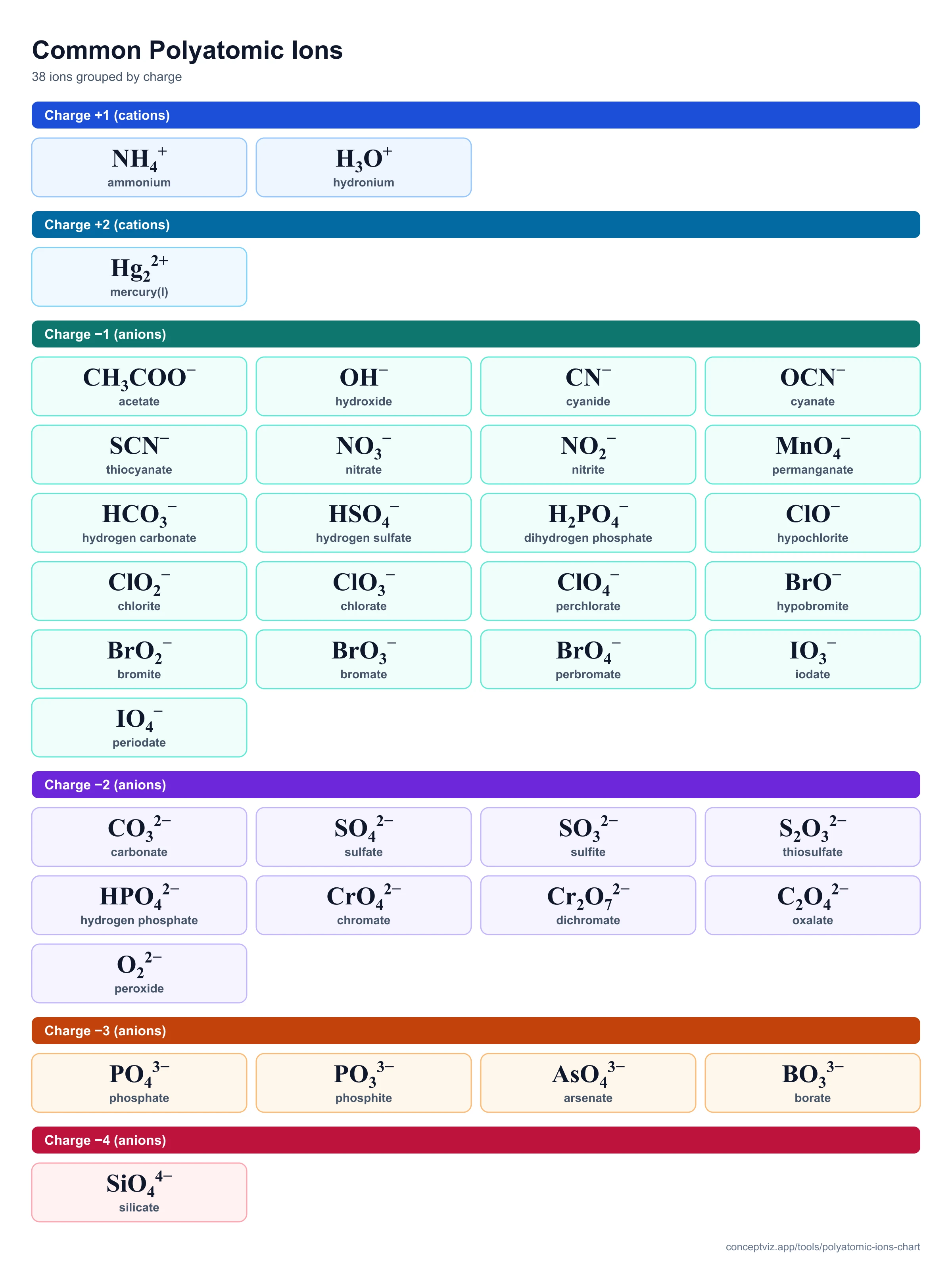
Polyatomic Ions Chart
Printable list of 38 common polyatomic ions with charges, naming rules and flashcards.
 Chemistry
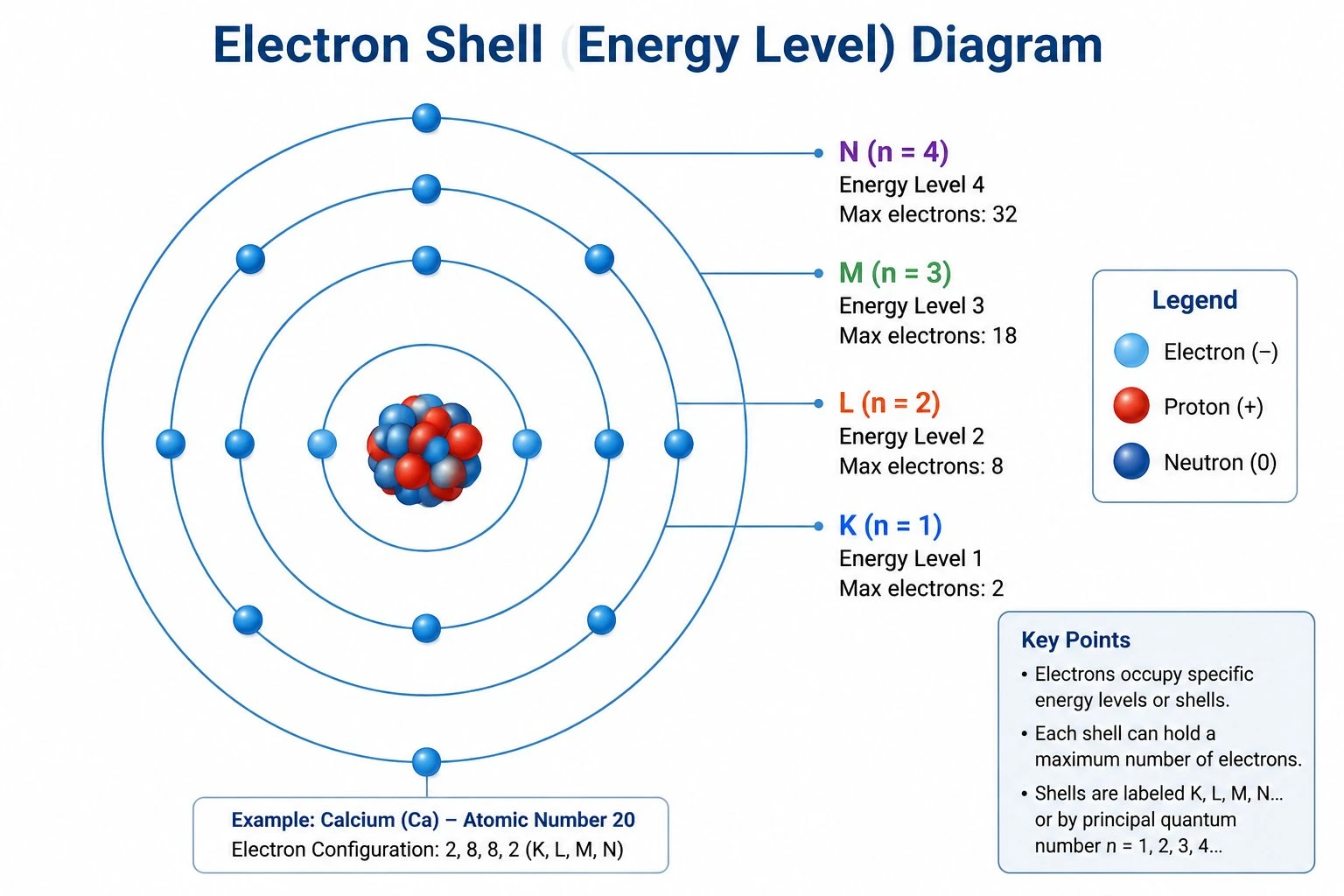
Electron Configuration Diagram
Shell and orbital box diagrams that explain why elements form the charges they do.
ChemistryBohr Model Maker
Build Bohr model diagrams with electron shells for any element.