Research Poster Size Guide: Conference Dimensions Compared
Research poster sizes at 9 conferences with official links, an A0 fit check, pixels per print size, and the text size that works at each reading distance.
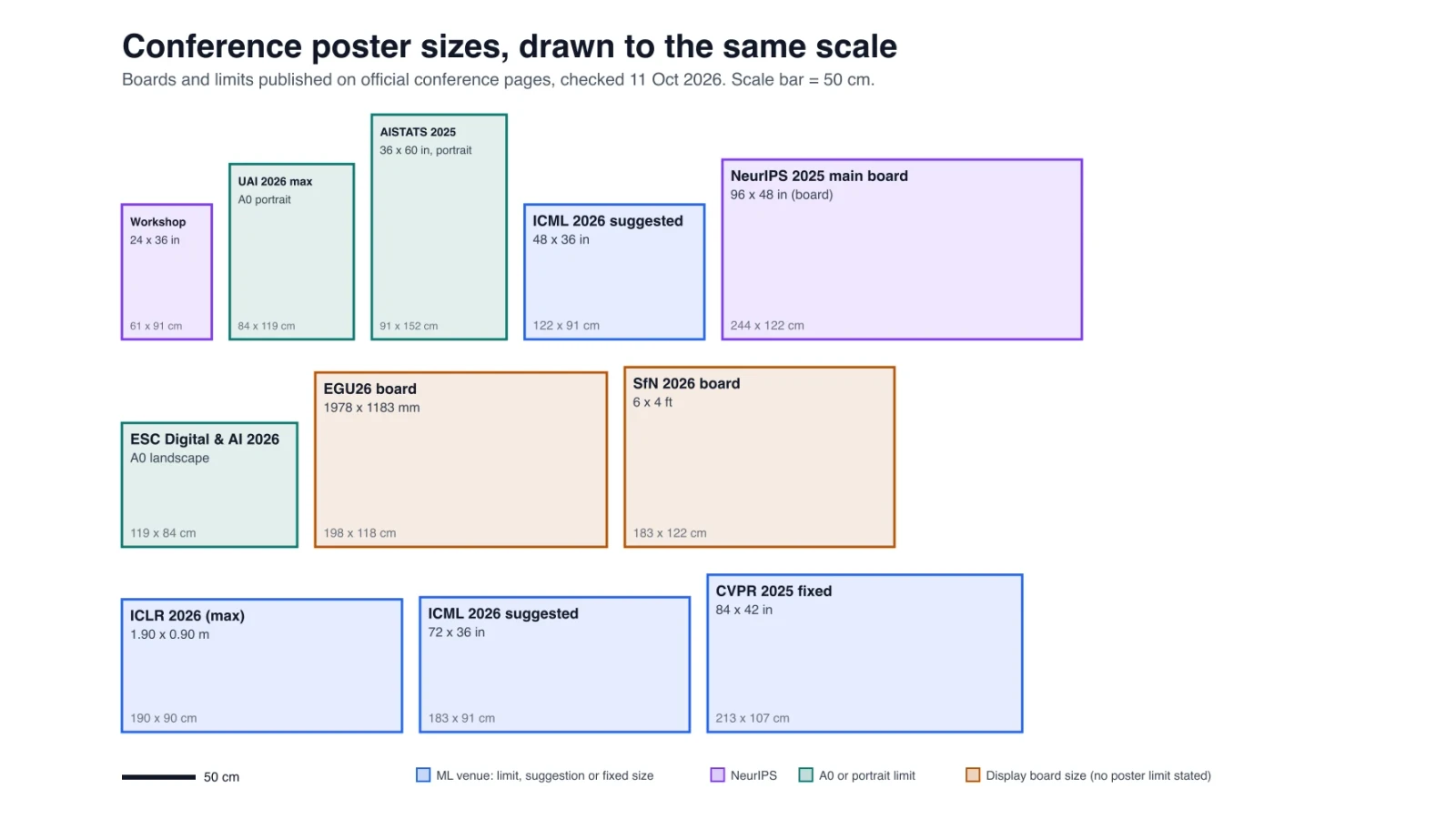
There is no standard research poster size. The size you print is the one on your conference's poster page, and those pages disagree more than most people expect: the nine events we checked publish numbers that run from a 61 × 91 cm (24 × 36 in) workshop poster to a 244 × 122 cm (96 × 48 in) board, and a poster that is fine at one venue can be too tall for the next.
Quick answer: read your conference's poster instructions first. If they only give a board size, make the poster slightly smaller than the board. If they say "A0", use 841 × 1189 mm and check the orientation. If you have no instructions at all, 48 × 36 in landscape or A0 are the safe defaults in most halls, but the table below shows where even those fail.

Scientific Poster Generator
Describe your study and get a designed poster draft with title, methods, results, and conclusion blocks. Rebuild the final file at your venue's exact print size.
Try it free →This guide is about the numbers: which size each venue publishes, how to convert between inches and millimeters, how many pixels a print needs, and how large your text must be for the distance people actually stand. If you want ready-made layouts at these sizes, use our scientific poster templates; we do not repeat them here.
Research poster sizes at nine conferences
We read each venue's official poster page on 11 October 2026 and copied what it says. Machine-learning venues publish the most precise numbers, so they dominate the rows; life-science societies will be added in a later update. Where the 2026 page was missing or not yet updated, the row uses the 2025 page and is marked. "Type" tells you how binding the number is, because a board size, a maximum, and a suggestion are three different things.
| Event (page checked) | What the page says | Type | Orientation | In (W × H) | Cm (W × H) |
|---|---|---|---|---|---|
| NeurIPS 2025 (2026 page not yet updated) | Main conference: boards are 96 × 48 in, poster can be any size that fits | Board | Not stated | 96 × 48 | 244 × 122 |
| NeurIPS 2025 workshops and Mexico City | "Please make your posters 24W x 36H inches"; lightweight paper | Requested size | Portrait (San Diego workshops) | 24 × 36 | 61 × 91 |
| ICML 2026 main | Suggested sizes 36 H × 48 W, 36 H × 60 W, 36 H × 72 W | Suggestion | Not stated | 48 × 36, 60 × 36, 72 × 36 | 122 × 91, 152 × 91, 183 × 91 |
| ICML 2026 workshops | Must not exceed 36 H × 24 W | Maximum | Portrait | 24 × 36 | 61 × 91 |
| ICLR 2026 main | Maximum 1.90 m × 0.90 m (the page also prints 76.4 × 37.4 in, which is a little larger) | Maximum | Landscape | 74.8 × 35.4 | 190 × 90 |
| ICLR 2026 workshops | Maximum 61 × 91 cm | Maximum | Portrait | 24 × 36 | 61 × 91 |
| CVPR 2025 (no 2026 page found) | Posters are 84 × 42 in, aspect ratio 2:1, landscape | Fixed print size | Landscape | 84 × 42 | 213 × 107 |
| UAI 2026 | "All posters should fit the A0 portrait format" | Maximum | Portrait | 33.1 × 46.8 | 84.1 × 118.9 |
| AISTATS 2025 (no 2026 page found) | Maximum "60 inches × 36 inches", portrait; foamboard stand 78.7 × 39.4 in | Maximum | Portrait | 36 × 60 (our reading) | 91 × 152 |
| SfN Neuroscience 2026 | A 6 ft by 4 ft poster board per presenter | Board | Not stated | 72 × 48 | 183 × 122 |
| EGU26 | Landscape boards; "full dimensions of 1978 mm width × 1183 mm height" | Board | Landscape | 77.9 × 46.6 | 198 × 118 |
| ESC Digital & AI Summit 2026 | "A0 Poster size - 84,1 cm (height) x 118,9 cm (width)"; one sheet only | Required size | Landscape | 46.8 × 33.1 | 118.9 × 84.1 |
Two cautions on the table. The AISTATS page lists "60 inches × 36 inches" next to "portrait", so we read it as 36 in wide and 60 in tall; the page also gives the foamboard stand as "78.7 × 39.4 in (200 × 100 cm) portrait", written height first like "60 × 36", which supports that reading, but confirm with your session chair. And the ICLR page gives the metric and inch figures slightly differently, so plan for the smaller one. Poster pages change from year to year (NeurIPS 2025 and CVPR 2025 are last year's pages), so treat this as a map of how much venues vary, then check your own year.
Not listed: ACS and AGU. Their official pages could not be read in our check (one blocked automated access, one returned an empty document), and third-party copies of those numbers disagree with each other, so we left them out.
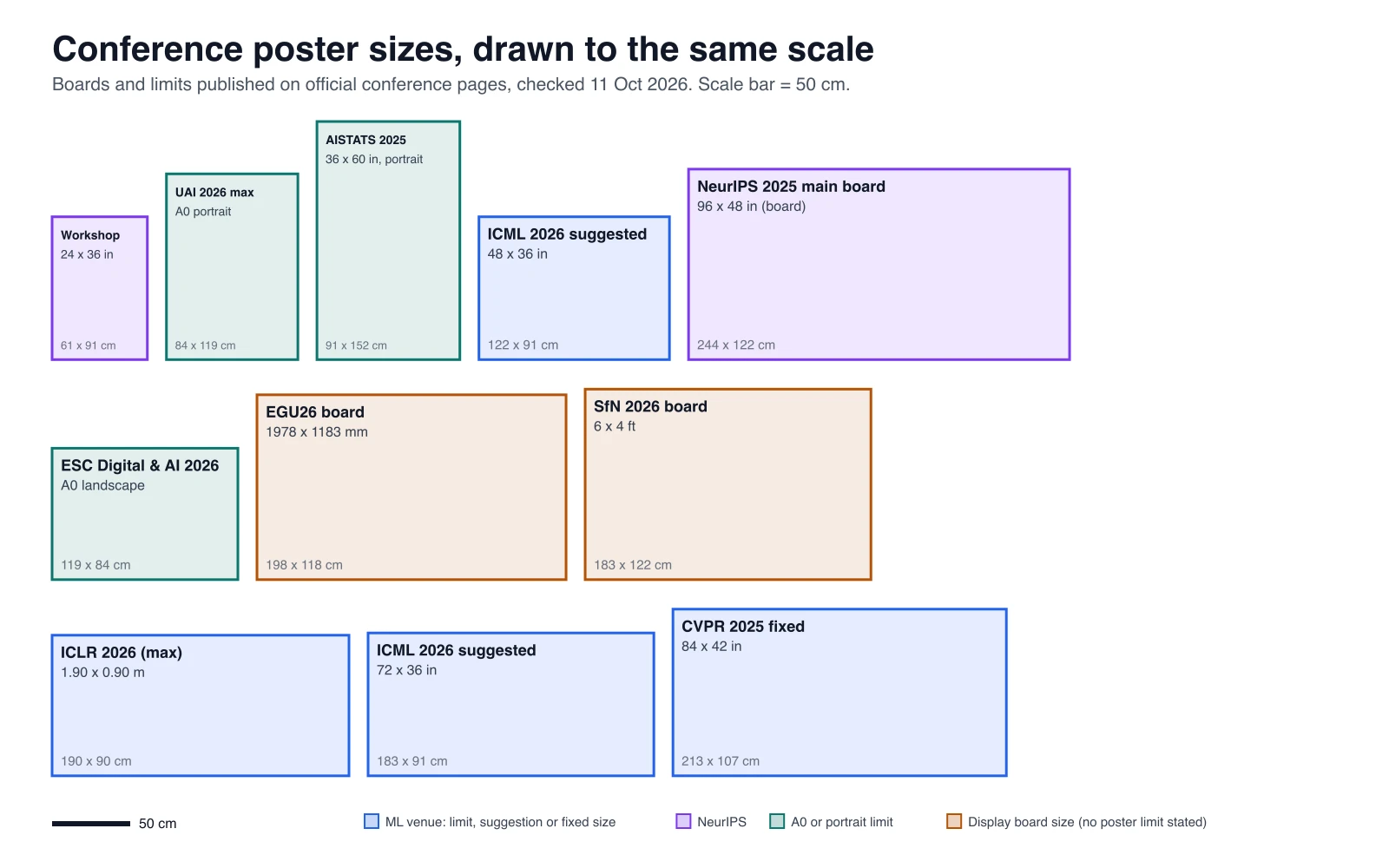
Exact SVG chart rendered from the numbers in the table above. Colors show how binding each number is. Source pages and check date are in the table. "Workshop" is the 24 x 36 in portrait size asked for or capped by the NeurIPS 2025, ICML 2026 and ICLR 2026 workshops. ICML's 60 x 36 in suggestion (152 x 91 cm) is in the table but not drawn.
What the table tells you
- Three kinds of numbers. A board size (NeurIPS main, SfN, EGU) is the space you may use, not a required poster size. A maximum (ICLR, UAI, AISTATS) is a hard ceiling. A fixed print size (CVPR) means the venue's print vendor makes it at that size. Read which one your instructions give before you design.
- Machine-learning venues are wide and short. ICLR, CVPR and ICML main-conference posters are 90 to 107 cm tall (ICML's three suggestions are all 36 in high), so a tall portrait poster does not fit.
- Neuroscience and geoscience give you a board, not a rule. SfN's page states only the board; EGU states the board dimensions and that it is landscape. Anything that fits works.
- Some venues ask for A0, but not the same A0. UAI wants A0 portrait; the ESC summit wants A0 landscape. Same paper size, opposite orientation.
Does an A0 poster fit? A check across the same nine venues
A0 is the size people copy from one conference to the next, so we checked it against each venue's published dimensions. A0 is 841 × 1189 mm (the UAI page states it as 84.1 × 118.9 cm). This is our own arithmetic from the numbers above, not something the venues state.
| Venue | A0 portrait (841 W × 1189 H mm) | A0 landscape (1189 W × 841 H mm) |
|---|---|---|
| NeurIPS 2025 main board | Fits | Fits |
| NeurIPS 2025 workshop | Too big | Too big |
| ICML 2026 main (48 × 36 in suggestion) | Too tall | Fits |
| ICLR 2026 main (1.90 × 0.90 m) | Too tall | Fits |
| CVPR 2025 (84 × 42 in) | Too tall | Fits |
| UAI 2026 | Fits (required orientation) | Orientation not allowed |
| AISTATS 2025 (read as 36 W × 60 H in) | Fits | Too wide |
| SfN 2026 board (6 × 4 ft) | Fits, about 3 cm spare in height (the page does not state orientation; calculated as 72 in wide by 48 in high) | Fits |
| EGU26 board (1978 × 1183 mm) | Too tall by 6 mm | Fits |
| ESC Digital & AI 2026 | Not allowed | Required |
Of the seven rows that allow landscape (NeurIPS, ICML, ICLR, CVPR, SfN, EGU, ESC), landscape A0 fits all seven and portrait A0 fits only two (the NeurIPS and SfN boards). If your lab reuses one A0 file for several meetings, build it landscape unless a venue says portrait.
Inches or A-series: converting without mistakes
Venues tend to quote either inches (ICML, CVPR and NeurIPS use them) or the ISO A series (UAI and the ESC summit use A0), though the table shows exceptions such as AISTATS using inches. The two do not line up, so do not round one to the other. The common ones:
| Size | Millimeters | Inches | Aspect ratio (long : short) |
|---|---|---|---|
| A0 | 841 × 1189 | 33.1 × 46.8 | 1.41 : 1 |
| A1 | 594 × 841 | 23.4 × 33.1 | 1.41 : 1 |
| 48 × 36 in | 1219 × 914 | 48 × 36 | 1.33 : 1 (4:3) |
| 36 × 24 in | 914 × 610 | 36 × 24 | 1.5 : 1 (3:2) |
| 84 × 42 in (CVPR) | 2134 × 1067 | 84 × 42 | 2 : 1 |
A1 is exactly A0 cut in half, so any A0 layout scales to A1 by a factor of 0.707. Moving between A0 and 48 × 36 in changes the shape, not just the size: a 48 × 36 in layout is 1.33 : 1, while A0 is 1.41 : 1, so you will gain or lose a strip along one edge. Rebuild the layout rather than stretching it.
How many pixels does a printed poster need?
Pixel size is print size in inches times pixels per inch (ppi). That one formula answers "what resolution should my figure be", and the answer for a full-size image is larger than most people guess.
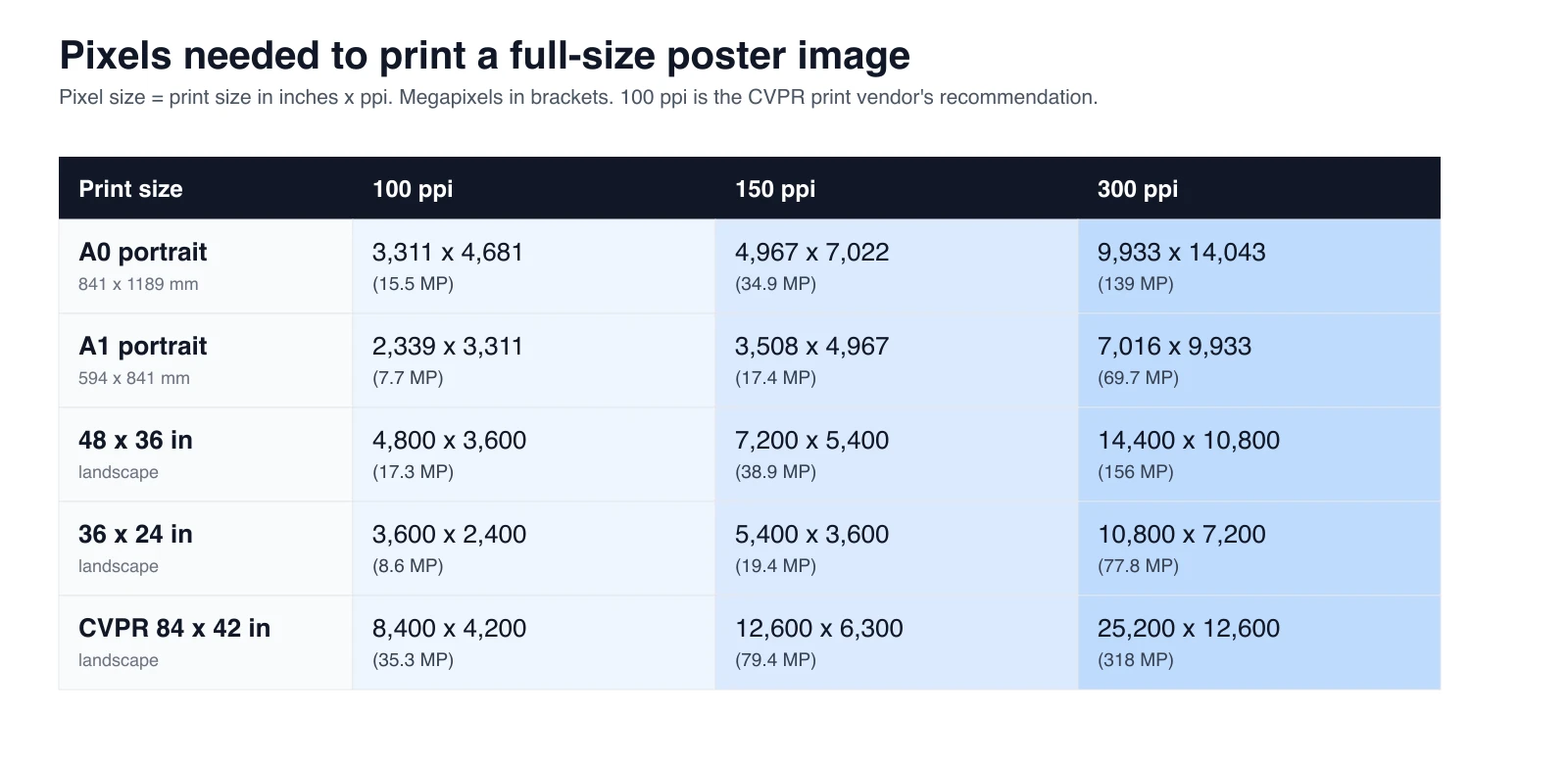
Exact SVG table computed from print size x ppi. A0 uses 841 and 1189 mm converted at 25.4 mm per inch.
- Where a single full-poster image is concerned, an A0 image at 150 ppi is about 35 megapixels and at 300 ppi about 139 megapixels.
- A venue's own print vendor may ask for less. The CVPR page says "100 DPI or vector art at full size is recommended", and that the file is scaled automatically if needed. At 100 ppi an 84 × 42 in poster is 8,400 × 4,200 pixels.
- Figures matter more than the whole poster. What a viewer sees up close is each photo and chart. A figure printed 10 inches wide needs about 3,000 pixels across for 300 ppi, or 1,500 for 150 ppi. Charts exported as vector PDF or SVG have no resolution limit, so use vectors wherever your software allows.
- Do not upscale. A small screenshot stretched to fit a box has the same pixels it started with, only bigger. Re-export from the original data or microscope file at the size it will print.
- An AI-generated poster draft is a design sketch. Use it to choose a layout, then rebuild the final file with your own figures at the size your venue needs.
Designing a poster larger than PowerPoint allows
PowerPoint's custom slide size accepts 1 to 56 inches in either direction, according to Microsoft's slide size help page (checked 11 October 2026). A0 (46.8 in) and 48 × 36 in fit; 84 × 42 in (CVPR), 76.4 in (the ICLR page's inch figure) and 72 × 36 in (an ICML suggestion) do not.
For those, design at half scale. For CVPR that means a 42 × 21 in file with the same 2:1 shape. Then tell your printer the final size is 84 × 42 in, or scale it to 200 percent in the export. Every measurement doubles with it, including text: a 24 pt body in the half-size file prints as 48 pt. Check the PDF page size before you send it, and print a small proof at half size if your vendor offers one.
How big should text be for the distance people stand?
Text size on a poster follows one rule: the farther the reader, the larger the letters, in direct proportion. We scaled it from ordinary reading. Printed body text is usually 10 to 12 pt read at about 40 cm. Standing twice as far needs text twice as large to look the same to the eye.
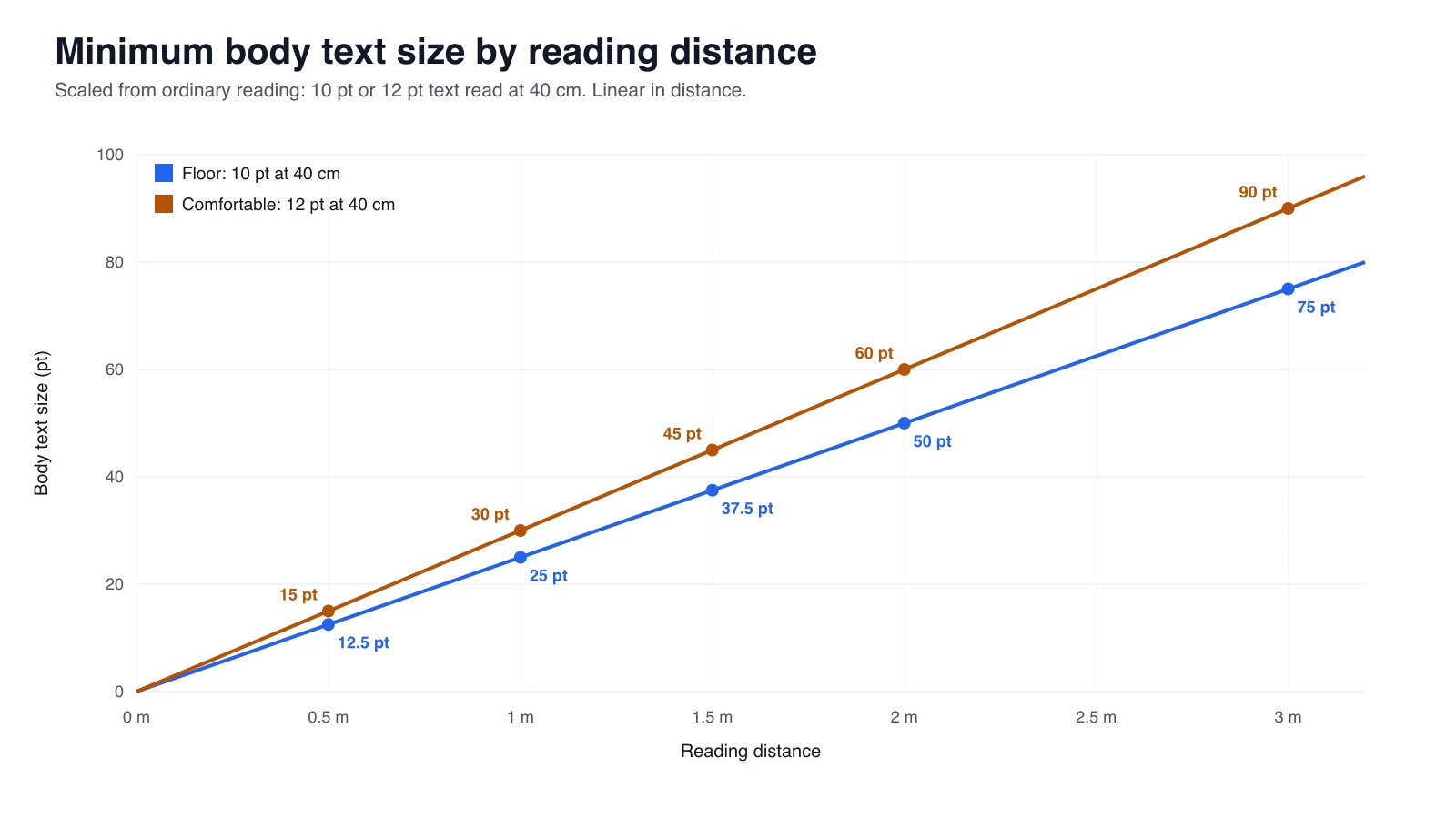
Exact SVG chart of text size = baseline size x distance / 40 cm. This is our own scaling estimate, not a venue requirement.
| Reading distance | Floor (10 pt at 40 cm) | Comfortable (12 pt at 40 cm) | Typical situation |
|---|---|---|---|
| 0.5 m | 12.5 pt | 15 pt | Reading while leaning in |
| 1 m | 25 pt | 30 pt | Standing at a poster in a busy aisle |
| 1.5 m | 37.5 pt | 45 pt | Section headings read from the aisle |
| 2 m | 50 pt | 60 pt | Subheads and key numbers |
| 3 m | 75 pt | 90 pt | The title |
Use the table to sanity-check sizes, not to choose a typeface. For recommended pt sizes per poster size, typefaces, and word counts, see our guide to scientific poster font sizes. At 1 m the floor lands at 25 pt, in line with the 24 to 32 pt body text range in the print checklist of our template guide.
Checklist before you send the file to print
- Find the instruction page and copy the number, the unit, and whether it is a board, a maximum, a suggestion, or a fixed size.
- Match orientation. UAI and AISTATS say portrait, CVPR and ICLR say landscape, ESC says landscape A0. Many pages say nothing.
- Leave a margin. Keep text and logos at least 2.5 cm (1 in) inside the edge, and stay a little under a board's size so pins have room.
- Set the page to the real size (or half size for anything over 56 in), not a 16:9 slide.
- Check figure pixels against the table above, or use vector files.
- Export a PDF with fonts embedded and confirm the PDF page size matches the order.
- Print a letter-size proof and read it at arm's length. Text that is crisp at 100% zoom on screen can still be too small at the viewing distance.
- Check lead time. Many print vendors have early-bird and rush prices tied to the conference date, as the CVPR page does.
Scientific Poster Generator
Generate a layout draft from your abstract, then rebuild it at the exact size from the checklist above. Start free with 2 image credits, valid for 7 days, no card required.
Related Guides
- Scientific Poster Templates: 7 Free PowerPoint Layouts: ready-made files at 48 × 36 in, A0, A1 and more
- Scientific Poster Font Sizes: type sizes and typefaces by poster size
- Academic Poster Design: Complete Guide: sections, layout, and color
- PhD Poster Design Guide: a step-by-step workflow
- Scientific Poster Examples: award-winning designs to copy from
- How to Present References on a Poster: citation formats that fit
Frequently Asked Questions
What is the standard size for a research poster?
There is no single standard. Among the nine events we checked in October 2026, sizes ranged from 24 x 36 in workshop posters to the 96 x 48 in NeurIPS main-conference board, with A0, a 6 x 4 ft board and the 84 x 42 in CVPR landscape poster in between. Use the size on your conference's poster page.
What is the most common conference poster size?
For physical posters, there is no universal size. Among the nine events we checked, only UAI and the ESC summit name A0 explicitly, and ICML suggests 48 x 36 inches (1219 x 914 mm) first. A quoted size can be a board, a maximum, or a suggestion. In our check, landscape A0 fit all seven rows that allow landscape, while portrait A0 fit only two of them.
Is A0 the same as 36 x 48 inches?
No. A0 is 841 x 1189 mm (33.1 x 46.8 in) with a 1.41 : 1 shape, while 36 x 48 in is 914 x 1219 mm with a 1.33 : 1 shape. A 36 x 48 in poster is wider and slightly shorter than A0, so a layout cannot be moved between them without reworking it.
What resolution should I use for a conference poster?
Pixel size equals print size in inches times ppi. For photos and micrographs, 150 to 300 ppi at final print size is the usual range; the CVPR print vendor recommends 100 DPI or vector art at full size. Export charts as vector PDF or SVG where you can.
Can I make a poster in PowerPoint if it is larger than 56 inches?
PowerPoint's custom slide size accepts 1 to 56 inches per side, so a larger poster must be designed at half scale and printed at 200 percent. Microsoft documents the 56-inch limit on its slide size help page.
How large should poster text be?
Scale from normal reading: 10 to 12 pt text read at 40 cm needs about 25 to 30 pt at 1 m and 50 to 60 pt at 2 m. This is a scaling estimate, not a venue rule. See our font size guide for typefaces and size tables by poster format.
Do I need a different poster size for a workshop?
Often, yes. NeurIPS 2025 workshops asked for 24 x 36 in portrait, ICML 2026 workshops cap posters at 36 H x 24 W in portrait, and ICLR 2026 workshops cap them at 61 x 91 cm portrait. Main-conference boards are much larger.
Can ConceptViz make a poster at my exact print size?
The scientific poster generator creates a designed poster draft from your description. Treat it as a layout to rebuild at your venue's exact size with your own figures. New accounts start free with 2 image credits, valid for 7 days, with no card required.
Further Reading
Categories
More Posts
Free Printable Water Cycle Worksheets for Teachers (2026)
Free printable water cycle worksheets for elementary, middle, and high school, with labeled diagrams, blank quiz worksheets, and NGSS-aligned activities.
How to Create a Vector Image: A Complete Guide for Beginners and Researchers
Learn how to create vector images using Inkscape, Illustrator, and AI tools. Covers the SVG format, tracing raster images, and best practices for illustration.
Bode Plot Generator Guide: Make Magnitude and Phase Plots from a Transfer Function
Learn how to use a Bode plot generator, enter transfer functions correctly, read magnitude and phase plots, and avoid common frequency-response mistakes.