Urinary System Diagram Generator for Labeled & Blank Diagrams
Create a clearly labeled urinary system diagram in seconds. Show the kidneys, renal arteries and veins, ureters, urinary bladder, and urethra — or generate a blank, unlabeled version for worksheets and quizzes. Free to use.
Urinary System Diagram Generator
Free to try ·
Your urinary system diagram will appear here
Describe what you need and click Generate
Urinary System Diagram Examples
Labeled diagrams of the kidneys, ureters, bladder, urethra, and urine flow pathway
Full Urinary System (Labeled)
The complete system at a glance — both kidneys, the ureters, bladder, and urethra, all labeled in anterior view.
Male vs Female Urinary Systems
Both sexes side by side — same kidneys, ureters, and bladder, different urethra anatomy labeled on each.
Urinary System for Kids
A kid-friendly version with simple shapes and large labels — perfect for an elementary science class.
How Urine Flows
The step-by-step journey of urine: from the nephron through the renal pelvis, down the ureter, into the bladder, and out.
Kidney in the Urinary System
A kidney cross-section in context — cortex, medulla, pelvis, and calyces labeled, with the ureter connecting to the rest of the system.
Blank Urinary System Worksheet
An unlabeled, print-ready diagram with numbered blanks — use it as a quiz or fill-in worksheet.
What is the urinary system?
The urinary system — also called the renal system — is the set of organs that filters blood, removes metabolic waste, and excretes it from the body as urine. It also regulates blood volume, blood pressure, electrolyte balance, and blood pH, making it one of the body's key homeostatic systems. The main organs are the two kidneys (which filter blood), the ureters (which carry urine from each kidney to the bladder), the urinary bladder (which stores urine), and the urethra (which carries urine out of the body). This generator draws the whole system with each part clearly labeled.
The organs: from kidneys to urethra
- Kidneys: two bean-shaped organs positioned on either side of the vertebral column, just below the rib cage. Each kidney contains about one million nephrons — the tiny filtering units that produce urine. The renal artery delivers blood to each kidney, and the renal vein carries filtered blood back to the inferior vena cava.
- Ureters: two muscular tubes, one from each kidney, that carry urine down to the bladder using peristaltic contractions. They enter the bladder at an angle that prevents backflow.
- Urinary bladder: a muscular, hollow organ in the pelvic cavity that stores urine until it is expelled. A healthy adult bladder holds about 400–600 mL and signals the urge to void at roughly half capacity.
- Urethra: the tube that carries urine from the bladder out of the body. It is about 3–4 cm long in females (opening just anterior to the vagina) and about 20 cm long in males (passing through the prostate and penis), which is why urinary tract infections are more common in females.
How urine is formed: the nephron
Each nephron runs through three stages. First, filtration: blood enters the glomerulus (a tiny knot of capillaries inside Bowman's capsule) under pressure. Water, ions, glucose, urea, and other small molecules are forced into the capsule to form a filtrate; large proteins and blood cells stay behind. Second, reabsorption: as filtrate flows through the proximal convoluted tubule, the loop of Henle, and the distal convoluted tubule, the body reclaims about 99% of the water, all the glucose, and most of the ions it needs. Third, secretion: the tubules actively dump extra waste products — such as hydrogen ions and creatinine — into the filtrate. What remains flows into the collecting duct and then into the renal pelvis as concentrated urine.
Urine flow from kidney to outside the body
Once urine leaves the collecting ducts, it drains into the minor calyces, then the major calyces, and collects in the funnel-shaped renal pelvis at the center of the kidney. From there, peristaltic waves push urine down the ureter to the bladder, where it is stored. When the bladder is full, nerve signals create the urge to void. During urination, the detrusor muscle of the bladder wall contracts, the internal urethral sphincter relaxes, and urine passes through the urethra and out of the body.
Labeled vs blank diagrams for worksheets and quizzes
A fully labeled diagram is ideal for teaching and study notes, while a blank, unlabeled version is what you need for worksheets, handouts, and quizzes. With this tool you can generate either: ask for "a labeled urinary system diagram" to get every structure named, or ask for "a blank urinary system diagram with numbered blank lines" to get an unlabeled version students can fill in. Black-and-white line art works best for printing, and a numbered blank diagram doubles as both the quiz and, with labels restored, the answer key.
How to generate a labeled urinary system diagram
- Describe what you need in plain English — the whole urinary system, a kidney cross-section, the nephron, urine flow steps, or a male-vs-female comparison.
- Specify the view and labels you want — for example, "anterior view, label both kidneys, ureters, bladder, and urethra, include the renal artery and vein."
- Choose labeled for teaching or unlabeled (blank) for a worksheet or quiz, then generate the diagram.
- Review the result for accuracy, regenerate or refine the wording if needed, and download the image to drop into a slide, handout, or study guide.
Frequently Asked Questions
Related Biology Tools
 Biology
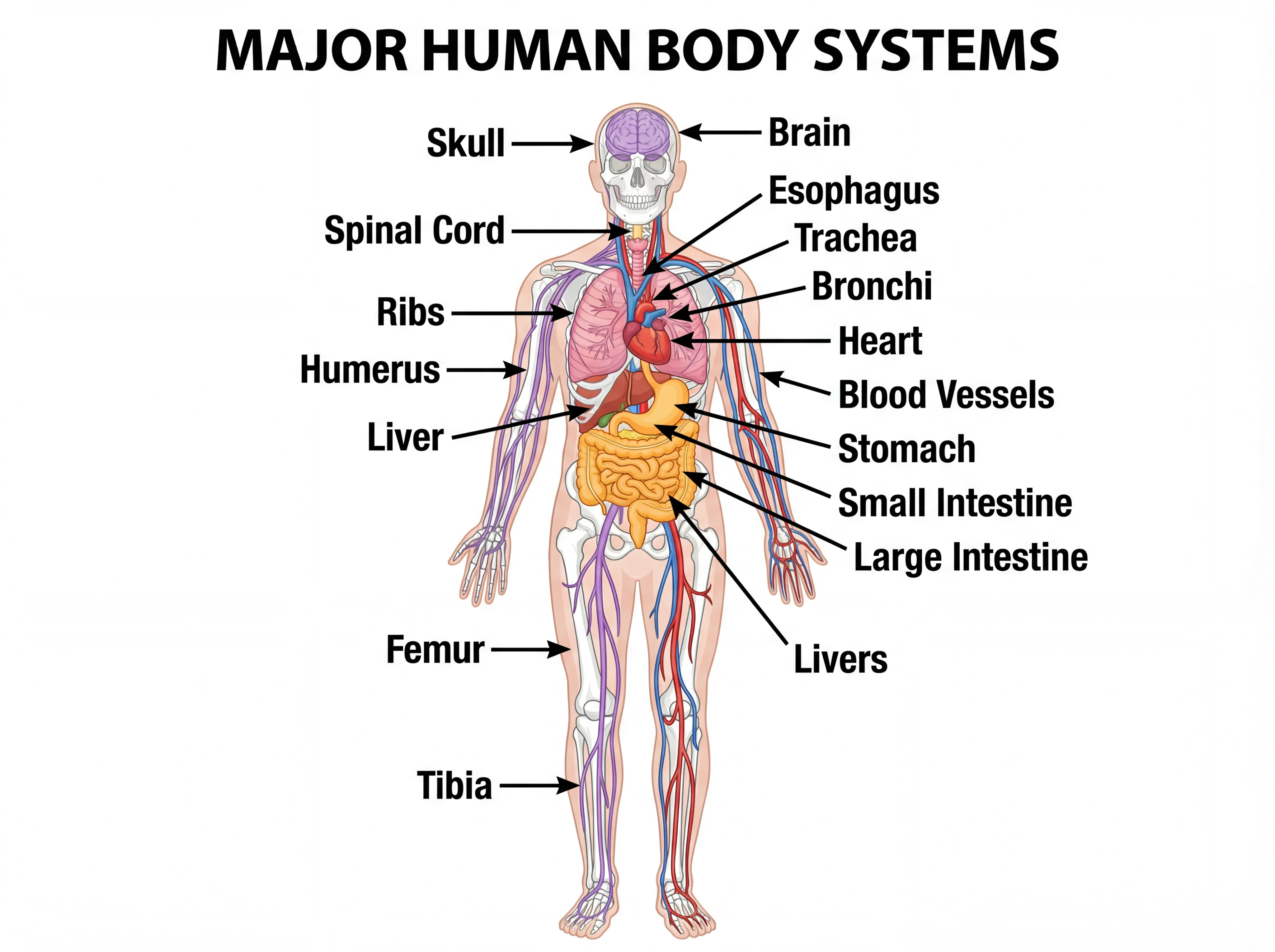
Human Body Systems Diagram Generator
Draw labeled diagrams of all the body's organ systems, from skeletal to circulatory.
 Biology
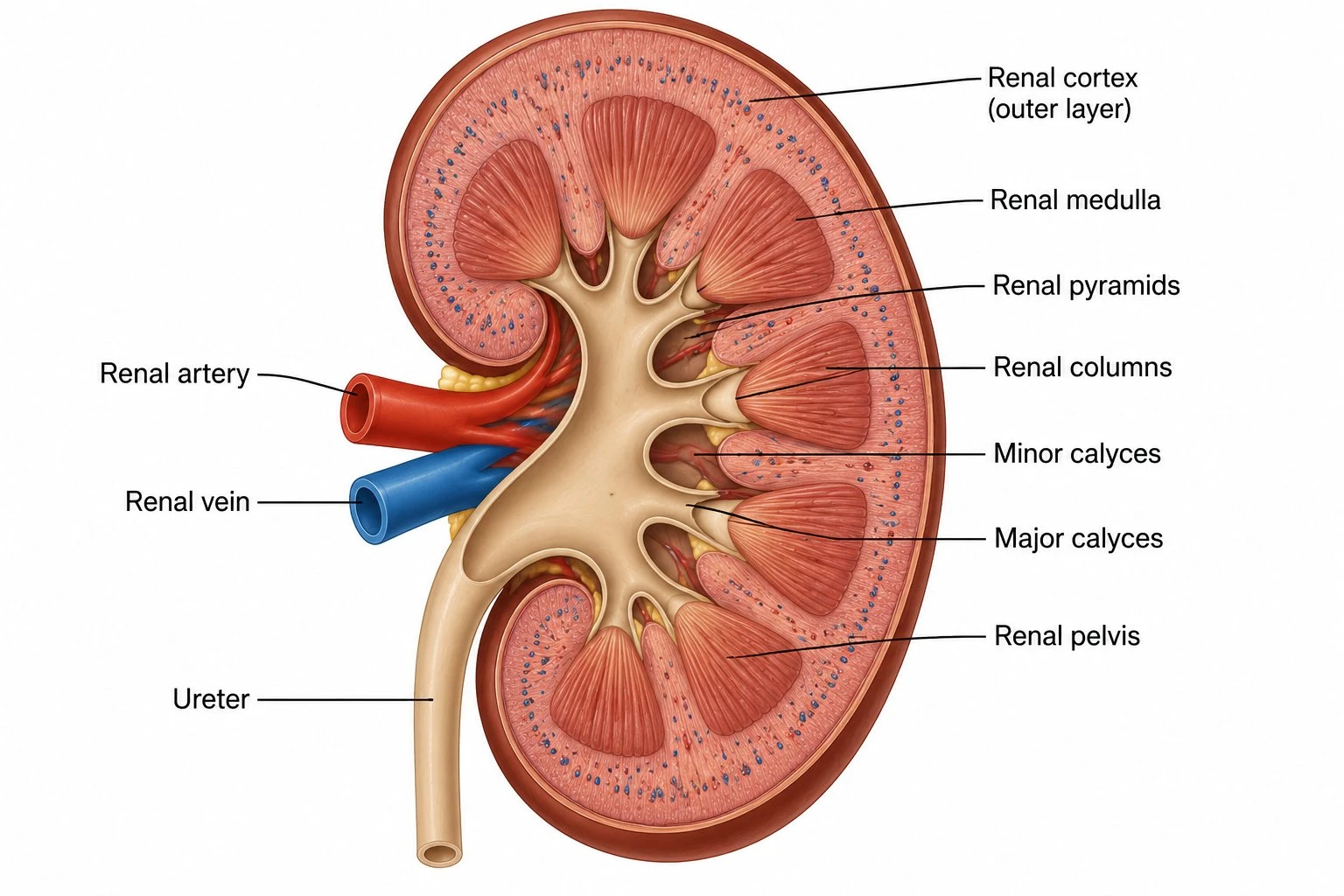
Kidney Diagram Generator
Create detailed labeled diagrams of the kidney, including the nephron, cortex, medulla, and blood supply.
 Biology
Digestive System Diagram Generator
Generate labeled diagrams of the digestive system showing the GI tract from mouth to rectum.