Phosphorus Cycle Diagram Generator Labeled & Printable
Create a labeled phosphorus cycle diagram from a short description. Show weathering of phosphate rock, plant uptake, the food chain, decomposition, and sedimentation — then download a clear, printable diagram for biology and earth-science class, free.
Phosphorus Cycle Diagram Generator
Free to try ·
Your phosphorus cycle diagram will appear here
AI-generated — review every label and arrow for accuracy before classroom use
Phosphorus Cycle Diagram Examples
Labeled, aquatic, terrestrial, human-impact, and blank worksheet versions
Complete Labeled Phosphorus Cycle
Every process and reservoir labeled — weathering, uptake, the food chain, decomposition, and sedimentation back into rock.
Simple Overview Diagram
A clean four-reservoir overview for introductory biology — easy to read and easy to label.
Aquatic Phosphorus Cycle
The water-focused version, including the runoff-to-algal-bloom pathway that drives eutrophication.
Terrestrial Phosphorus Cycle
Zooms in on the soil — weathering, the soil phosphorus pool, root uptake, and decomposition.
Human Impact Diagram
Shows how mining, fertilizer, and runoff add phosphorus and disrupt the natural balance.
Blank Worksheet (Fill-in)
A printable fill-in-the-blank version — the structure is drawn, students supply the labels.
What is the phosphorus cycle, and why does it matter?
The phosphorus cycle is the biogeochemical cycle that moves phosphorus through rocks, soil, water, and living things. Phosphorus is essential to life: it forms the backbone of DNA and RNA, the energy molecule ATP, and the phospholipids that build cell membranes. Because almost no phosphorus exists as a gas, the element stays close to the ground — locked in rock and sediment, released slowly into soil and water, taken up by organisms, and eventually buried again. This generator turns a short description into a clearly labeled phosphorus cycle diagram so students and teachers can see how those pieces connect.
The key processes in the phosphorus cycle
- Weathering: rain and acids slowly break down phosphate rock, releasing phosphate ions (PO₄³⁻) into the soil and water.
- Absorption by plants: plant roots take up dissolved phosphate from the soil, often helped by mycorrhizal fungi.
- The food chain: herbivores get phosphorus by eating plants, and carnivores get it by eating herbivores, so it passes up through consumers.
- Decomposition: when plants and animals die, decomposers (bacteria and fungi) return phosphorus to the soil and water as phosphate.
- Sedimentation and rock formation: phosphate that washes into lakes and oceans settles as sediment and, over millions of years, becomes new phosphate rock.
Why the phosphorus cycle has no gas phase
This is the detail teachers most want students to notice. Unlike the carbon cycle and the nitrogen cycle, the phosphorus cycle has no significant atmospheric or gaseous stage — phosphorus does not normally enter the air as a gas. Because of this, phosphorus moves mainly through water and rock rather than the atmosphere, which makes it the slowest of the major biogeochemical cycles: a single atom can stay locked in rock for millions of years before weathering frees it again. A good labeled diagram makes this stand out by showing rock and sediment, not the sky, as the cycle’s main long-term reservoir.
The four main reservoirs of phosphorus
- Rock and sediment: the largest, slowest store of phosphorus, released only by weathering and uplift over geological time.
- Soil: the active pool plants draw from, holding both inorganic phosphate and organic phosphorus from decay.
- Water: dissolved phosphate in rivers, lakes, and oceans, where it fuels aquatic life — and, in excess, algal blooms.
- Living organisms: phosphorus held in DNA, RNA, ATP, bones, and teeth as it passes through the food chain.
Labeled vs. blank diagrams for worksheets
For teaching, two versions of the diagram do different jobs. A fully labeled phosphorus cycle is the answer key and the study reference — every reservoir and arrow is named, so students can trace weathering to uptake to decomposition to sedimentation. A blank diagram keeps the same structure but leaves the labels empty, turning it into a fill-in-the-blank worksheet or quiz. Generating both from the same description gives you a matched pair: hand out the blank version in class and use the labeled version to grade. The gallery above includes a printable black-and-white worksheet for exactly this purpose.
How to generate a labeled phosphorus cycle diagram
- Describe the diagram you want — for example, "a complete labeled phosphorus cycle with weathering, plant uptake, the food chain, decomposition, and sedimentation."
- Pick an aspect ratio (16:9 works well for slides and worksheets) and a quality setting.
- Generate the diagram, then read every label and arrow against your textbook before you use it.
- Download the image and drop it into a slide deck, handout, lab report, or printed worksheet.
Frequently Asked Questions
Related Biology Tools
 Biology
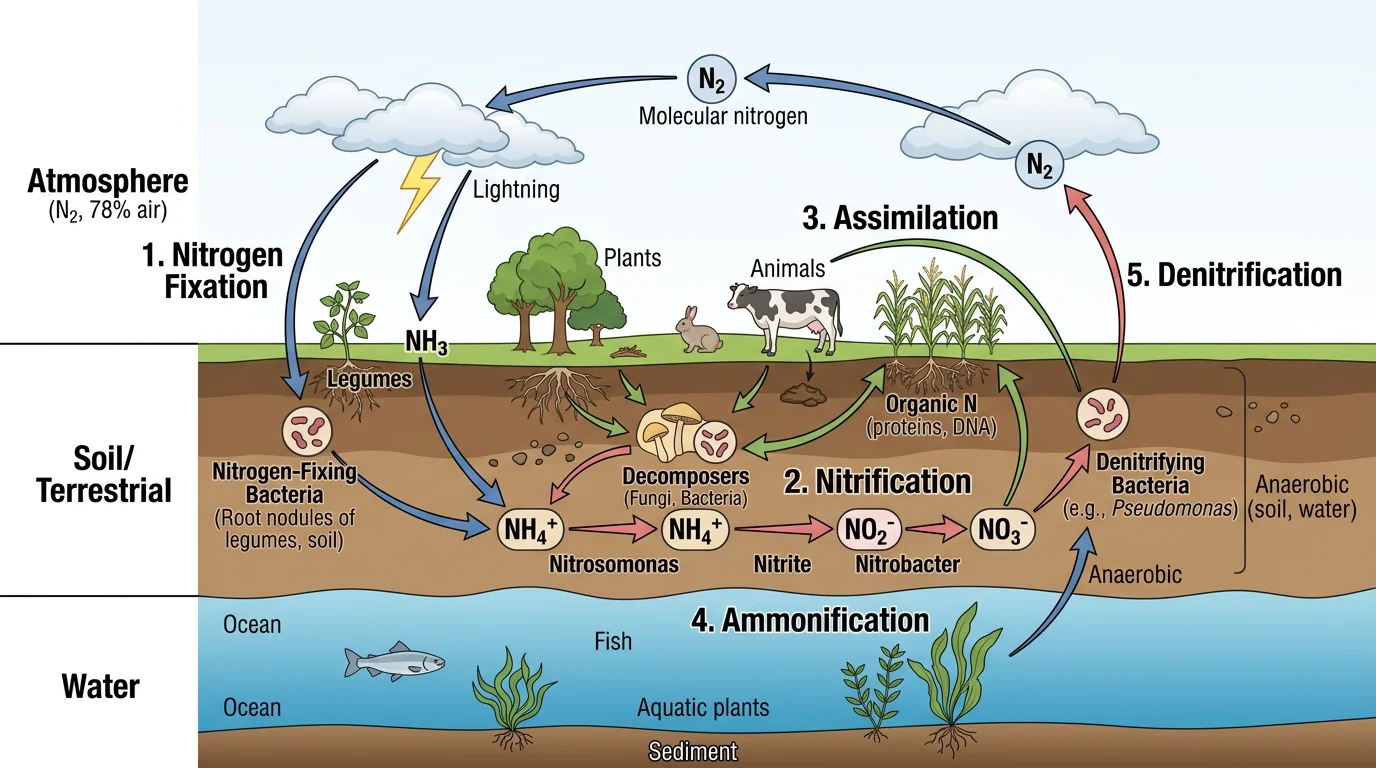
Nitrogen Cycle Diagram Generator
Make a labeled nitrogen cycle diagram with fixation, nitrification, and denitrification.
BiologyCarbon Cycle Diagram Generator
Create a labeled carbon cycle diagram showing photosynthesis, respiration, and combustion.
 Science
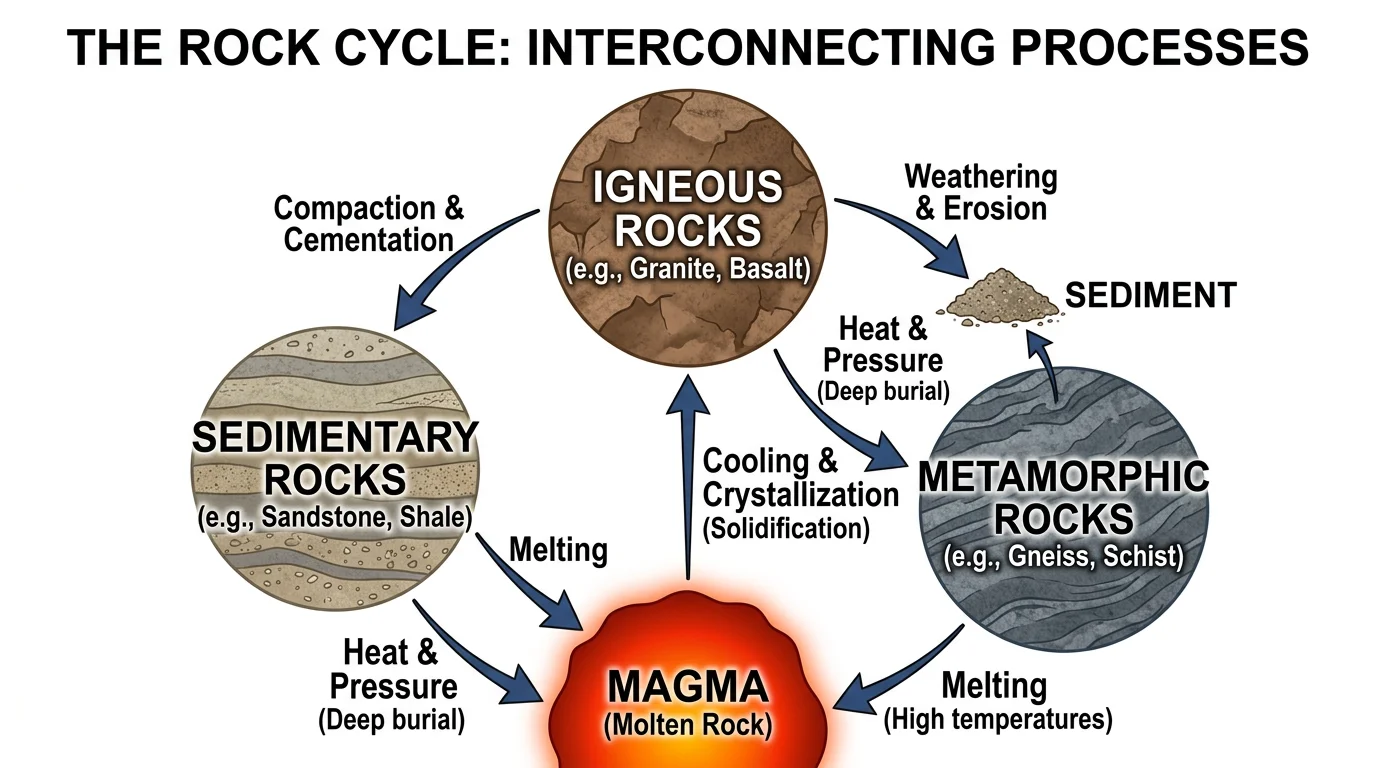
Rock Cycle Diagram Generator
Draw a labeled rock cycle linking igneous, sedimentary, and metamorphic rock.