Lewis Dot Structure Generator for Electron Dot Diagrams
Use this AI Lewis structure generator to draw electron dot diagrams for molecules and ions. Show valence electrons, bonding pairs, lone pairs, single, double, and triple bonds, formal charges, and resonance — then export your diagram, free.
Lewis Dot Structure Generator
Free to try ·
Your Lewis dot structure will appear here
AI-generated — count the valence electrons and verify the structure for graded work
Lewis Structure Examples
Electron dot concepts — bonding pairs, lone pairs, bond order, formal charge, and resonance
Resonance & Delocalized Bonds
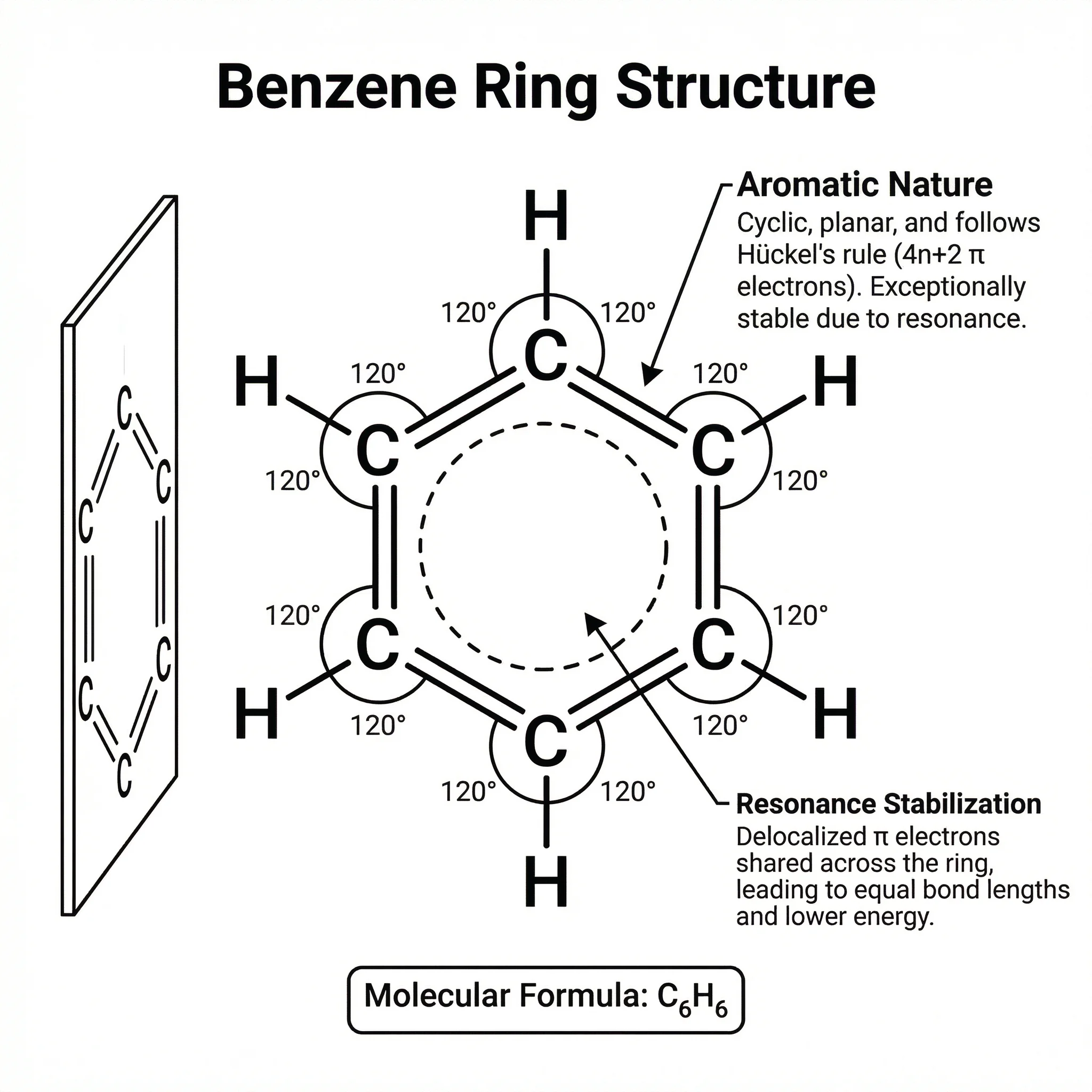
Benzene illustrates resonance — the alternating double bonds are really delocalized electrons spread evenly around the ring.
Lone Pairs & Charges
Electron-dot notation in action: the lone pairs on the hydroxide and the negative charge on the leaving bromide are shown explicitly.
Lone Pairs on N and O
The amino and carboxyl groups show where lone pairs sit on nitrogen and oxygen, and how formal charges create the zwitterion.
Single Bonds & Bonding Pairs
Glucose is held together almost entirely by single covalent bonds — each line is one shared bonding pair of electrons.
Single vs Double Bonds
A clear contrast of bond orders: the C=O carbonyl is a double bond while the surrounding C–O and C–C linkages are single bonds.
Bonds, Lone Pairs & Resonance
A worked example combining lone pairs, a C=O double bond, and the two resonance structures of the amide linkage.
What is a Lewis dot structure?
A Lewis dot structure — also called an electron dot diagram or Lewis structure — is a simple drawing that shows how the valence electrons in a molecule or ion are arranged. Each atom is written as its element symbol, dots represent the outer-shell (valence) electrons, and lines represent the pairs of electrons shared in a bond. The diagram makes the bonding visible: you can see which atoms are connected, how many bonds join them, where the unshared electrons sit, and whether any atom carries a charge. This Lewis structure generator turns a molecule or ion you describe into exactly that kind of clearly labeled electron diagram.
Valence electrons and the octet rule
Everything in a Lewis structure starts from valence electrons — the electrons in an atom's outermost shell. A neutral main-group atom has the same number of valence electrons as its group number on the periodic table (carbon has 4, oxygen has 6, hydrogen has 1). The octet rule says that atoms tend to gain, lose, or share electrons until they are surrounded by eight valence electrons, the stable configuration of a noble gas. Hydrogen is the exception — it follows a duet rule and is happy with two. Counting up the total valence electrons available is always the first step, because every dot and every bond line in the finished diagram must come from that total.
Bonding pairs, lone pairs, and bond order
- Bonding pairs are electrons shared between two atoms; each shared pair is drawn as a line and counts toward both atoms' octets.
- Lone pairs (non-bonding pairs) are valence electrons that stay on a single atom and are drawn as a pair of dots — for example, the two lone pairs on the oxygen in water.
- A single bond is one shared pair, a double bond is two shared pairs, and a triple bond is three shared pairs — bond order rises and the bond gets shorter and stronger.
- When more electrons are needed to complete octets, lone pairs are converted into extra bonds, which is how double and triple bonds (as in O2, CO2, or N2) appear.
How to draw a Lewis dot structure step by step
- Count the total valence electrons from every atom, then add one for each negative charge or subtract one for each positive charge on an ion.
- Pick the central atom (usually the least electronegative, never hydrogen) and connect the surrounding atoms to it with single bonds.
- Distribute the remaining electrons as lone pairs, completing the octets of the outer atoms first, then the central atom.
- If the central atom is short of an octet, shift lone pairs from neighboring atoms to form double or triple bonds.
- Check formal charges and, where more than one valid arrangement exists, draw the resonance structures.
Formal charge and resonance
Formal charge is a bookkeeping tool that tells you whether the electrons in a structure are distributed sensibly. For each atom it is calculated as: valence electrons − non-bonding electrons − half the bonding electrons. The best Lewis structure is usually the one where formal charges are closest to zero, and any negative formal charge sits on the most electronegative atom. When a molecule or ion can be drawn correctly in more than one way — such as ozone (O3), the nitrate ion (NO3⁻), or the carbonate ion (CO3²⁻) — those equivalent structures are called resonance structures, and the real molecule is a blend (resonance hybrid) of them. The double-headed arrow between resonance structures means the electrons are delocalized, not flipping back and forth.
Using this tool in chemistry class
Lewis structures are a foundation of general and organic chemistry: they are the starting point for predicting molecular geometry with VSEPR theory, for judging polarity, and for following electrons through reaction mechanisms. This generator is built to help with homework, lab reports, study guides, flashcards, and lecture slides — describe the molecule or ion and get a clean, labeled electron diagram in seconds. Because the diagrams are AI-generated, treat them as a study and visualization aid rather than an authority: always count the valence electrons yourself and verify the bonds, lone pairs, and formal charges before relying on a diagram for graded work.
Frequently Asked Questions
Related Chemistry Tools
 Chemistry
Chemistry Structure Generator
Draw organic structures, mechanisms, and skeletal formulas from a plain-English description.
 Chemistry
Molecule Generator from Description
Turn a name, formula, or SMILES string into a labeled molecular structure diagram.
 Research
AI Scientific Image Generator
Create publication-style scientific figures and molecular illustrations from a prompt.