CRISPR Cas9 Diagram Generator gRNA, PAM, and repair
Generate CRISPR-Cas9 diagrams from a text prompt: guide RNA, PAM, cut site, NHEJ vs HDR, and knockout workflows. Includes exact sequence-level references.
Create Your CRISPR-Cas9 Diagram
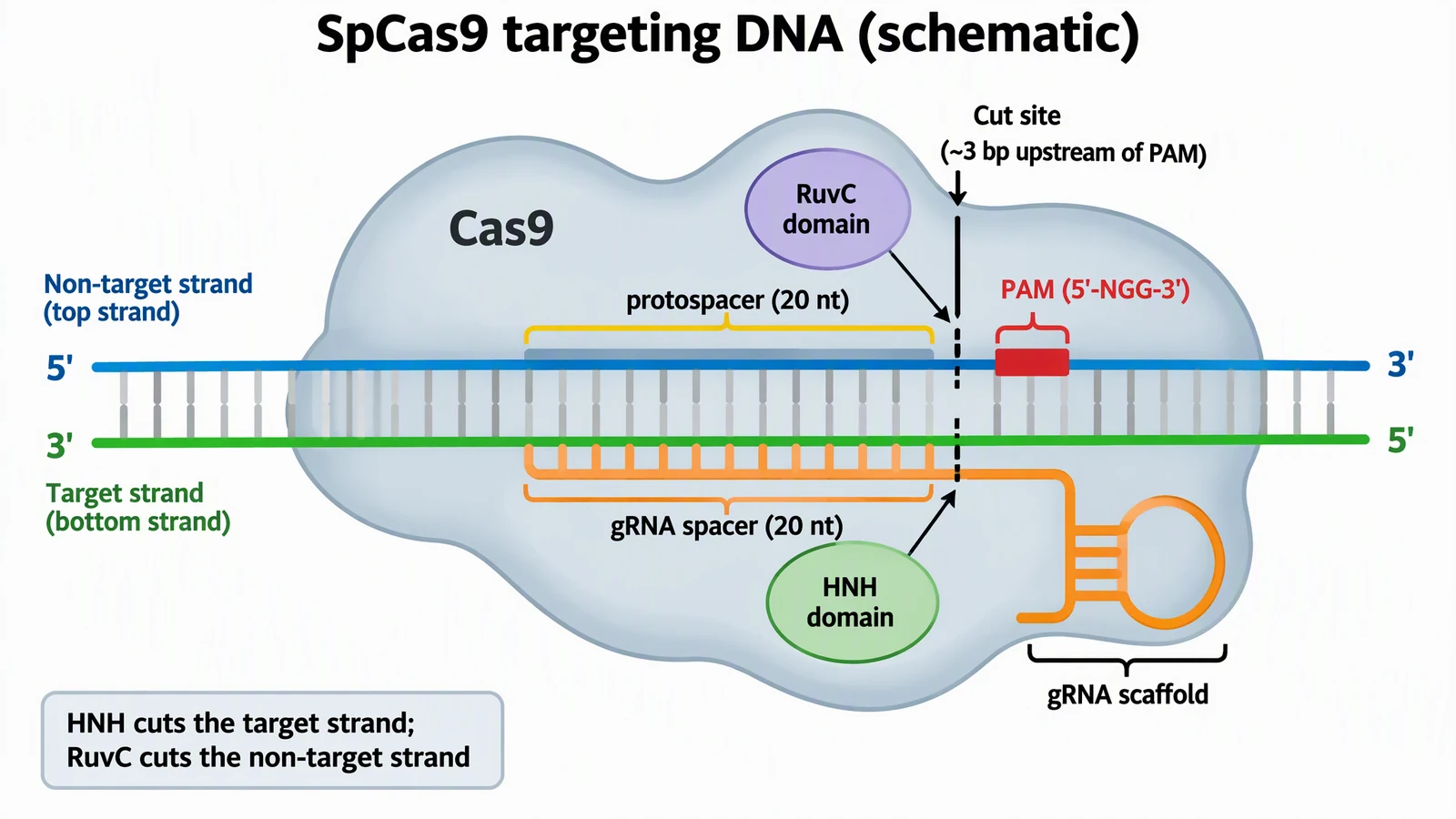 Example: Guide, PAM, and cut siteView full size
Free to try ·
Your CRISPR diagram will appear here
AI schematics are concept-level. Check strands, PAM, and cut site before use.
CRISPR-Cas9 Diagram Examples
Two exact SVG references drawn in code, plus three AI schematics with their known flaws noted. AI diagrams need human review.
PAM and cut site at sequence level (exact SVG)
Drawn in code, not by AI: the protospacer, the NGG PAM on the non-target strand, the gRNA paired with the target strand, and the blunt cut 3 bp upstream of the PAM. The 20-nt sequence is illustrative.
PAM position by nuclease (exact SVG)
Drawn in code: SpCas9 and SaCas9 read the PAM 3′ of the protospacer and cut blunt; Cas12a reads TTTV 5′ of it and leaves a staggered cut. Schematic, not to scale.
Guide RNA, PAM, and cut site (AI schematic)
AI-generated concept schematic with no nucleotide letters. Known flaws: the cut site and the gRNA pairing end at the end of the protospacer bracket instead of 3 bp inside it, and the Cas9 body is a generic blob. Use the exact SVG for positions. There are also faint background artifacts.
NHEJ vs HDR (AI diagram)
AI-generated concept diagram of the two repair routes after a double-strand break. Known flaws: the donor template connects to the repaired DNA only by an arrow, and there are faint background artifacts.
CRISPR knockout workflow (AI infographic)
AI-generated six-step workflow. Icons are decorative and there are faint background artifacts; check the step order and delivery options against your own protocol.
What a CRISPR-Cas9 diagram shows
A CRISPR-Cas9 diagram explains how a guide RNA (gRNA) leads the Cas9 nuclease to a matching DNA site, how the enzyme cuts both strands, and what the cell does next. Most figures in papers, lectures, and grant applications fall into three types: the targeting schematic (gRNA, PAM, cut site), the repair-pathway figure (NHEJ versus HDR), and the experiment workflow (design, deliver, select, validate).
The parts every Cas9 targeting diagram must get right
- Protospacer: the 20-nt DNA sequence on the non-target strand that matches the gRNA spacer (T in DNA, U in RNA).
- PAM: for SpCas9 it is 5′-NGG-3′, located immediately 3′ of the protospacer on the non-target strand. The PAM is not part of the gRNA.
- gRNA pairing: the gRNA spacer base-pairs with the target strand, the strand that does not carry the PAM.
- Cut site: SpCas9 makes a mostly blunt double-strand break about 3 bp upstream of the PAM.
- Nuclease domains: HNH cleaves the target strand (the one paired with the gRNA); RuvC cleaves the non-target strand.
After the cut: NHEJ, HDR, and knockout
Non-homologous end joining (NHEJ) rejoins the ends and often leaves small insertions or deletions (indels); an indel that shifts the reading frame can knock out the gene. Homology-directed repair (HDR) copies a donor template with homology arms, which allows a precise edit or knock-in but is less efficient and depends on the cell state. A good repair figure shows both routes starting from the same double-strand break.
Exact SVG vs AI illustration on this page
- Exact SVG: the two sequence-level references in the gallery are drawn in code, so strand polarity, base pairing, the PAM position, and the cut site are fixed. Use them when a figure has to show real positions.
- AI illustration: the generator is best for concept-level schematics, such as the repair pathways and the experiment workflow. AI does not guarantee sequence-level accuracy: base pairing, strand direction, and which domain cuts which strand can come out wrong.
- Always have a person who knows the system check the figure before it goes into a manuscript, thesis, or slide deck. Generated images are not a substitute for a peer-reviewed source.
How to prompt for a correct Cas9 schematic
- Ask for a concept-level schematic and tell the model not to write nucleotide letters. Letters are where AI errors show up.
- State the relationships you need: PAM on the non-target strand at the 3′ end of the protospacer, gRNA paired with the target strand, cut about 3 bp upstream of the PAM.
- Name the nuclease. SpCas9, SaCas9, and Cas12a use different PAMs and cut differently, so say which one you mean.
- Check every label against the exact SVG above before using the result.
Frequently Asked Questions
Related Biology Tools
 Biology
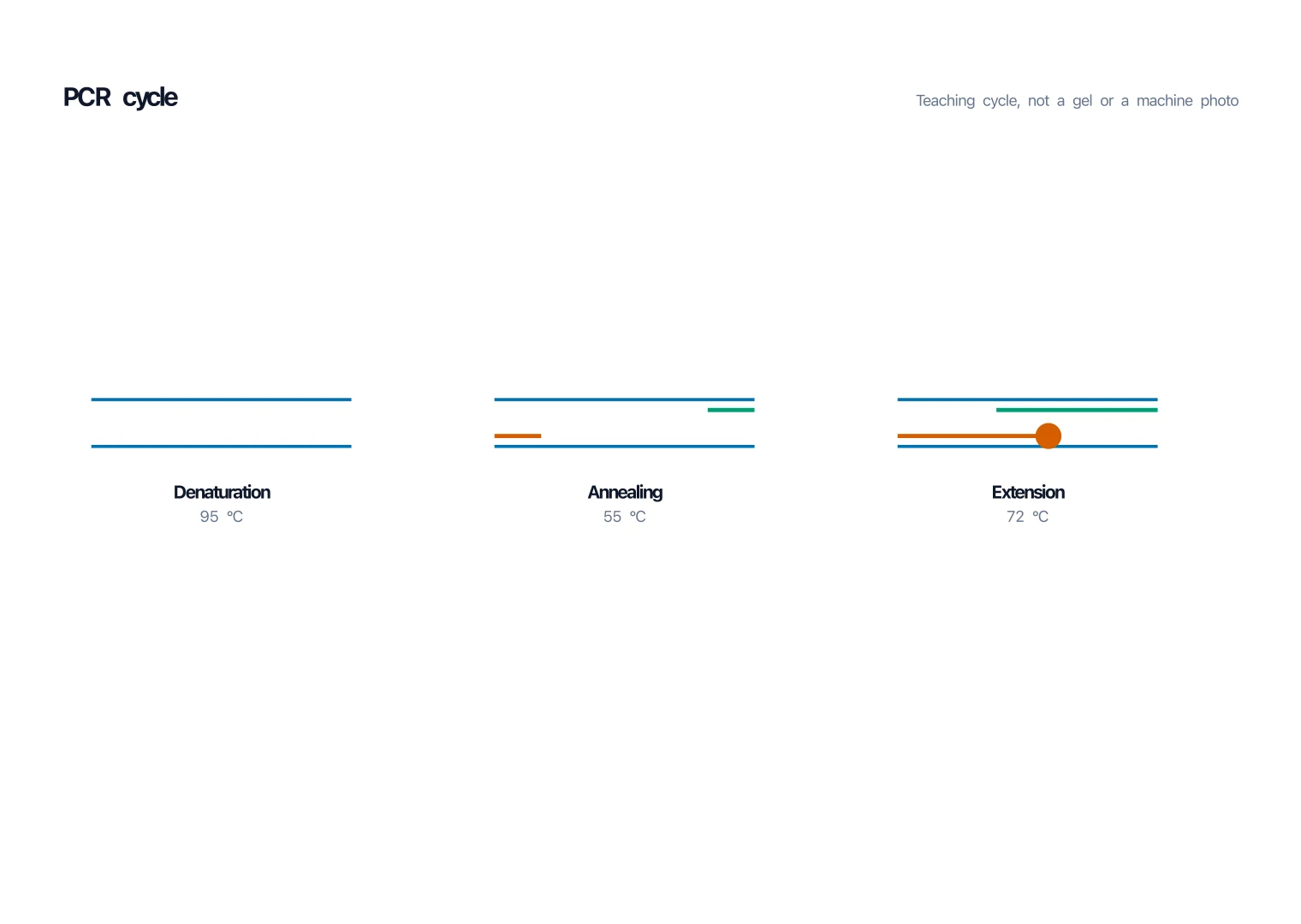
PCR Diagram Generator
The cycle of denaturation, annealing, and extension, drawn as an exact SVG.
 Biology
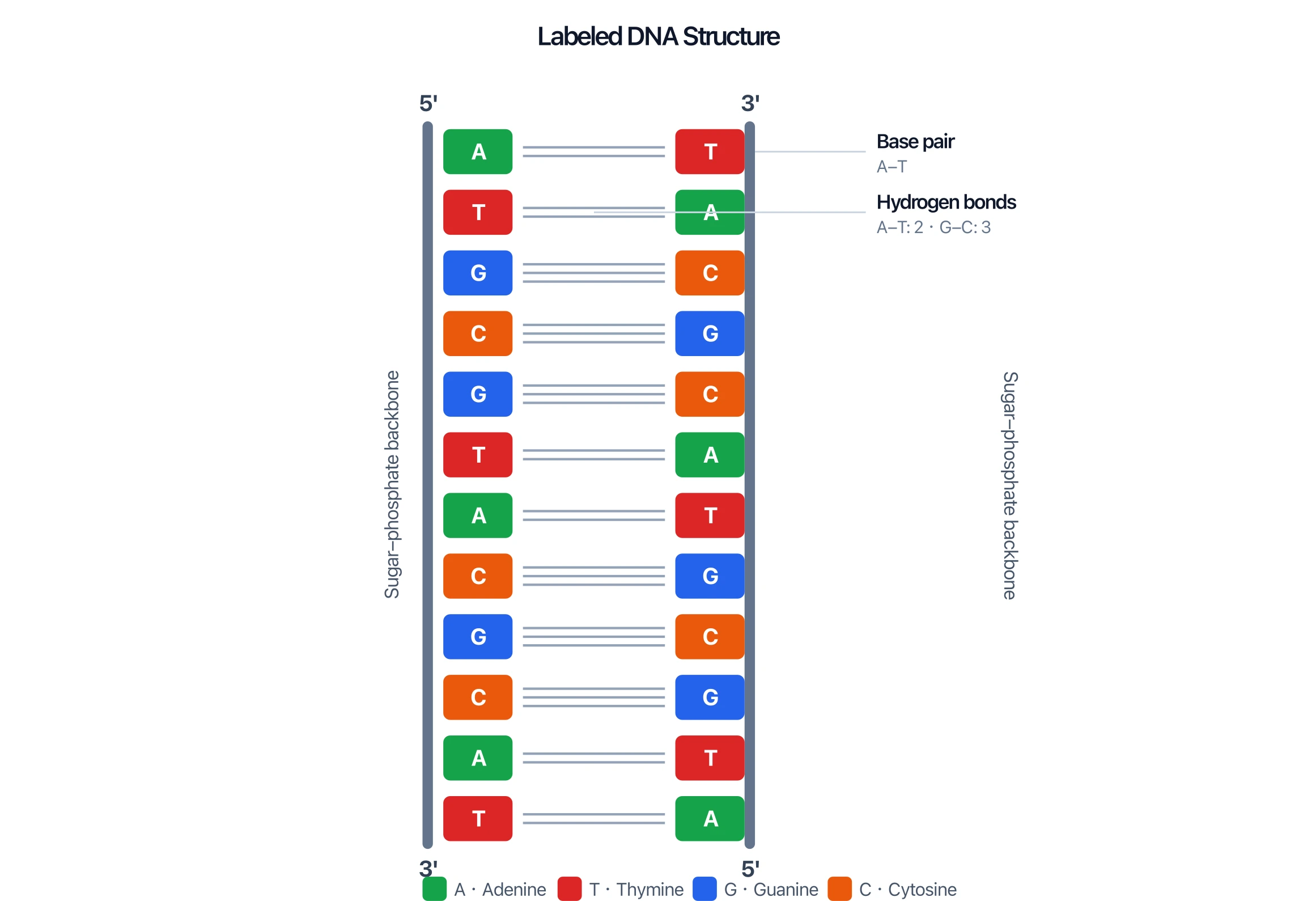
DNA Structure Diagram Generator
The helix, bases, and backbone: the anatomy of the DNA that Cas9 targets.
 Research
AI Scientific Image Generator
Describe any lab or biology figure and generate a clean illustration.