Circulatory System Diagram Generator for Labeled & Blank Diagrams
Create a clearly labeled circulatory system diagram in seconds. Show the heart, aorta, arteries, veins, capillaries, pulmonary circulation, systemic circulation, and oxygenated vs deoxygenated blood — or generate a blank, unlabeled version for worksheets and quizzes. Free to use.
Circulatory System Diagram Generator
Free to try ·
Your circulatory system diagram will appear here
Describe what you need and click Generate
Circulatory System Diagram Examples
Labeled diagrams of the full circulatory system, pulmonary and systemic loops, heart chambers, and blood vessel types
Full Circulatory System
The complete map — heart at center, arteries in red and veins in blue, with every major vessel labeled.
Pulmonary vs Systemic Circulation
Two loops side by side: pulmonary (heart to lungs) in one color and systemic (heart to body) in another.
Simple Circulatory System for Kids
A clear, simplified version with large labels — ideal for elementary and middle school science lessons.
Blood Flow Through the Heart
How blood moves through the four chambers and four valves — each step numbered and labeled.
Arteries, Veins, and Capillaries
Side-by-side cross-sections of all three vessel types — wall layers, lumen size, and valves compared.
Blank Circulatory System Worksheet
An unlabeled version with numbered blank lines — ready to print as a quiz or fill-in worksheet.
What is the circulatory system?
The circulatory system — also called the cardiovascular system — is the body's transport network. The heart pumps blood through a closed loop of blood vessels: arteries carry blood away from the heart, capillaries exchange oxygen, nutrients, and waste with tissues, and veins return blood to the heart. This continuous flow delivers oxygen and nutrients to every cell while carrying away carbon dioxide and metabolic waste. This generator draws the full system with every major vessel and structure clearly labeled.
Two circulations: pulmonary and systemic
- Pulmonary circulation: the right side of the heart pumps deoxygenated blood (blue) to the lungs through the pulmonary arteries. In the lungs, blood releases CO₂ and picks up oxygen, then returns to the left side of the heart through the pulmonary veins as oxygenated blood (red).
- Systemic circulation: the left side of the heart pumps oxygenated blood through the aorta to the entire body. Arteries branch into smaller arterioles and then capillaries, where oxygen and nutrients are exchanged with tissues. Deoxygenated blood then collects into venules and veins, returning to the right side of the heart via the superior and inferior vena cava.
- Superior vena cava: returns deoxygenated blood from the head, neck, arms, and upper chest to the right atrium.
- Inferior vena cava: returns deoxygenated blood from the abdomen, pelvis, and legs to the right atrium.
The heart: chambers, valves, and blood flow
The heart has four chambers. The right atrium receives deoxygenated blood from the body and passes it through the tricuspid valve into the right ventricle, which pumps it through the pulmonary valve into the pulmonary arteries toward the lungs. The left atrium receives oxygenated blood from the lungs and passes it through the mitral (bicuspid) valve into the left ventricle — the most muscular chamber — which pumps it through the aortic valve into the aorta and out to the body. The four valves (tricuspid, pulmonary, mitral, aortic) prevent backflow and keep blood moving in one direction.
Arteries, veins, and capillaries
The three types of blood vessels each have a distinct structure suited to their function. Arteries carry blood under high pressure away from the heart; their thick, muscular walls can handle the force. Veins carry blood at low pressure back to the heart; their thinner walls include valves to prevent backflow. Capillaries are microscopic, single-cell-thick vessels that connect arterioles to venules; their thin walls allow oxygen, carbon dioxide, nutrients, and waste to diffuse directly between blood and tissue. You can generate a cross-section diagram comparing all three vessel types side by side.
Oxygenated vs deoxygenated blood
In diagram convention, oxygenated blood is shown in red and deoxygenated blood in blue. Oxygenated blood travels from the lungs through the pulmonary veins, into the left side of the heart, and out through the aorta and systemic arteries to the body. Deoxygenated blood travels from the body through the superior and inferior vena cava, into the right side of the heart, and out through the pulmonary arteries to the lungs. Despite the color convention, all blood in the body is always red — the blue color in diagrams represents lower oxygen saturation, not a different substance.
Labeled vs blank diagrams for worksheets and quizzes
A fully labeled diagram is ideal for teaching and study notes, while a blank, unlabeled version is what you want for worksheets, handouts, and quizzes. With this tool you can generate either: describe "a labeled circulatory system diagram" to get every vessel and structure named, or ask for "a blank circulatory system diagram with numbered blank lines" to get a fill-in version. Black-and-white line art works best for printing, and a numbered blank diagram doubles as both the quiz and — with labels added back — the answer key.
How to generate a labeled circulatory system diagram
- Describe what you need in plain English — the full circulatory system, just the pulmonary loop, the heart chambers and valves, a vessel cross-section comparison, or a simplified version for kids.
- Specify view and labels — for example, "anterior full-body view, arteries in red and veins in blue, label the aorta, vena cava, and major branches."
- Choose labeled for teaching or unlabeled (blank) for a worksheet or quiz, then generate the diagram.
- Review the result for accuracy, regenerate or refine the prompt if needed, and download the image to use in a slide, handout, or study guide.
Frequently Asked Questions
Related Biology Tools
 Biology
Human Body Systems Diagram Generator
Draw labeled diagrams of the body's organ systems, from skeletal to circulatory.
 Biology
Heart Diagram Generator
Create detailed labeled heart diagrams showing chambers, valves, and blood flow pathways.
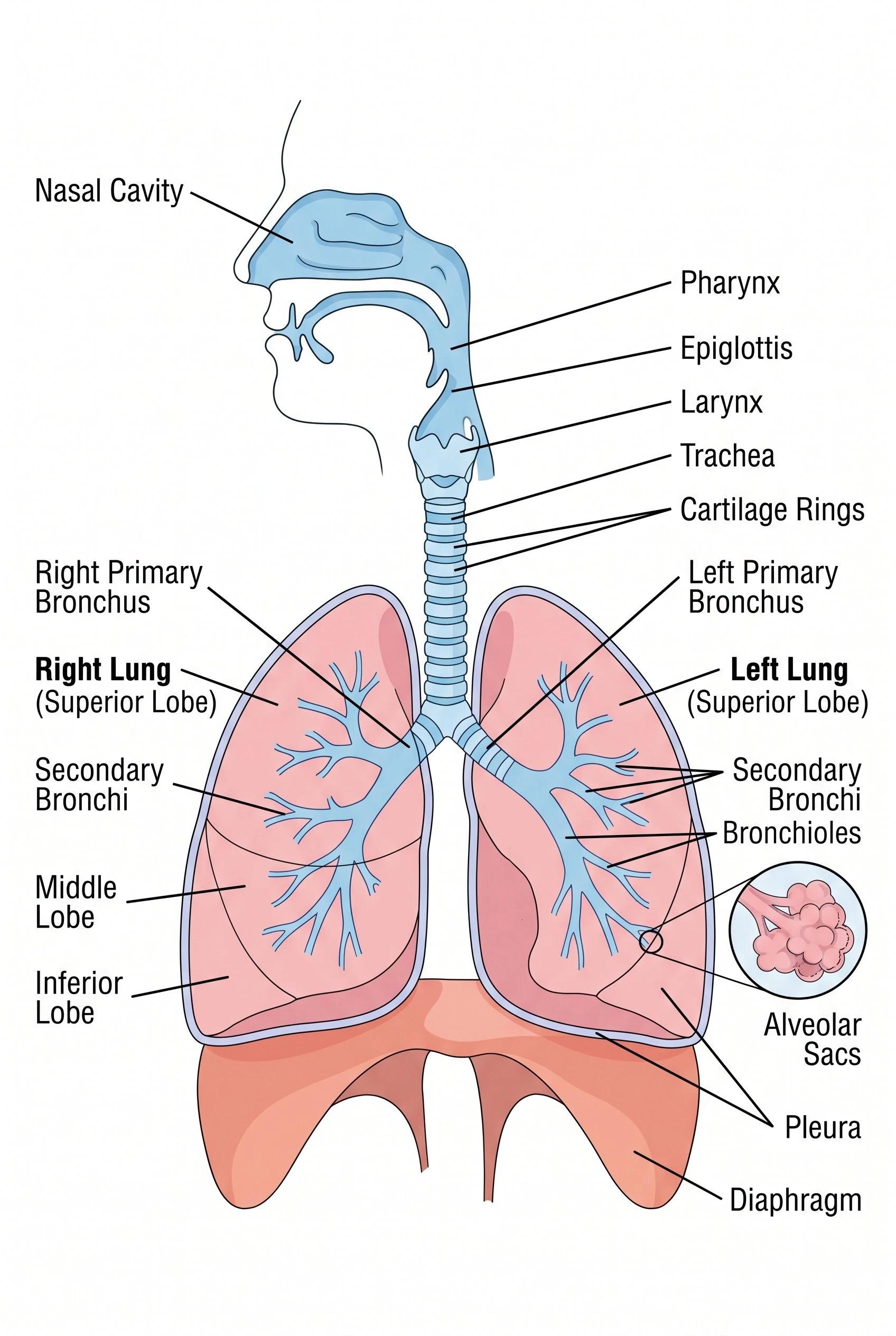 Biology
Respiratory System Diagram Generator
Generate labeled respiratory system diagrams from nasal cavity to alveoli, including gas exchange.