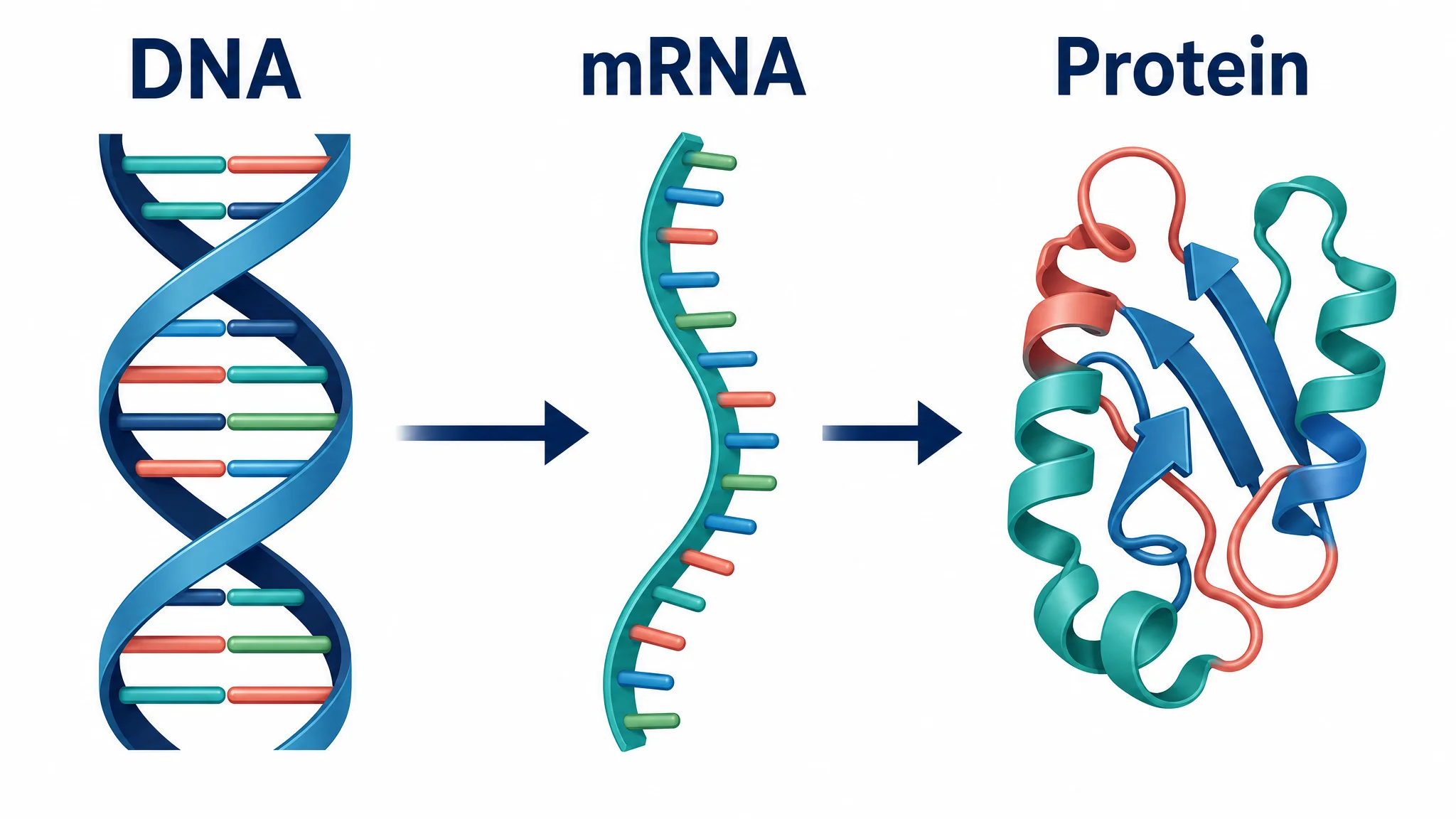
Central Dogma Diagram Guide: DNA to RNA to Protein
Learn how to read and draw a central dogma diagram, including DNA, mRNA, transcription, translation, ribosomes, codons, and common mistakes.
A central dogma diagram explains how genetic information becomes a functional product inside a cell. In its most common classroom form, the diagram shows DNA being transcribed into RNA, then RNA being translated into protein. That simple flow is the reason many students remember the phrase "DNA to RNA to protein."
This guide explains how to read a central dogma diagram, how to draw one clearly, which labels matter, how transcription and translation differ, and what mistakes make a biology diagram misleading.
Biology Drawing Generator
Create labeled biology diagrams for genetics, cell biology, molecular biology, and classroom lessons.
Create a biology diagram ->Quick Answer: What Does a Central Dogma Diagram Show?
A central dogma diagram shows the flow of genetic information:
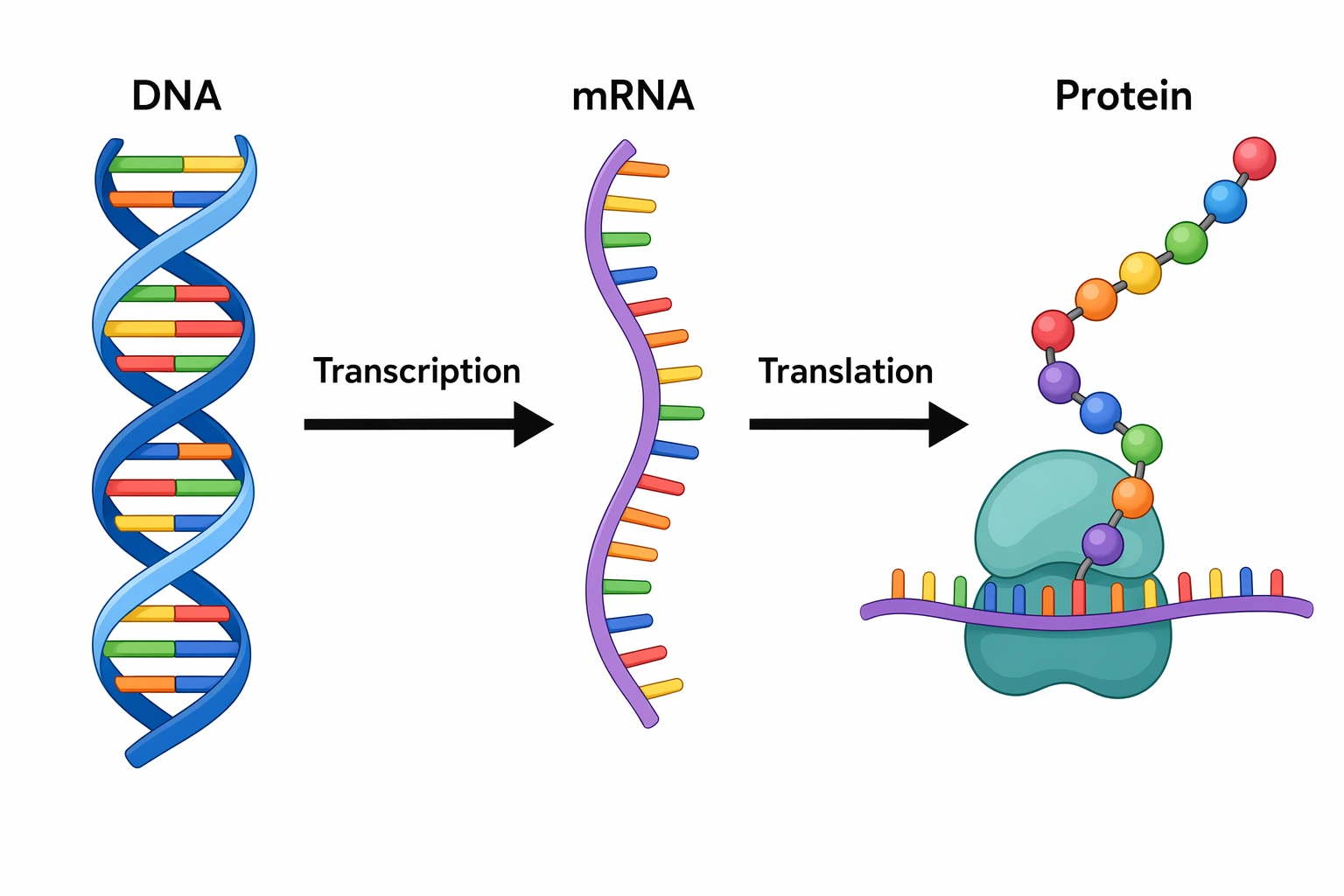
DNA -> RNA -> proteinThe first arrow is transcription. During transcription, information in a DNA sequence is copied into an RNA molecule, usually messenger RNA (mRNA). The second arrow is translation. During translation, ribosomes read the mRNA sequence in codons and assemble amino acids into a protein.
For a beginner-friendly diagram, include these five labels:
| Label | What it means | Where it appears |
|---|---|---|
| DNA | Long-term genetic information | Nucleus in eukaryotic cells |
| Transcription | DNA information copied into RNA | From DNA to mRNA |
| mRNA | Messenger RNA transcript | Between transcription and translation |
| Translation | mRNA decoded into amino acids | At the ribosome |
| Protein | Amino acid chain that folds into a functional molecule | Product of translation |
The best simple version avoids too much detail. It should make the information flow obvious before adding enzymes, codons, organelles, or exceptions.
A clean central dogma diagram starts with the information flow: DNA -> mRNA -> protein.
What Is the Central Dogma in Biology?
The central dogma is a core idea in molecular biology: genetic information generally flows from nucleic acid sequence to protein sequence. The National Human Genome Research Institute describes the central dogma as information moving from DNA to RNA to protein, with RNA-to-protein as another direct route in some contexts.
In practical classroom terms, the central dogma explains how a gene becomes a trait or cellular function:
- A gene is a DNA sequence.
- The gene can be copied into an RNA transcript.
- The RNA transcript can be translated into a protein.
- The protein can act as an enzyme, receptor, structural molecule, signal, or regulator.
That chain matters because a DNA sequence is not useful simply because it exists. It affects the cell when it is expressed. Gene expression is the process of using information in a gene to make a functional product, often a protein.
Khan Academy's introduction to gene expression and the central dogma is a useful reference for students who need the high-level story before they memorize molecular details. Nature Education's archived Scitable article on translation from DNA to mRNA to protein goes deeper into how mRNA, codons, tRNA, and ribosomes connect.
The Basic Central Dogma Diagram
The most useful beginner diagram has one clean horizontal path:
DNA --transcription--> mRNA --translation--> proteinThis version is enough for:
- middle school biology introductions
- high school genetics worksheets
- first-pass AP Biology review
- explaining how genes relate to proteins
- showing why mutations in DNA can change proteins
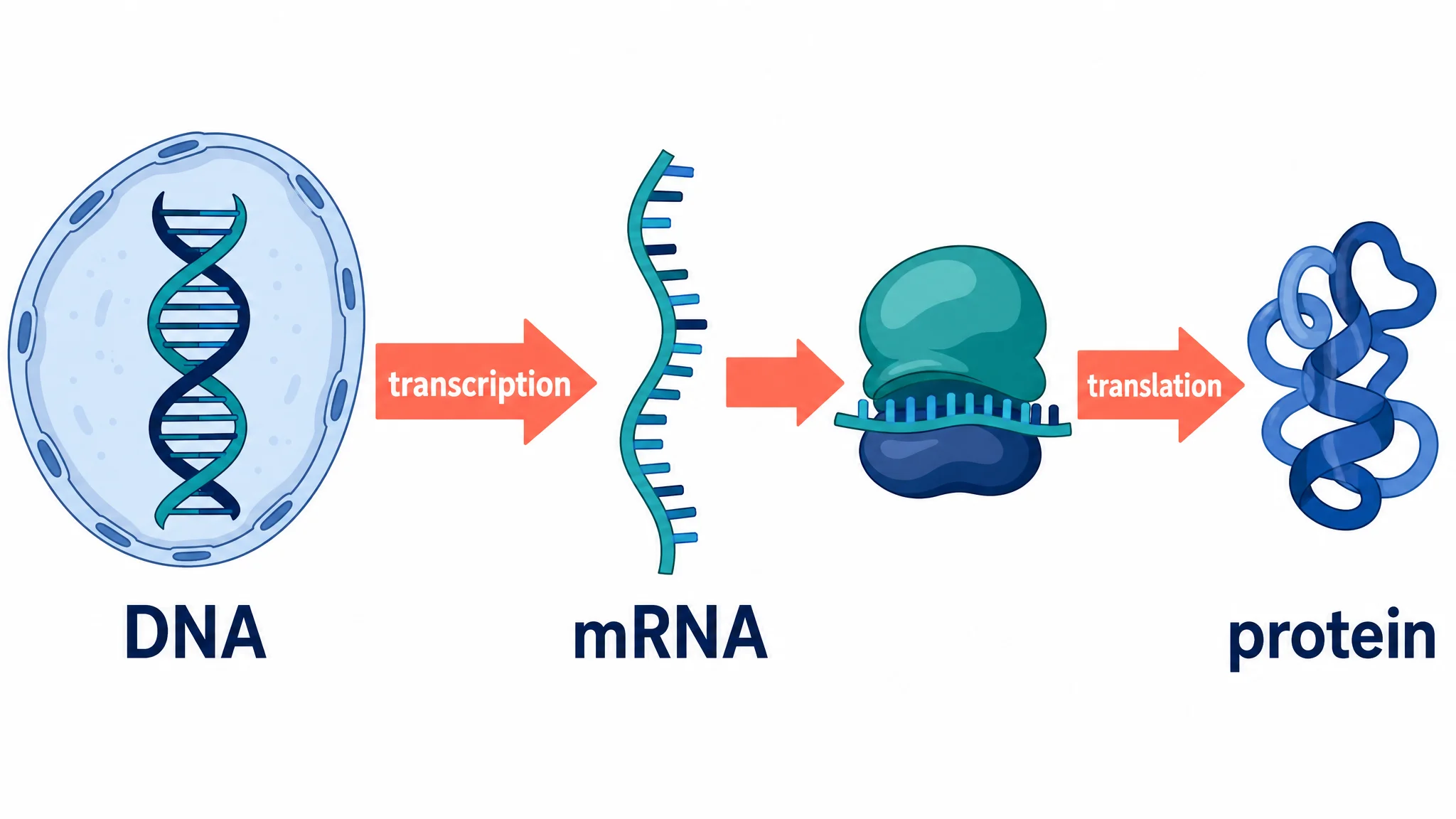
The overview version should keep DNA, mRNA, ribosome, and protein visually separate.
If you are drawing the diagram for a eukaryotic cell, it helps to show the nucleus. DNA stays inside the nucleus, transcription happens in the nucleus, and mature mRNA travels to the cytoplasm where ribosomes translate it. If you are drawing a prokaryotic cell, do not show a nucleus; transcription and translation can be coupled more closely because bacteria do not separate their DNA inside a membrane-bound nucleus.
DNA, RNA, and Protein: What Each Part Represents
DNA
DNA stores genetic information in a sequence of bases: A, T, C, and G. In diagrams, DNA is usually shown as a double helix or as two paired strands. If the diagram is focused on gene expression, you do not need to draw the entire chromosome. A short gene segment is enough.
Useful DNA labels:
- gene
- coding sequence
- template strand
- promoter
- transcription start site
Use these only when they help the lesson. A simple central dogma diagram can just label "DNA."
RNA
RNA is usually shown as a single strand. Messenger RNA, or mRNA, carries the copied information from a gene to the translation machinery. In eukaryotes, an early RNA transcript is processed before mature mRNA is translated.
Useful RNA labels:
- mRNA
- RNA transcript
- codon
- 5' end and 3' end
- start codon
- stop codon
For a basic diagram, "mRNA" is usually enough. For a translation-focused diagram, codons become important.
Protein
Protein is the product of translation. It begins as a polypeptide chain of amino acids. That chain then folds into a three-dimensional structure and may be modified before it performs its function.
Useful protein labels:
- amino acid chain
- polypeptide
- folded protein
- enzyme
- receptor
- structural protein
Do not draw protein as if it were a copy of the DNA strand. The protein is built from amino acids, not nucleotides.
Transcription: DNA to mRNA
Transcription is the step where information in DNA is copied into RNA. RNA polymerase binds near a gene, opens the DNA locally, and builds an RNA strand using one DNA strand as a template. In eukaryotic diagrams, this happens in the nucleus.
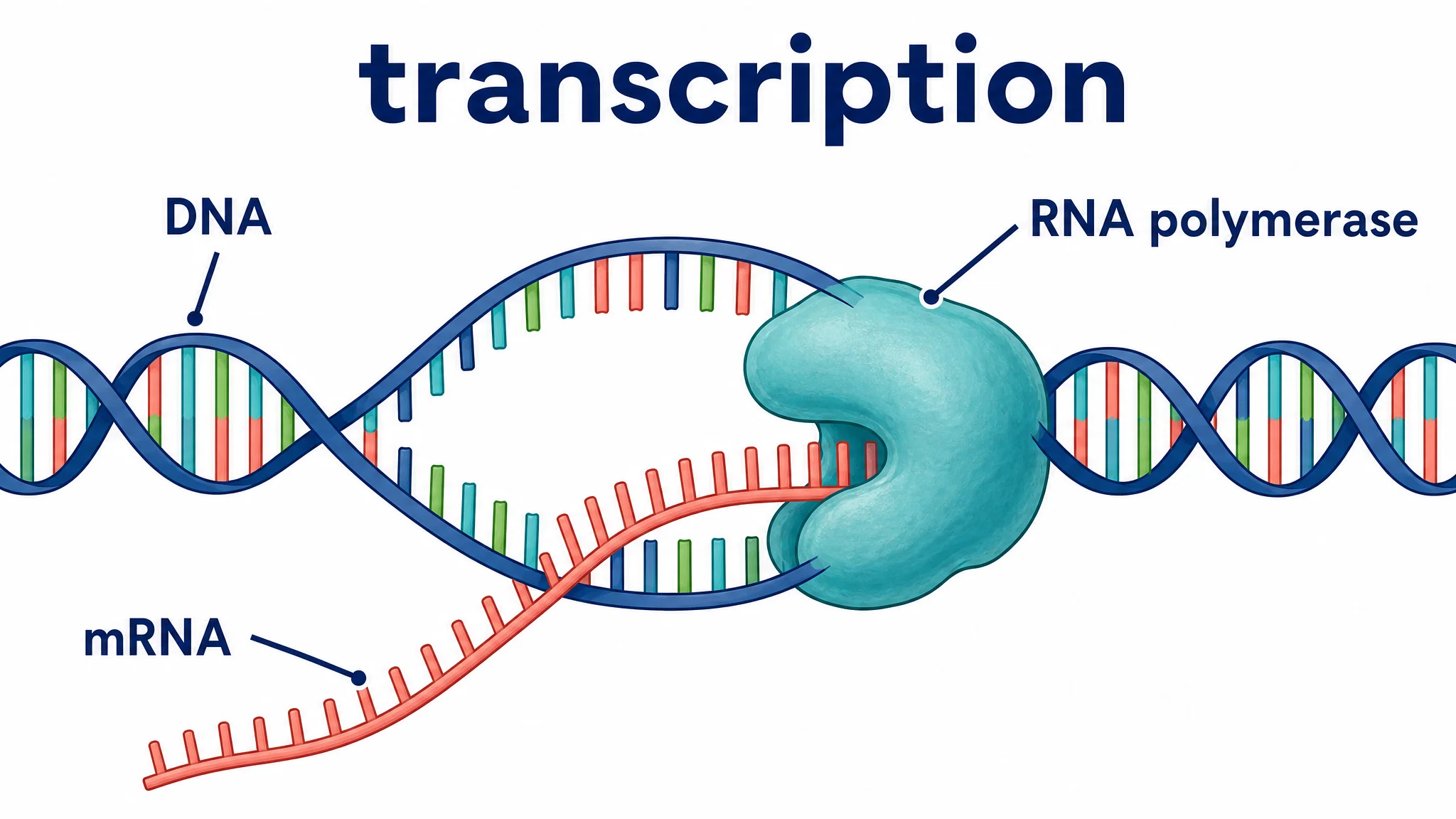
During transcription, RNA polymerase uses DNA as a template to produce an mRNA transcript.
A good transcription diagram should show:
| Element | Visual cue | Why it matters |
|---|---|---|
| DNA template | Opened DNA region | Shows RNA is copied from DNA |
| RNA polymerase | Enzyme at the opened region | Shows the process is enzyme-driven |
| mRNA strand | Single strand emerging | Shows RNA is not double-stranded like DNA |
| Direction | Arrow from DNA to RNA | Shows information flow |
If the page is for early learners, avoid adding introns, exons, caps, tails, spliceosomes, and transcription factors all at once. Those details are real, but they can hide the core idea.
For a more advanced eukaryotic version, you can add:
- promoter and transcription start site
- pre-mRNA
- RNA processing
- 5' cap
- poly-A tail
- intron removal
- mature mRNA export from the nucleus
The NCBI Bookshelf chapter on DNA to RNA is useful when you need more detail on transcription mechanics, RNA polymerase, and RNA processing.
Translation: mRNA to Protein
Translation is the step where information in mRNA is decoded to build a protein. A ribosome reads the mRNA sequence in groups of three bases called codons. Transfer RNAs, or tRNAs, bring amino acids that match those codons. The ribosome links the amino acids into a growing chain.
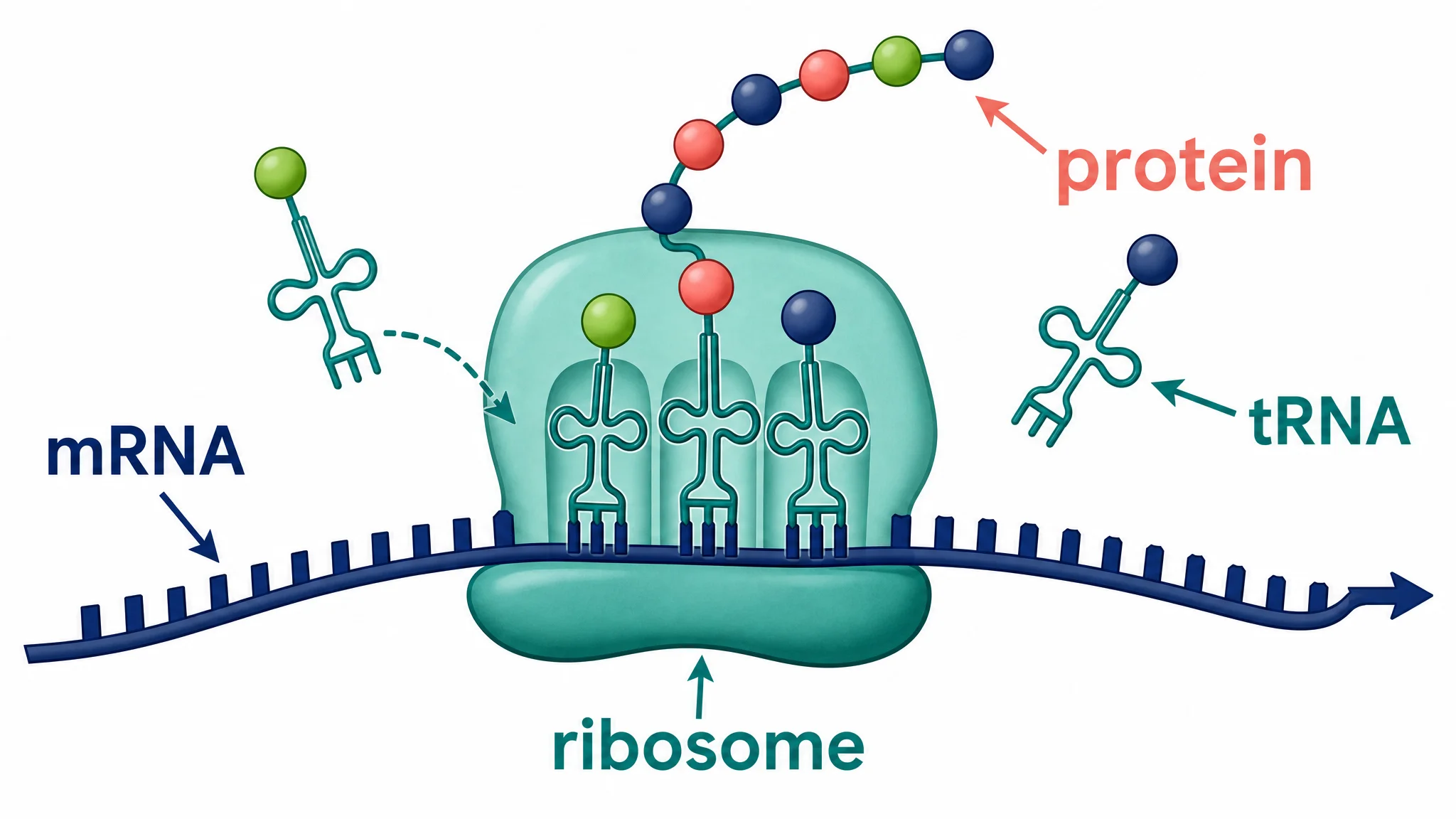
During translation, the ribosome reads mRNA codons and builds a protein from amino acids.
A good translation diagram should show:
| Element | Visual cue | Why it matters |
|---|---|---|
| mRNA | Single strand through ribosome | Shows the message being read |
| Ribosome | Two-part machine around mRNA | Shows where translation occurs |
| tRNA | Adapter molecules | Connects codons to amino acids |
| Amino acids | Small units forming a chain | Shows what protein is made from |
| Protein | Growing polypeptide or folded product | Shows the output |
For most educational diagrams, it is enough to show a ribosome, a few tRNAs, and a growing amino acid chain. Do not try to draw all 64 codons unless the lesson is specifically about the genetic code.
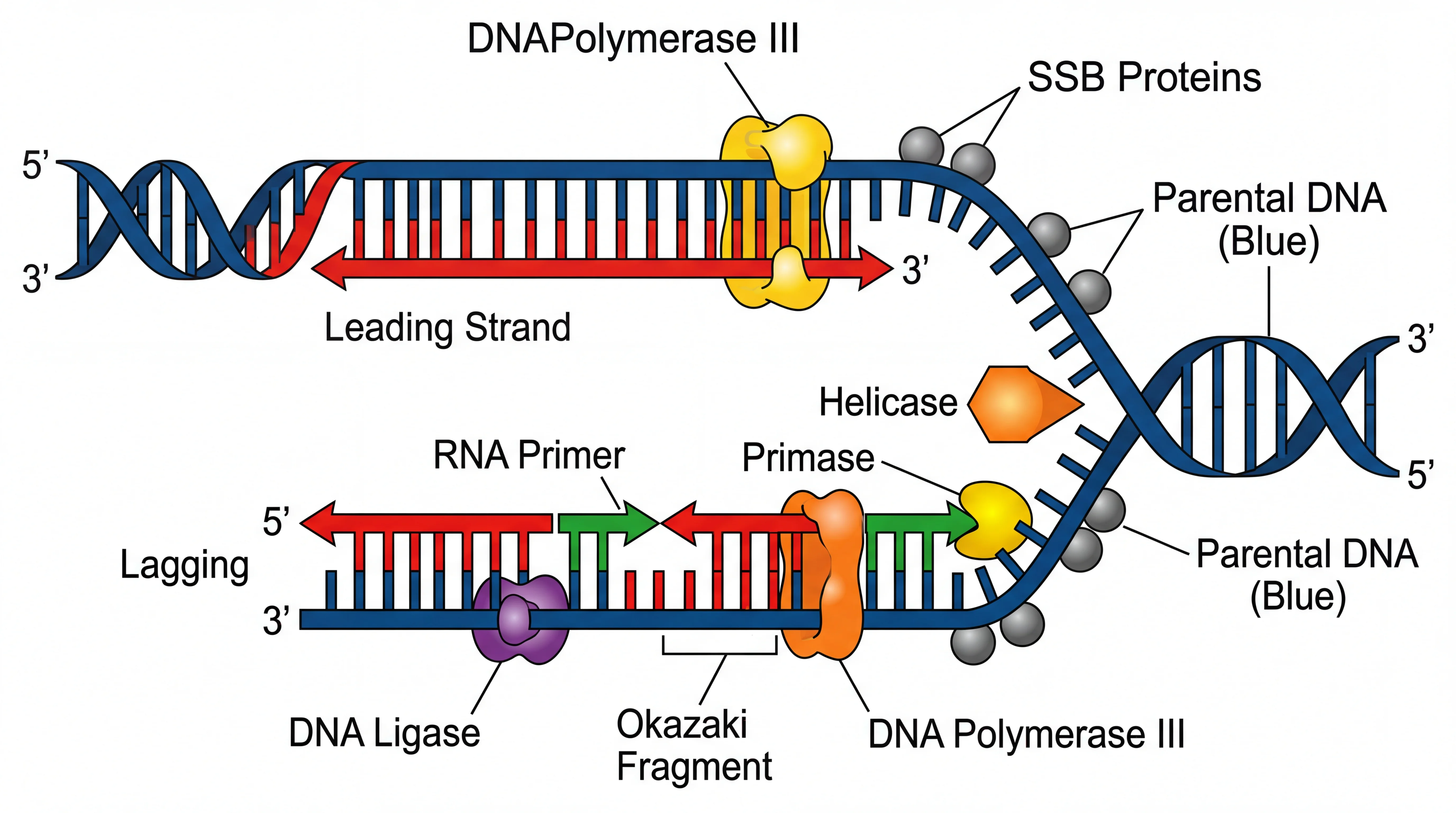
Central Dogma vs DNA Replication
Students often place DNA replication inside the same linear flow as transcription and translation. Replication is related, but it answers a different question.
| Process | Input | Output | Main purpose |
|---|---|---|---|
| DNA replication | DNA | DNA copy | Copy the genome before cell division |
| Transcription | DNA | RNA | Copy a gene into an RNA transcript |
| Translation | mRNA | Protein | Build a protein from the RNA message |
DNA replication is DNA -> DNA. It preserves genetic information for new cells. Transcription and translation are gene expression. They use genetic information to make a cellular product.
If you want to include replication in a central dogma diagram, place it as a loop or side arrow near DNA:
DNA -> DNA        replication
DNA -> RNA        transcription
RNA -> protein    translation
That keeps replication visible without confusing it with the main expression pathway.
Transcription & Translation Diagram Generator
Type a DNA sequence and get the mRNA, codons, and amino acids it codes for as an accurate, labeled central-dogma diagram.
How to Draw a Central Dogma Diagram Step by Step
1. Choose the level of detail
Before drawing, decide who the diagram is for.
| Audience | Best diagram level |
|---|---|
| Middle school | DNA -> RNA -> protein |
| High school biology | DNA -> mRNA -> ribosome -> protein |
| AP Biology | Add transcription, RNA processing, codons, tRNA, and translation |
| Intro college biology | Add promoter, template strand, pre-mRNA, mature mRNA, ribosomal sites |
| Research presentation | Focus on the specific gene, product, regulation, or experimental finding |
The diagram should answer the user's question, not prove that you know every molecular component.
2. Draw the main information flow first
Start with three large anchors:
DNA mRNA proteinThen add arrows:
DNA --transcription--> mRNA --translation--> proteinIf the diagram becomes complicated, this main flow should still be visible from a distance.
3. Add the cell context only if useful
For eukaryotic cells, a nucleus boundary is often helpful:
- DNA inside the nucleus
- transcription inside the nucleus
- mRNA leaving the nucleus
- translation at ribosomes in the cytoplasm
For prokaryotes, do not draw a nucleus. A bacterial version can show DNA in the cytoplasm and ribosomes translating mRNA while transcription is still underway.
4. Add labels in a consistent order
Place labels outside crowded molecular shapes. Keep leader lines short and straight. Use consistent capitalization: DNA, mRNA, tRNA, ribosome, protein.
Good labels for a general central dogma diagram:
- DNA
- transcription
- mRNA
- translation
- ribosome
- protein
Good optional labels for advanced diagrams:
- RNA polymerase
- template strand
- codon
- anticodon
- amino acid
- polypeptide
- start codon
- stop codon
5. Check the biology before styling
Before adding colors, ask:
- Does information flow from DNA to RNA to protein?
- Is RNA shown as a single strand?
- Is translation happening at a ribosome?
- Is protein made of amino acids, not bases?
- If a nucleus is shown, does mRNA leave it before translation?
- If replication is shown, is it separated from gene expression?
Style should support the biology, not cover errors.
Central Dogma Diagram Variants
Simple classroom diagram
Use this when students are first learning the concept:
DNA -> RNA -> proteinStrength: memorable and fast.
Weakness: does not show where transcription and translation happen.
Labeled cell diagram
Use this for high school or AP Biology:
nucleus: DNA -> mRNA
cytoplasm: mRNA -> ribosome -> protein
Strength: connects central dogma to cell structure.
Weakness: only accurate for eukaryotic cells.
Gene expression diagram
Use this when the goal is to explain phenotype:
gene -> mRNA -> protein -> trait or cell functionStrength: connects molecular biology to observable outcomes.
Weakness: can oversimplify traits controlled by many genes or environmental effects.
Mutation effect diagram
Use this when explaining how DNA changes can affect protein:
DNA mutation -> altered mRNA codon -> changed amino acid -> possible protein effectStrength: useful for genetics lessons.
Weakness: not every mutation changes the protein; silent and noncoding mutations need careful explanation.
Common Mistakes in Central Dogma Diagrams
Mistake 1: Showing protein as a direct copy of DNA
Protein is not a nucleotide strand. A protein is a chain of amino acids. Use a bead chain, ribbon, or folded shape instead of another helix.
Mistake 2: Making mRNA double-stranded
mRNA should usually appear as a single strand. A ladder-like double strand can make students think RNA looks like DNA.
Mistake 3: Hiding the ribosome
If you show translation, include the ribosome. It is the molecular machine that reads mRNA and builds protein.
Mistake 4: Mixing up transcription and translation
Transcription makes RNA from DNA. Translation makes protein from RNA. Label the arrows, not just the molecules.
Mistake 5: Treating DNA replication as part of protein production
Replication copies DNA before cell division. It is not the step that makes mRNA or protein. If you include it, use a separate DNA -> DNA arrow.
Mistake 6: Overloading one diagram
Do not put every detail into one figure. A central dogma overview, a transcription close-up, and a translation close-up are often clearer than one crowded mega-diagram.
What Searchers Usually Need from This Topic
People searching for a central dogma diagram are usually trying to finish one of these tasks:
| Task | What the page should provide |
|---|---|
| Understand the concept | A plain-language DNA -> RNA -> protein explanation |
| Draw a biology assignment | A labeled diagram structure and steps |
| Prepare a worksheet | Simple and advanced versions |
| Teach transcription vs translation | Side-by-side process comparison |
| Study for a test | Common mistakes and quick definitions |
| Build a presentation visual | Clean diagram variants and label choices |
That is why a useful guide should not only define the central dogma. It should show what to put in the diagram, what to leave out, and how to adapt the figure to the learner's level.
Central Dogma Diagram Checklist
Use this checklist before submitting or publishing the diagram:
- The title says what the diagram shows.
- DNA, mRNA, and protein are visually distinct.
- Transcription and translation arrows are labeled.
- mRNA is shown as single-stranded.
- Translation includes a ribosome.
- Protein is shown as an amino acid chain or folded shape.
- Optional replication is separated as DNA -> DNA.
- Eukaryotic diagrams show nucleus/cytoplasm separation correctly.
- Labels are readable at the final display size.
- The figure is not crowded with unnecessary enzymes or pathways.
When to Use a Tool Instead of Drawing by Hand
For a quick study note, hand drawing is fine. For a worksheet, slide deck, poster, or blog image, a tool can save time because it keeps labels aligned and output consistent.
Use a generator when you need:
- multiple diagram variants for different grade levels
- clean labels and arrows
- a print-friendly worksheet image
- a presentation-ready figure
- a starting point you can revise in class
Use manual drawing when you need:
- a specific teacher-required convention
- exact nucleotide sequences
- a detailed experimental figure
- a diagram based on real sequence data
Biology Drawing Generator
Create central dogma, genetics, cell, and molecular biology visuals from a short description.
FAQ
What is the central dogma diagram?
A central dogma diagram is a biology diagram showing how genetic information flows from DNA to RNA to protein. It usually labels transcription as the DNA-to-RNA step and translation as the RNA-to-protein step.
What are the three parts of the central dogma?
The common three-part version is DNA, RNA, and protein. More detailed diagrams add the processes between them: transcription from DNA to RNA and translation from mRNA to protein.
Is DNA replication part of the central dogma?
DNA replication is related but separate. It is DNA to DNA copying, usually shown as a side arrow or loop near DNA. Transcription and translation are the main gene-expression steps that lead to protein production.
Where does transcription happen?
In eukaryotic cells, transcription happens in the nucleus where DNA is located. In prokaryotic cells, transcription happens in the cytoplasm because there is no nucleus.
Where does translation happen?
Translation happens at ribosomes. In eukaryotic cells, mature mRNA leaves the nucleus and is translated by ribosomes in the cytoplasm or on the rough endoplasmic reticulum.
What is the difference between transcription and translation?
Transcription copies information from DNA into RNA. Translation reads mRNA codons at a ribosome and builds a protein from amino acids.
Should a central dogma diagram include codons?
Include codons if the lesson is about translation or the genetic code. For a basic overview, codons can be omitted so the DNA-to-RNA-to-protein flow stays clear.
What is the most common mistake in central dogma diagrams?
The most common mistake is making the diagram too crowded or implying that protein is a direct copy of DNA. Protein should be shown as an amino acid chain or folded molecule, not as another nucleotide strand.
Create Your Own Biology Diagram
If you need a clean central dogma visual for a lesson, worksheet, blog post, or slide deck, start with a simple prompt such as:
Create a labeled central dogma diagram showing DNA transcription to mRNA in the nucleus and mRNA translation into protein at a ribosome in the cytoplasm.Then revise the output for your audience. A middle school version may only need DNA, mRNA, and protein. An AP Biology version may need RNA polymerase, codons, tRNA, ribosome, and amino acids. The best diagram is the one that explains the exact biology your reader needs to understand.
Categories
More Posts
How to Create a Conceptual Framework for Your Research Paper: Complete Guide
Learn how to develop a strong conceptual framework for your thesis or dissertation. Includes step-by-step instructions, examples by discipline, templates, and visual diagram tips.
How to Present References in a Scientific Poster: Complete Citation Guide
Learn the best practices for formatting and presenting references on scientific posters. Includes citation styles, font sizes, placement tips, and real examples.
7 Best Free Prezi Alternatives in 2026 (Ranked)
Looking for a free Prezi alternative? Compare 7 best options with zoom effects & animations—Google Slides, Canva, Genially & more. No $59/month needed.