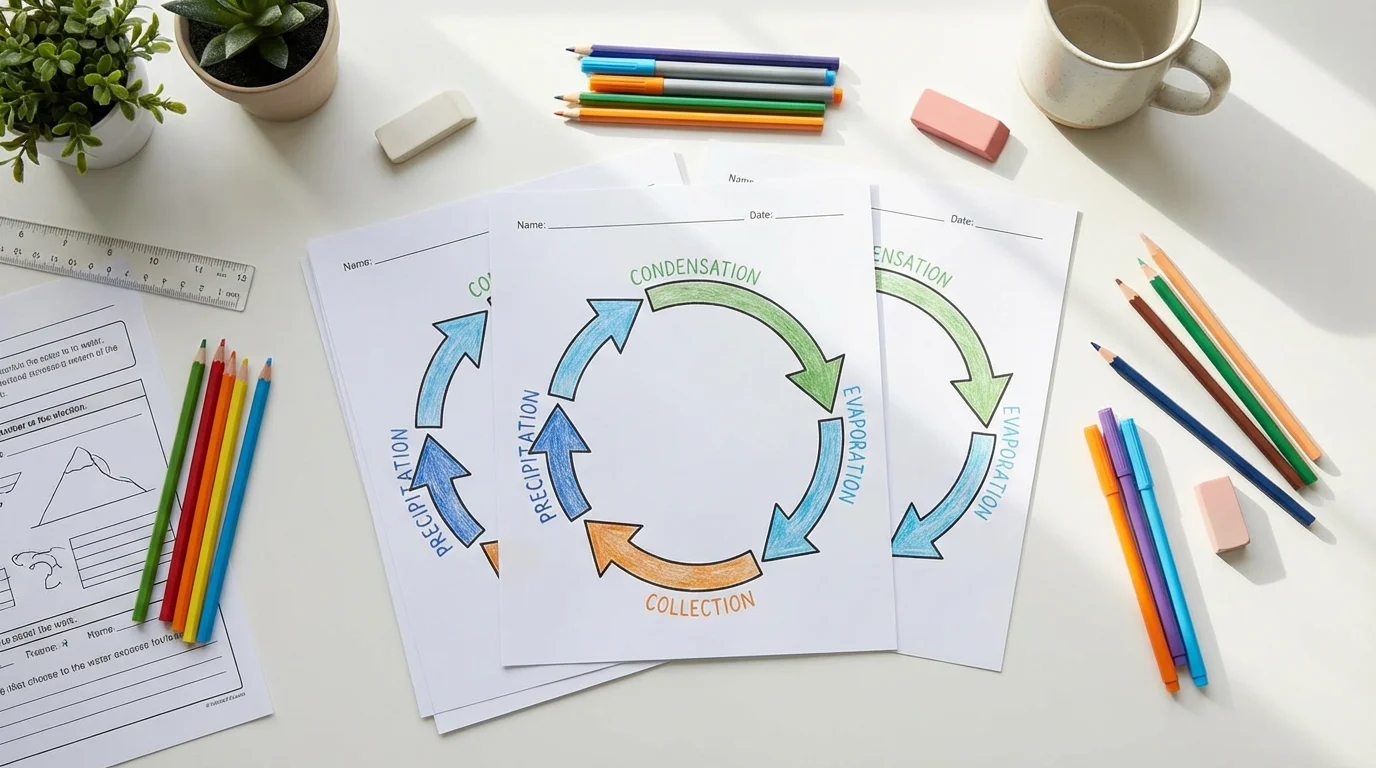
Free Printable Water Cycle Worksheets for Teachers (2026)
Free printable water cycle worksheets for elementary, middle, and high school, with labeled diagrams, blank quiz worksheets, and NGSS-aligned activities.
Teaching the water cycle is a cornerstone of science education, from elementary through high school. But finding the right worksheets — ones that are grade-appropriate, visually clear, and ready to print — can be surprisingly time-consuming.
In this guide, we'll share free printable water cycle worksheets for every grade level, explain the key concepts students need to learn, and show you how to create custom diagrams with AI.
What is the Water Cycle?
The water cycle (also called the hydrological cycle) describes the continuous movement of water on, above, and below Earth's surface. Water constantly changes form — from liquid to vapor to ice — as it moves through the environment.
According to the U.S. Geological Survey (USGS), the water cycle is driven by two forces: energy from the sun (which causes evaporation) and gravity (which pulls water back to Earth as precipitation).
The 4 Main Stages of the Water Cycle
For younger students, focus on these four core stages:
-
Evaporation — The sun heats water in oceans, lakes, and rivers, turning it into water vapor that rises into the air.
-
Condensation — As water vapor rises and cools, it forms tiny droplets that create clouds.
-
Precipitation — When clouds become heavy with water, it falls back to Earth as rain, snow, sleet, or hail.
-
Collection — Water gathers in oceans, lakes, rivers, and underground aquifers, and the cycle begins again.
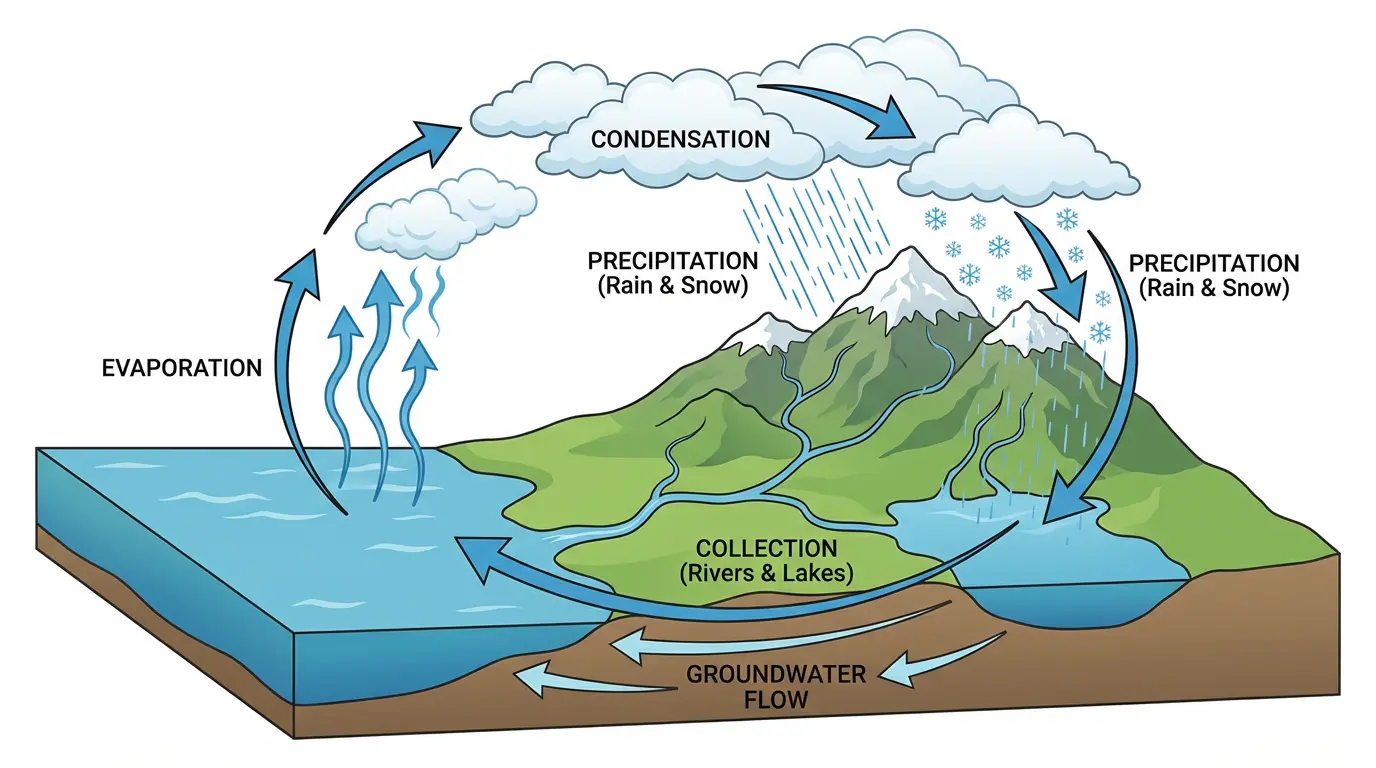 A complete labeled water cycle diagram showing all major stages — perfect for classroom instruction.
Advanced Vocabulary (Middle & High School)
Older students should also learn these additional processes:
-
Transpiration — Plants release water vapor through tiny pores in their leaves called stomata. According to the USGS Glossary, transpiration accounts for about 10% of atmospheric moisture.
-
Infiltration — Water seeps into the soil and becomes groundwater.
-
Runoff — Water flows across land surfaces into streams, rivers, and eventually the ocean.
-
Sublimation — Ice and snow transform directly into water vapor without melting first.
Water Cycle Worksheets by Grade Level
Different grade levels require different levels of complexity. Here's what to focus on at each stage:
Elementary School (K-5)
For younger students, keep it simple. Focus on the four main stages with colorful, engaging visuals.
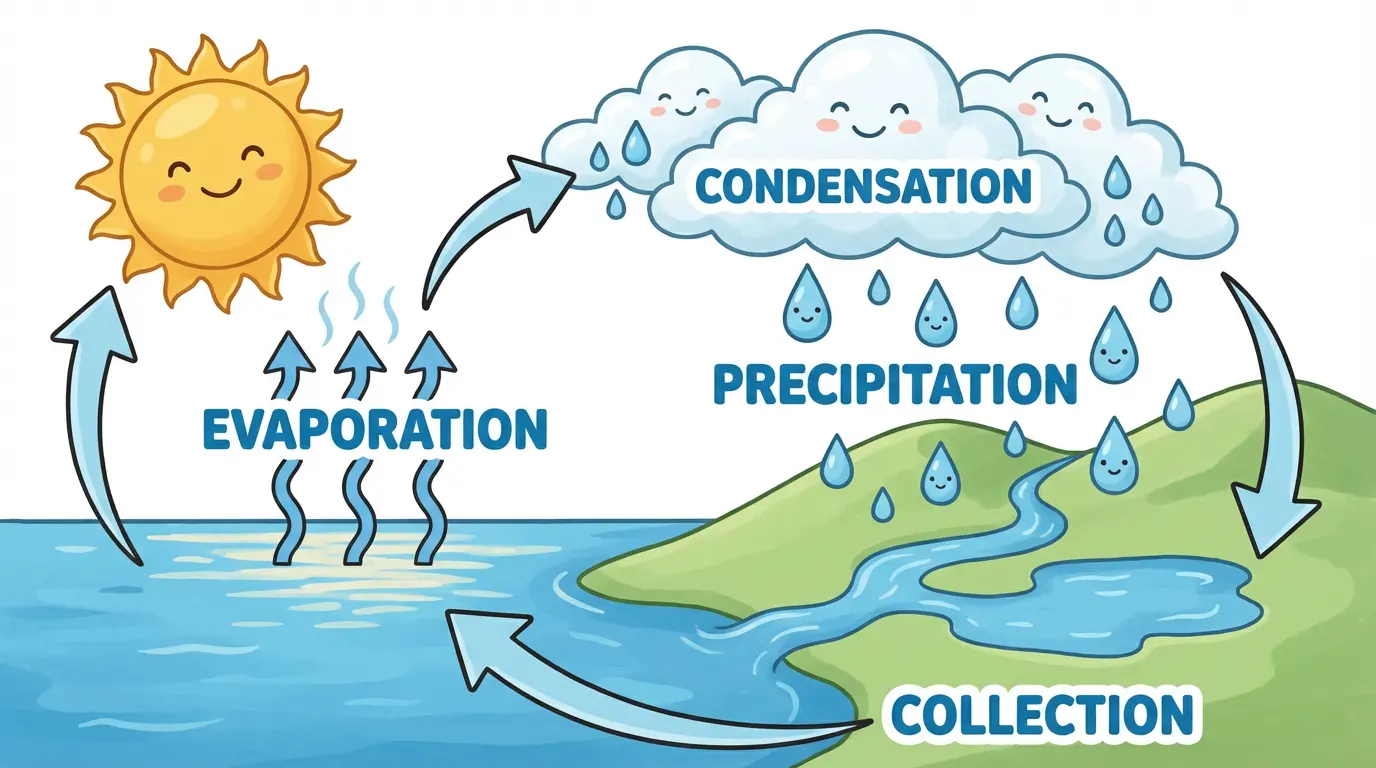 A simplified water cycle diagram for elementary students — uses friendly imagery and focuses on 4 key stages.
What to include:
- Large, easy-to-read labels
- Cartoon-style sun and clouds
- Only 4 stages: evaporation, condensation, precipitation, collection
- Coloring activities to reinforce learning
NGSS Alignment: At 5th grade, students work toward standard 5-ESS2-1, developing models to describe how Earth's systems interact.
Middle School (6-8)
Middle schoolers can handle more complexity. Add transpiration, runoff, and infiltration to the diagram.
What to include:
- All 6-7 stages of the water cycle
- Arrows showing water movement direction
- Cross-section views showing groundwater
- Vocabulary matching exercises
NGSS Alignment: The key standard is MS-ESS2-4: "Develop a model to describe the cycling of water through Earth's systems driven by energy from the sun and the force of gravity."
High School (9-12)
High school students should understand the water cycle at a systems level, including human impacts and quantitative data.
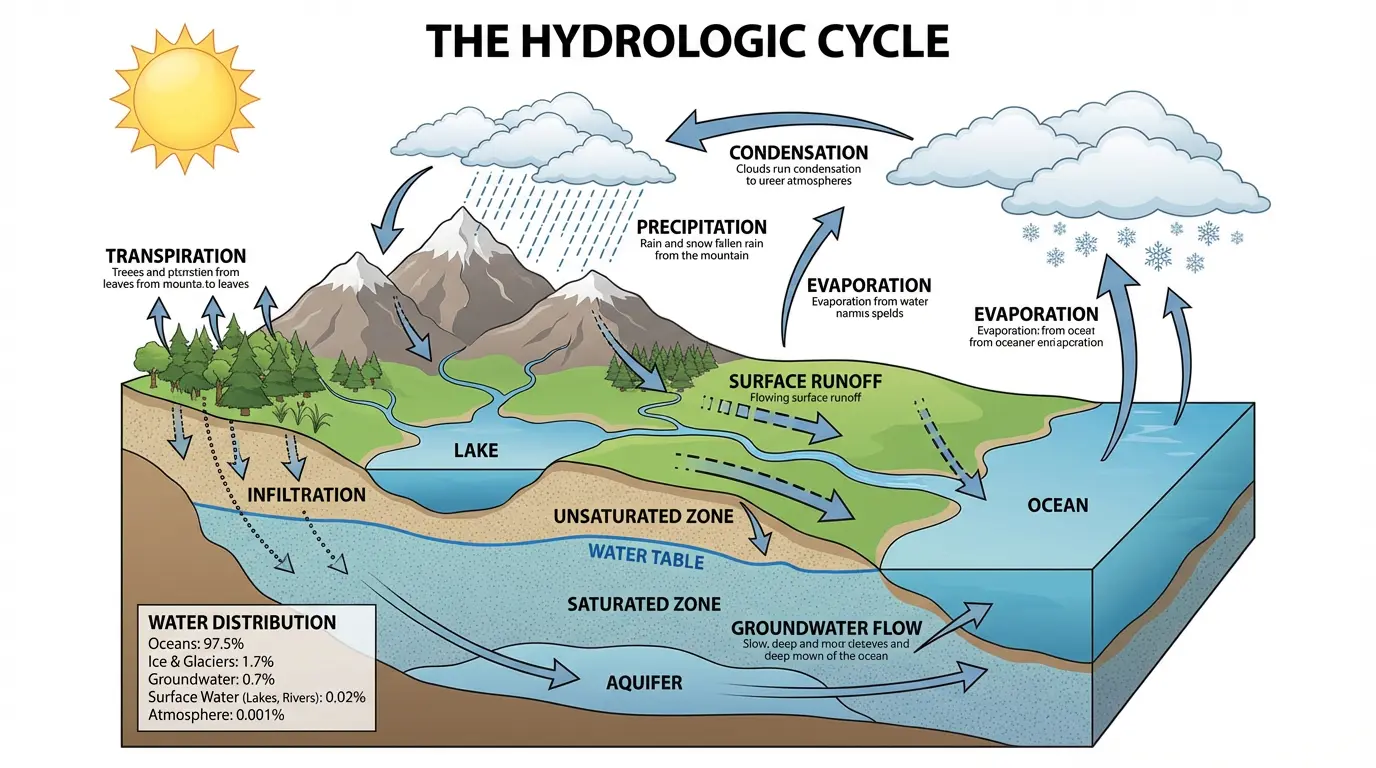 An advanced water cycle diagram showing aquifers, water table, and underground water storage — suitable for high school earth science.
What to include:
- Detailed cross-section showing aquifer layers
- Water table and groundwater storage
- Transpiration from vegetation
- Human impacts (irrigation, dams, urbanization)
- Percentage data (e.g., "97% of Earth's water is in oceans")
NGSS Alignment: Standard HS-ESS2-5 asks students to "plan and conduct an investigation of the properties of water and its effects on Earth materials and surface processes."
Labeled vs. Unlabeled Worksheets
Effective teaching requires both types of worksheets:
Labeled Diagrams (For Teaching)
Use labeled diagrams when introducing the water cycle. Students can:
- Follow along during lectures
- Use as study guides
- Reference during hands-on activities
Unlabeled Diagrams (For Assessment)
Use blank diagrams for quizzes and tests. Students must:
- Fill in the stage names
- Draw arrows showing water movement
- Write definitions for each process
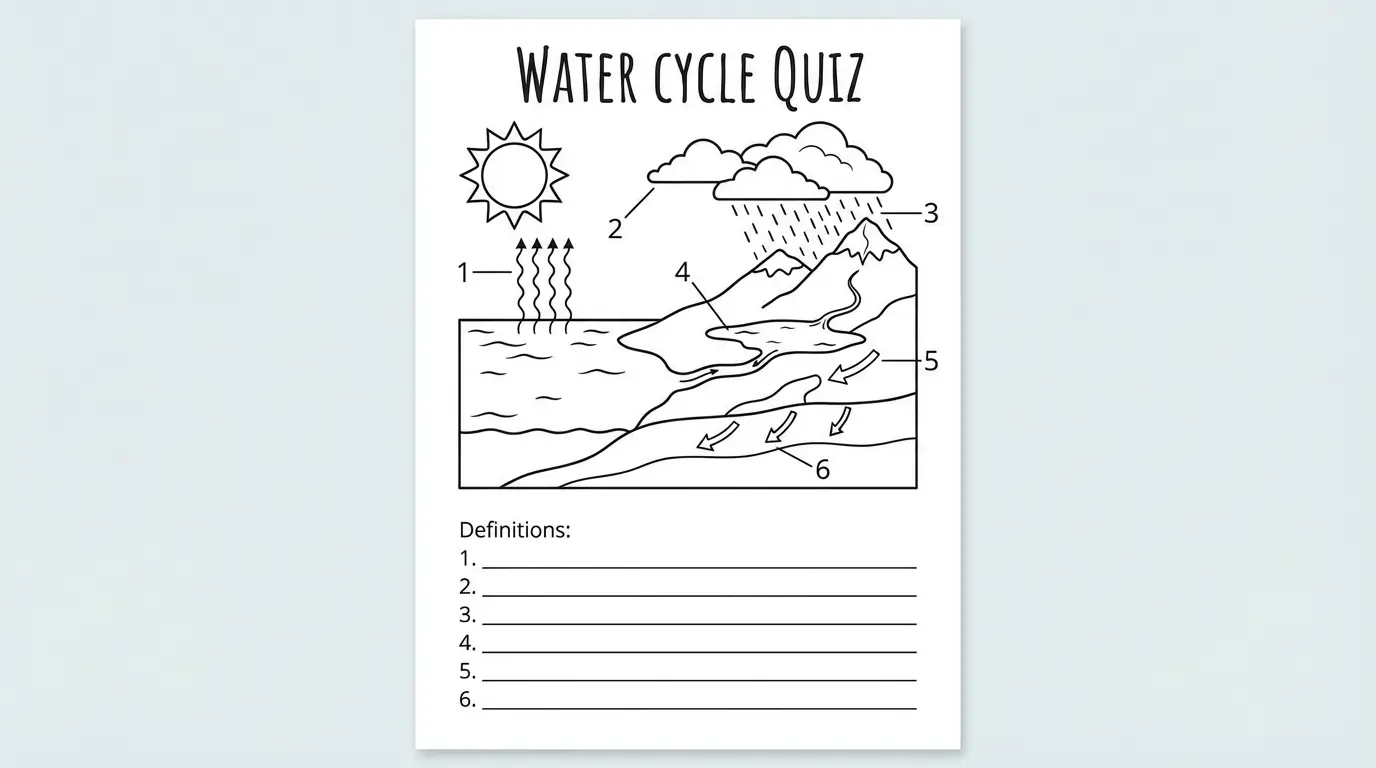 An unlabeled water cycle worksheet — perfect for quizzes and labeling exercises.
Pro tip: Give students the labeled version first, then assess with the unlabeled version a few days later.
Hands-On Water Cycle Activities
Worksheets work best when paired with hands-on activities. Here are teacher-tested favorites:
1. Water Cycle in a Bag
Materials: Ziplock bag, water, blue food coloring, tape
Instructions: Add a small amount of blue-tinted water to the bag, seal it, and tape it to a sunny window. Over several days, students observe evaporation, condensation, and "precipitation" as water droplets form and run down the bag.
This activity is recommended by Science Buddies as one of the best hands-on water cycle demonstrations.
2. Water Cycle Bracelet
Materials: String, colored beads (each color represents a stage)
Instructions: Students create a bracelet with beads representing each water cycle stage. As they add each bead, they explain what happens at that stage.
3. Water Cycle Role Play
Instructions: Students act as water molecules, moving through different "stations" (ocean, cloud, mountain, river) based on dice rolls or spinner results. This helps them understand the random, non-linear nature of the cycle.
NASA's Precipitation Education recommends simulation games where students move through the water cycle as a drop of water.
Create Custom Water Cycle Worksheets with AI
Need a worksheet that's not quite like anything you can find online? ConceptViz lets you generate custom water cycle diagrams in seconds.
What you can create:
- Diagrams for specific grade levels
- Black & white versions (saves printer ink)
- Labeled or unlabeled versions
- Custom focus areas (e.g., "water cycle emphasizing groundwater")
Try it free: Water Cycle Diagram Generator
Simply describe what you need, select your options, and download a print-ready worksheet. No design skills required.
Download Free Water Cycle Worksheets
Here are additional free resources from trusted educational sites:
| Resource | Grade Level | What's Included |
|---|---|---|
| K5 Learning | K-5 | Labeling worksheets, vocabulary |
| Tutoring Hour | 3-8 | Cut-and-glue, matching activities |
| Scholastic Teachables | K-8 | Informational texts, graphic organizers |
| Teachers Pay Teachers | All grades | Wide variety of free options |
Frequently Asked Questions
What are the 4 main stages of the water cycle?
The four main stages are evaporation (water becomes vapor), condensation (vapor forms clouds), precipitation (water falls as rain/snow), and collection (water gathers in bodies of water). These are the core concepts for elementary students.
What grade level is the water cycle taught?
The water cycle is introduced in 2nd-3rd grade and revisited with increasing complexity through high school. The main NGSS standards are 5-ESS2-1 (5th grade) and MS-ESS2-4 (middle school).
What's the difference between evaporation and transpiration?
Evaporation is water turning to vapor from surfaces like oceans and lakes. Transpiration is water vapor released by plants through their leaves. Both add moisture to the atmosphere.
How do I teach the water cycle to younger students?
Start with the 4 main stages using colorful, simple diagrams. Use hands-on activities like the "water cycle in a bag" to make the concept tangible. Avoid overwhelming them with advanced vocabulary like transpiration or infiltration.
Are these worksheets aligned with NGSS standards?
Yes. Elementary worksheets align with 5-ESS2-1, while middle school worksheets align with MS-ESS2-4, which specifically requires students to "develop a model to describe the cycling of water through Earth's systems."
Ready to create your own water cycle worksheets? Try our free Water Cycle Diagram Generator and download print-ready diagrams in seconds.
カテゴリー
もっと読む
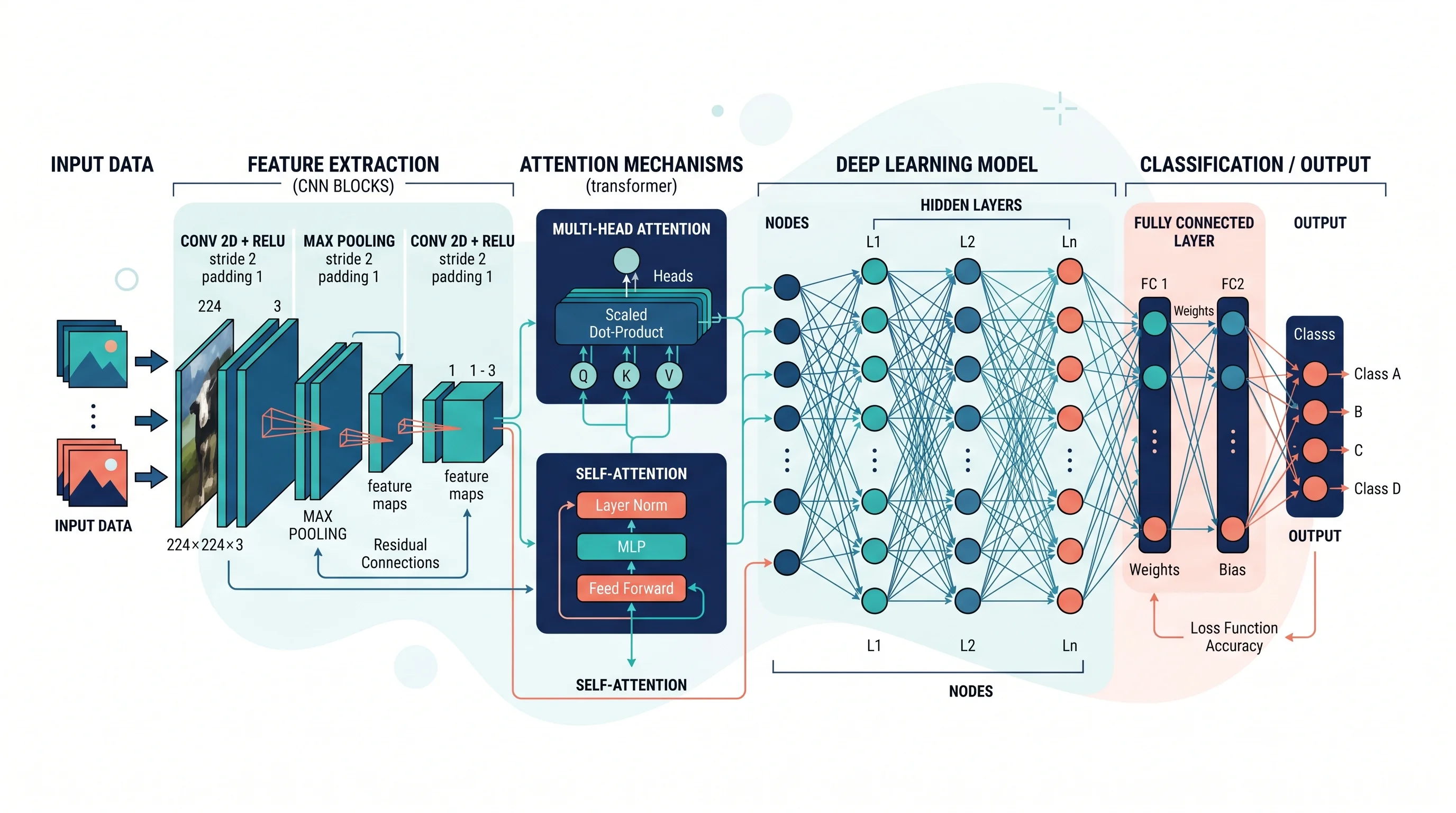
How to Draw a Neural Network Architecture Diagram: A Complete Guide
Learn how to draw neural network architecture diagrams for CNNs, RNNs, Transformers, and more. A step-by-step guide with tools, examples, and best practices.
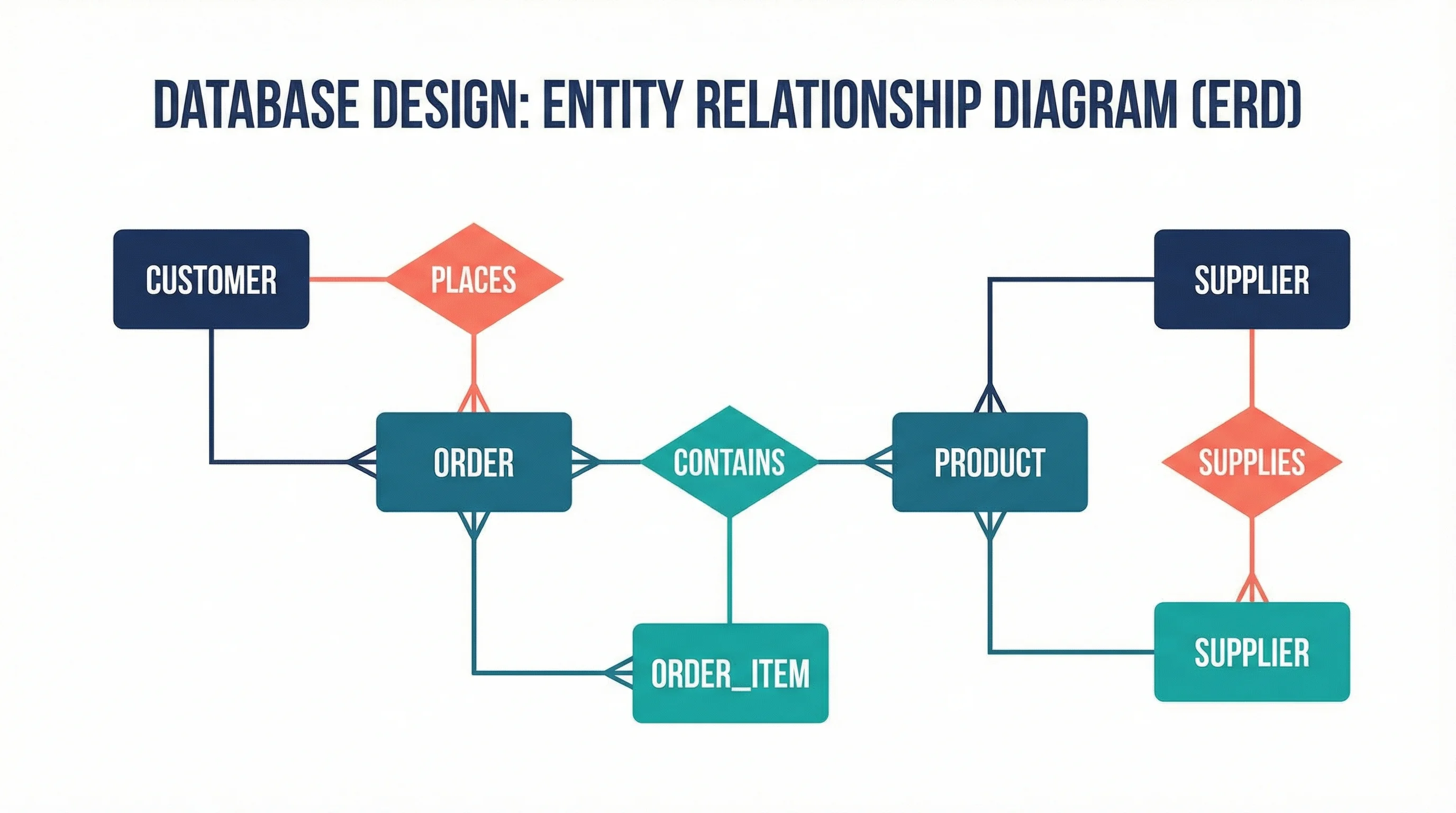
ER Diagram Guide: How to Design Entity-Relationship Diagrams Step by Step (2026)
Learn how to draw ER diagrams from scratch in this step-by-step guide. Covers Chen and Crow's Foot notation, best practices, real examples, and free tools.
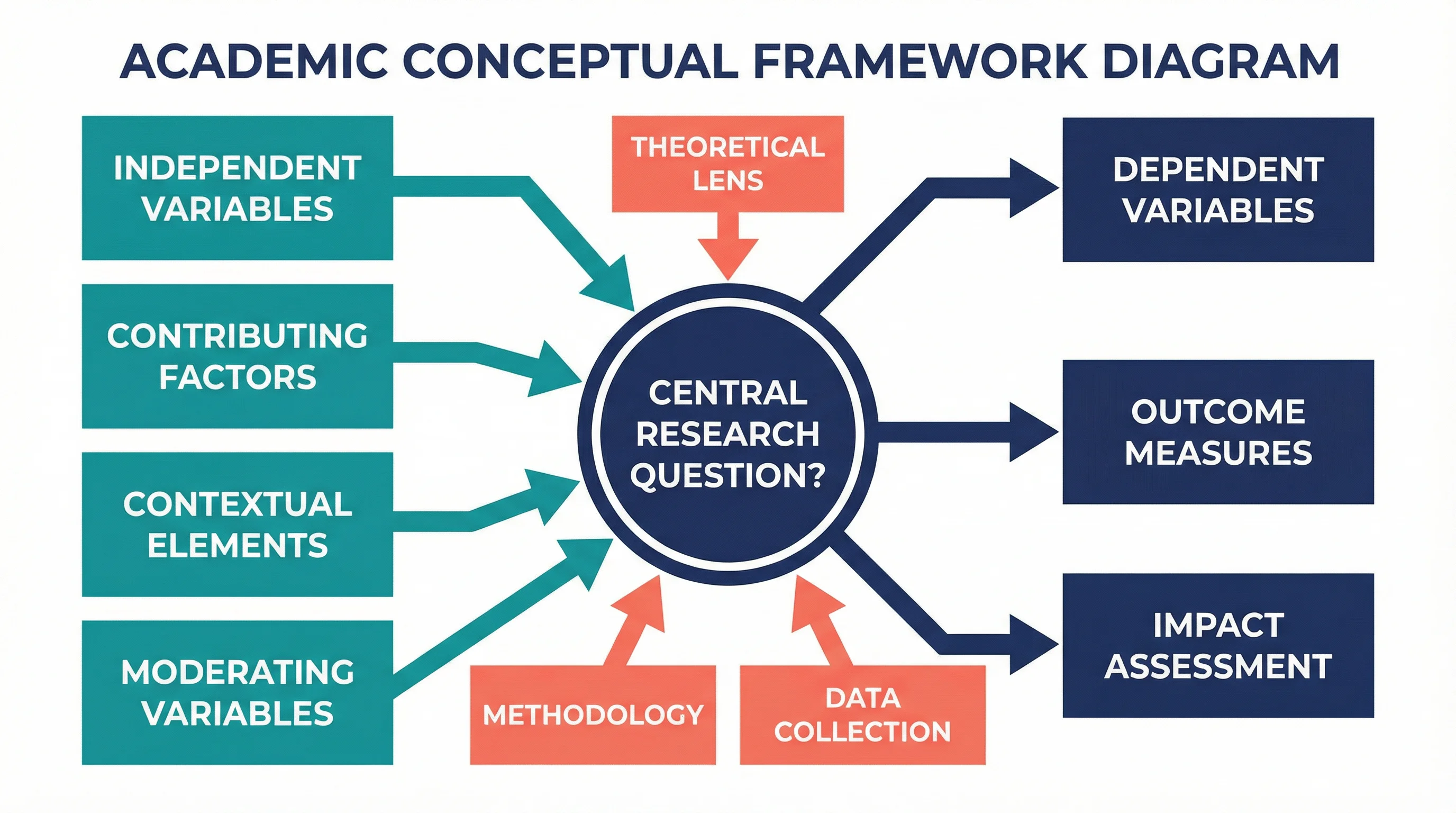
Framework vs Model in Research: Complete Guide to Understanding the Difference
Learn the key differences between frameworks and models in academic research, with examples, when to use each, and how to apply them in your methodology.