Theoretical Framework Generator Visualize Your Theory
Build a theoretical framework diagram for your thesis or dissertation in seconds. Describe the theory, constructs, and hypothesized relationships in plain English and the AI lays them out with labeled arrows, giving you a clean framework figure for papers and proposals.
Theories, constructs & hypothesized relationshipsLabeled hypothesis arrows (H1, H2, …)Built on TAM, TPB, SCT, UTAUT and moreLabeled constructs and hypothesis arrows
Browse classic theory models across disciplines or generate your own above
Вид:
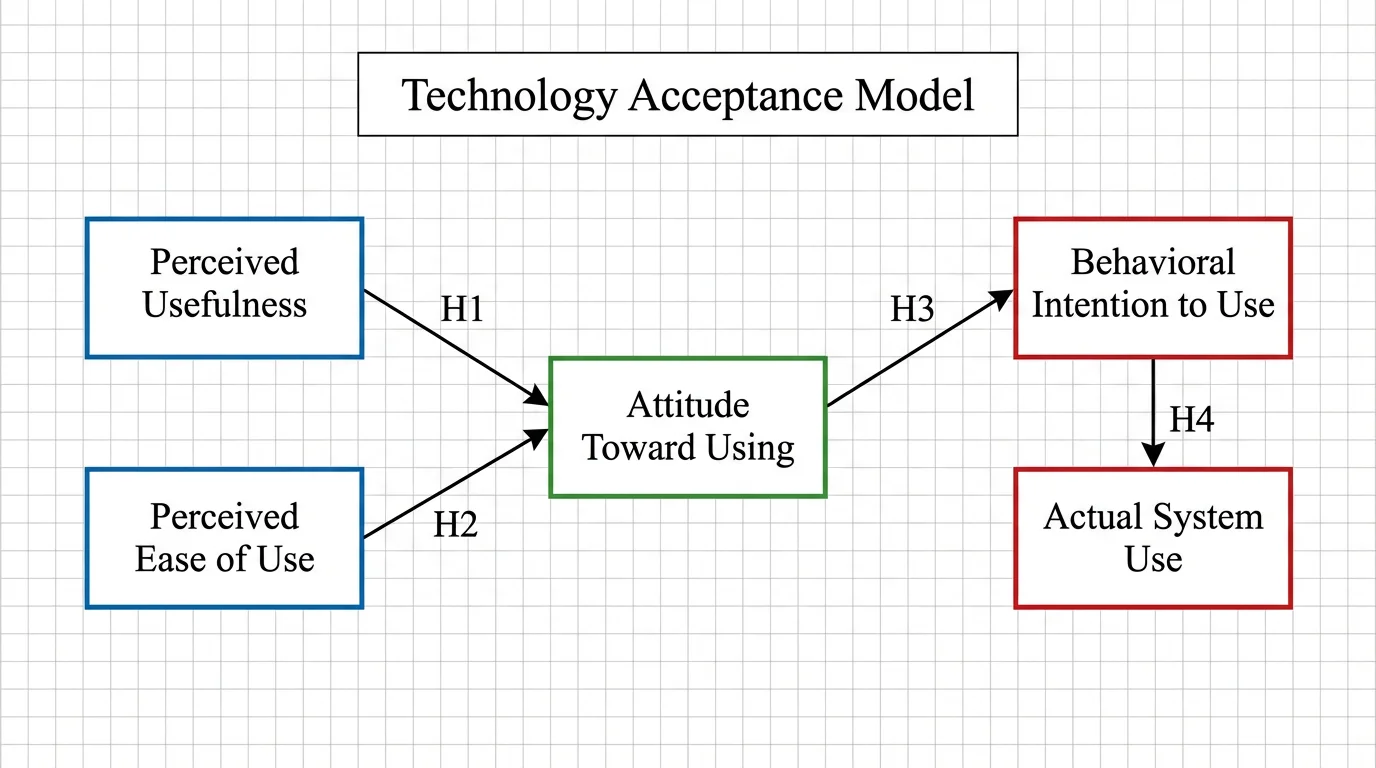
Technology Acceptance Model (TAM)
Davis's TAM — the canonical theoretical framework for information-systems and technology-adoption research.
TAMtechnologyIS-research
Theory of Planned Behavior (TPB)
Ajzen's TPB, with three antecedents feeding behavioral intention and behavior — a staple in psychology and health research.
TPBpsychologybehavior
Social Cognitive Theory (SCT)
Bandura's triadic reciprocal determinism, mapping the bidirectional links between person, behavior, and environment.
SCTBandurapsychology
UTAUT Model
The Unified Theory of Acceptance and Use of Technology, with four core constructs and moderators shown as dotted paths.
UTAUTtechnologyacceptance
Self-Determination Theory (SDT)
Deci & Ryan’s SDT, connecting the three basic psychological needs to the motivation continuum and outcomes.
SDTmotivationpsychology
Resource-Based View (RBV)
Barney's RBV, tracing firm resources through VRIO analysis to sustainable competitive advantage and performance.
RBVstrategymanagement
Theoretical framework examples by discipline
Each example below names the original source and uses the construct names from that source, so your diagram matches the literature you cite. Pick a preset to load the prompt into the generator, then edit the constructs and arrows for your study.
Technology Acceptance Model (TAM)
Davis (1989), MIS Quarterly; extended by Davis, Bagozzi & Warshaw (1989), Management Science
Davis proposed perceived usefulness and perceived ease of use as the two core beliefs behind user acceptance of a technology, and found that ease of use may work through usefulness. The version most theses draw adds attitude toward using and behavioral intention to use, leading to actual system use.
Typical fields: Information systems, e-learning, health IT, digital services
Theory of Planned Behavior (TPB)
Ajzen (1991), Organizational Behavior and Human Decision Processes
Attitude toward the behavior, subjective norm, and perceived behavioral control predict behavioral intention, and intention predicts behavior. Perceived behavioral control can also act on behavior directly and is expected to moderate the intention to behavior link.
Typical fields: Health behavior, psychology, environmental behavior, marketing
Social Cognitive Theory (SCT)
Bandura (1986), Social Foundations of Thought and Action; self-efficacy from Bandura (1977), Psychological Review
Triadic reciprocal causation: personal factors (cognitive, affective, and biological), behavior, and the environment all influence one another. Studies usually measure self-efficacy and outcome expectations as the personal factors.
Typical fields: Education, health promotion, human-computer interaction
Unified Theory of Acceptance and Use of Technology (UTAUT)
Venkatesh, Morris, Davis & Davis (2003), MIS Quarterly
Performance expectancy, effort expectancy, and social influence predict behavioral intention; facilitating conditions and behavioral intention predict use behavior. Gender, age, experience, and voluntariness of use moderate these paths, and each path has its own set of moderators.
Typical fields: Information systems, e-government, health IT, mobile banking
Self-Determination Theory (SDT)
Deci & Ryan (1985), Intrinsic Motivation and Self-Determination in Human Behavior
Satisfying the basic psychological needs for autonomy, competence, and relatedness supports more autonomous motivation and well-being. Extrinsic motivation runs along a continuum of external regulation, introjection, identification, and integration, next to intrinsic motivation.
Typical fields: Education, sport, health care, work motivation
Resource-Based View (RBV)
Barney (1991), Journal of Management; Wernerfelt (1984), Strategic Management Journal
Barney assumed firm resources are heterogeneous and immobile, and judged their potential for sustained competitive advantage by value, rareness, imitability, and substitutability. Later work by Barney replaced substitutability with organization, giving the VRIO framework many diagrams use.
Freeman (1984), Strategic Management: A Stakeholder Approach
A firm should create value for everyone with a stake in it, such as employees, customers, suppliers, investors, and communities, not only for shareholders. Studies often adapt it into a model of stakeholder pressure, firm responses, and outcomes, which is your own extension and should be labeled as adapted.
Typical fields: Business ethics, corporate social responsibility, sustainability
Goal-Setting Theory with self-efficacy
Locke & Latham (1990), summarized in Locke & Latham (2002), American Psychologist; Bandura (1977)
Specific, difficult goals lead to higher performance than vague "do your best" goals. Goal commitment, feedback, and task complexity moderate that effect, and self-efficacy raises both the goals people set and their commitment to them.
Typical fields: Education, organizational behavior, sport psychology
Combined TAM and TPB
Combined model compared by Taylor & Todd (1995), Information Systems Research
A common way to combine two theories: TAM supplies perceived usefulness and perceived ease of use, TPB adds subjective norm and perceived behavioral control, and all of them feed one shared behavioral intention.
Typical fields: Information systems, technology adoption
Authors and years checked against the Crossref records of the original articles; construct names checked against those abstracts, the theory authors' own pages, and the reviews linked in the citation section below. Checked October 2026.
Fill in these five parts in order. Together they become the description you paste into the theoretical framework generator above, and the same order works for the text of your framework section.
1Theory: Name the theory and its original source, for example "Theory of Planned Behavior (Ajzen, 1991)".
2Constructs: List the constructs exactly as the theory names them, such as attitude toward the behavior, subjective norm, and perceived behavioral control.
3Variables and measures: Under each construct, note the variable you will measure and the scale or data source, for example "subjective norm: 3-item scale".
4Hypothesized arrows: Draw one arrow per predicted relationship, from cause to effect. Use solid arrows for direct effects and dashed arrows for moderators.
5H1 to Hn: Number every arrow and write the matching hypothesis in your text, for example "H1: Attitude toward the behavior positively predicts intention".
Theory: [name] ([author], [year])
Constructs: [construct A], [construct B], [construct C], [outcome]
Variables and measures: [construct A] = [scale or data source]; ...
Arrows: [A] -> [outcome] (H1); [B] -> [outcome] (H2); [C] moderates [A] -> [outcome] (H3, dashed)
Hypotheses: H1 ... Hn, one per arrow
Put a short note under the figure that names the original source of the theory and says whether you drew it as published or adapted it. If you added, removed, or renamed constructs, say so, because readers compare your diagram with the original. Format the note and the reference list in the citation style your program or journal uses.
As published: "Figure 1. Theory of Planned Behavior. Based on Ajzen (1991)."
Adapted: "Figure 2. Research framework adapted from the Technology Acceptance Model (Davis, 1989), with perceived trust added as a predictor of behavioral intention."
A diagram you draw yourself from a theory is different from copying a published figure. If you reuse an original figure, check the rights holder's terms. For example, Icek Ajzen's TPB diagram page allows its figure in a thesis, dissertation, presentation, poster, or journal article as long as the copyright notice is kept (Checked October 2026). Theory overviews used for this page: TAM, UTAUT and resource-based theory (Newcastle University TheoryHub).
What is a theoretical framework in research?
A theoretical framework is the established theory you adopt as the lens for your study — the constructs, propositions, and relationships borrowed from existing literature that explain the phenomenon you are investigating. It anchors your research in scholarship that came before you, justifies the variables you choose to measure, and tells reviewers and your thesis committee why you expect the relationships you are about to test. A theoretical framework diagram makes that lens visible: it draws the theory’s core constructs as boxes and its hypothesized relationships as labeled arrows, so the whole argument can be grasped at a glance. This generator turns a plain-English description of your theory into exactly that figure, with the constructs placed and the hypothesis arrows drawn for you.
Theoretical framework vs conceptual framework
These two terms are constantly confused, but they do different jobs. The theoretical framework is the broad foundation — an existing, named theory from the literature, such as the Technology Acceptance Model or the Theory of Planned Behavior, that you adopt more or less intact as your lens. The conceptual framework is your own targeted model for this specific study: it takes that theory (or several theories) and lays out the exact variables and relationships you will actually test, sometimes adding new constructs or links. Put simply, the theoretical framework is the established theory you stand on; the conceptual framework is the custom map you build for your particular research question. This tool can draw either — a textbook theory model or your adapted study design — so you can present both in your thesis if your program requires them.
Components of a theoretical framework
Theory: the named, established theory you adopt as your lens (for example, TAM, TPB, SCT, UTAUT, SDT, or RBV) and the assumptions it carries.
Constructs and concepts: the abstract building blocks the theory defines — such as perceived usefulness, self-efficacy, or behavioral intention.
Variables: the measurable indicators you use to operationalize each construct in your data.
Relationships: the directional links between constructs, drawn as arrows, that the theory predicts.
Propositions and hypotheses: the testable statements (H1, H2, …) attached to each relationship, expressing what you expect to find.
Why a theoretical framework matters for your thesis
A strong theoretical framework is what separates a focused, defensible study from a loose collection of variables. It grounds your research in existing scholarship, so you are extending a recognized conversation rather than starting from scratch; it justifies your choice of variables and the direction of your hypotheses; and it gives your methodology a clear rationale that examiners can follow. Many dissertation and grant guidelines ask for a theoretical or conceptual framework section, so check what your own program requires, and a clear framework diagram helps readers see your argument at a glance. Visualizing the theory also helps you, the researcher: laying out the constructs and arrows quickly exposes missing links, untested assumptions, and relationships you have not yet hypothesized.
How to build a theoretical framework from your topic
Start from your research question and identify the phenomenon or outcome you are trying to explain.
Search the literature for established theories that already model that phenomenon, and choose the one (or two) that best fit your context.
Pull out the theory’s core constructs and define how you will measure each as a variable in your study.
Map the relationships the theory predicts between those constructs, and state each one as a numbered hypothesis or proposition.
Describe all of this in the box above and generate the diagram, then refine the labels and export the figure for your proposal or thesis chapter.
Theoretical framework examples across disciplines
Theoretical frameworks appear in every field, and the generator adapts to all of them. Information-systems and management researchers build TAM- and UTAUT-style adoption models or Resource-Based View diagrams; psychology and behavioral researchers draw on the Theory of Planned Behavior, Social Cognitive Theory, or Self-Determination Theory; education researchers map self-efficacy and motivation onto learning outcomes; and public-health and nursing researchers adapt health-behavior theories to their interventions. Whether your study is quantitative with hypothesis arrows or qualitative with propositions linking themes, you can describe the theory and its relationships in plain English and get a framework figure that fits your paper.