Générateur de Schéma Cycle de Calvin Cycle de Calvin
Décrivez le schéma du cycle de calvin dont vous avez besoin et notre IA le créera instantanément. Idéal pour les cours de biologie, les présentations de recherche et les supports pédagogiques.
Générateur de Schéma Cycle de Calvin
By using ConceptViz, you agree not to generate or edit adult, sexual, explicit, unsafe, or policy-violating content. See Content Policy.
Gratuit à essayer ·
Votre schéma du cycle de calvin apparaîtra ici
Décrivez votre schéma et cliquez sur Générer
Exemples de Schémas du Cycle de Calvin
Parcourez les exemples du cycle de calvin ou générez le vôtre ci-dessus
Cycle de Calvin Entièrement Étiqueté
Un schéma complet du cycle de calvin avec les trois phases clairement étiquetées, montrant le flux du carbone à travers la fixation, la réduction et la régénération du RuBP.
Vue d'Ensemble Simplifiée en Trois Phases
Une vue d'ensemble simplifiée du cycle de calvin mettant en évidence les trois phases principales avec un code couleur pour une compréhension facile par les étudiants.
Vue Détaillée des Molécules
Un schéma détaillé du cycle de calvin avec les structures moléculaires des intermédiaires clés pour les cours avancés de biologie et de biochimie.
Cycle de Calvin dans le Contexte du Chloroplaste
Le cycle de calvin replacé dans son contexte cellulaire dans le stroma du chloroplaste, montrant les connexions avec les réactions dépendantes de la lumière dans les thylakoïdes.
Réactions Lumineuses vs Cycle de Calvin
Un schéma comparatif montrant comment les réactions lumineuses et le cycle de calvin fonctionnent ensemble, connectés par l'ATP, le NADPH et d'autres molécules partagées.
Version Quiz Vierge
Un schéma du cycle de calvin en format feuille de travail avec des étiquettes vierges pour les évaluations pédagogiques et l'auto-évaluation.
Qu'est-ce que le Cycle de Calvin ?
Le cycle de calvin, également connu sous le nom de réactions indépendantes de la lumière ou cycle de Calvin-Benson-Bassham (CBB), est la deuxième étape de la photosynthèse qui se déroule dans le stroma des chloroplastes. Contrairement aux réactions dépendantes de la lumière, le cycle de calvin ne nécessite pas directement la lumière mais dépend de l'ATP et du NADPH produits par les réactions lumineuses. Découvert par Melvin Calvin, Andrew Benson et James Bassham dans les années 1950, cette voie métabolique est responsable de la conversion du dioxyde de carbone atmosphérique (CO2) en molécules organiques, spécifiquement le glycéraldéhyde-3-phosphate (G3P), que la plante utilise pour construire le glucose et d'autres glucides. Le cycle doit effectuer trois tours pour fixer trois molécules de CO2 et produire une nette molécule de G3P.
Les Trois Phases du Cycle de Calvin
- Phase 1 — Fixation du Carbone : L'enzyme RuBisCO catalyse l'attachement du CO2 à la molécule de RuBP à 5 carbones, produisant deux molécules du composé à 3 carbones 3-PGA
- Phase 2 — Réduction : L'ATP et le NADPH des réactions lumineuses convertissent le 3-PGA en G3P (glycéraldéhyde-3-phosphate), un sucre à 3 carbones à haute énergie
- Phase 3 — Régénération du RuBP : L'ATP est utilisé pour réarranger les molécules de G3P en RuBP à 5 carbones, permettant au cycle de continuer à fixer plus de CO2
- Pour chaque 3 molécules de CO2 fixées, le cycle consomme 9 ATP et 6 NADPH pour produire 1 nette molécule de G3P
- Les 5 molécules de G3P restantes sont recyclées pour régénérer 3 molécules de RuBP, maintenant le cycle en marche
- Deux molécules de G3P (provenant de deux tours de 3 CO2 chacun) se combinent pour former une molécule de glucose
Molécules Clés du Cycle de Calvin
Plusieurs molécules critiques conduisent le cycle de calvin. La RuBisCO (ribulose-1,5-bisphosphate carboxylase/oxygénase) est l'enzyme la plus abondante sur Terre et catalyse la première étape de la fixation du carbone. Le RuBP (ribulose-1,5-bisphosphate) est l'accepteur de CO2 à 5 carbones qui est régénéré à chaque cycle. Le 3-PGA (3-phosphoglycérate) est le premier produit stable à 3 carbones de la fixation du carbone. Le G3P (glycéraldéhyde-3-phosphate) est le produit sucré à 3 carbones qui peut être utilisé pour construire le glucose, le saccharose, l'amidon, les acides aminés et les acides gras. L'ATP fournit l'énergie et le NADPH fournit le pouvoir réducteur, tous deux provenant des réactions dépendantes de la lumière qui se produisent dans les membranes thylakoïdales.
Relation avec les Réactions Lumineuses
Le cycle de calvin et les réactions dépendantes de la lumière forment un système interconnecté. Les réactions lumineuses se produisent dans les membranes thylakoïdales, où la chlorophylle absorbe l'énergie lumineuse pour décomposer l'eau, libérer l'oxygène et produire de l'ATP et du NADPH. Ces transporteurs d'énergie se déplacent ensuite vers le stroma, où le cycle de calvin les utilise pour fixer le CO2 en carbone organique. Le cycle de calvin renvoie l'ADP, le phosphate inorganique (Pi) et le NADP+ aux réactions lumineuses pour le recyclage. Bien qu'appelé 'indépendant de la lumière', le cycle de calvin se produit généralement pendant la journée car il dépend de l'approvisionnement continu en ATP et NADPH des réactions lumineuses actives.
Photosynthèse C3, C4 et CAM
La voie standard du cycle de calvin est appelée photosynthèse C3 car le premier produit stable (3-PGA) possède 3 carbones. La plupart des plantes, dont le riz, le blé et le soja, utilisent cette voie. Cependant, dans des conditions chaudes et sèches, la RuBisCO peut fixer par erreur l'oxygène au lieu du CO2 (photorespiration), gaspillant de l'énergie. Les plantes C4 comme le maïs et la canne à sucre ont développé une étape supplémentaire de concentration du carbone qui fournit du CO2 directement à la RuBisCO, minimisant la photorespiration. Les plantes CAM comme les cactus et les plantes succulentes ouvrent leurs stomates la nuit pour collecter le CO2 et le stocker sous forme d'acides organiques, puis le libèrent dans le cycle de calvin pendant la journée avec les stomates fermés pour conserver l'eau.
Comment Créer un Schéma du Cycle de Calvin
- Choisissez le niveau de détail — vue d'ensemble simplifiée, manuel standard ou biochimie avancée
- Décidez du contexte — cycle autonome, dans le chloroplaste, ou comparé aux réactions lumineuses
- Spécifiez les molécules et enzymes à étiqueter (RuBisCO, RuBP, 3-PGA, G3P, ATP, NADPH)
- Sélectionnez le code couleur pour les trois phases : fixation, réduction et régénération
- Ajoutez des annotations de comptage du carbone pour suivre comment les carbones se déplacent dans le cycle
- Notre générateur IA crée instantanément des schémas du cycle de calvin précis, prêts à publier
Questions Fréquentes
Plus d'Outils de Schémas de Biologie
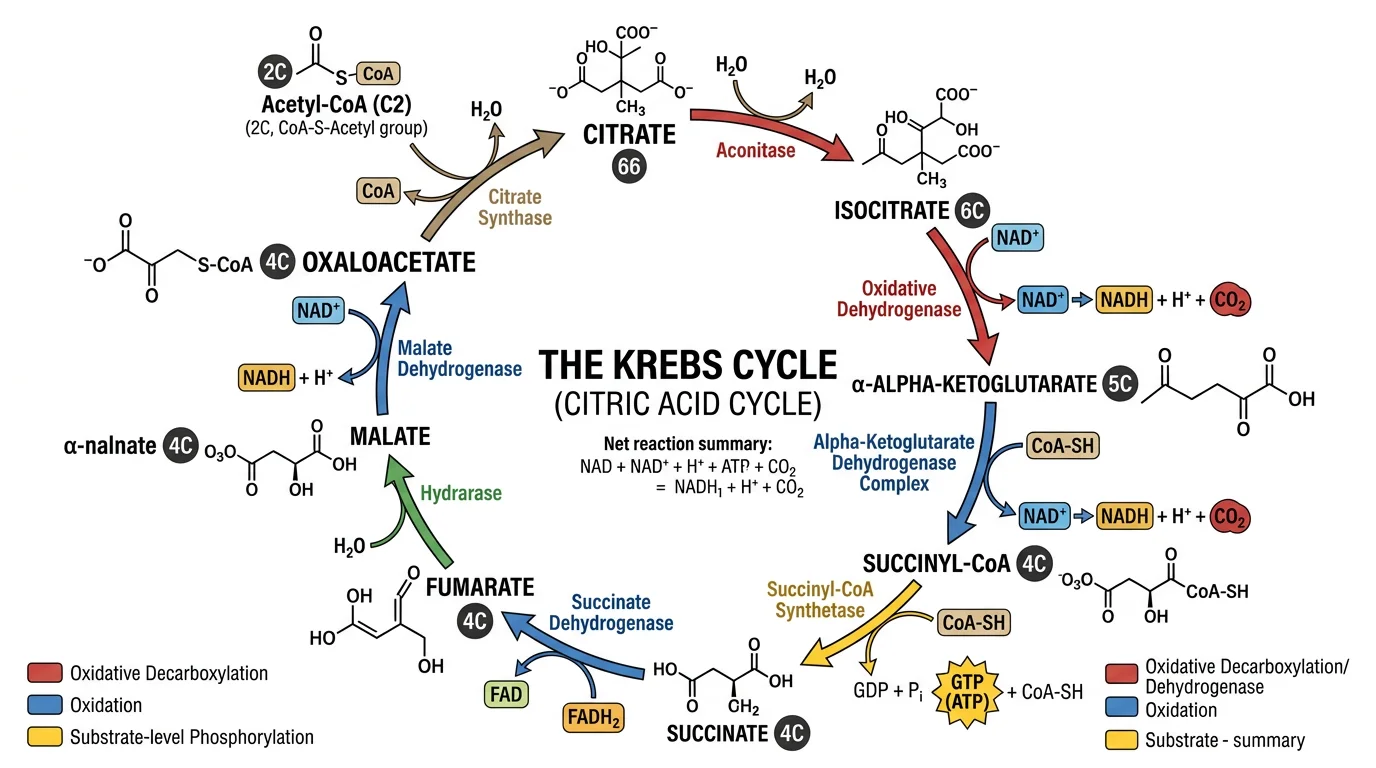 Biologie
Schéma du Cycle de Krebs
Créez des schémas professionnels du cycle de Krebs pour la respiration cellulaire et la biochimie.
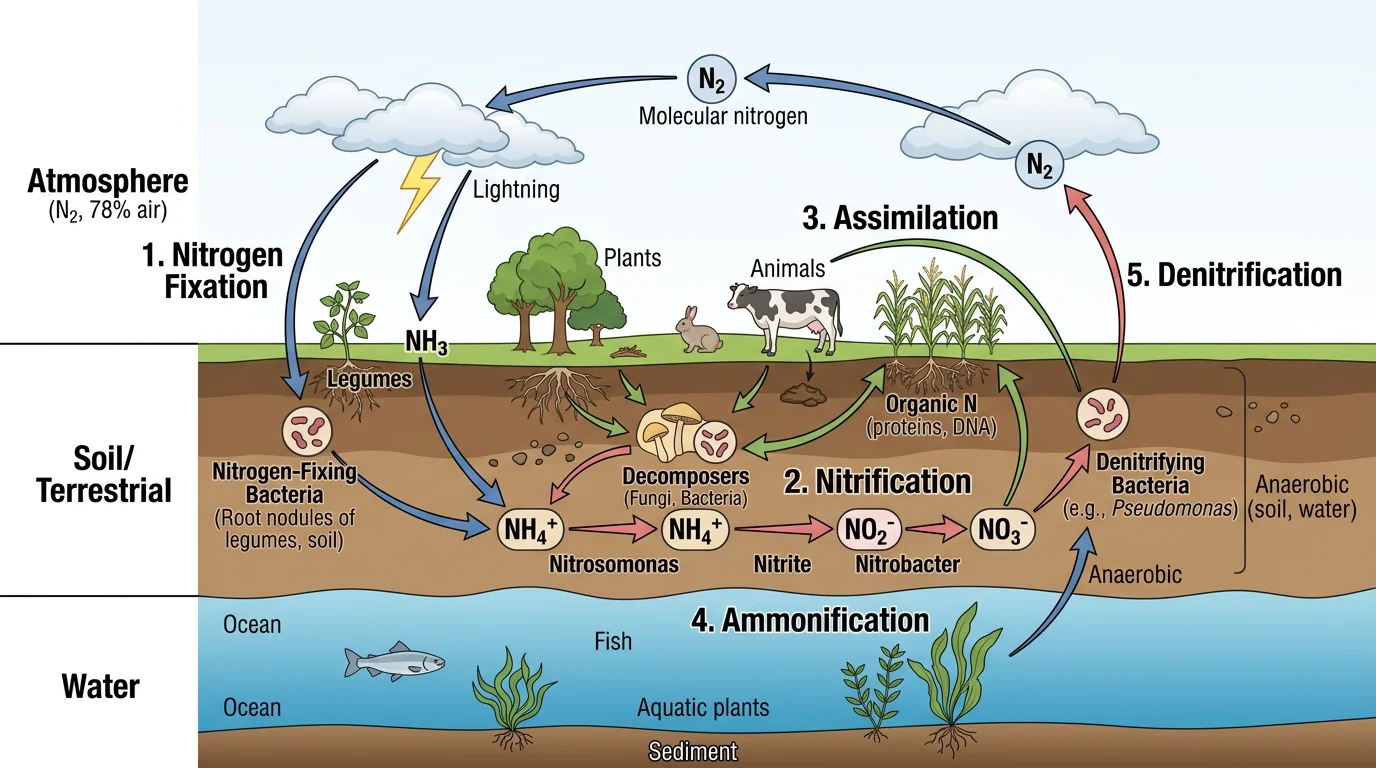 Biologie
Schéma du Cycle de l'Azote
Générez des schémas du cycle de l'azote montrant la fixation, la nitrification et la dénitrification.
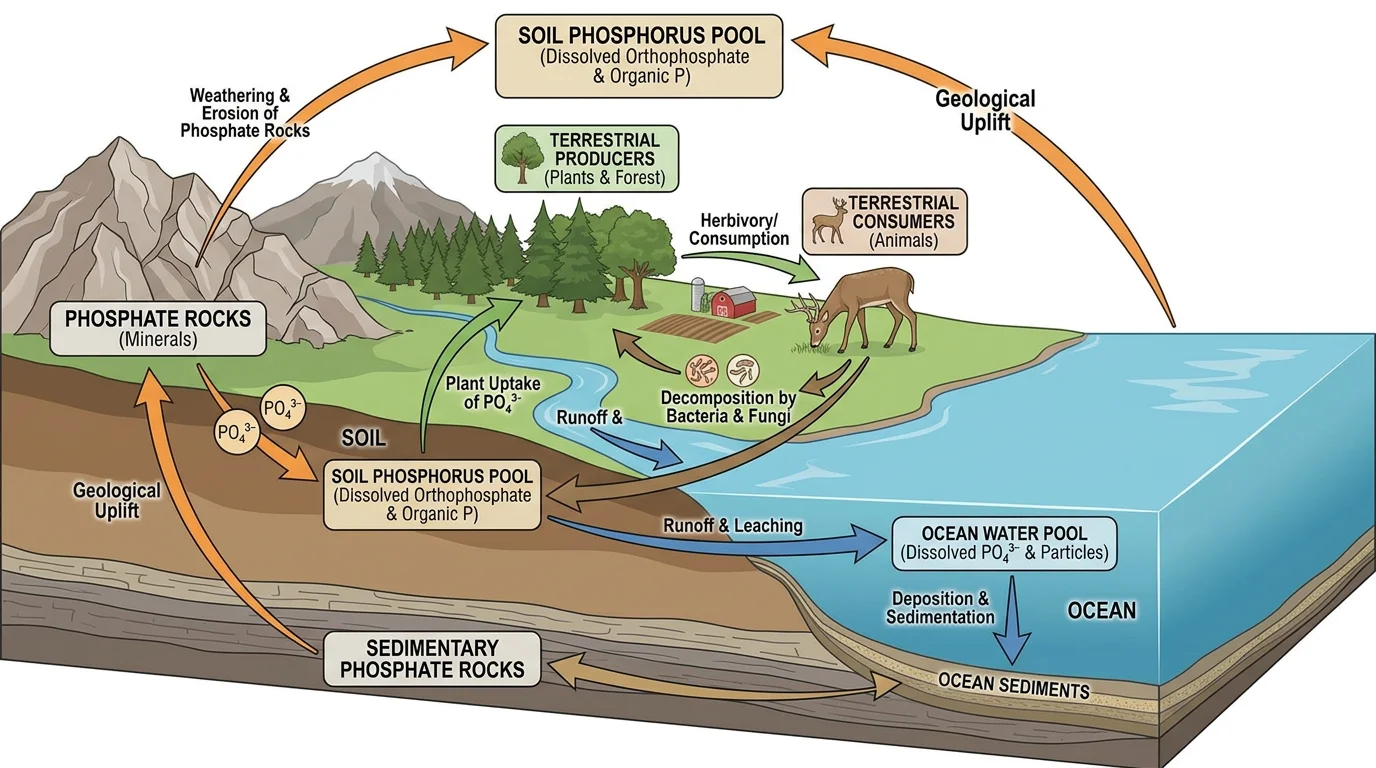 Biologie
Schéma du Cycle du Phosphore
Créez des schémas du cycle du phosphore montrant l'altération, l'absorption et la sédimentation.