Free Photosynthesis Diagram Worksheets for Teachers (2026)
Download free printable photosynthesis diagram worksheets for elementary, middle, and high school. Includes labeled diagrams, blank worksheets for quizzes, light & dark reaction visuals, and hands-on activities aligned with NGSS standards.
Photosynthesis is one of the most fundamental concepts in biology — and one of the trickiest to teach well. Students need to understand not just what happens, but where it happens in the plant cell, why it matters, and how it connects to the broader carbon cycle.
The right diagram can make all the difference. In this guide, we'll share free printable photosynthesis worksheets for every grade level, break down the science behind the process, and show you how to create custom diagrams in seconds with AI.
What is Photosynthesis?
Photosynthesis is the process by which plants, algae, and some bacteria convert light energy into chemical energy stored in glucose. According to National Geographic Education, this process is essential for life on Earth — it produces the oxygen we breathe and forms the base of nearly every food chain.
The Photosynthesis Equation
The overall equation for photosynthesis is:
6CO₂ + 6H₂O + Light Energy → C₆H₁₂O₆ + 6O₂
In plain English:
- Carbon dioxide (from the air) + Water (from the soil) + Sunlight → Glucose (food for the plant) + Oxygen (released into the air)
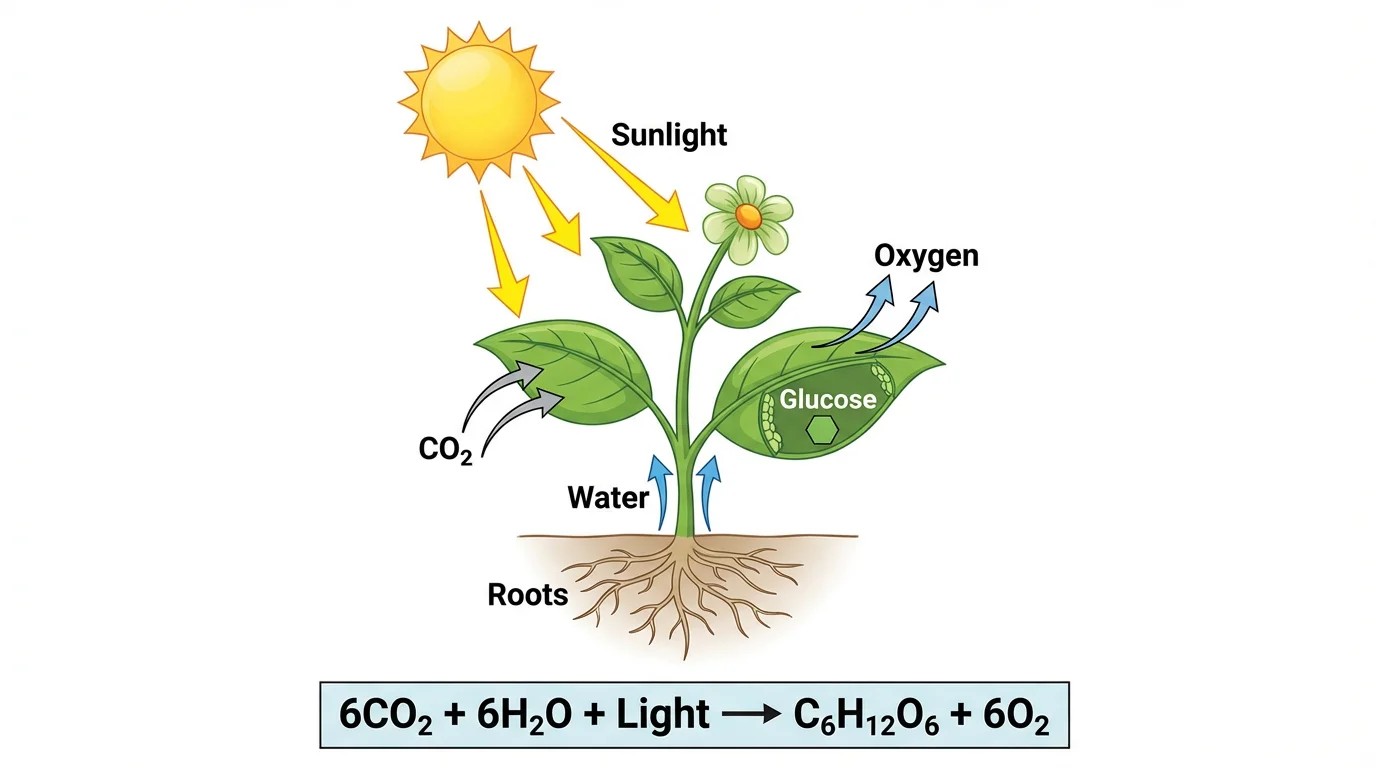 A complete labeled photosynthesis diagram showing inputs, outputs, and where the process occurs — perfect for classroom instruction.
Where Does Photosynthesis Happen?
Photosynthesis takes place in the chloroplasts — specialized organelles found in plant cells and algae. Inside the chloroplast, there are two key regions:
- Thylakoid membranes — where light-dependent reactions occur
- Stroma — where the Calvin cycle (light-independent reactions) takes place
This is why teaching photosynthesis works best alongside a plant cell diagram — students can see exactly where chloroplasts are located and how they function within the cell.
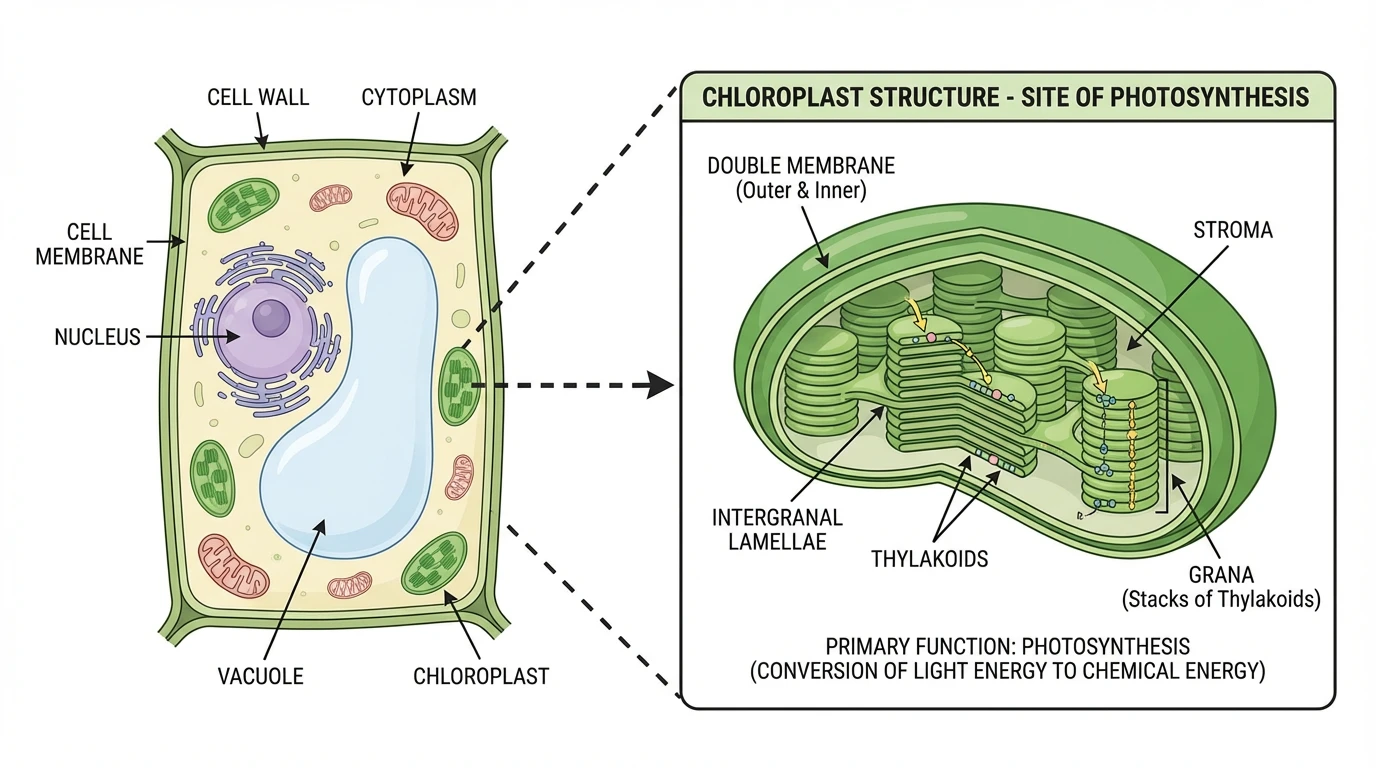 A plant cell diagram highlighting chloroplasts — the site of photosynthesis.
The Two Stages of Photosynthesis
For middle and high school students, it's important to understand that photosynthesis happens in two distinct stages. According to Biology LibreTexts, these stages are interconnected but occur in different parts of the chloroplast.
Stage 1: Light-Dependent Reactions
Location: Thylakoid membranes
What happens:
- Chlorophyll absorbs sunlight
- Water molecules are split (photolysis), releasing oxygen
- Light energy is converted into chemical energy (ATP and NADPH)
Key inputs: Light, Water (H₂O) Key outputs: Oxygen (O₂), ATP, NADPH
Stage 2: The Calvin Cycle (Light-Independent Reactions)
Location: Stroma
What happens:
- CO₂ from the air is "fixed" into organic molecules
- ATP and NADPH from Stage 1 power the reactions
- Glucose is produced
According to Khan Academy, the Calvin cycle has three main steps:
- Carbon Fixation — CO₂ is attached to a 5-carbon molecule (RuBP) by the enzyme RuBisCO
- Reduction — The resulting molecules are converted into G3P using ATP and NADPH
- Regeneration — RuBP is regenerated so the cycle can continue
Key inputs: CO₂, ATP, NADPH Key outputs: Glucose (G3P), ADP, NADP⁺
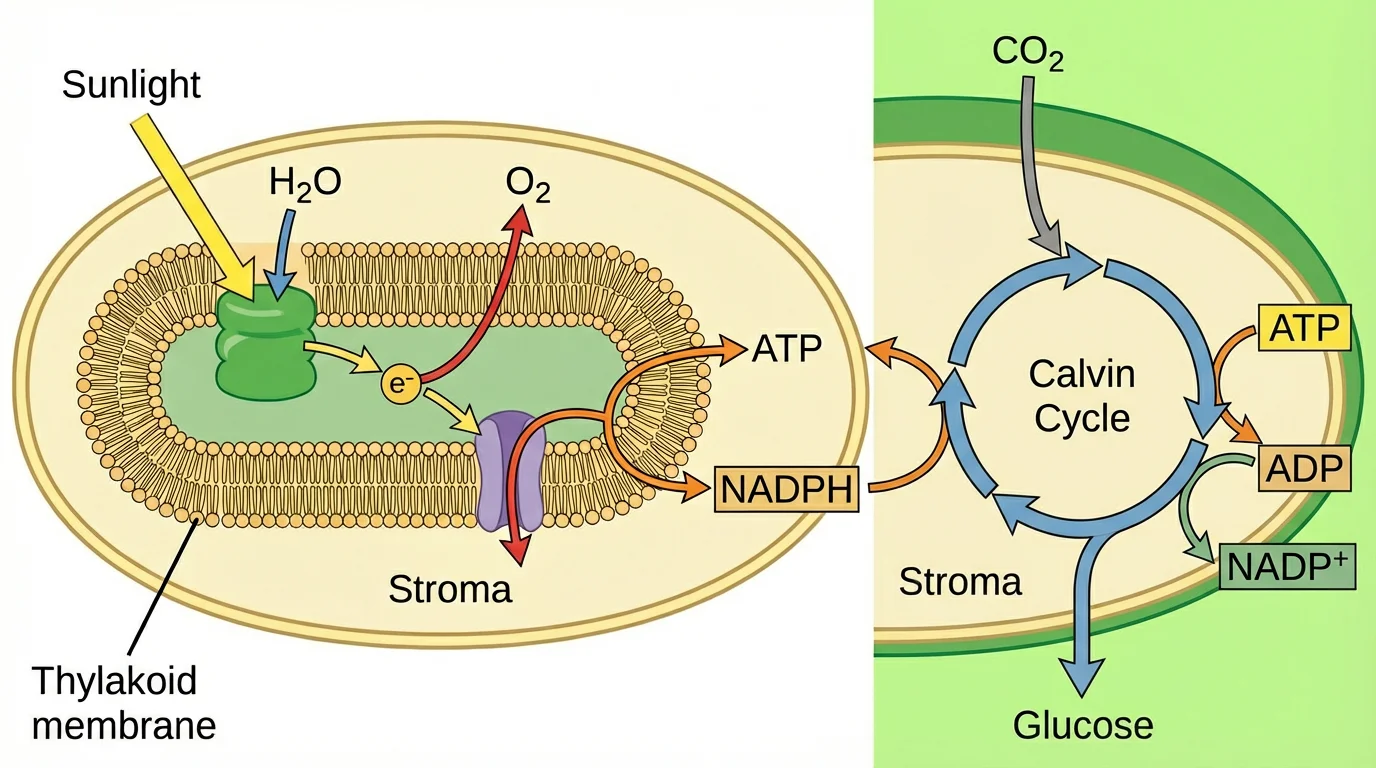 Diagram showing both stages of photosynthesis: light reactions in the thylakoid and the Calvin cycle in the stroma.
Photosynthesis Worksheets by Grade Level
Different grade levels require different approaches. Here's what to focus on at each stage:
Elementary School (K-5)
For younger students, keep it simple. Focus on the basic equation and the idea that plants make their own food using sunlight.
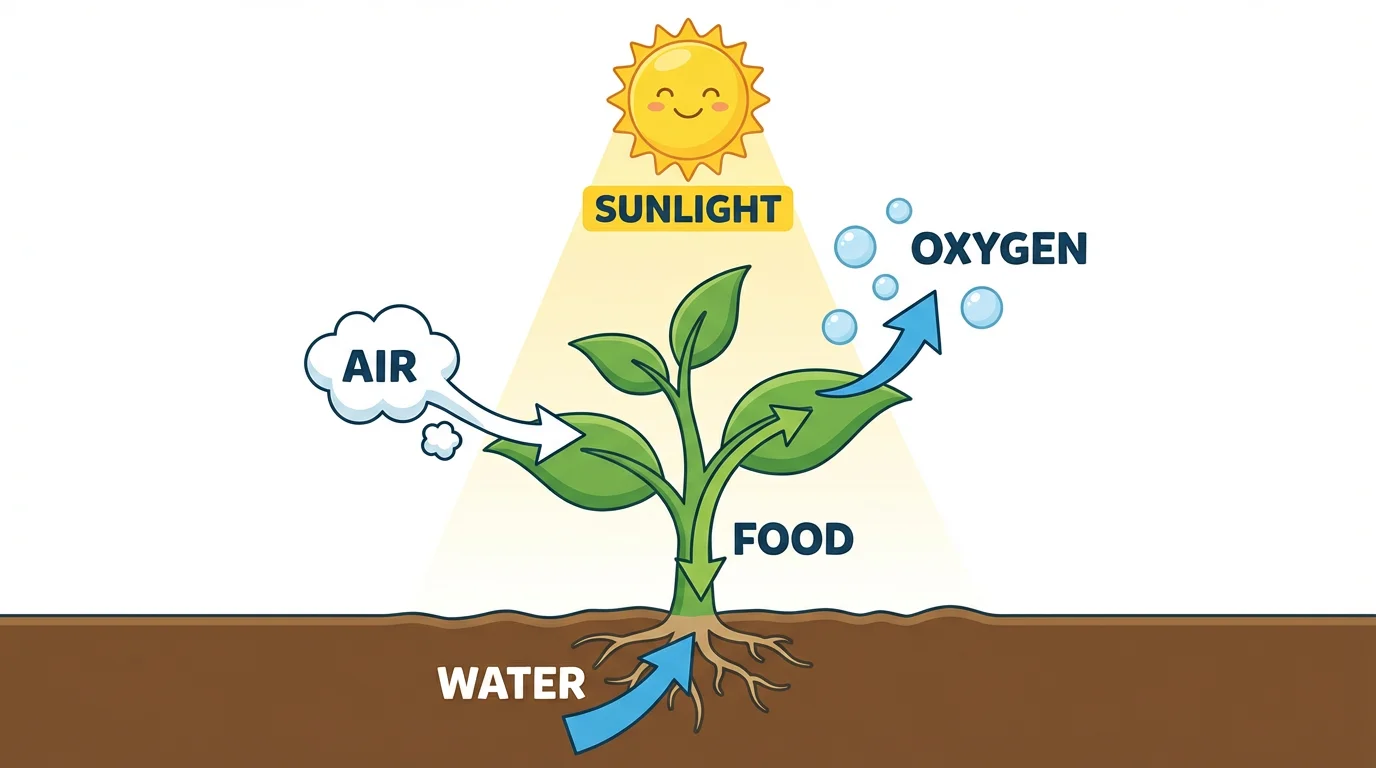 A simplified photosynthesis diagram for elementary students — focuses on sun, water, air, and the plant making food.
What to include:
- Large, colorful visuals of a plant with the sun
- Simple labels: sunlight, water, carbon dioxide, oxygen, sugar
- No mention of chloroplasts or chemical equations
- Coloring activities and matching exercises
NGSS Alignment: Standard 5-LS1-1 asks students to "support an argument that plants get the materials they need for growth chiefly from air and water."
Key concept for this age: Plants don't eat food like animals — they make their own food using sunlight!
Middle School (6-8)
Middle schoolers can handle the full equation and should understand where photosynthesis happens in the cell.
What to include:
- The complete photosynthesis equation
- Labeled chloroplast diagram
- Introduction to inputs (CO₂, H₂O, light) and outputs (glucose, O₂)
- Connection to cellular respiration (the reverse process)
- Vocabulary matching and fill-in-the-blank activities
NGSS Alignment: Standard MS-LS1-6 requires students to "construct a scientific explanation based on evidence for the role of photosynthesis in the cycling of matter and flow of energy into and out of organisms."
According to OpenSciEd, their 7th-grade photosynthesis unit has earned the highest NGSS Design Badge score, making it an excellent curriculum resource.
High School (9-12)
High school students should understand photosynthesis at a molecular level, including the two stages and their locations.
What to include:
- Detailed thylakoid and stroma diagrams
- Light-dependent vs. light-independent reactions
- ATP, NADPH, and electron transport chain concepts
- Calvin cycle steps (carbon fixation, reduction, regeneration)
- Comparison with cellular respiration
- Data analysis activities (e.g., effect of light intensity on photosynthesis rate)
NGSS Alignment: Standard HS-LS1-5 asks students to "use a model to illustrate how photosynthesis transforms light energy into stored chemical energy."
Labeled vs. Unlabeled Worksheets
Just like with our water cycle worksheets, effective teaching requires both types:
Labeled Diagrams (For Teaching)
Use labeled diagrams when introducing photosynthesis:
- Students follow along during lectures
- Reference during lab activities
- Study guides for test preparation
Unlabeled Diagrams (For Assessment)
Use blank diagrams for quizzes and tests:
- Students label the inputs and outputs
- Identify where each stage occurs
- Write the equation from memory
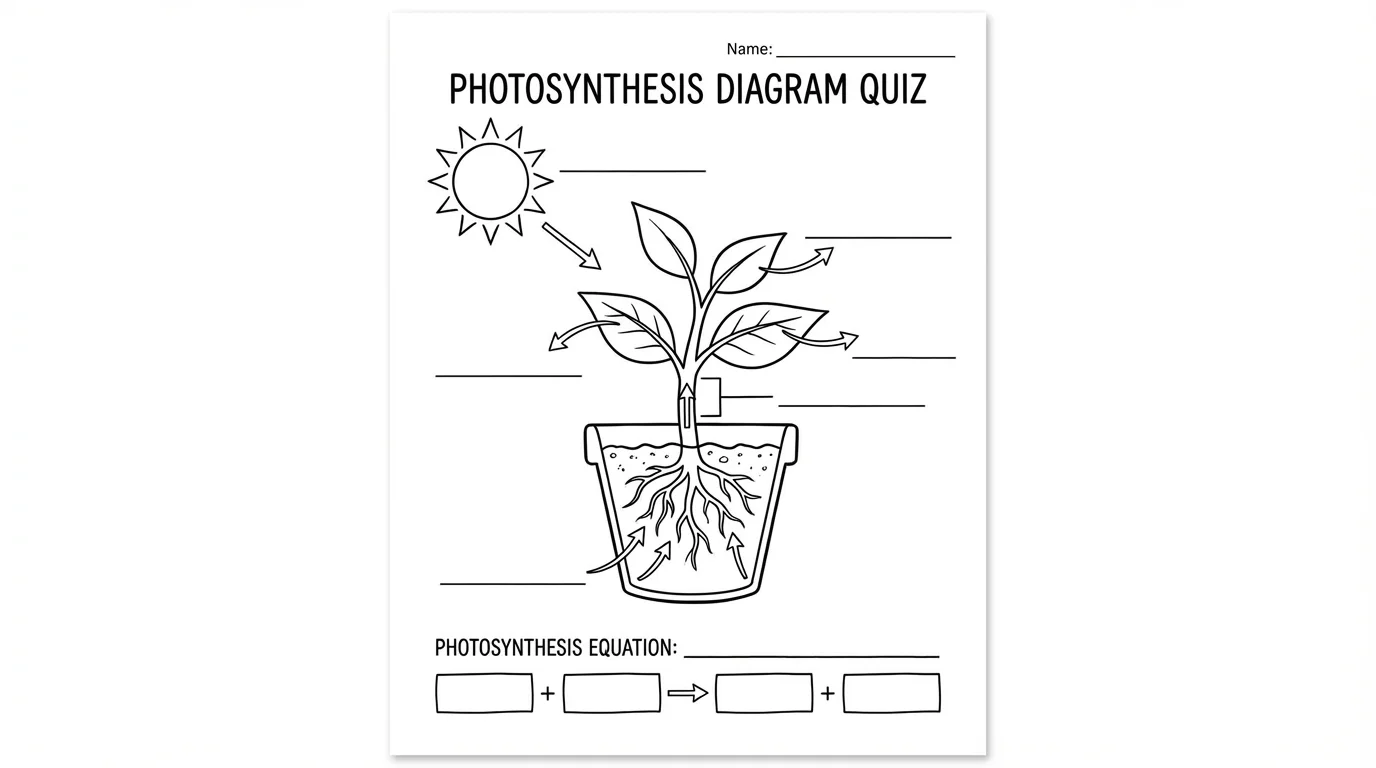 An unlabeled photosynthesis worksheet — perfect for quizzes and student labeling exercises.
Pro tip: Have students create their own labeled diagram from memory before a test. Research shows that active recall is more effective than passive review.
Connecting Photosynthesis to Other Topics
Photosynthesis doesn't exist in isolation. Help students see the bigger picture by connecting it to related concepts:
1. Plant Cell Structure
Before teaching photosynthesis, make sure students understand plant cell anatomy — especially the chloroplast. Use our Plant Cell Diagram Generator to create custom visuals showing where photosynthesis occurs.
2. Cellular Respiration
Photosynthesis and cellular respiration are essentially reverse processes:
| Photosynthesis | Cellular Respiration | |
|---|---|---|
| Equation | 6CO₂ + 6H₂O → C₆H₁₂O₆ + 6O₂ | C₆H₁₂O₆ + 6O₂ → 6CO₂ + 6H₂O |
| Location | Chloroplasts | Mitochondria |
| Energy | Stored | Released |
| Organisms | Plants, algae | All living things |
This is a great opportunity to use an Animal vs. Plant Cell Comparison diagram to show that animal cells have mitochondria but no chloroplasts.
3. The Carbon Cycle
Photosynthesis is a crucial part of the global carbon cycle. Plants remove CO₂ from the atmosphere and convert it into organic matter. When plants are eaten or decompose, that carbon is released back into the environment.
4. Food Chains and Ecosystems
Plants are producers — they create energy from sunlight. All other organisms (consumers) depend on this energy, either directly (herbivores) or indirectly (carnivores eating herbivores).
Hands-On Photosynthesis Activities
Worksheets work best when paired with hands-on experiments. Here are teacher-tested favorites:
1. Leaf Disk Floating Experiment
Materials: Spinach leaves, baking soda solution, syringe, light source
How it works: Leaf disks normally float because of air spaces. When you remove the air with a syringe and place them in baking soda solution (CO₂ source), they sink. Under light, photosynthesis produces oxygen, which fills the air spaces and makes the disks float again.
Learning objective: Demonstrate that light is required for photosynthesis and that oxygen is a product.
2. Elodea and Bromothymol Blue
Materials: Elodea (aquarium plant), bromothymol blue indicator, test tubes, light source
How it works: Bromothymol blue turns yellow in the presence of CO₂ and blue when CO₂ is removed. Place Elodea in yellow bromothymol blue solution under light — the solution turns blue as the plant absorbs CO₂ for photosynthesis.
3. Starch Test with Variegated Leaves
Materials: Variegated plant (like coleus), iodine solution, ethanol, hot water
How it works: Variegated leaves have green (with chlorophyll) and white (without chlorophyll) areas. After exposing to light and testing with iodine, only the green areas turn blue-black (indicating starch), proving that chlorophyll is necessary for photosynthesis.
4. Chromatography of Plant Pigments
Materials: Spinach leaves, chromatography paper, rubbing alcohol
How it works: Separate the pigments in a leaf to reveal that "green" leaves actually contain multiple pigments: chlorophyll a, chlorophyll b, carotenoids, and xanthophylls.
Create Custom Photosynthesis Diagrams with AI
Need a diagram that's perfectly tailored to your lesson? ConceptViz lets you generate custom photosynthesis diagrams in seconds — just describe what you need.
What you can create:
- Diagrams for specific grade levels (elementary, middle, high school)
- Labeled or unlabeled versions
- Focus on specific aspects (light reactions only, Calvin cycle only)
- Black & white versions for printing
- Simplified or detailed views
Try it free: Create Your Diagram
Simply describe what you need — like "simple photosynthesis diagram for 4th grade showing sun, water, CO2, and oxygen" — and download a print-ready worksheet. No design skills required.
Looking for more science diagram tools? Check out our free tools for teachers, including generators for plant cells, animal cells, and the water cycle.
Download Free Photosynthesis Worksheets
Here are additional free resources from trusted educational sites:
| Resource | Grade Level | What's Included |
|---|---|---|
| NGSS Life Science | 6-12 | Labeling worksheets, equation practice |
| WeAreTeachers | 6-12 | Maze, scavenger hunt, reading questions |
| K5 Learning | K-5 | Simple diagrams, vocabulary |
| Easy Teacher Worksheets | 3-8 | Multiple worksheet types |
| Math Worksheets 4 Kids | 3-7 | Charts, labeling, fill-in-the-blank |
| Education.com | K-8 | Printable activities |
Frequently Asked Questions
What is the simple equation for photosynthesis?
The simplified equation is: Carbon dioxide + Water + Sunlight → Glucose + Oxygen. The chemical equation is: 6CO₂ + 6H₂O + light → C₆H₁₂O₆ + 6O₂.
What are the two stages of photosynthesis?
The two stages are the light-dependent reactions (which occur in the thylakoid membranes and produce ATP, NADPH, and oxygen) and the Calvin cycle or light-independent reactions (which occur in the stroma and produce glucose).
What grade level is photosynthesis taught?
Photosynthesis is introduced in elementary school (grades 3-5) at a basic level and revisited with increasing complexity through middle school (MS-LS1-6) and high school (HS-LS1-5).
What's the difference between light and dark reactions?
Light reactions require direct sunlight and occur in the thylakoid membranes, producing ATP and NADPH. The Calvin cycle (sometimes called "dark reactions") doesn't require light directly but uses the ATP and NADPH from light reactions to fix CO₂ into glucose. Note: The term "dark reactions" is outdated because these reactions still depend on products from light reactions.
Why is photosynthesis important?
Photosynthesis is essential because it: (1) produces the oxygen we breathe, (2) removes CO₂ from the atmosphere, (3) creates food (glucose) that powers nearly all life on Earth, and (4) forms the base of most food chains.
How do I teach photosynthesis to younger students?
Start with the simple concept that plants make their own food using sunlight, water, and air. Use colorful diagrams, avoid chemical equations, and focus on the "ingredients" (sun, water, air) and "products" (food for the plant, oxygen for us). Hands-on activities like growing plants in different light conditions work great.
Ready to create your own photosynthesis worksheets? Try ConceptViz and generate print-ready diagrams in seconds — no design skills required.
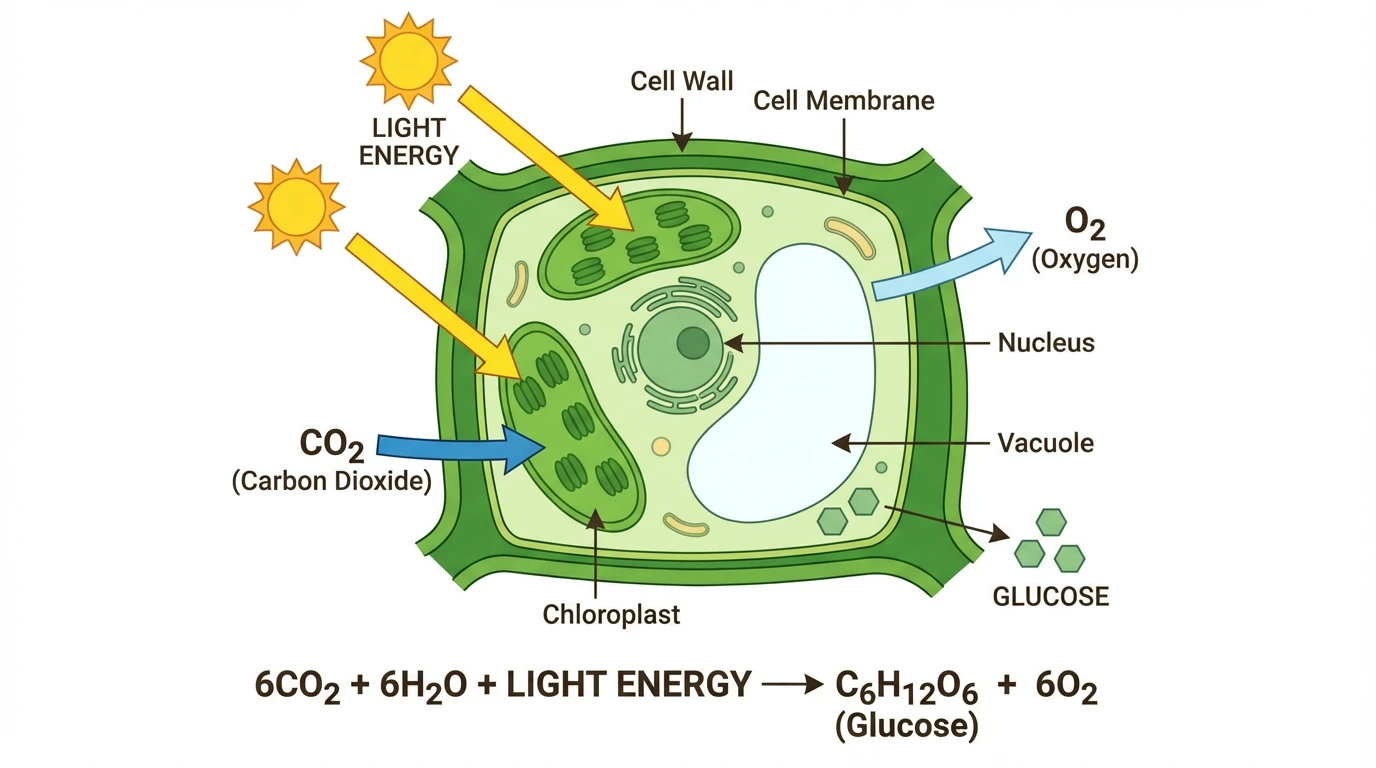 A plant cell diagram highlighting the chloroplast and the photosynthesis process.
Related Resources
Categories
More Posts

10 Best Free Miro Alternatives 2026: No Paywall, Unlimited Boards
The best free Miro alternatives with unlimited boards and real-time collaboration — Excalidraw, FigJam, Canva Whiteboard & more. No credit card required.
Science Journal Cover Design: Complete Guide to Getting Your Research Featured
Learn how to design compelling journal cover art that gets your research noticed. Includes technical specs for Nature, Cell, ACS journals, design principles, and step-by-step creation process.
AI Worksheet Generator Guide: Create Printable Worksheets and Answer Keys
Learn how to use an AI worksheet generator for printable classroom worksheets, answer keys, differentiation, diagrams, and teacher review workflows.