Decision Tree Generator Decision Trees
Describe your decision scenario and our AI will create a professional decision tree instantly. Perfect for business analysis, machine learning visualization, and strategic planning.
Decision Tree Generator
Free to try ·
Your decision tree will appear here
Describe your decision scenario and click Generate
Decision Tree Examples
Browse decision tree examples or generate your own above
Business Investment Decision Tree
A business investment decision tree analyzing whether to launch a new product, expand existing lines, or maintain the status quo, with probability-weighted payoffs.
Medical Diagnosis Decision Tree
Clinical decision tree guiding diagnosis from initial symptoms through diagnostic tests to treatment recommendations with probability assessments.
ML Classification Decision Tree
Machine learning decision tree classifier showing feature-based splits with Gini impurity scores and sample distributions at each node.
Risk Analysis Decision Tree
Risk analysis decision tree for project management, evaluating potential risks with probability-impact matrices and recommended mitigation actions.
Project Management Decision Tree
Strategic project management decision tree comparing agile vs waterfall approaches with resource, timeline, and budget implications.
Simple Yes/No Decision Tree
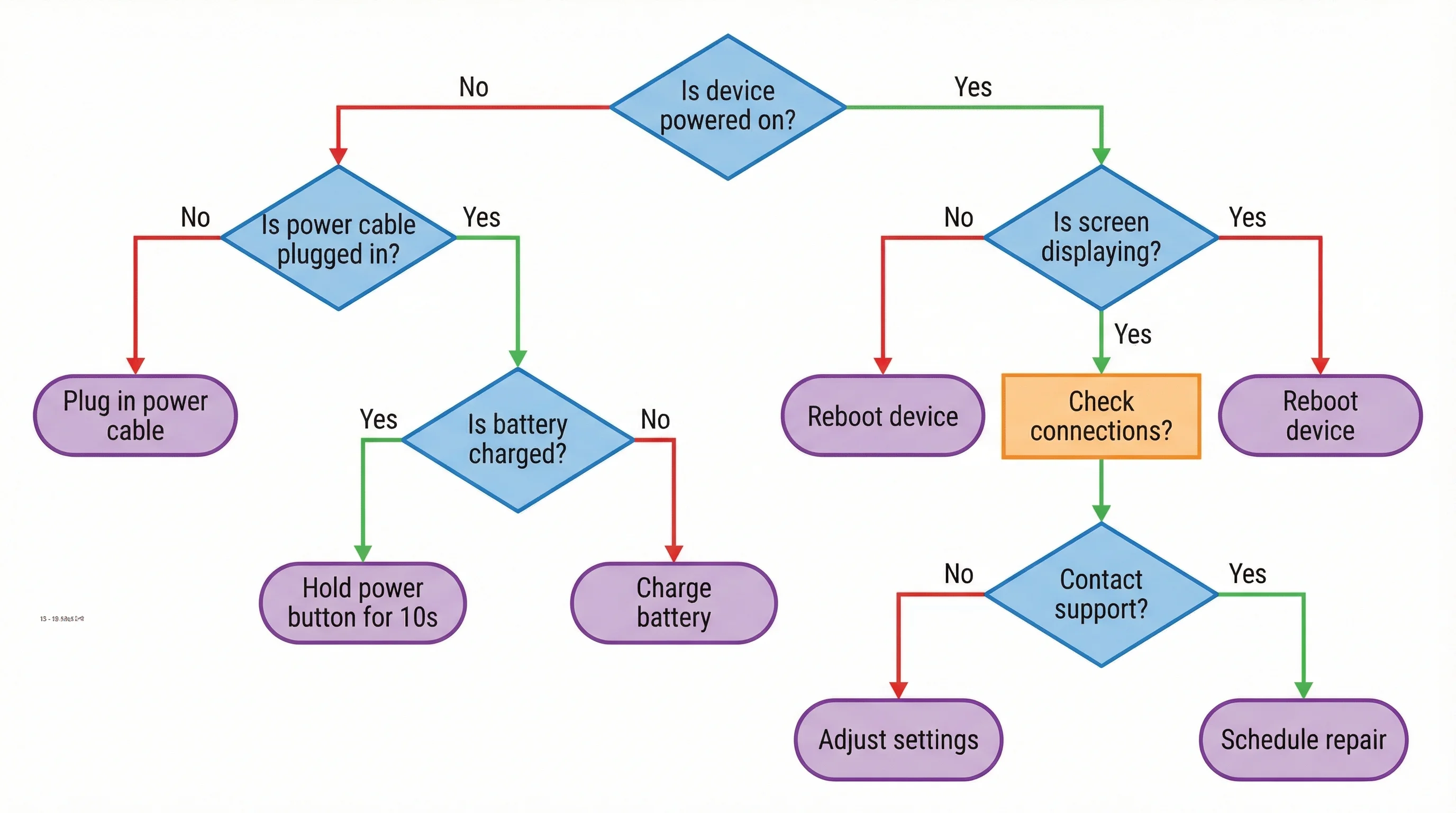
A simple binary yes/no decision tree demonstrating basic decision logic with clear branching paths and straightforward outcomes.
What is a Decision Tree?
A decision tree is a visual diagram that maps out all possible outcomes of a series of related choices. It uses a tree-like structure of nodes and branches to model decisions and their consequences, including chance events, resource costs, and utility. Decision trees are widely used in operations research, business strategy, machine learning, and medical diagnosis. The diagram starts at a single root node and branches outward, with each branch representing a possible action or outcome, ultimately leading to terminal nodes that show final results or payoffs.
Types of Decision Tree Nodes
- Decision nodes (squares) represent points where a choice must be made between alternatives
- Chance nodes (circles) represent uncertain events with assigned probabilities
- Terminal nodes (triangles) show final outcomes with associated payoffs or values
- Each branch from a decision node represents an available option or action
- Branches from chance nodes include probability values that must sum to 1.0
- Expected Monetary Value (EMV) is calculated by multiplying each outcome by its probability and summing the results
Decision Trees in Business and Machine Learning
In business, decision trees help managers evaluate strategic options by quantifying uncertainty and calculating expected values. They are essential for capital budgeting, new product launches, market entry strategies, and risk assessment. In machine learning, decision trees are supervised learning algorithms used for classification and regression tasks. ML decision trees split data based on feature values to minimize impurity (measured by Gini index or entropy). Popular algorithms include CART, ID3, C4.5, and Random Forest, which uses ensembles of decision trees for improved accuracy and reduced overfitting.
How to Create a Decision Tree
- Define the primary decision or question at the root node
- Identify all possible alternatives or actions at each decision point
- Add chance nodes for uncertain outcomes and assign probability values
- Calculate expected values by working backward from terminal nodes (folding back)
- Assign payoffs or utility values to each terminal outcome
- Our AI generator creates professionally structured decision trees from your text description instantly
Decision Tree vs Flowchart
While decision trees and flowcharts may look similar, they serve different purposes. A flowchart maps a process or workflow step by step, showing the sequence of actions and conditions. A decision tree specifically models decisions under uncertainty, incorporating probability values, expected outcomes, and quantitative payoffs. Decision trees always branch from a single root and expand outward, while flowcharts can have loops, merge points, and parallel paths. Decision trees are analytical tools for choosing the optimal path, whereas flowcharts are descriptive tools for documenting how a process works.
Frequently Asked Questions
More Analysis & Decision Tools
AnalysisAI Flowchart Generator
Create professional flowcharts for process mapping and workflow documentation.
AnalysisTree Diagram Maker
Generate hierarchical tree diagrams for organizational structures and data classification.
AnalysisMind Map Generator
Create mind maps for brainstorming, planning, and organizing complex ideas visually.