Nitrogen Cycle Diagram Generator for Labeled & Blank Diagrams
Generate a clearly labeled nitrogen cycle diagram, or a blank fill-in-the-blank version for worksheets and quizzes. Describe the cycle you need — fixation, nitrification, assimilation, ammonification, and denitrification — and get a printable diagram for biology and earth-science classes.
Nitrogen Cycle Diagram Generator
免費試用 ·
Your nitrogen cycle diagram will appear here
Describe your diagram and click Generate
Nitrogen Cycle Diagram Examples
Labeled, simplified, and blank fill-in-the-blank diagrams for class
Complete Labeled Nitrogen Cycle
Every process labeled, with the N₂, NH₃, NO₂⁻, and NO₃⁻ conversions annotated stage by stage.
Simplified Overview
A beginner-friendly overview with color-coded pathways — ideal for introductory biology.
Soil Bacteria Focus
Shows the microbes that drive each step — the nitrogen-fixing, nitrifying, and denitrifying bacteria.
Aquatic Nitrogen Cycle
How nitrogen moves through the water column, sediments, and marine life in oceans and lakes.
Human Impact
How the Haber-Bosch process, fertilizers, combustion, and wastewater disrupt the natural balance.
Blank Fill-in-the-Blank Worksheet
A printable fill-in-the-blank version with numbered labels and a word bank for quizzes.
What is the nitrogen cycle and why does it matter?
The nitrogen cycle is the biogeochemical process that moves nitrogen through the atmosphere, soil, water, and living organisms. Nitrogen is essential for life because it builds amino acids, proteins, nucleic acids (DNA and RNA), and chlorophyll. The catch is that nitrogen gas (N₂) makes up about 78% of the air, yet almost no organism can use it in that form — the triple bond holding N₂ together is too strong to break without help. The nitrogen cycle solves this by converting atmospheric nitrogen into usable forms through a chain of reactions driven mostly by specialized bacteria. That makes it a core topic in biology, ecology, agriculture, and earth science, and a frequent diagram question on tests. This generator draws that cycle for you, with every process and chemical form labeled.
The key processes of the nitrogen cycle
- Nitrogen fixation — atmospheric N₂ is converted into ammonia (NH₃) by nitrogen-fixing bacteria such as Rhizobium in legume root nodules and free-living Azotobacter, and a smaller amount by lightning.
- Nitrification — a two-step aerobic process where Nitrosomonas bacteria oxidize ammonia (NH₃) to nitrite (NO₂⁻), then Nitrobacter oxidizes nitrite to nitrate (NO₃⁻).
- Assimilation — plants take up nitrate (NO₃⁻) and ammonium (NH₄⁺) through their roots and build it into amino acids and proteins; animals get their nitrogen by eating plants.
- Ammonification (decomposition) — decomposers break down dead organisms and waste, returning nitrogen to the soil as ammonia (NH₃) or ammonium (NH₄⁺).
- Denitrification — anaerobic bacteria such as Pseudomonas convert nitrate (NO₃⁻) back into nitrogen gas (N₂), completing the loop and returning nitrogen to the atmosphere.
Nitrogen reservoirs: atmosphere, soil, and organisms
A nitrogen cycle diagram is easier to read once you see it as nitrogen moving between reservoirs. The atmosphere is the largest reservoir — a vast pool of N₂ that most life cannot touch until fixation unlocks it. The soil (and sediment, in aquatic systems) holds reactive nitrogen as ammonium and nitrate, the forms plants actually absorb. Living organisms are a third reservoir: nitrogen locked into proteins and DNA, passed up the food chain from plants to animals and released again by decomposers. Showing these three compartments — and the arrows that connect them — is what turns a tangle of reactions into a clear, teachable diagram.
Labeled vs. blank fill-in-the-blank diagrams
For teaching and reference you want a fully labeled nitrogen cycle, with each process named and each chemical form (N₂, NH₃, NO₂⁻, NO₃⁻) marked. For assessment you usually want the opposite: a blank, fill-in-the-blank version where the structure and arrows are drawn but the labels are replaced with numbered blanks, ideally with a word bank at the bottom. This generator makes both. Ask for a "labeled" diagram for notes and slides, or a "blank worksheet with numbered labels and a word bank" for quizzes and homework — then print it for the whole class. Many teachers generate the labeled version first as an answer key, then the blank version for students.
How to generate a labeled nitrogen cycle diagram
- Type a description of the diagram you need — the level (middle school, AP biology), the focus (soil bacteria, aquatic, human impact), and whether you want it labeled or blank.
- Pick an aspect ratio: 16:9 works well for slides and posters, 4:3 for printed handouts, 1:1 for square classroom displays.
- Generate the diagram and review it. Because it is AI-generated, check that the processes, arrow directions, and chemical formulas are scientifically correct before you use it.
- Refine the prompt if a detail is off — for example, ask for clearer arrows or a specific bacterium — then regenerate and download the result.
Using nitrogen cycle diagrams in the classroom
The nitrogen cycle shows up across middle-school science, high-school biology, AP Biology, and earth-science courses, and it is a reliable diagram and short-answer question. A labeled diagram is useful for direct instruction and revision notes; a simplified, color-coded version helps younger students see the four main stages without the chemistry; a blank worksheet works as a do-now, a formative check, or an exam-style item. Because you can generate variations — a soil-bacteria focus, an aquatic version, or one centered on human impact and eutrophication — you can match the diagram to the exact lesson. Generate an answer key and a matching blank in a couple of minutes, then print a set for the class.
常見問題
Related Biology Tools
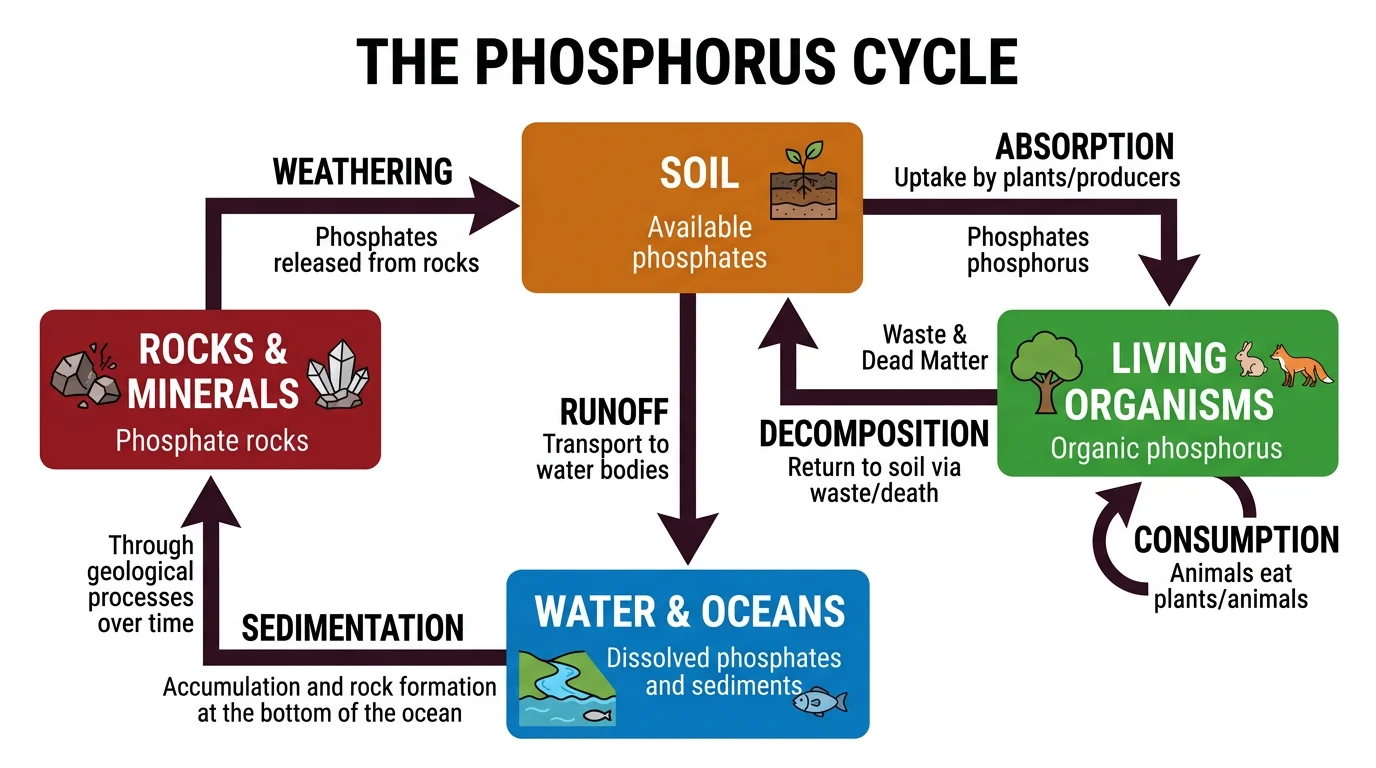 Biology
Carbon Cycle Diagram Generator
Create labeled carbon cycle diagrams showing photosynthesis, respiration, decomposition, and combustion.
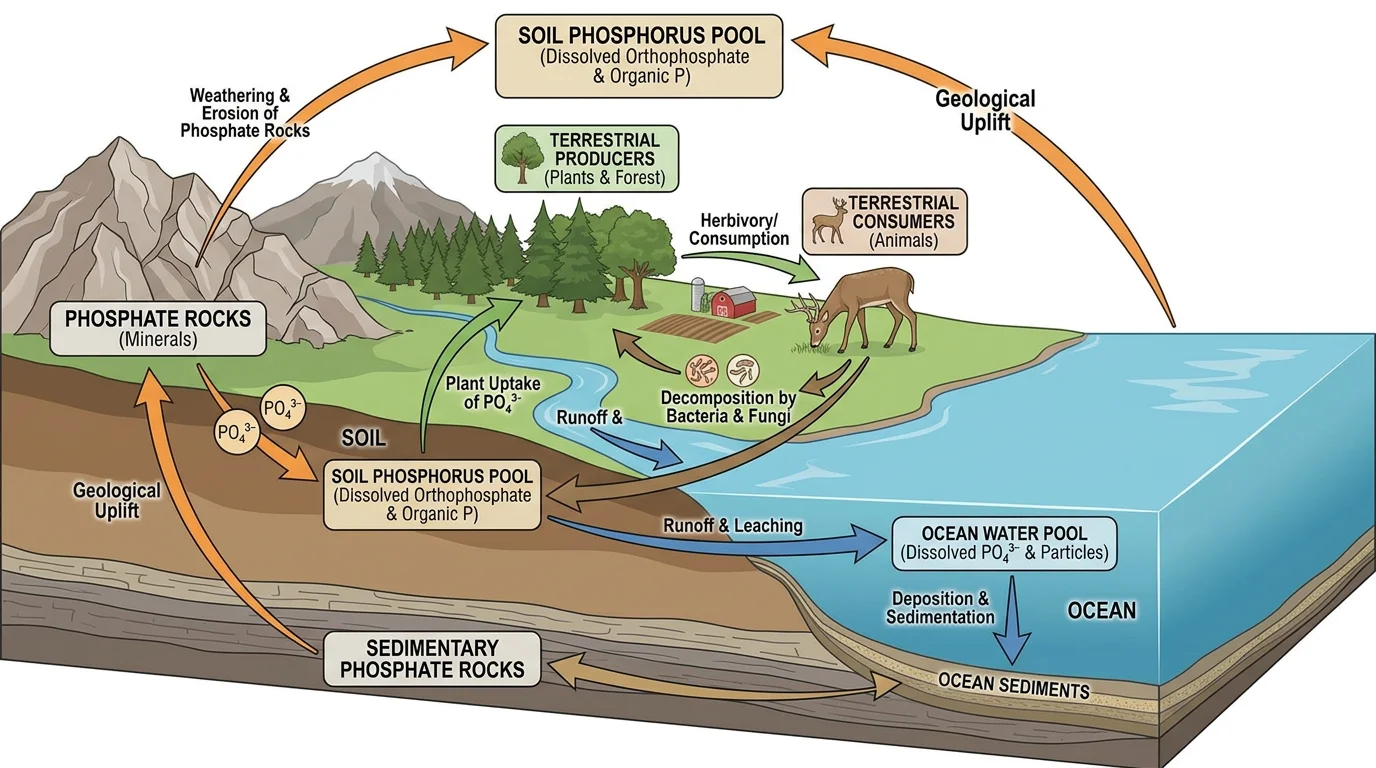 Biology
Phosphorus Cycle Diagram Generator
Draw labeled phosphorus cycle diagrams covering weathering, uptake, decomposition, and sedimentation.
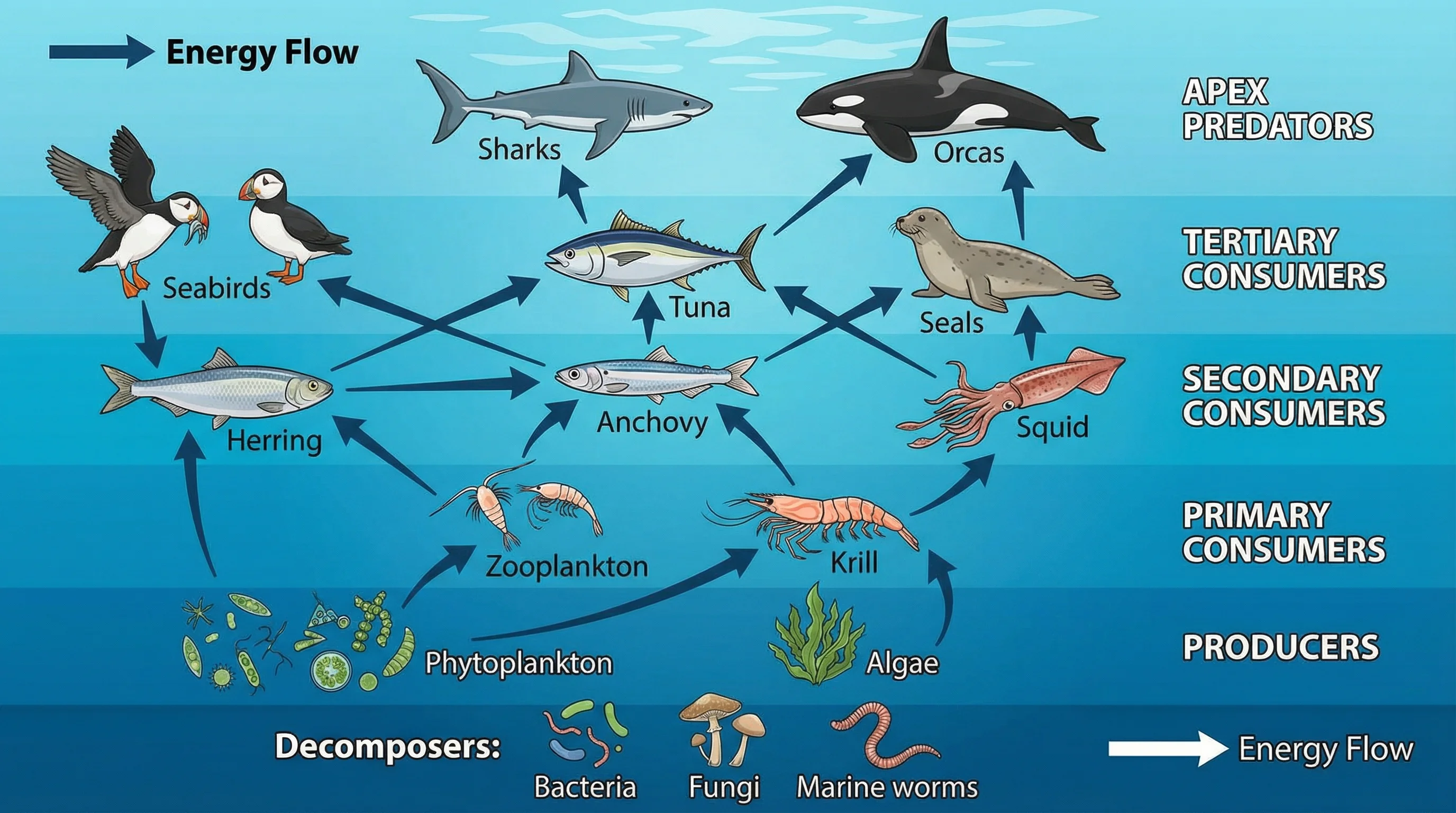 Biology
Food Web Generator
Build food web diagrams showing energy flow and trophic relationships in an ecosystem.