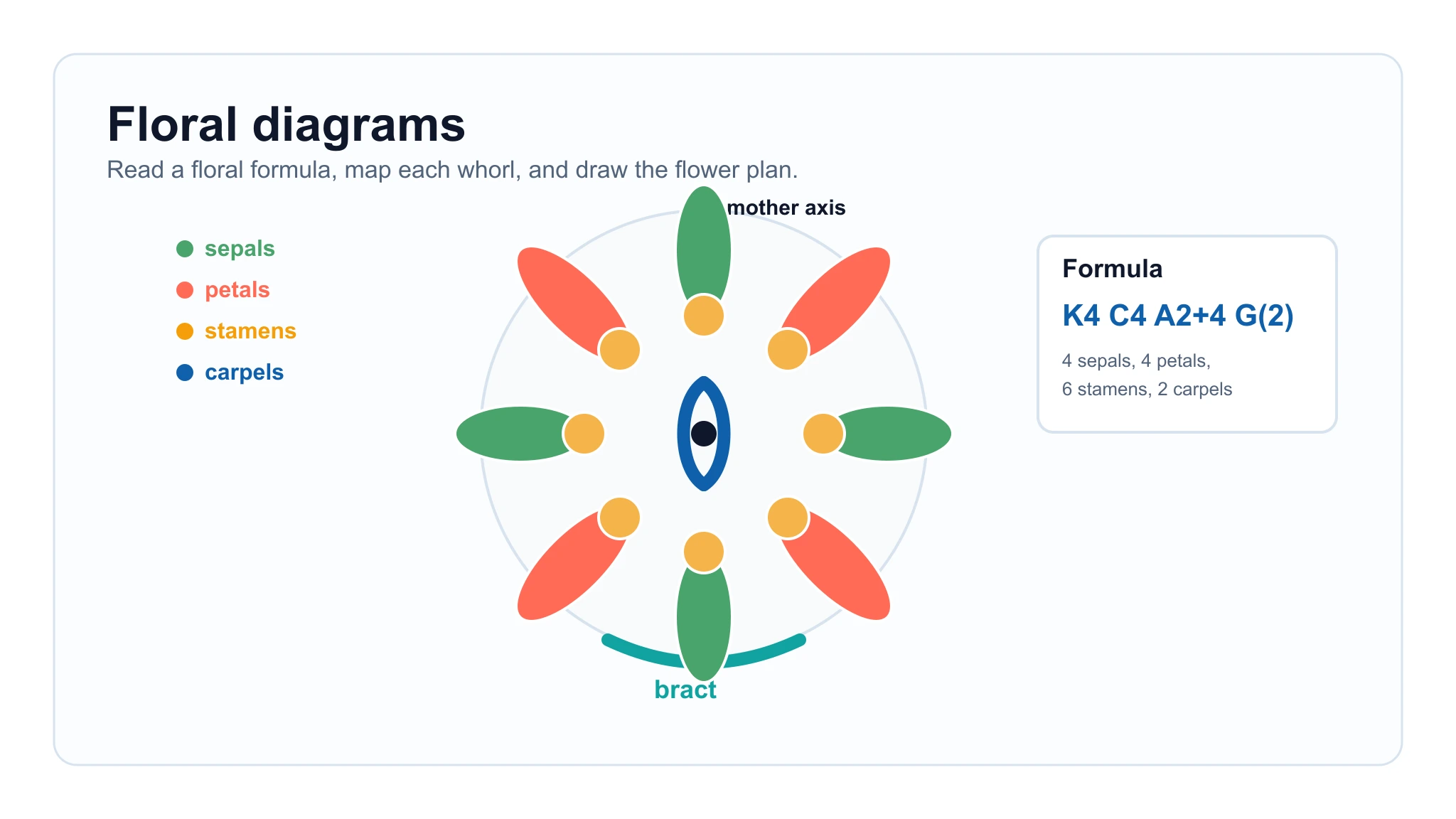
Floral Diagram Guide: Floral Formula Symbols, Examples, and How to Draw One
Learn how to read floral diagrams, understand floral formula symbols, draw whorls from a formula, and use examples like Brassicaceae.
A floral diagram is a compact botanical drawing that shows the plan of a flower as if you were looking down on a cross-section through the flower bud. Instead of drawing a realistic rose, lily, or mustard flower, the diagram shows how many sepals, petals, stamens, and carpels are present, how they are arranged, and whether any parts are fused.
That is why students often search for a floral diagram together with a floral formula. The formula gives a shorthand description such as K4 C4 A2+4 G(2). The diagram turns that shorthand into a visual plan. This guide explains how to read both, how to draw a floral diagram step by step, and how to avoid the mistakes that make botany diagrams confusing.
Floral Diagram Generator
Enter a floral formula such as K4 C4 A2+4 G(2), render a botanical floral diagram, and export SVG or PNG.
Generate a floral diagram ->Quick Answer: What Is a Floral Diagram?
A floral diagram is a schematic top view of a flower. It represents the floral whorls around the center of the flower:
- calyx: sepals
- corolla: petals
- androecium: stamens
- gynoecium: carpels
- mother axis: the stem-side reference point
- bract or bracteoles: associated leaf-like structures, when present
The purpose is not to make the flower look decorative. The purpose is to show structure. A good floral diagram answers questions such as:
| Question | What the diagram should show |
|---|---|
| How many floral parts are present? | Count of sepals, petals, stamens, and carpels |
| Are parts separate or fused? | Separate shapes vs joined arcs or grouped structures |
| Is the flower radially or bilaterally symmetrical? | Repeating circular pattern vs one main symmetry plane |
| Where is the mother axis? | Dot or circle outside the floral whorls |
| What is the relation to the bract? | Bract usually shown below the flower plan |
A floral diagram turns a flower into a structural map: whorls, counts, fusion, axis, and bract.
Why Floral Diagrams and Floral Formulae Belong Together
The floral diagram overview on Wikipedia describes floral diagrams as graphic representations of flower structure, especially the number, arrangement, and fusion of floral organs. The same page notes that they are commonly used together with floral formulae, because each format explains a different part of the flower.
The formula is concise. The diagram is spatial.
For example:
K4 C4 A2+4 G(2)This formula tells you:
K4: four sepalsC4: four petalsA2+4: six stamens in two groupsG(2): a gynoecium made from two fused carpels
But the formula alone does not show how those parts sit around the flower. The diagram fills that gap by showing the whorls as a plan view. Biology Reader's floral diagram explainer makes the same practical point: before drawing a diagram, you study the flower's symmetry, ovary position, aestivation, number of parts, and placentation.
Most people who need a floral diagram are not looking for a decorative flower image. They need a study tool that helps them translate botanical terms into a diagram they can use in class, exams, or lab notes.
Floral Formula Symbols You Need First
Before you draw, read the formula like a checklist. The letters tell you which floral whorl you are working with. The numbers tell you how many parts to draw. Parentheses and plus signs tell you how parts are grouped or fused.
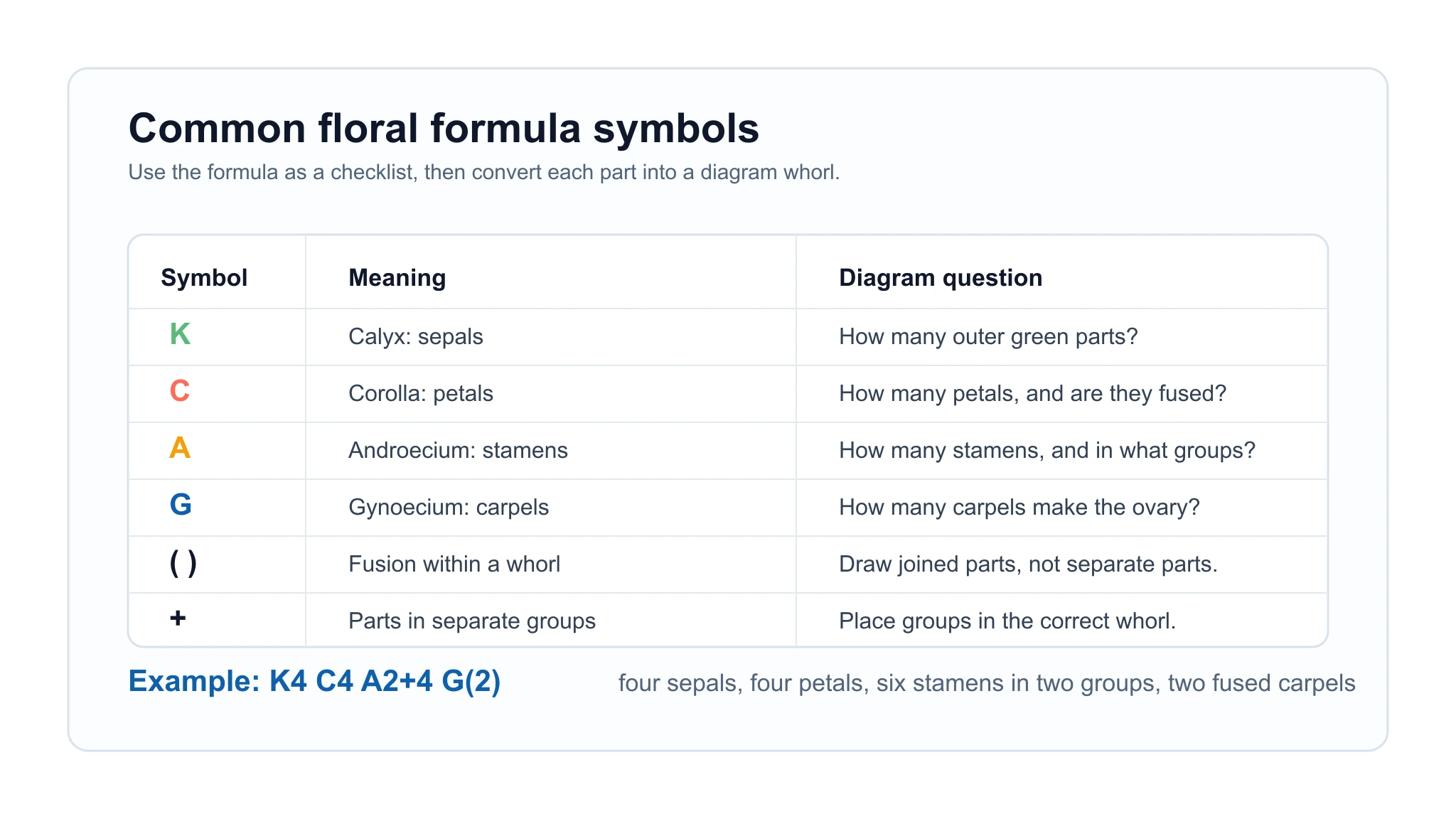
Start with the formula symbols, then convert each symbol into a whorl on the diagram.
| Symbol | Meaning | Drawing implication |
|---|---|---|
K | Calyx, or sepals | Draw the outer sepal whorl |
C | Corolla, or petals | Draw the petal whorl inside the sepals |
P | Perianth, when sepals and petals are not clearly distinct | Draw a single perianth whorl or repeated tepals |
A | Androecium, or stamens | Draw stamens inside the petals |
G | Gynoecium, or carpels | Draw the ovary/carpel structure at the center |
| number | Count of parts | Draw that many parts in the whorl |
( ) | Fusion within a whorl | Show parts joined rather than fully separate |
+ | Parts in separate groups | Draw the groups as distinct sets |
| infinity | Many parts | Show many repeated parts, not an exact count |
Aakash's floral formula and floral diagram guide frames these as semi-technical descriptions of flowering plants. That is useful wording: floral diagrams are not just drawings, but semi-technical botanical summaries.
How to Draw a Floral Diagram Step by Step
The easiest way to draw a floral diagram is to work from outside to inside. Do not start with the petals just because they are visually obvious in a real flower. Start with orientation.
- Mark the mother axis.
- Mark the subtending bract if the flower is lateral.
- Draw the sepal whorl.
- Draw the petal whorl.
- Draw the stamens.
- Draw the carpels or ovary in the center.
- Add fusion, grouping, or missing parts.
- Check the diagram against the floral formula.
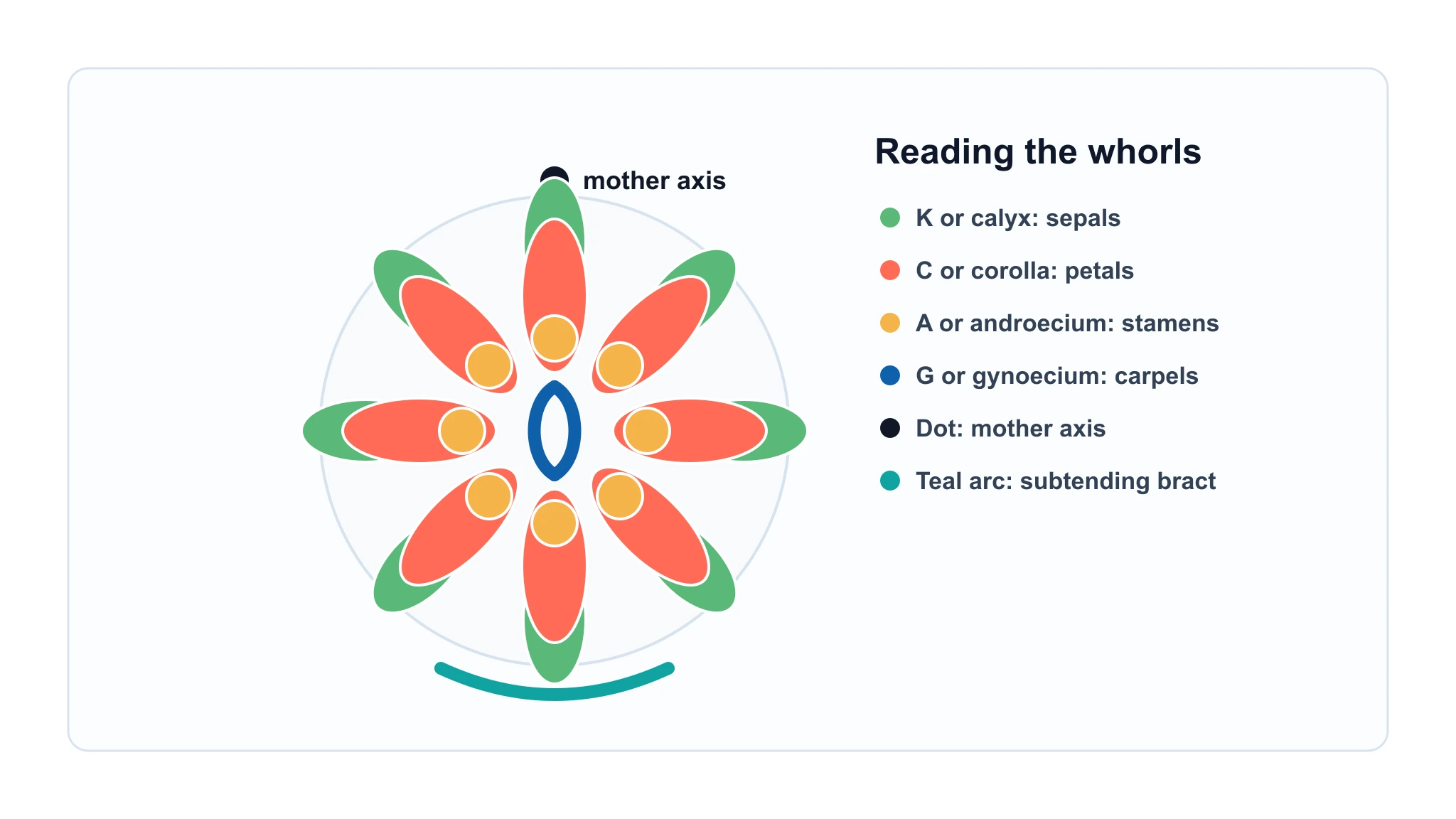
A clean floral diagram is built from orientation first, then whorls from outside to inside.
1. Place the mother axis
The mother axis is usually shown as a dot or small circle outside the floral whorls. It represents the side of the main stem from which the flower arises. This dot gives the diagram a front-back orientation.
Without the mother axis, a diagram can still show the number of floral parts, but it loses an important orientation cue. This matters when a flower is bilaterally symmetrical, when the bract position matters, or when the teacher expects standard botanical convention.
2. Place the bract
If a subtending bract is shown, it is usually placed below the flower plan. This gives you a reference line: mother axis above, bract below.
Students often ignore the bract because it is not part of the flower itself. That makes the diagram less complete. The bract helps explain how the flower is positioned relative to the plant.
3. Draw sepals before petals
Sepals are the outer whorl. In a formula, they are usually represented by K. If the formula says K5, draw five sepals. If it says K(5), draw five fused sepals rather than five fully separate ones.
Do not confuse sepals with petals just because both may be petal-like in some plants. If the formula uses P instead of K and C, it may mean the perianth is not clearly divided into calyx and corolla.
4. Draw petals inside sepals
Petals are represented by C. In a radially symmetrical flower, petals are usually arranged evenly around the center. In a bilaterally symmetrical flower, they may be unequal or arranged around a single plane of symmetry.
If the formula shows fusion, such as C(5), draw a joined corolla rather than five isolated petals. The diagram should show the structural idea, not every surface detail of a realistic flower.
5. Add stamens
Stamens are represented by A. A formula such as A5 is straightforward: draw five stamens. A formula such as A2+4 means the stamens occur in two groups, often two shorter and four longer stamens in common teaching examples.
The plus sign is important. It tells you not to draw all stamens as one undifferentiated ring when the formula is trying to preserve grouping.
6. Add carpels and ovary position
Carpels are represented by G. Parentheses usually indicate fusion, so G(2) means two fused carpels. The center of the floral diagram should show the gynoecium as the innermost structure.
Ovary position is sometimes represented with additional notation in formal botanical writing. For a beginner diagram, the key point is to show whether the carpel structure is one unit, several separate units, or a fused structure.
Worked Example: Brassicaceae Floral Diagram
A common classroom example is Brassicaceae, the mustard family. A simplified teaching formula is:
K4 C4 A2+4 G(2)That gives a clear drawing plan:
| Formula part | Meaning | Diagram action |
|---|---|---|
K4 | four sepals | draw four outer green sepals |
C4 | four petals | draw four petals inside the sepals |
A2+4 | six stamens in two groups | draw two short and four longer stamens |
G(2) | two fused carpels | draw a central fused gynoecium |
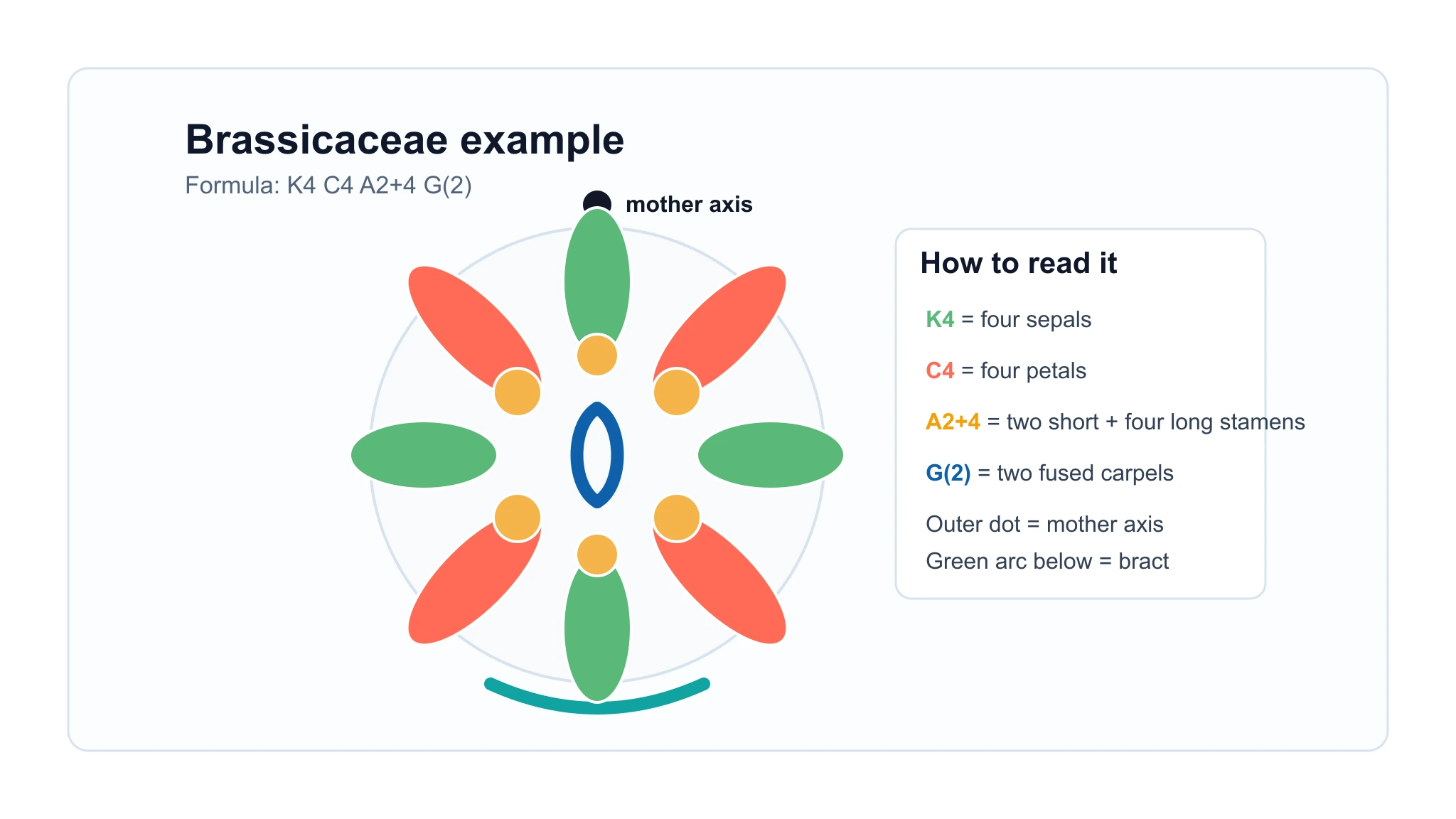
The formula K4 C4 A2+4 G(2) becomes a diagram by mapping each symbol to a whorl.
This is the kind of example that makes a floral formula useful. The formula is short enough to memorize, but the diagram makes the spatial pattern visible. If a student cannot explain why there are six stamens rather than four, the diagram forces that question.
Floral Diagram vs Floral Formula
Use both formats when possible. They answer different questions.
| Format | Strength | Limitation |
|---|---|---|
| Floral formula | Compact, easy to compare families, useful for notes | Hard to visualize arrangement |
| Floral diagram | Shows position, whorls, fusion, symmetry, and orientation | Takes more space and time to draw |
| Real flower drawing | Shows natural appearance | Often hides the structural plan |
LearnSci's resource on floral diagrams and floral formulae focuses on interpreting and constructing basic floral diagrams. That is exactly the workflow students need: read the formula, interpret the diagram, and move between the two.
In practice:
- Use a formula when you need a compact summary.
- Use a diagram when you need to understand arrangement.
- Use a real flower image when you need identification or visual reference.
- Use all three when teaching a plant family.
What a Floral Diagram Generator Should Do
A useful floral diagram generator should let you enter a formula and get a diagram that follows botanical notation. The GIGAZINE review of a floral diagram generator describes a web app that can generate a floral diagram from a floral formula and settings for flower components.
A reliable generator page would need:
- a formula input field
- controls for sepals, petals, stamens, and carpels
- support for fused parts and grouped stamens
- an editable diagram preview
- export as SVG or PNG
- examples for common plant families
For learning, the main goal is to understand how a formula becomes a diagram. For software, the generator should not behave like a generic image prompt box. It should parse structured floral notation and produce a predictable diagram.
Floral Diagram Generator
Turn floral formula notation into a predictable SVG floral diagram with fusion rings, mother axis, and bract.
Common Floral Diagram Mistakes
Mistake 1: Drawing a pretty flower instead of a structure
A floral diagram is not botanical illustration. It should show the arrangement of parts. Petal shading, texture, and realistic flower depth are usually distractions.
Mistake 2: Forgetting the mother axis
The mother axis helps orient the diagram. If your teacher expects it, omitting it can make an otherwise correct diagram look incomplete.
Mistake 3: Treating fused parts as separate parts
Parentheses matter. C5 and C(5) are not the same drawing instruction. The first suggests five petals. The second suggests five petals fused into a corolla.
Mistake 4: Ignoring the plus sign
A2+4 is not just A6. It preserves grouping. Draw the groups so the viewer can see why the formula uses a plus sign.
Mistake 5: Mixing up floral diagrams with flower anatomy diagrams
A flower anatomy diagram may show stigma, style, ovary, anther, filament, petal, and sepal in a side view. A floral diagram is usually a top-view plan. Both are useful, but they are not interchangeable.
Floral Diagram Checklist
Before you submit or publish a floral diagram, check:
- The mother axis is shown when needed.
- The bract is placed below the flower plan when included.
- Sepals are in the outer whorl.
- Petals are inside sepals.
- Stamens are inside petals.
- Carpels or ovary are in the center.
- The count of each whorl matches the formula.
- Parentheses are represented as fusion.
- Plus signs are represented as grouping.
- The diagram is clean enough to read at final size.
Practice Prompts
Use these prompts to test whether you can move from formula to diagram.
| Prompt | What to practice |
|---|---|
Draw K5 C5 A5 G(2) | Five-part whorls and fused carpels |
Draw K4 C4 A2+4 G(2) | Brassicaceae-style grouped stamens |
Explain why C5 and C(5) draw differently | Fusion vs separate petals |
| Add a mother axis and bract to a simple floral diagram | Orientation |
| Convert a diagram with four sepals and four petals into a formula | Diagram-to-formula reasoning |
| Compare a floral diagram with a flower anatomy side view | Difference between plan and anatomy |
If you are studying for an exam, do not memorize only one family diagram. Practice translating symbols into drawing actions. That skill transfers better when the formula changes.
FAQ
What is a floral diagram?
A floral diagram is a schematic top-view drawing of a flower that shows the number, arrangement, and fusion of floral parts such as sepals, petals, stamens, and carpels.
What is the difference between a floral diagram and a floral formula?
A floral formula is a compact symbolic description of flower structure. A floral diagram is the visual plan that shows how those parts are arranged around the flower.
What do K, C, A, and G mean in a floral formula?
K means calyx or sepals, C means corolla or petals, A means androecium or stamens, and G means gynoecium or carpels.
What does a plus sign mean in a floral formula?
A plus sign usually indicates that parts occur in separate groups. For example, A2+4 means the stamens are grouped as two plus four rather than simply six identical positions.
What do parentheses mean in a floral formula?
Parentheses indicate fusion within a whorl. For example, C(5) means five fused petals, and G(2) means two fused carpels.
What is the mother axis in a floral diagram?
The mother axis is the reference point showing the side of the main stem from which the flower arises. It is usually drawn as a dot or small circle outside the floral whorls.
Can a floral diagram be generated from a formula?
Yes, if the generator understands floral formula notation and can map symbols, numbers, fusion, and grouping into diagram shapes. A generic image generator is less reliable for this task.
Why are floral diagrams useful?
They help students and botanists compare flower structure, identify plant family patterns, understand symmetry and fusion, and translate compact floral formulae into visual diagrams.
Create Biology Diagrams Faster
For a class notebook, a hand-drawn floral diagram is enough. For worksheets, slides, online study guides, or lab resources, a clean digital diagram is easier to read and reuse.
Start with a prompt like:
Create a clean botanical floral diagram for formula K4 C4 A2+4 G(2). Show mother axis, subtending bract, four sepals, four petals, six stamens in two groups, and a central fused bicarpellary gynoecium.Then check the result against the formula. The goal is not just a nice flower image. The goal is a correct structural diagram that helps the reader understand the flower plan.
分類
更多文章

7 Best Free Napkin AI Alternatives in 2026 (Text-to-Visual Tools)
Best free Napkin AI alternatives: Gamma, Canva, Piktochart, Venngage & more. Compare AI-powered text-to-visual tools for diagrams and infographics.
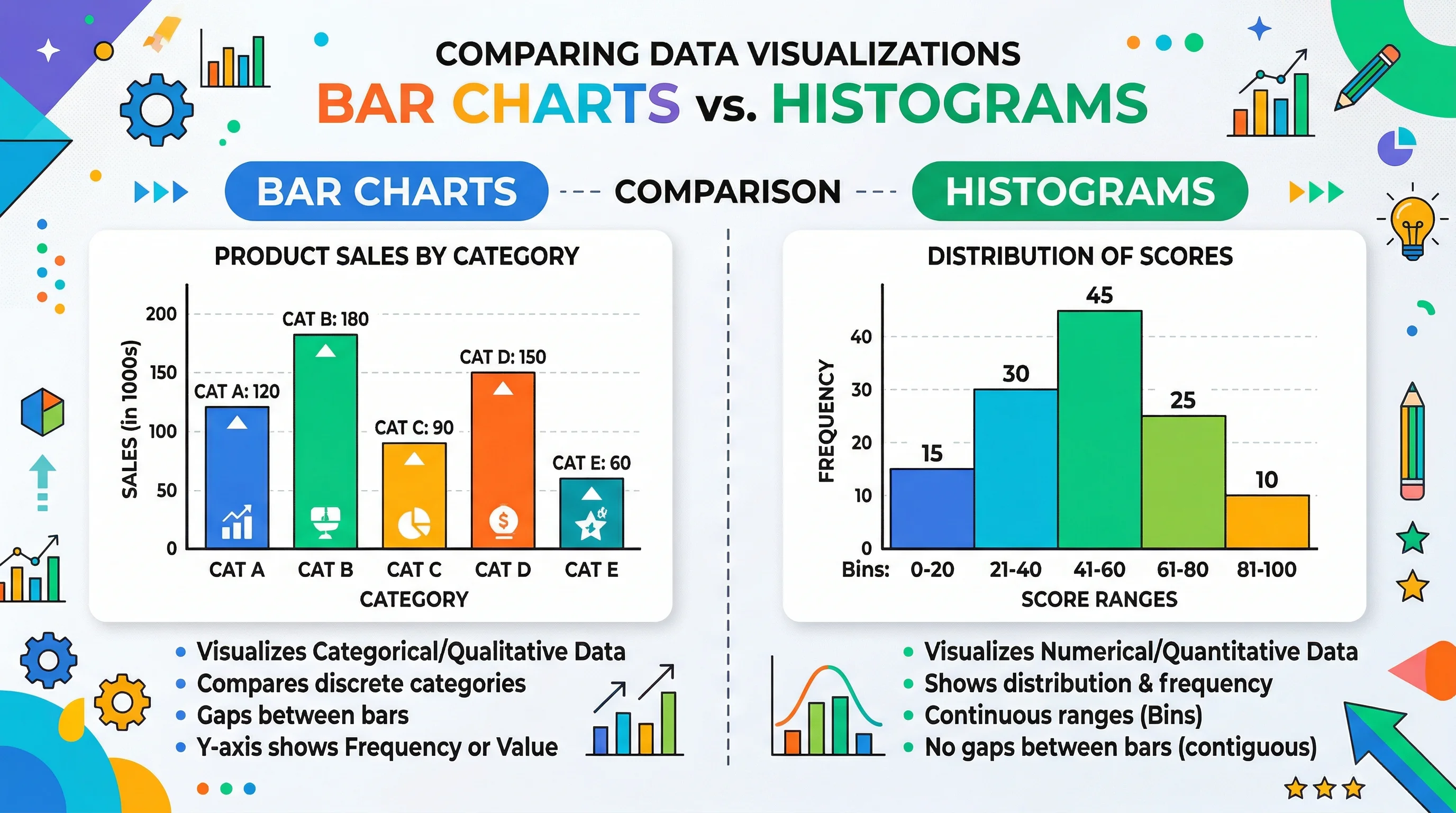
Bar Chart vs Histogram: Key Differences Explained
Learn the real difference between bar charts and histograms with clear examples. Covers when to use each, common mistakes, and how to create both quickly.

Framework vs Model in Research: Complete Guide to Understanding the Difference
Learn the key differences between frameworks and models in academic research. Includes practical examples, when to use each, and how to apply them in your research methodology.